THE URBAN HEART

Idea projektu
The Living Roof — Integration of Performance, Landscape, and Urban Public Space
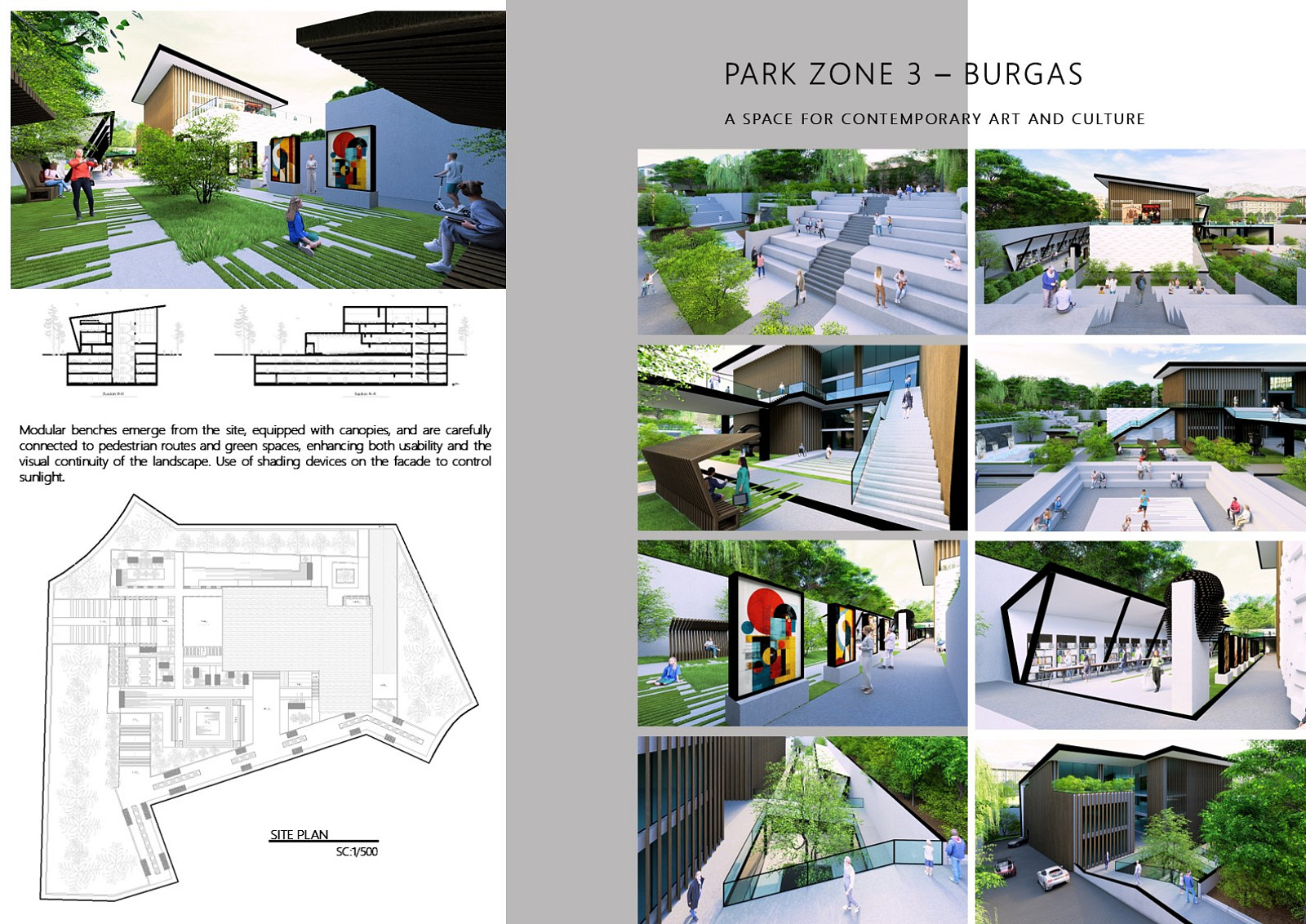
The project proposes a contemporary cultural and artistic center conceived as an integral extension of the park and the surrounding urban fabric. Rather than functioning as an autonomous architectural object, the building is designed as a public spatial framework that enables cultural activities to unfold across multiple levels, environments, and degrees of formality.
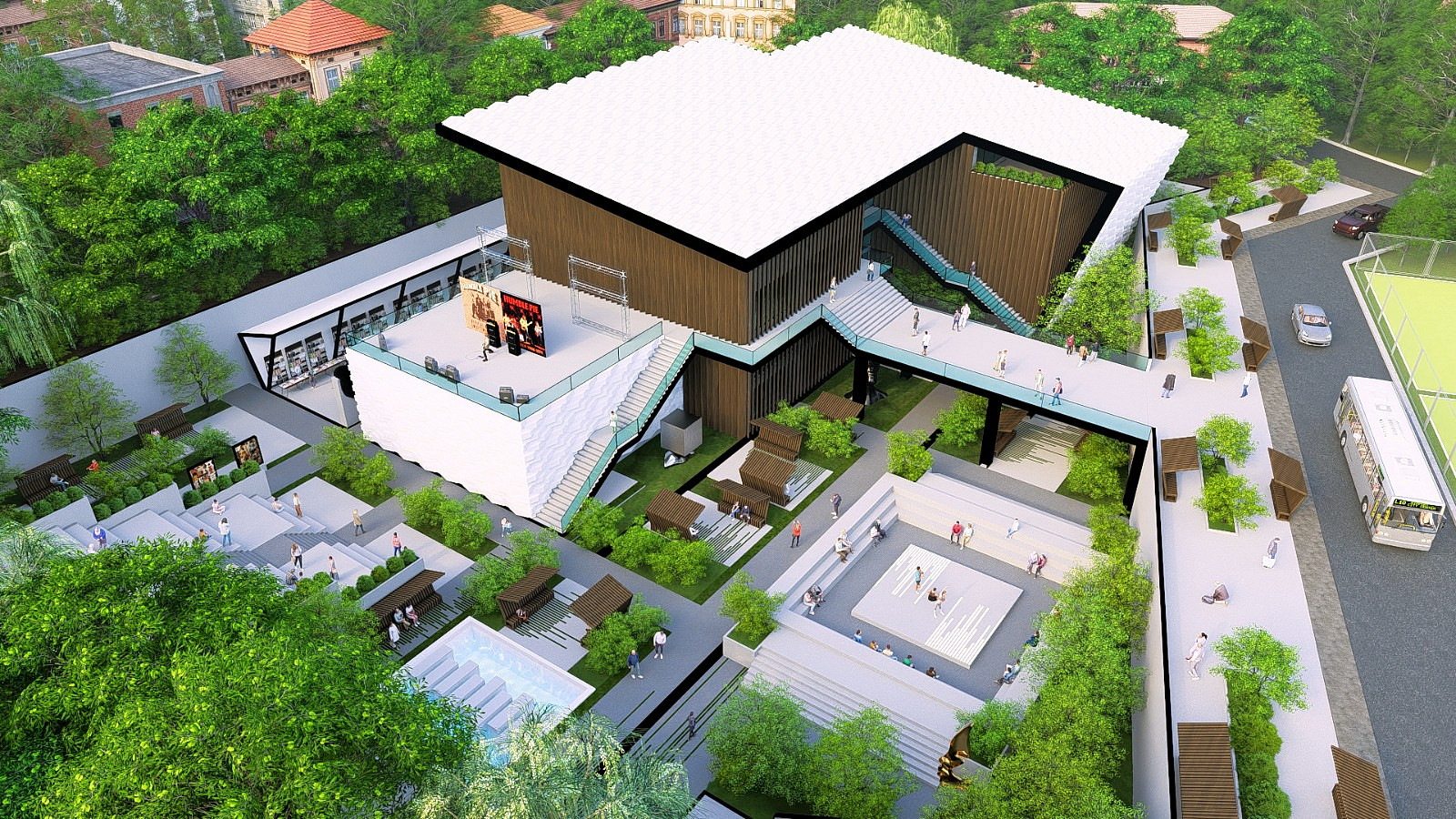
At the core of the proposal lies the concept of the Living Roof—a publicly accessible, active surface that operates simultaneously as an open-air performance space, a place of gathering, and a connective element between indoor cultural functions and the landscape.
Integration of Indoor and Outdoor Performance
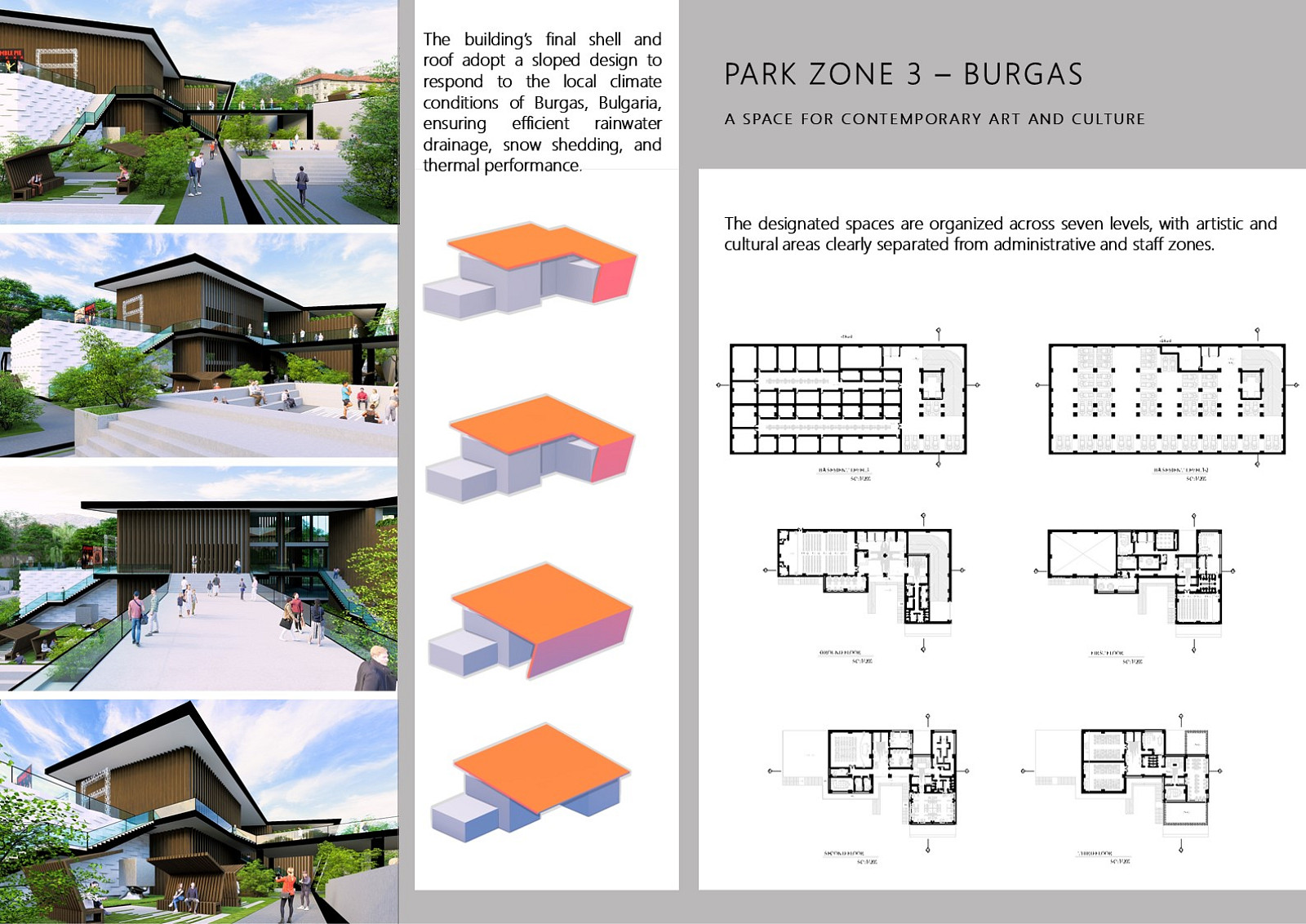
Performance spaces are organized as a continuous spatial system. The main indoor performance hall is positioned at ground level, providing a controlled environment for formal events. Directly above it, the roof functions as an open-air stage, allowing performances to extend into the public realm.
This vertical and programmatic continuity enables parallel or complementary use of indoor and outdoor performance spaces, expanding the cultural capacity of the project while reinforcing its openness and accessibility.
Popis projektu
Public Roof as Civic Infrastructure
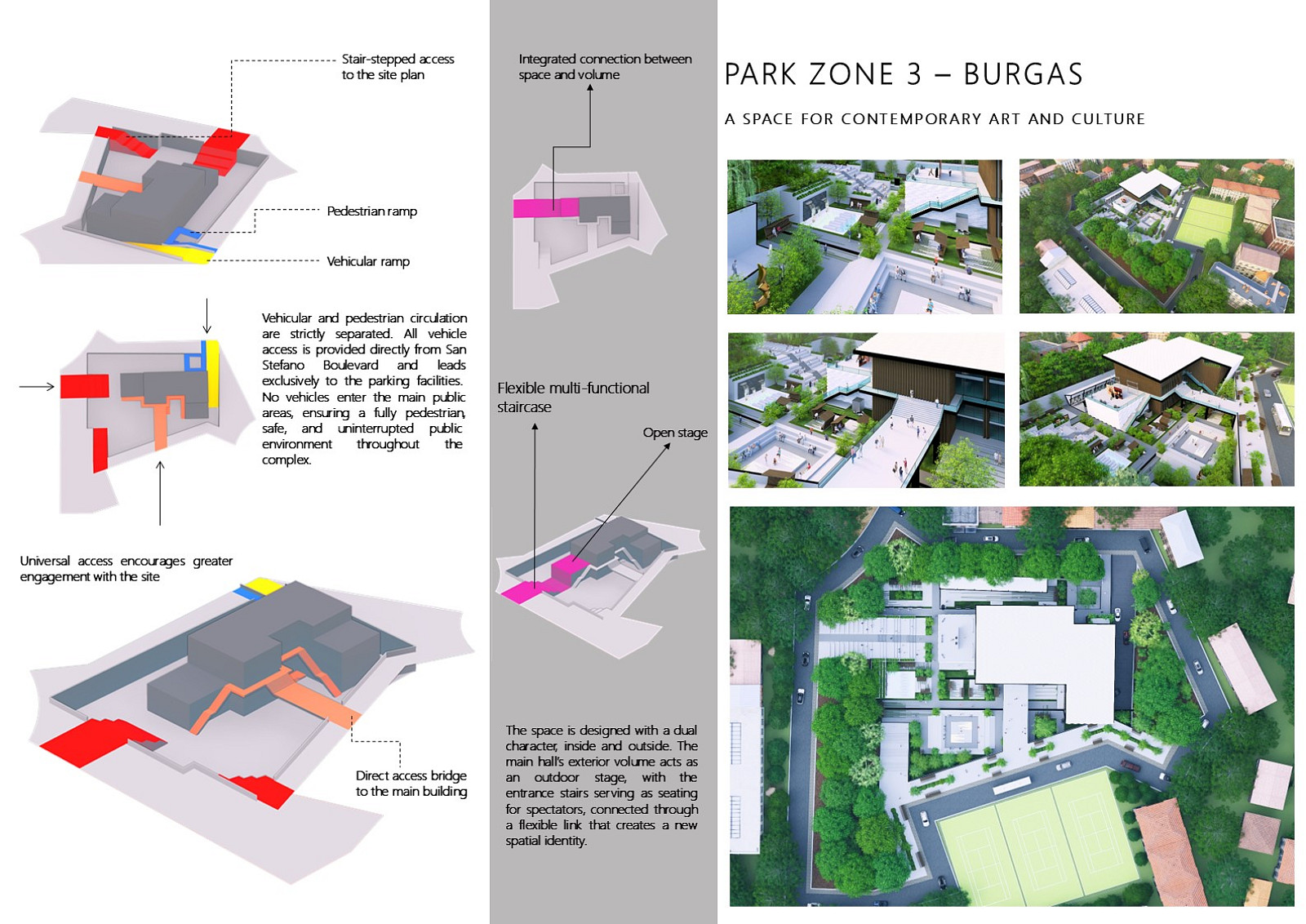
The roof is conceived as a primary civic infrastructure rather than a secondary architectural element. It is seamlessly connected to the park through a network of ramps and stairs, allowing gradual and inclusive access from multiple directions.
By integrating the roof into the pedestrian circulation system of the site, the project ensures continuous public use independent of scheduled events, transforming the building into a permanent destination within the park.
Flexible Seating and Informal Amphitheater
Facing the outdoor performance area, a system of stepped platforms and stairs is designed as a flexible and informal amphitheater. These elements operate as audience seating during performances while serving as spaces for rest, pause, and social interaction at other times.
This adaptability allows the architecture to respond to changing patterns of use throughout the day and reinforces the idea of culture as an everyday urban experience.
Clear Separation of Vehicular and Pedestrian Access
A clear functional separation between vehicular and pedestrian access is established to ensure safety, clarity, and comfort. Vehicular access, including service and parking entry, is defined independently, while pedestrian movement is prioritized across the site.
Pedestrian access is organized through a system of ramps and stairways approaching the building from multiple directions, reinforcing permeability and encouraging fluid movement between the park, the building, and the surrounding urban context.
Adaptive Use of “The Hole” and Exhibition Spaces
“The Hole” is utilized as a spatial opportunity rather than a constraint, accommodating flexible cultural functions such as temporary exhibitions, installations, and experimental artistic programs. Its sunken character allows for controlled spatial atmospheres while maintaining visual and physical connections to the surrounding landscape.
In addition to this central exhibition area, gallery spaces are distributed throughout the site, appearing along circulation paths, terraces, and transitional zones. This strategy transforms movement itself into a curatorial experience, allowing art to be encountered informally and continuously rather than confined to a single enclosed space.
Movement as an Organizing Principle
Movement functions as a key architectural driver. Circulation paths are derived from programmatic relationships and designed as non-linear sequences that connect performance spaces, exhibition areas, seating platforms, and public terraces.
Through changes in direction, level, and spatial compression and release, movement becomes an experiential layer of the project, generating dynamism and encouraging exploration.
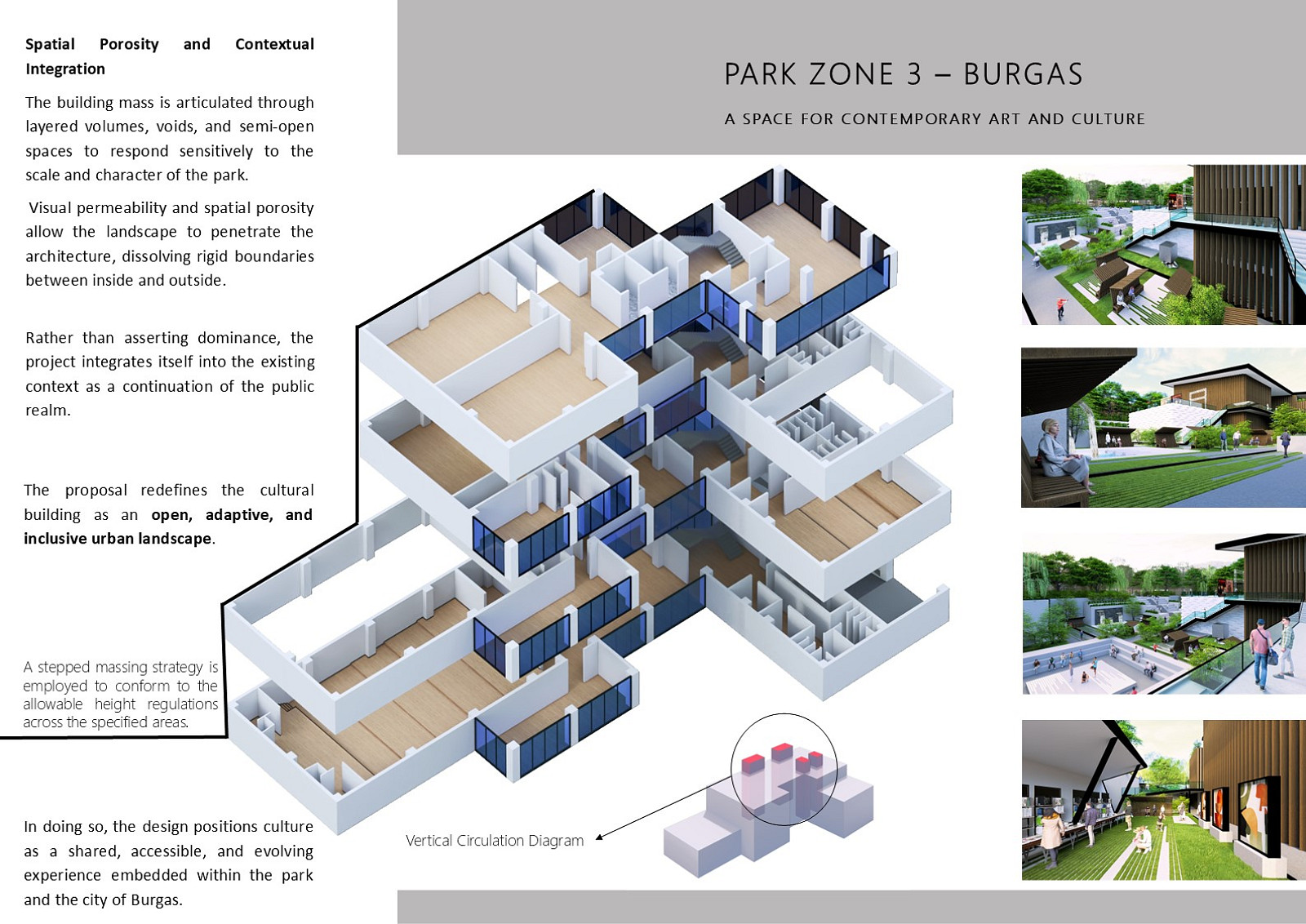
Spatial Porosity and Contextual Integration
The building mass is articulated through layered volumes, voids, and semi-open spaces to respond sensitively to the scale and character of the park. Visual permeability and spatial porosity allow the landscape to penetrate the architecture, dissolving rigid boundaries between inside and outside.
Rather than asserting dominance, the project integrates itself into the existing context as a continuation of the public realm.
Technické informace
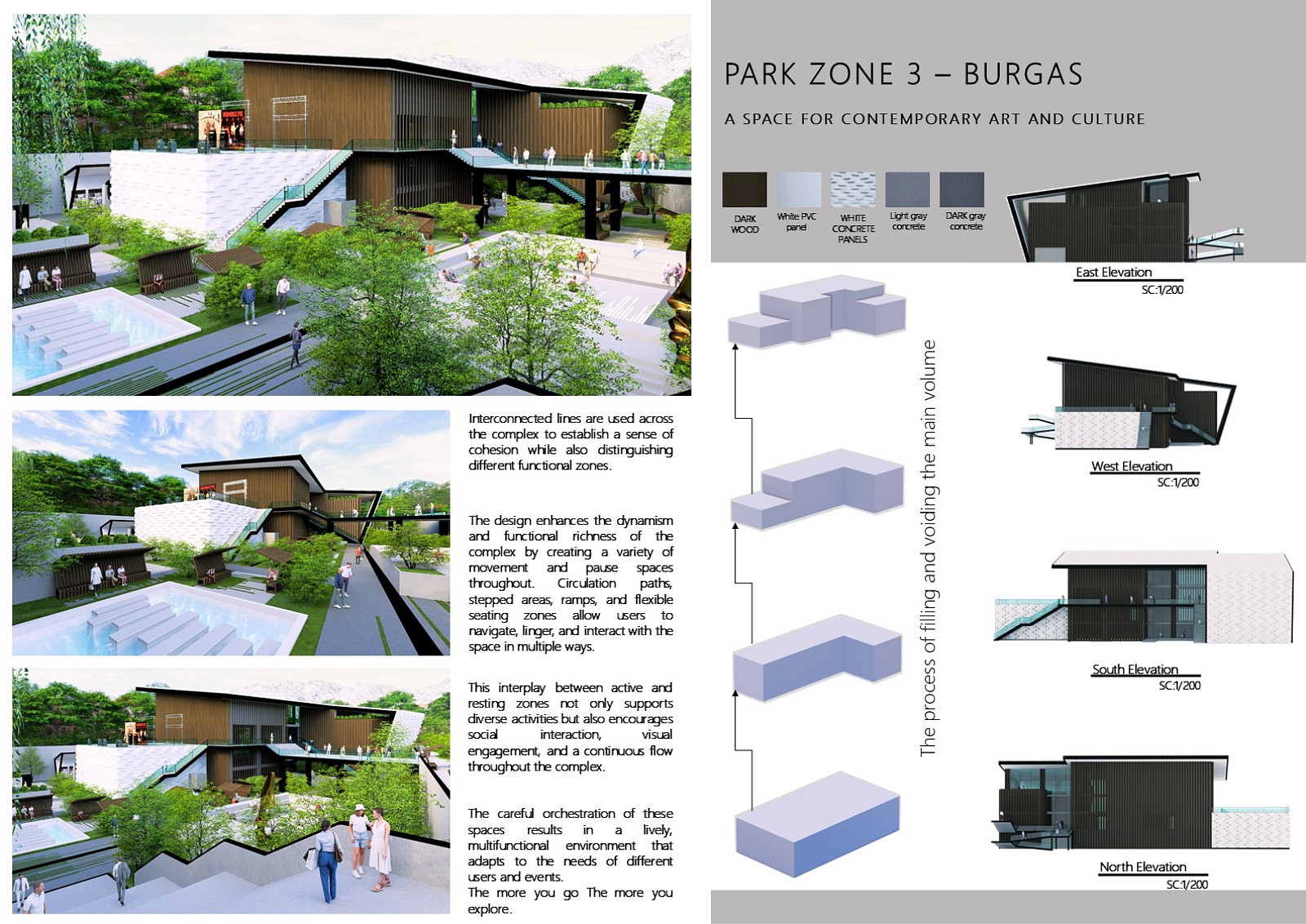
The project is based on a steel frame structural system composed of steel columns and beams arranged on a regular grid. This structural framework provides flexibility for cultural, exhibition, and public spaces while efficiently transferring vertical loads to the foundations. The roof is formed by a series of integrated concrete shell panels, either prefabricated or cast in situ, which create a distinctive architectural identity and serve as the primary enclosure of the building. Supported by the steel structural frame, the shell roof spans large areas and accommodates the spatial requirements of the cultural program.
The building envelope consists of full-height glazed curtain walls that maximize transparency and strengthen the visual connection between the interior spaces and the surrounding urban park. In front of the glass façades, a system of rotating timber louvers acts as a secondary skin, regulating daylight penetration, reducing direct solar gain, and improving thermal comfort. Beyond their environmental performance, the movable wooden louvers create a dynamic façade that continuously changes in response to sunlight and user needs throughout the day.
The combination of the concrete shell roof, lightweight steel structure, transparent glazing, and timber shading elements results in an open and contemporary architectural expression that encourages interaction between culture, nature, and public life. The building becomes an extension of the surrounding landscape, creating a vibrant and welcoming destination within the urban fabric of Burgas.

Copyright © 2026 INSPIRELI | All rights reserved. Use of this website signifies your agreement to the Terms of Use, Privacy Policy, and use of cookies.