OSNOWA - Adaptation of the historic spinning mill in Wilamowice at Paderewskiego Street into an exhibition and workshop center


Idea projektu
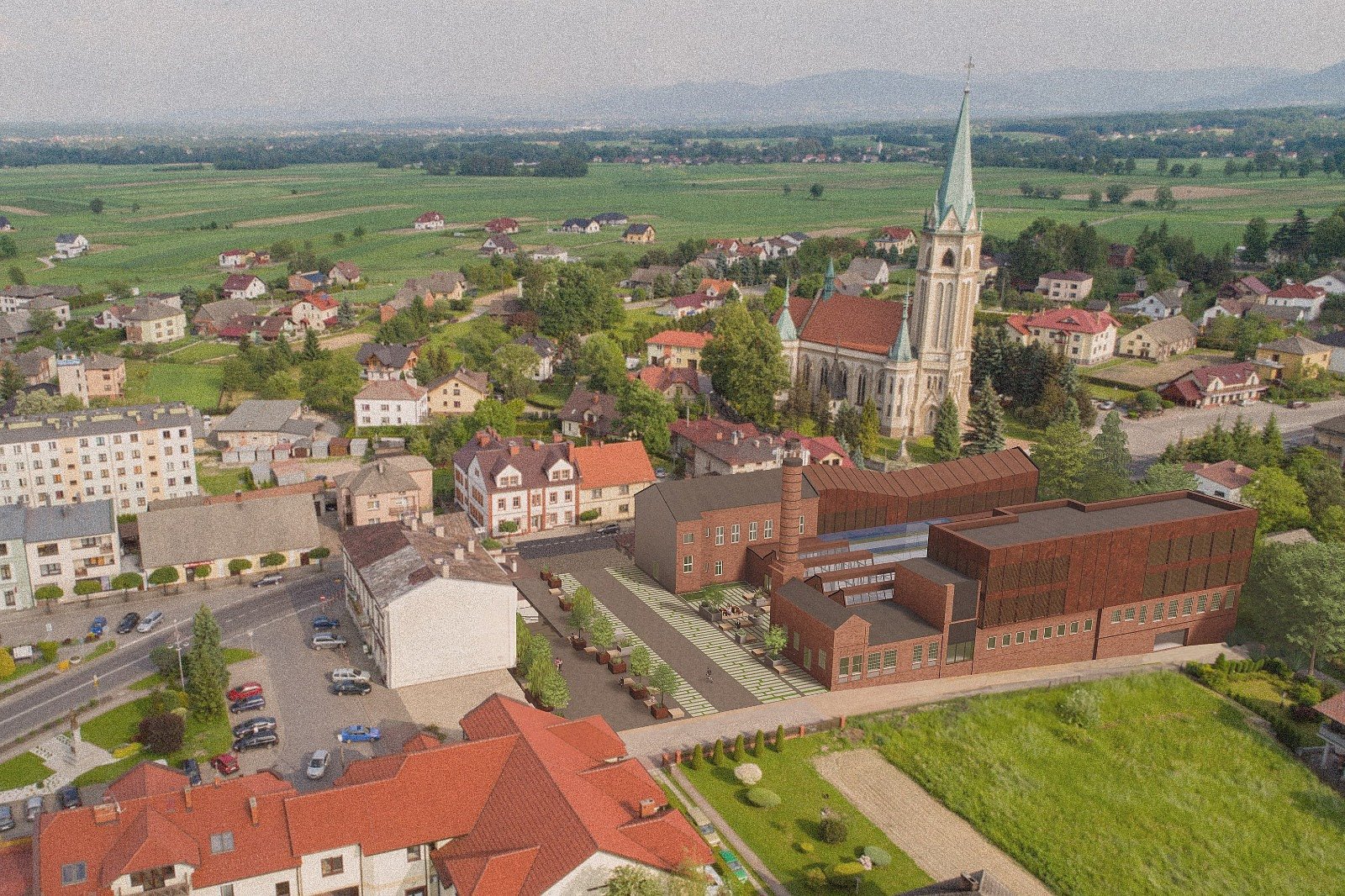
The project "Osnowa" (The Warp) focuses on the adaptive reuse of a historic, 19th-century spinning mill in Wilamowice, transforming it into a vibrant exhibition and workshop center. The main objective of the thesis is to create a multi-functional public facility that actively promotes and preserves the unique local culture, tradition, and the endangered Wilamowski language, thereby reinforcing the identity of the place.
The architectural concept is based on an author-developed, two-track methodological framework combining archiving research and in-situ technical condition analysis. The primary design challenge was to synthesize a strict conservation-led approach with contemporary architectural and public safety standards. In accordance with Article 9 of the Venice Charter, the project clearly distinguishes the newly designed tissue from the historical fabric. The chaotic, fragmented existing facades were visually unified by introducing a modern, lightweight superstructure. The material dialogue juxtaposes the rugged, industrial texture of the historic red brick with the contemporary, self-patinating character of weathering steel (Corten).
Functionally, the design is clearly zoned. The ground floor accommodates public spaces: a multifunctional central atrium designed to compensate for the town's lack of a traditional market square, weave and silkscreen workshops, an exhibition area, and a cafe with a library ("the third place"). The newly added vertical extension houses a regional business incubator for startups and administrative facilities.
Popis projektu
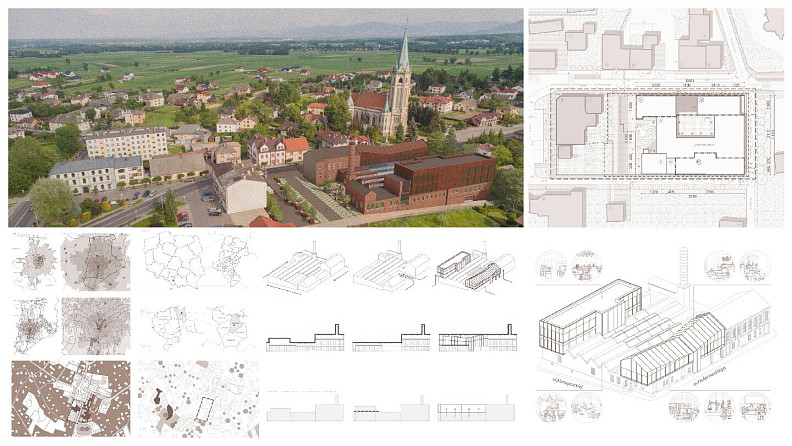
The spatial and architectural solution of the "Osnowa" project stems directly from the historical layout of the spinning mill complex, implementing an orthogonal and clear structural logic. The scope of the intervention covers the comprehensive modernization of the existing industrial tissue and the implementation of a contemporary vertical extension, establishing a cohesive relationship between the old and the new.
The spatial program is divided into distinct functional zones distributed across four levels:
Level -1 (Underground): Features a subterranean parking lot and modern civil protection standards, this zone functions as a dual-use space, serving as a Certified Temporary Sheltering Area.
Level 0 (Ground Floor): Dedicated entirely to public and cultural functions. The main entrance from Paderewskiego Street leads to a spacious, multi-functional central atrium. The southern wing accommodates traditional weaving and screen-printing workshops, which seamlessly transition into an exhibition-lecture area and a café with a library.
Levels +1 and +2 (Superstructure): Designed as a regional business incubator. They contain independent offices for startups, co-working areas, conference rooms, and shared social amenities.
Architecturally, the project balances strict technical performance with formal restraint.
Technické informace
The project is located at Paderewskiego Street in Wilamowice and represents a post-industrial adaptive reuse of a historic spinning mill into an Exhibition and Workshop Center with a Business Incubator. Under Polish building law, the facility is classified as a Category IX (9) building (Culture and Education) within the "N" height class (Low, under 12 meters). The structural layout introduces a mixed foundation system, utilizing a 30 cm thick reinforced concrete foundation raft under the new sections, combined with structural underpinning, reinforcement, and XPS insulation of the historical brick foundations. The existing structure consists of monolithic brick load-bearing walls made of structural red clay brick, which have been thoroughly cleaned and preserved.
The superstructure utilizes a lightweight, flexible concrete column-and-beam system, complemented by a cantilevered steel structure (UPN and HEB 300 profiles) along the main street front. The new facades are clad in weathering steel (Corten), creating a deliberate dialogue with the texture of the original red brick. To prevent overheating of the extensively glazed startup zones, moveable, perforated Corten louvers were integrated, creating a dynamic play of light and shadow within the interior while ensuring passive thermal comfort.
From a fire safety perspective, the building is classified with mixed hazard categories. To ensure high energy efficiency and meet strict thermal transmittance standards, all roofs and shed roofs feature enhanced insulation with integrated operable glass skylights for natural ventilation and daylighting control. Additionally, the Level -1 underground garage serves a dual-use function, providing 41 parking spaces under normal conditions and accommodating a Certified Temporary Sheltering Area for up to 140 people in crisis situations. To respect the historical structure and avoid deep wall penetrations, pre-engineered dry water-sewer connection points were designed for the rapid deployment of emergency chemical/modular toilets.
Dokumentace
Vytvořeno pomocí:


Copyright © 2026 INSPIRELI | All rights reserved. Use of this website signifies your agreement to the Terms of Use, Privacy Policy, and use of cookies.