Senegal Secondary School - Djilakh


Idea projektu
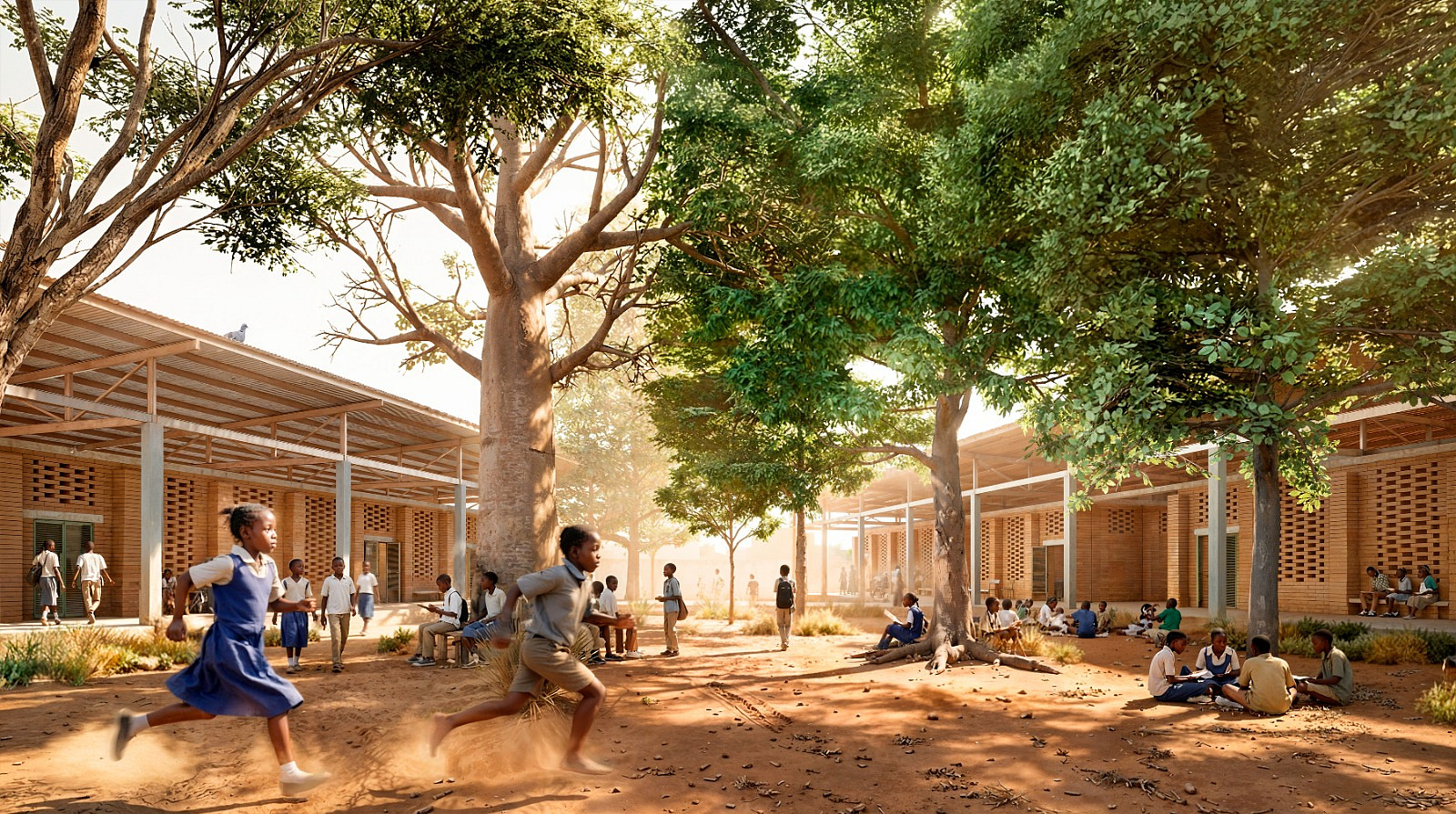
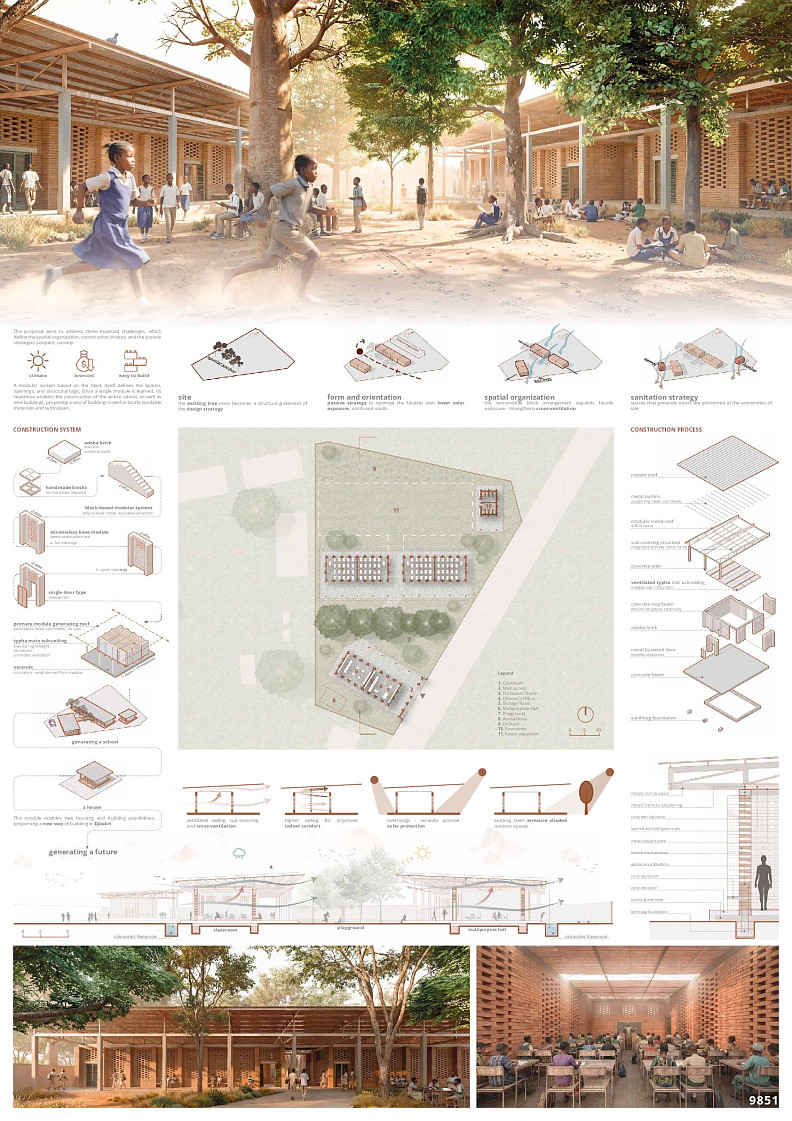
The proposal was designed to address three main issues: climate, low cost, and easy to build. All spatial, constructive, and passive strategies aim to solve these challenges through a responsive, sustainable, and replicable architecture adapted to the context of Djilakh, Senegal.
Popis projektu
The site layout is organized according to the existing tree mass, optimizing north/s south facades, prevailing winds, and rationalizing the construction process through orthogonal geometry, repetition, and the absence of roof cuts, ensuring easy execution and replication without the use of specific tools.
Technické informace
The construction system is based on 40×40cm adobe blocks, a low-cost, manually produced material that does not require machinery. Six blocks generate the base module of 2.40m, which structures the entire project — from site layout to roof, classrooms, circulation, solids, and voids. Once a single module and three opening variations are mastered, it is possible to build a classroom, which in turn generates all spaces of the school program.
The modules adopt a windowless design. Openings are created through interspersed adobe blocks, reducing construction cost and maintenance. Smaller openings are distributed across the surface, allowing continuous ventilation and acting as a dust filter.
The modules are configured as: full-opening modules located on North/ South facades, providing greater ventilation area; upper openings, smaller and positioned at the upper portion of the module on East/West facades, protected by roof overhangs to avoid direct solar exposure and glare; and the louvered door module, the only framed opening in the project, which also includes upper openings. The combination of these three modules forms a classroom composed of 4 modules in length and 3 in width, ensuring a clear, simple, and adaptable construction system.
The classroom module generates the roof system, composed of a lightweight metal structure elevated, ventilated and metal sheets. The roof slope follows a single direction, avoiding cuts in the sheets and optimizing rainwater collection. and generous overhangs form a continuous veranda that organizes circulation between blocks and creates shaded collective spaces.
The sub-roof system consists of handmade typha mats, modular and layered, tied to a metal mesh. This additional layer improves thermal and acoustic performance, while small gaps between modules allow hot air extraction. As a vernacular material, responds efficiently to hot climates, acts as a dust barrier, and ensures durability and low maintenance when protected from direct sun and wind.
Dokumentace
Vytvořeno pomocí:


Copyright © 2026 INSPIRELI | All rights reserved. Use of this website signifies your agreement to the Terms of Use, Privacy Policy, and use of cookies.