Integro – mixed-use building with an integration facility for people in need


Idea projektu
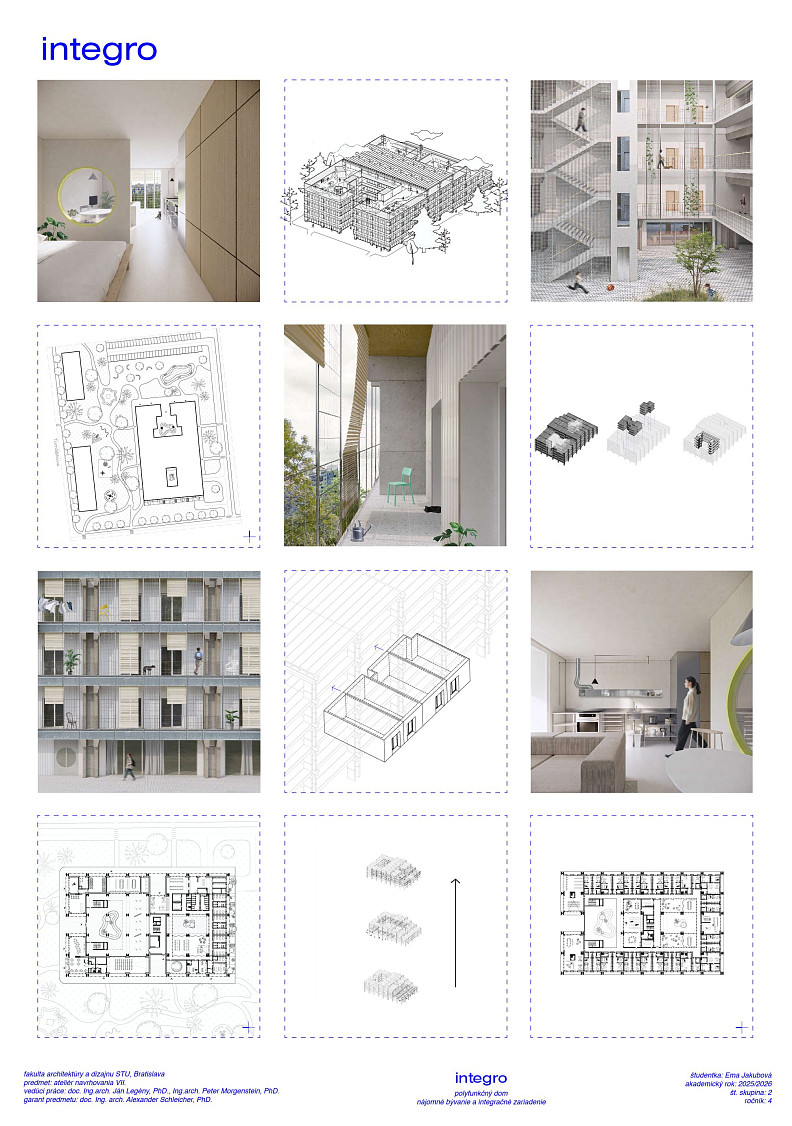
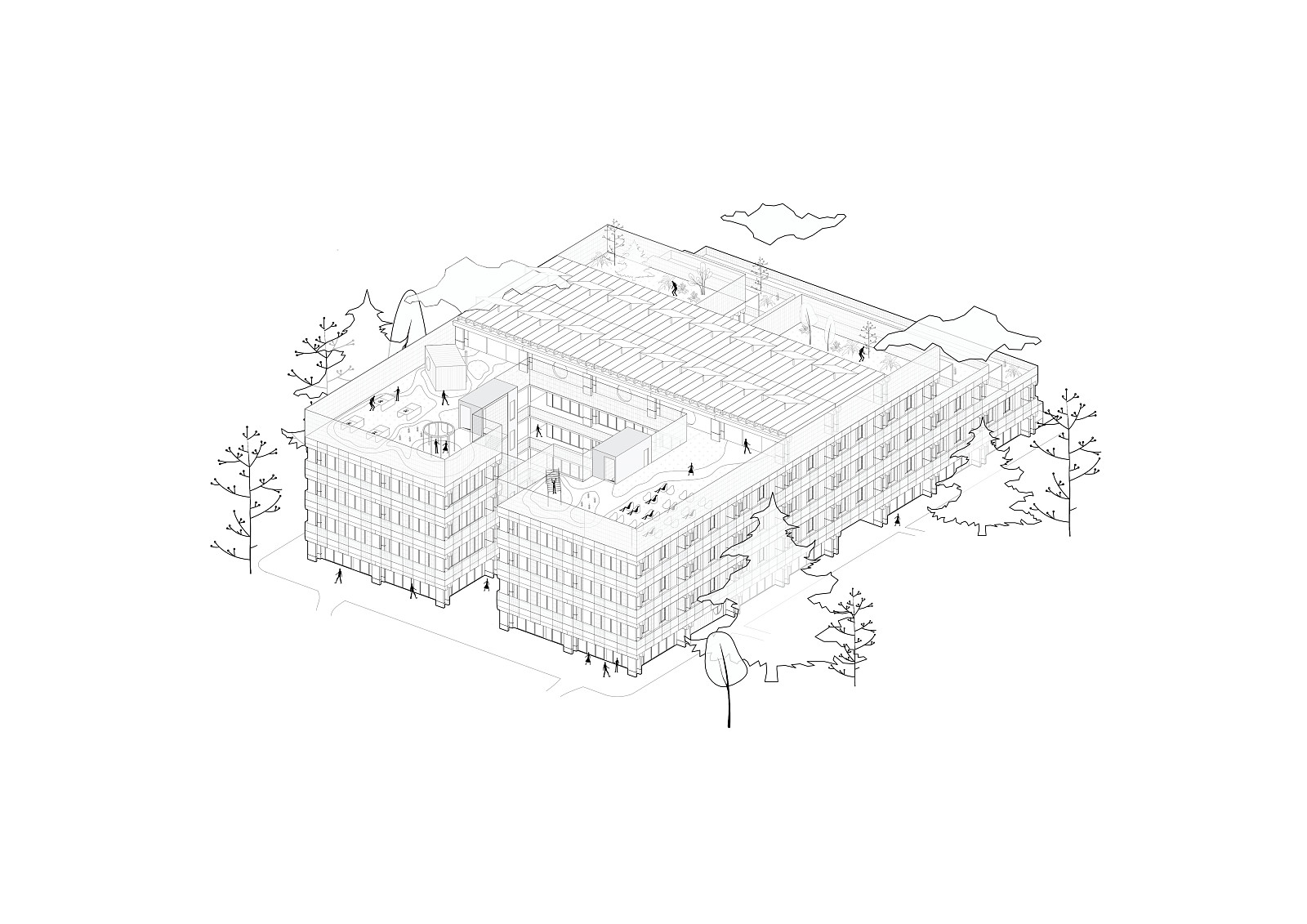
In the beginning, there was only a skeleton and a housing crisis... Integro represents an architectural response to several concurrent crises in Bratislava. Amidst the escalating housing crisis and the boom in developer-driven interventions, we tend to overlook the most alarming and life-threatening issues, such as the homelessness crisis. Society simultaneously condemns and normalizes homelessness through its indifference. According to a 2023 census, nearly 2,200 people in Bratislava are homeless or experiencing severe housing instability. Therefore, for this studio project, I chose to focus on socially excluded individuals, utilizing architecture and urban design as tools to restore their dignity and facilitate their integration into society. To achieve this without consuming another greenfield site, the design rehabilitates a neglected brownfield, thereby saving resources, restoring urban compactness, and bringing the original concrete skeleton back to life.
Popis projektu
Programme:
Underground parking:
The garage provides technical facilities for the building, cellar storage units for residents, general storage, and 61 parking spaces, 2 of which are designated for persons with disabilities.
Ground floor:
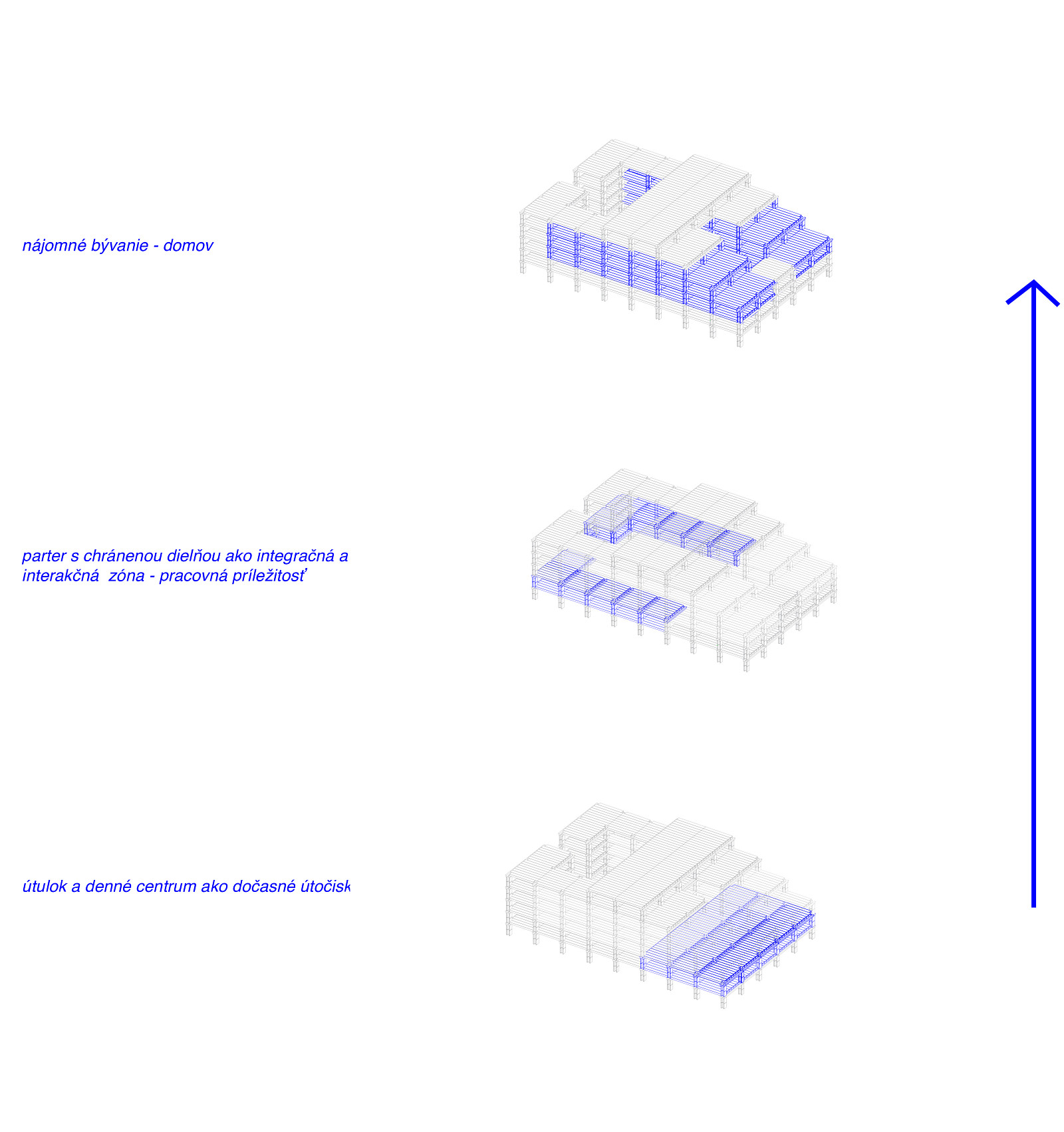
I propose the ground floor, a space with high potential for the public's first contact with homeless individuals, with a clear spatial hierarchy.
Day center (first step to integration - facilities)
The southern part of the ground floor serves as a day center for the homeless, offering low-threshold services (hygiene, food distribution, sleeping bags and clothing, leisure activities, social counseling), as well as a low-threshold accommodation facility providing temporary overnight stays for 24 people. The main entrance to this part of the ground floor is regulated and, unlike the entrance to the residential building, moved to the eastern facade facing a less frequented street. This ensures clear operational zoning and increases the sense of privacy and safety for both user groups. This approach is crucial for minimizing potential tension and stigmatization on the ground floor and guarantees the smooth operation of the accommodation facility without disrupting the residents' zone. Simultaneously, it ensures discretion and dignity for socially vulnerable individuals arriving from the street.
Active ground floor with a sheltered workshop (second step to integration - income for long-term housing)
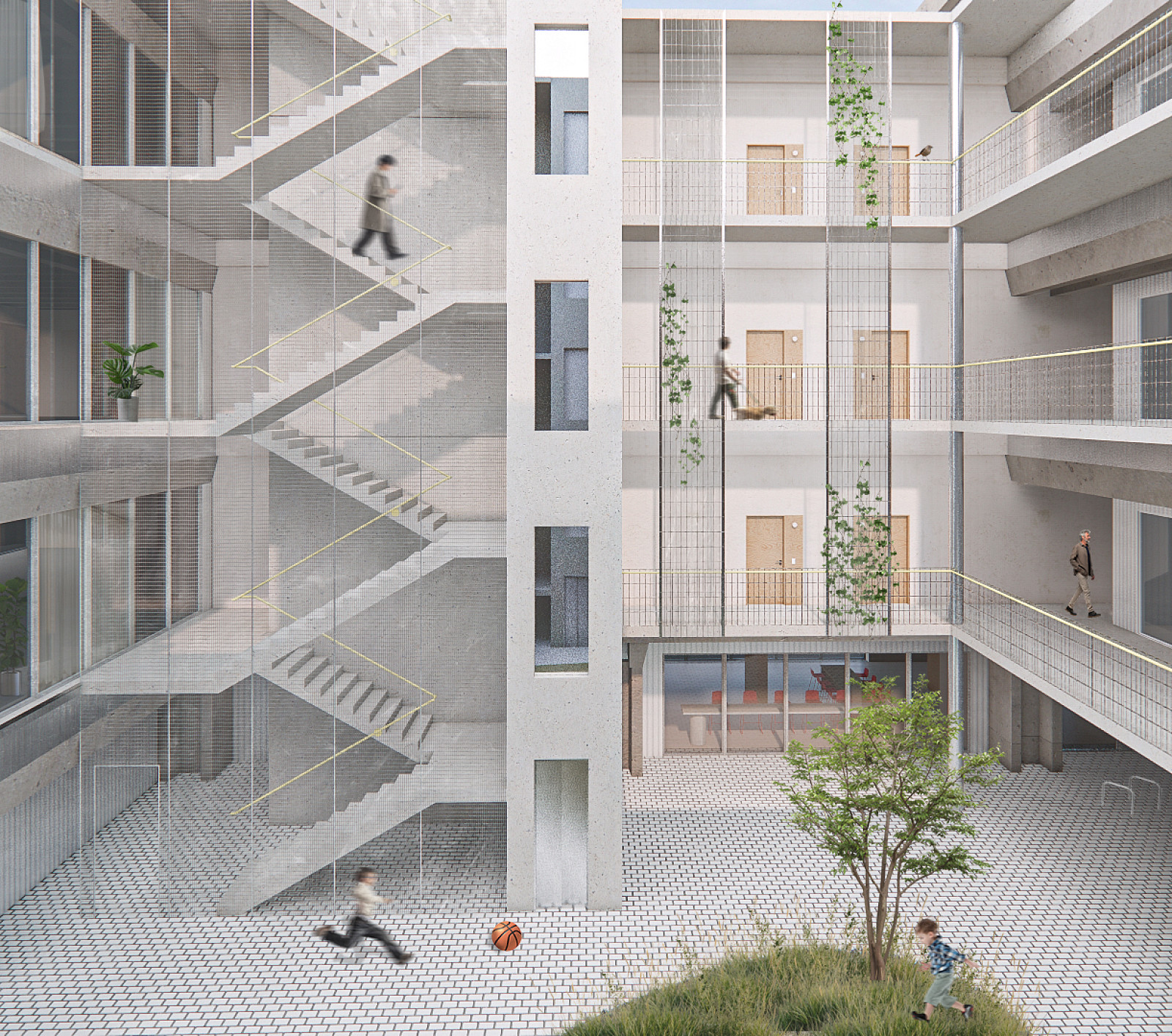
The northern part of the ground floor, adjacent to Papánek Square and the cultural center, has a public character, encouraging the concentration of the general public in the neighborhood. It acts as a catalyst for a subconscious integration process that tends to arise spontaneously in spaces designed and adapted for this purpose – primarily a café operating as a sheltered workshop. Work integration in spaces open to the public serves as a tool for destigmatization. According to psychologist Gordon Allport, the regular visual and interactive presence of people in need engaged in meaningful activity changes the majority's perception from passive recipients to active community contributors, thereby breaking down barriers of fear and prejudice. Although the western facade borders a main traffic artery, the architecture here engages in a dialogue with its surroundings through a semi-public inner courtyard. The space, defined by play elements, street furniture, and greenery, fosters a sense of belonging and safe movement for residents, children, and passers-by. This urban courtyard transforms the linear traffic barrier into a layered community zone, fulfilling the requirement for the quality and sustainability of social housing. The ground floor of this facade opens up to the public. Directly adjacent to the café is a multifunctional hall—a space suitable for community events, tenant meetings, or educational activities, supporting the idea of integration and the importance of community participation. Thanks to large-format glazing that can be fully opened, the courtyard transforms during the summer months into a vibrant urban scene and a natural community hub that breaks down the boundary between interior and exterior.
Residential floors (third step to integration - Housing First principle and classic rental housing):
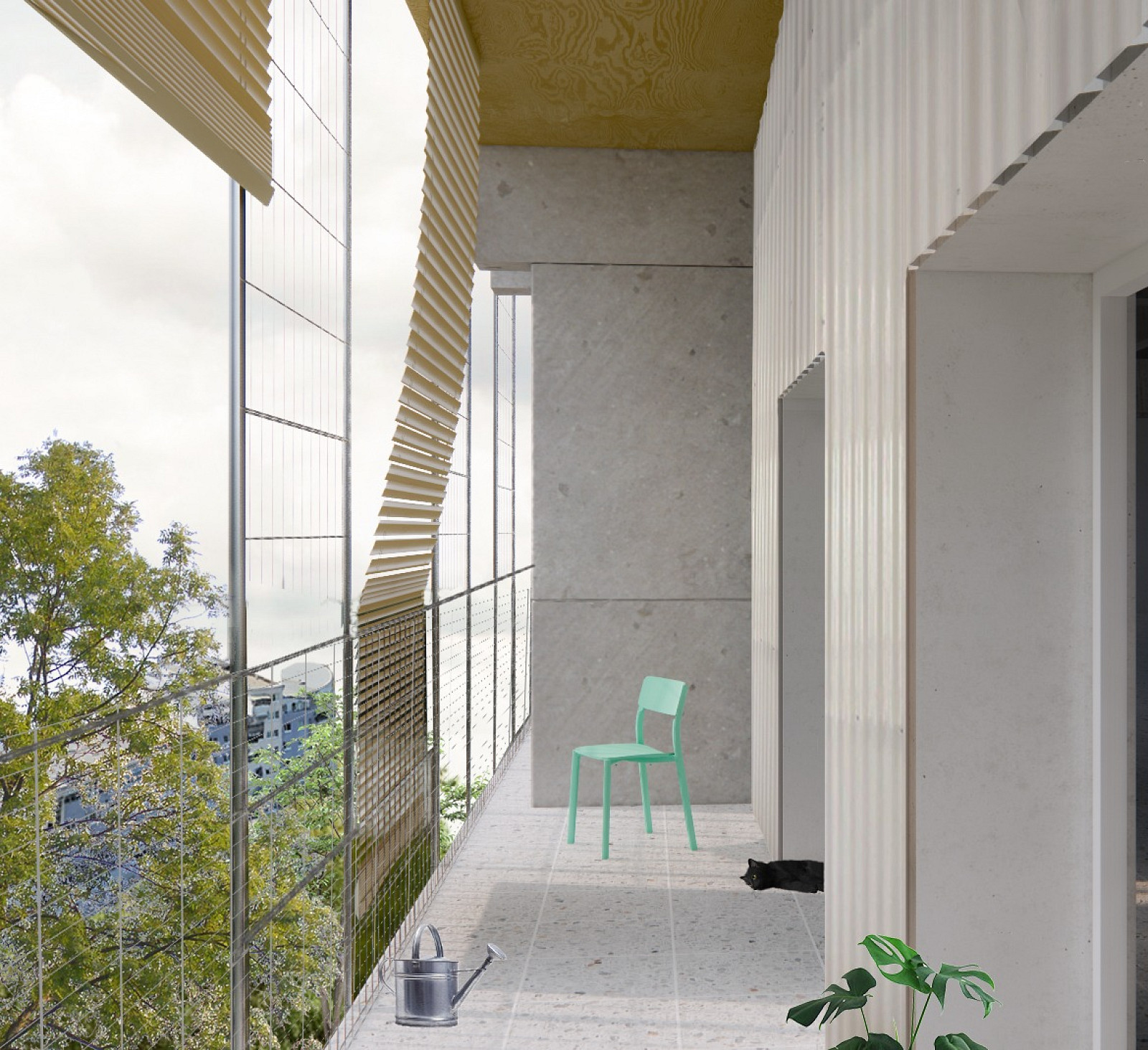
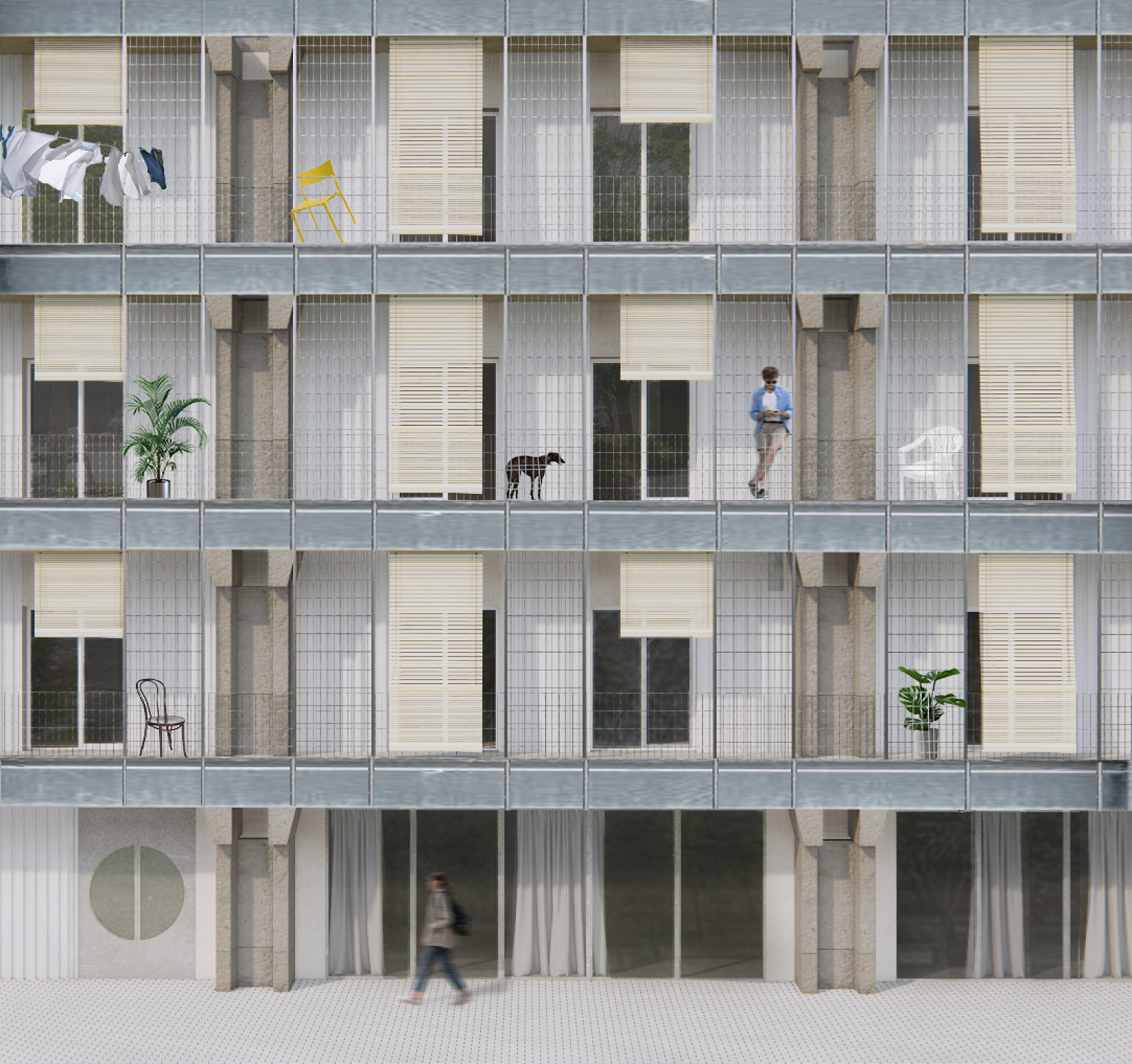
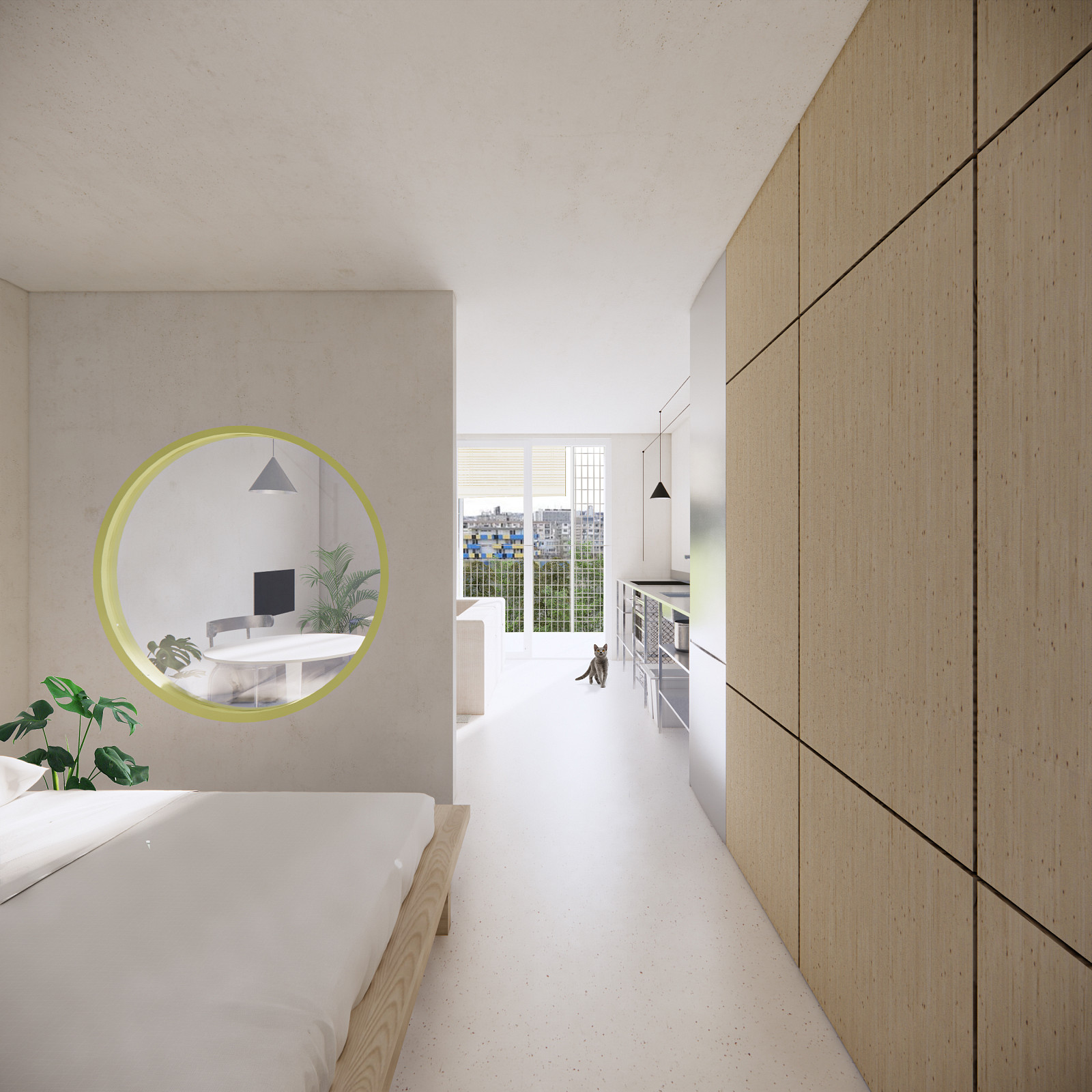
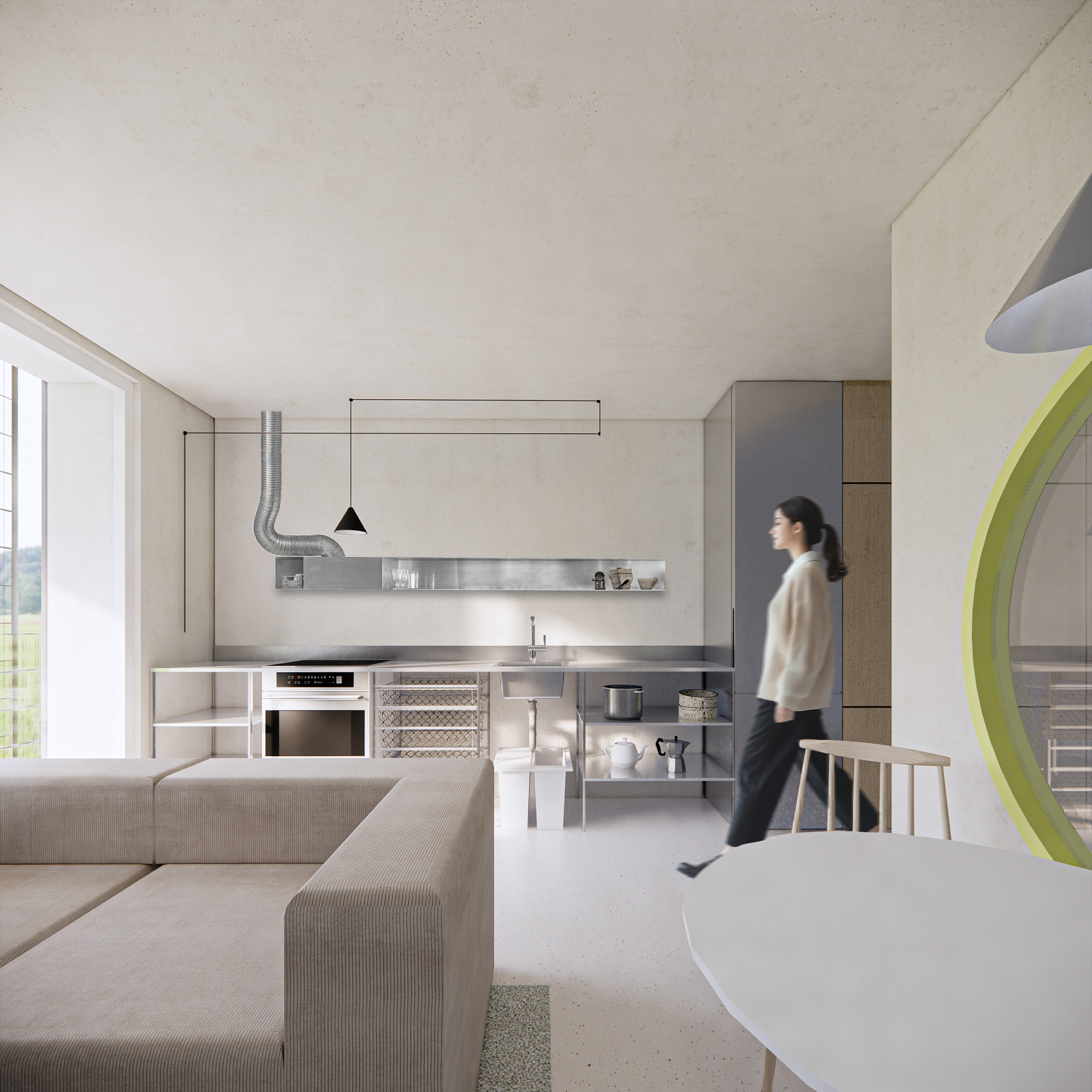
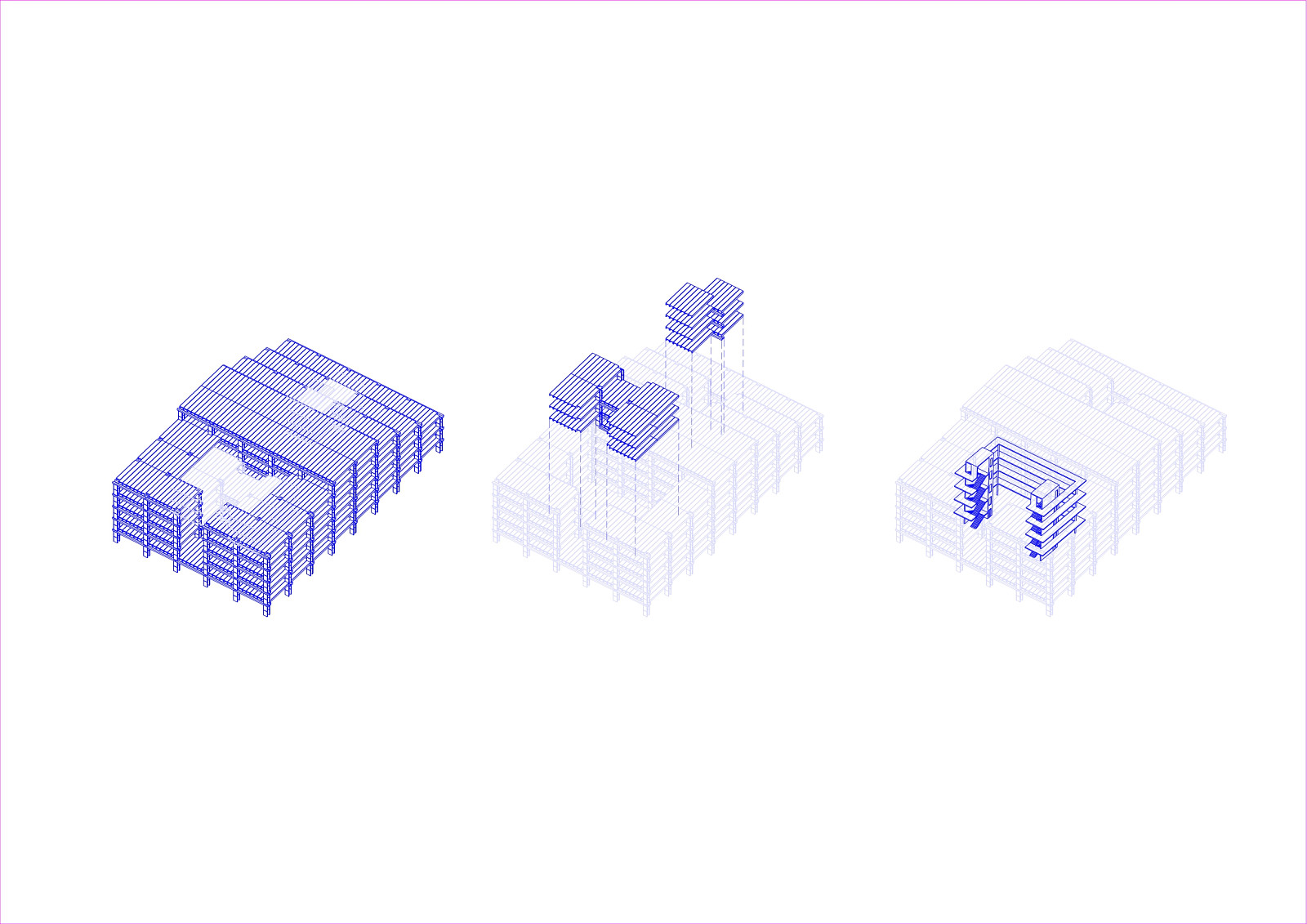
Providing stable housing is essential for the transition from a sheltered workshop to the open labor market. The design presents minimally furnished residential units in various sizes. The structural system is based on the box-in-box principle, where self-supporting prefabricated wooden modules are inserted into the existing reinforced concrete skeleton, eliminating thermal bridges and acoustically separating from the primary structure. They allow a high degree of standardization and accelerate the construction process. The modules are inserted as finished units, including building services distribution (MEP), which minimizes wet construction processes on site and increases detailing precision. Each residential floor features common rooms that serve for gatherings and joint activities among residents.
Residential Units:
• 1-room apartment (studio), 2 beds: 33 m²
• 1-room apartment (studio), 3 beds: 44.5 m²
• 1-room apartment, 2 beds, accessible (barrier-free): 44.5 m²
• 1-room apartment, 2 beds, economical: 24 m²
• 3-room apartment, 4 beds: 78.28 m²
• Average apartment area: 44.945 m²
Total number of apartments: 77
Number of accessible (barrier-free) apartments: 12
Accessible Roof (The result of cooperation and coexistence):
The active roof connects diverse spaces for the resident community. It includes outdoor kitchens, raised beds for growing vegetables, a space for a summer rooftop cinema, ping-pong tables, climbing frames, and a shared sauna. The top two rows of the skeleton's modules serve a new function as a shelter and roof area for photovoltaic panels. With this solution, the roof is transformed into a pillar of the building's energy concept, where technological self-sufficiency coexists in direct synergy with active community life.
Technické informace
Box-in-box: The inserted wooden modules create a highly insulated secondary envelope within the tempered skeleton, thus eliminating thermal bridges. The peripheral casing of the modules with an insulation thickness of 240 mm achieves U = 0.14 W/(m2.K). This thickness is applied exclusively to the facade panels of the modules, which form the cooled peripheral envelope in direct contact with the exterior, thereby meeting the standard for passive houses.
RES (Renewable Energy Sources): A system of heat pumps and rooftop photovoltaics (estimated installed capacity is 20-30 kWp) ensures a high degree of energy self-sufficiency.
Circularity: The implementation of air recuperation and innovative heat recovery from greywater from the day center's hygiene facilities dramatically reduces the costs of domestic hot water heating and space heating. This system can recover up to 60% of heat from wastewater.
Dokumentace


Copyright © 2026 INSPIRELI | All rights reserved. Use of this website signifies your agreement to the Terms of Use, Privacy Policy, and use of cookies.
