Threads of Water: reinterpreting the traditional valencian garden in Cabanyal


Idea projektu
Threads of Water is a landscape proposal for the former Neptune Gardens in the Cabanyal-Canyamelar neighbourhood of Valencia — a historic fishing community undergoing rapid transformation just steps from the Mediterranean shore. The project begins with a simple but generative question: how can a public park reconnect a working-class neighbourhood with its own identity while simultaneously opening it toward the sea?
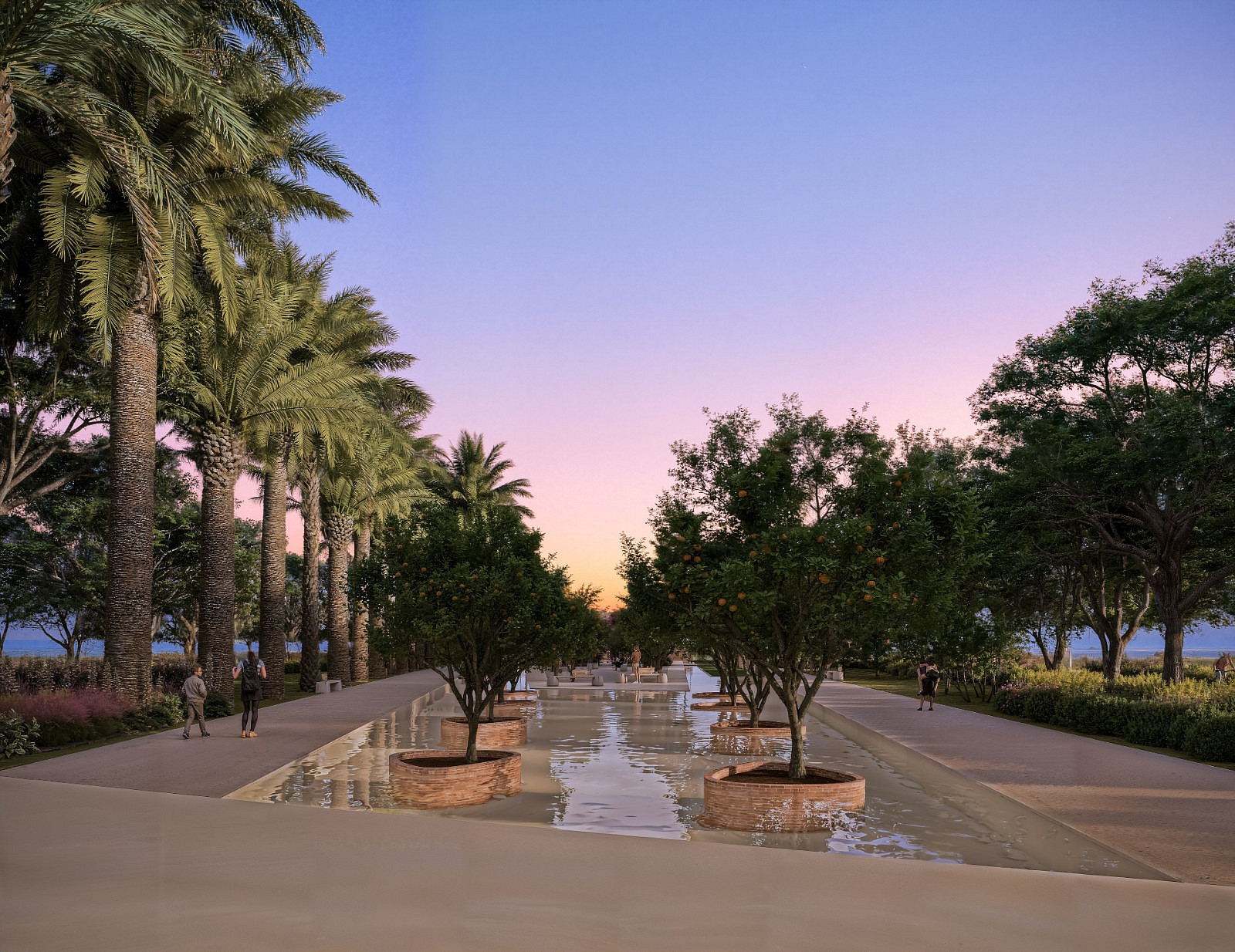
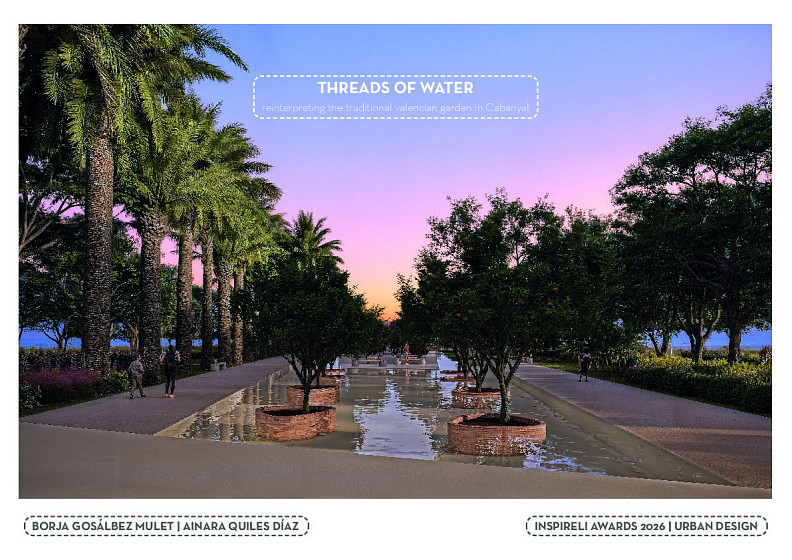
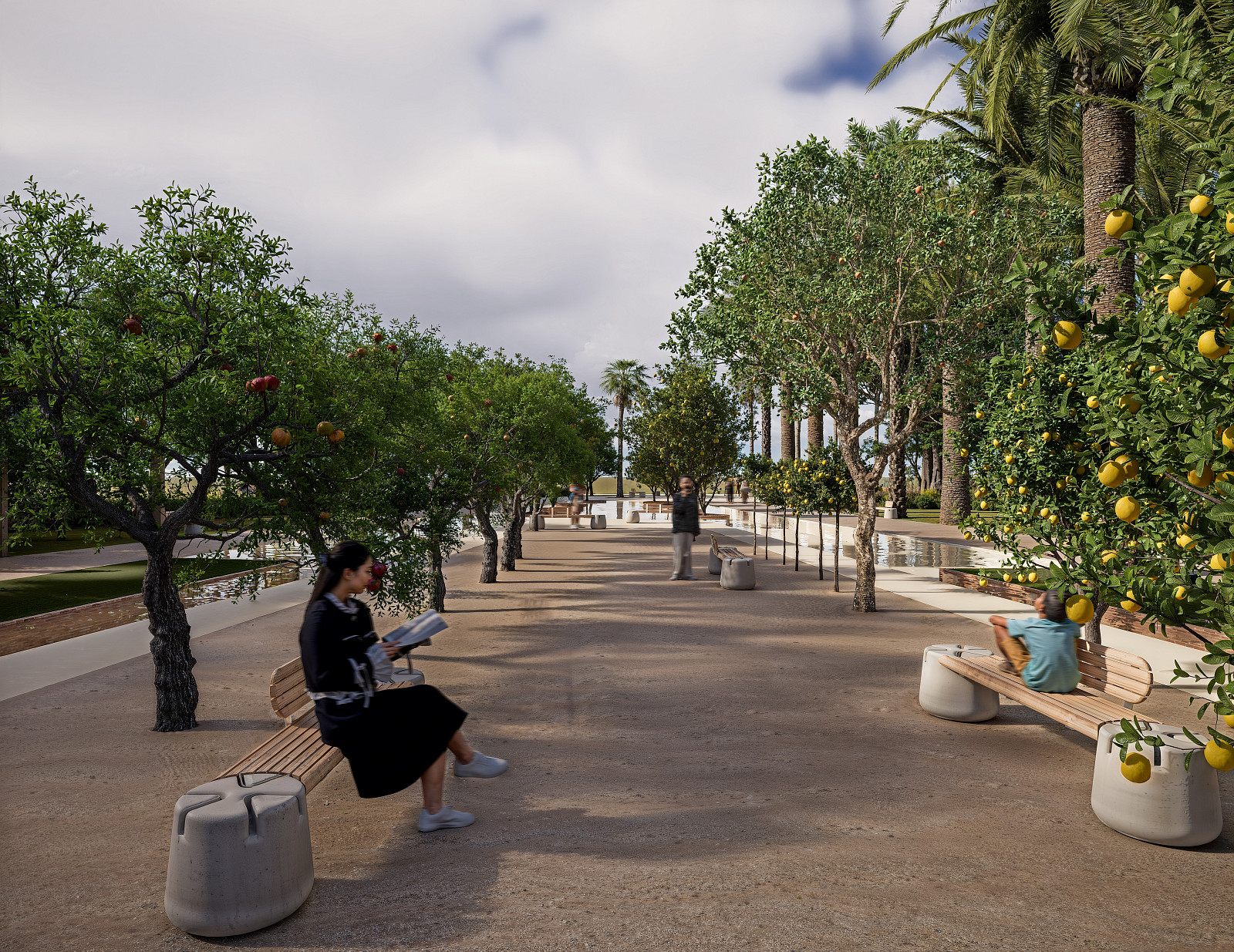
The answer draws on the spatial intelligence of the traditional Valencian garden — its flatness, its water channels, its citrus groves, its layered enclosures — and reinterprets these principles through a contemporary lens. Water is not decoration here; it is infrastructure, narrative, and threshold. A linear pond runs along the park's edge like an "acequia", structuring the whole composition and defining a green-and-water double ring that protects a contemplative core from the urban noise surrounding it.
The proposal is a careful act of translation: taking the horticultural and formal vocabulary of a centuries-old garden tradition and asking it to perform as a twenty-first-century neighbourhood park — porous, seasonal, resilient, and deeply rooted in place.
Popis projektu
The design is organised around a bifurcated longitudinal axis and a series of transverse connections that echo the historic parcelary logic of Cabanyal's urban fabric — three parallel strips running north to south, two for pedestrian movement and one dedicated to the water system. This formal decision embeds the park within the neighbourhood's street memory, making it legible as an extension of the existing city rather than an object dropped into it.
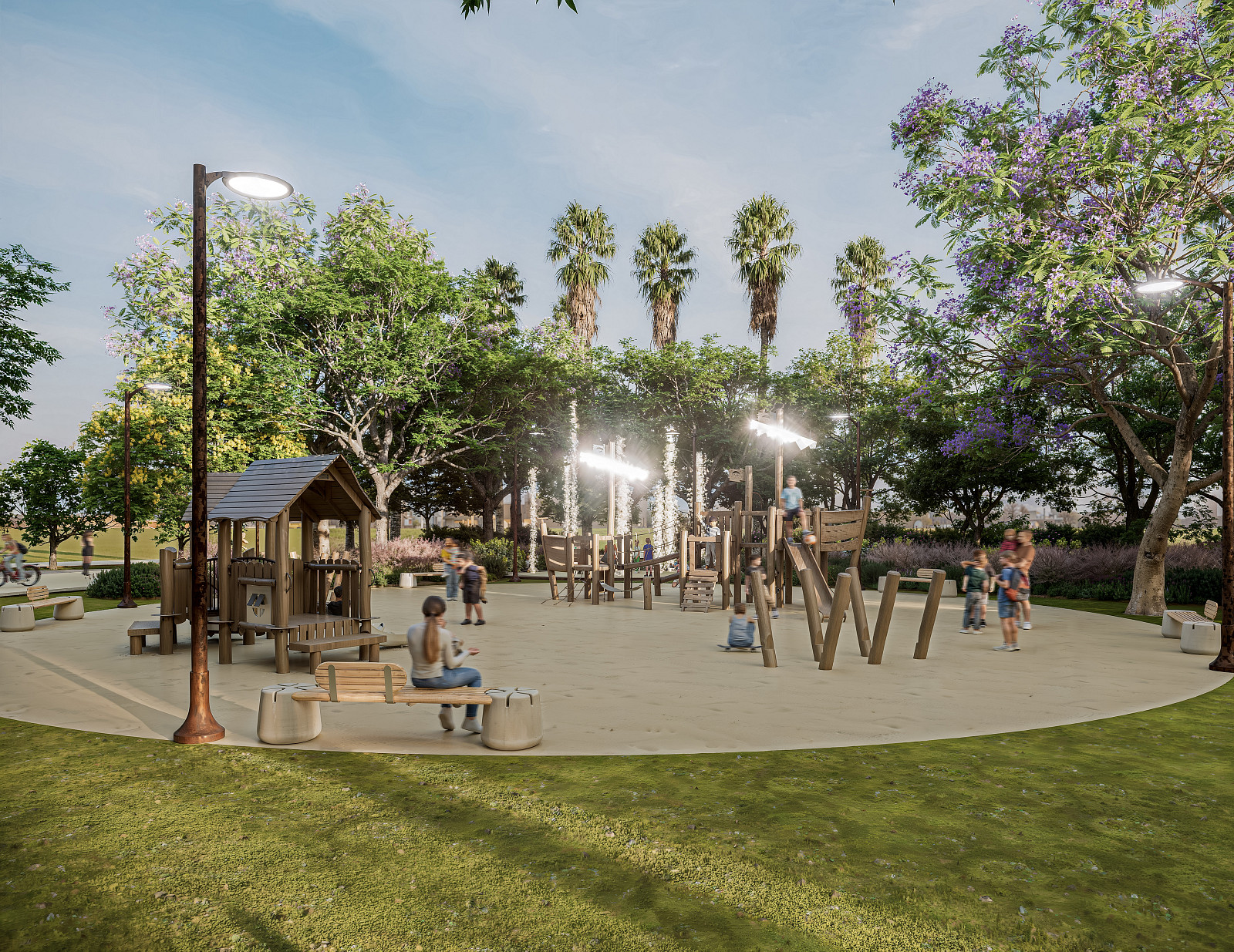
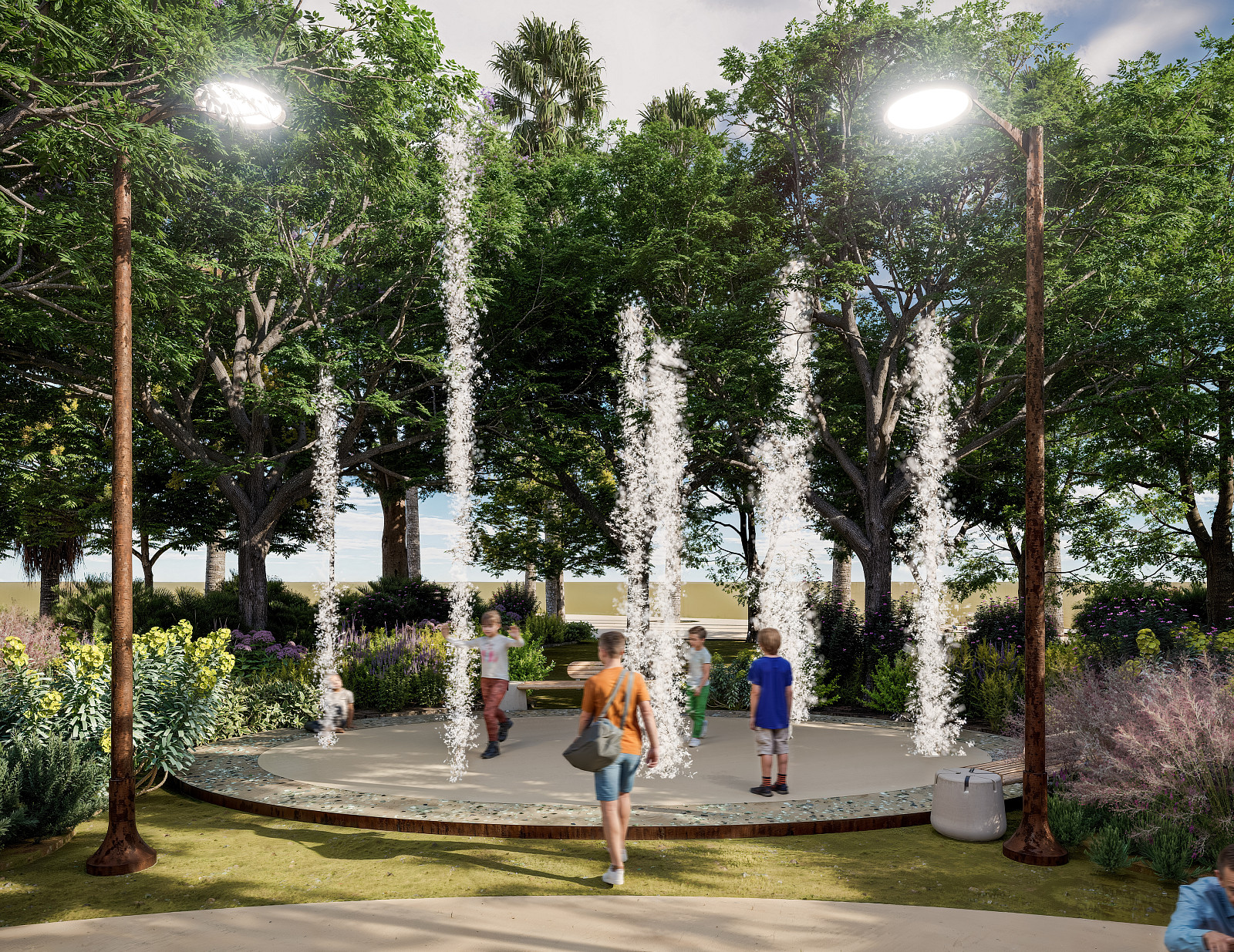
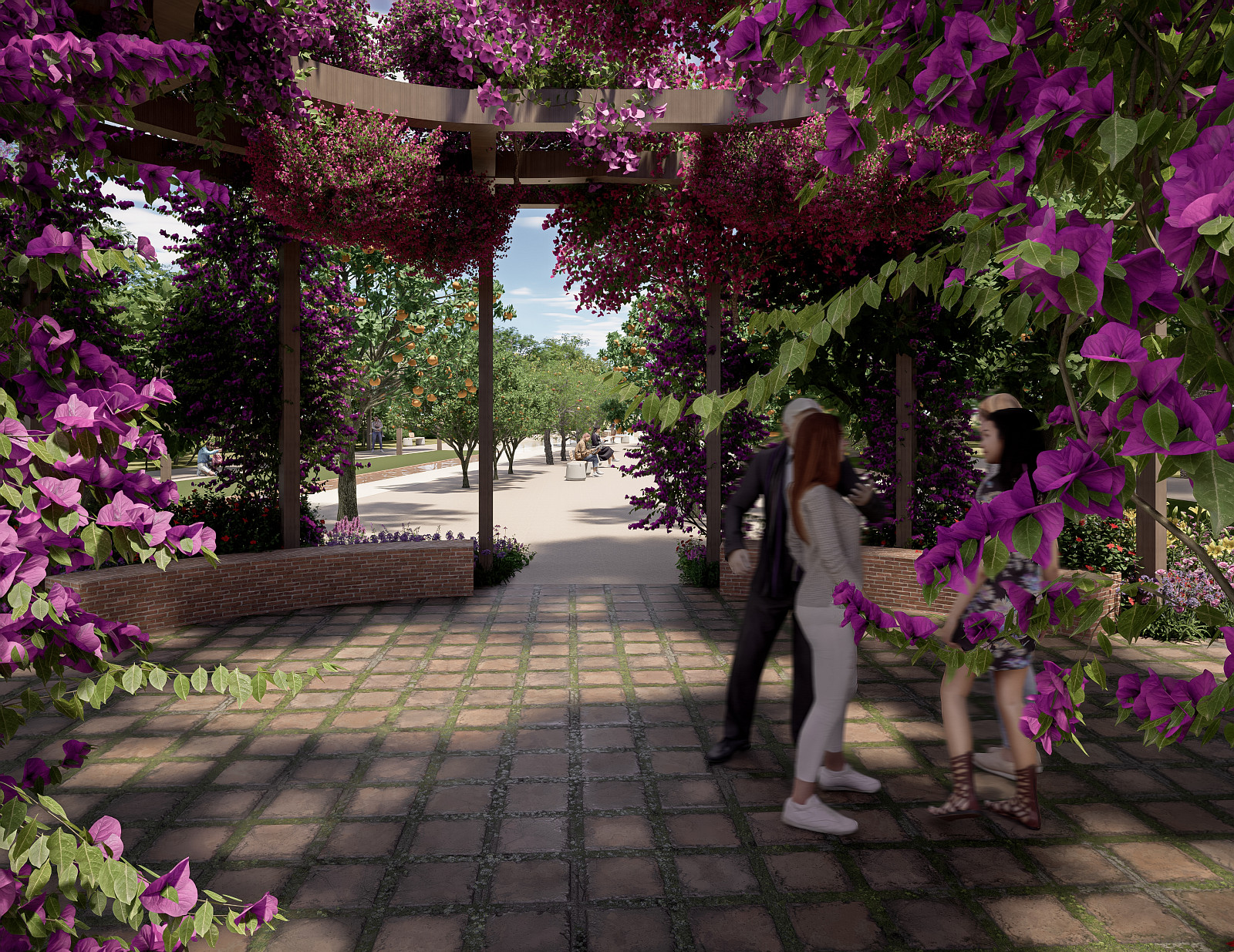
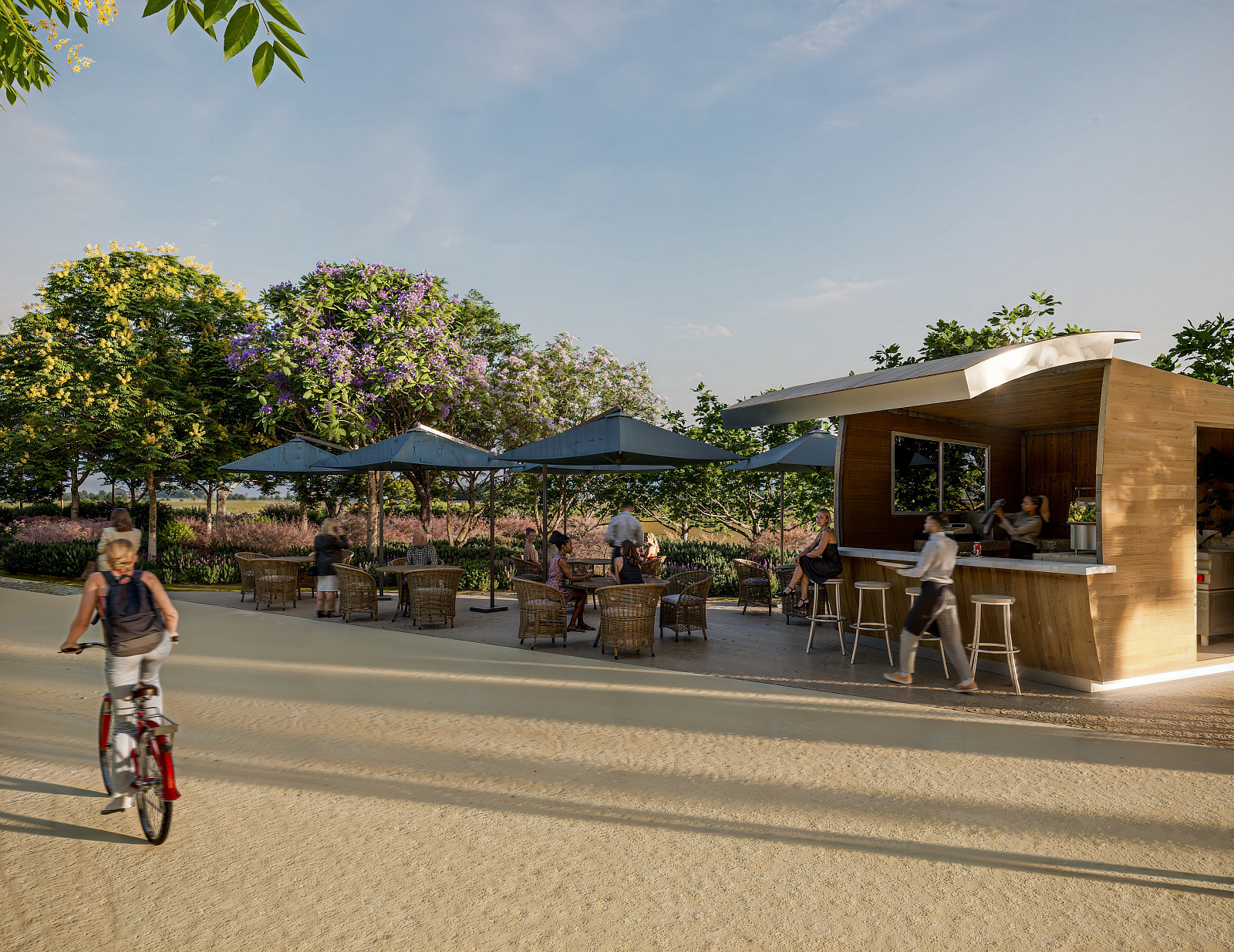
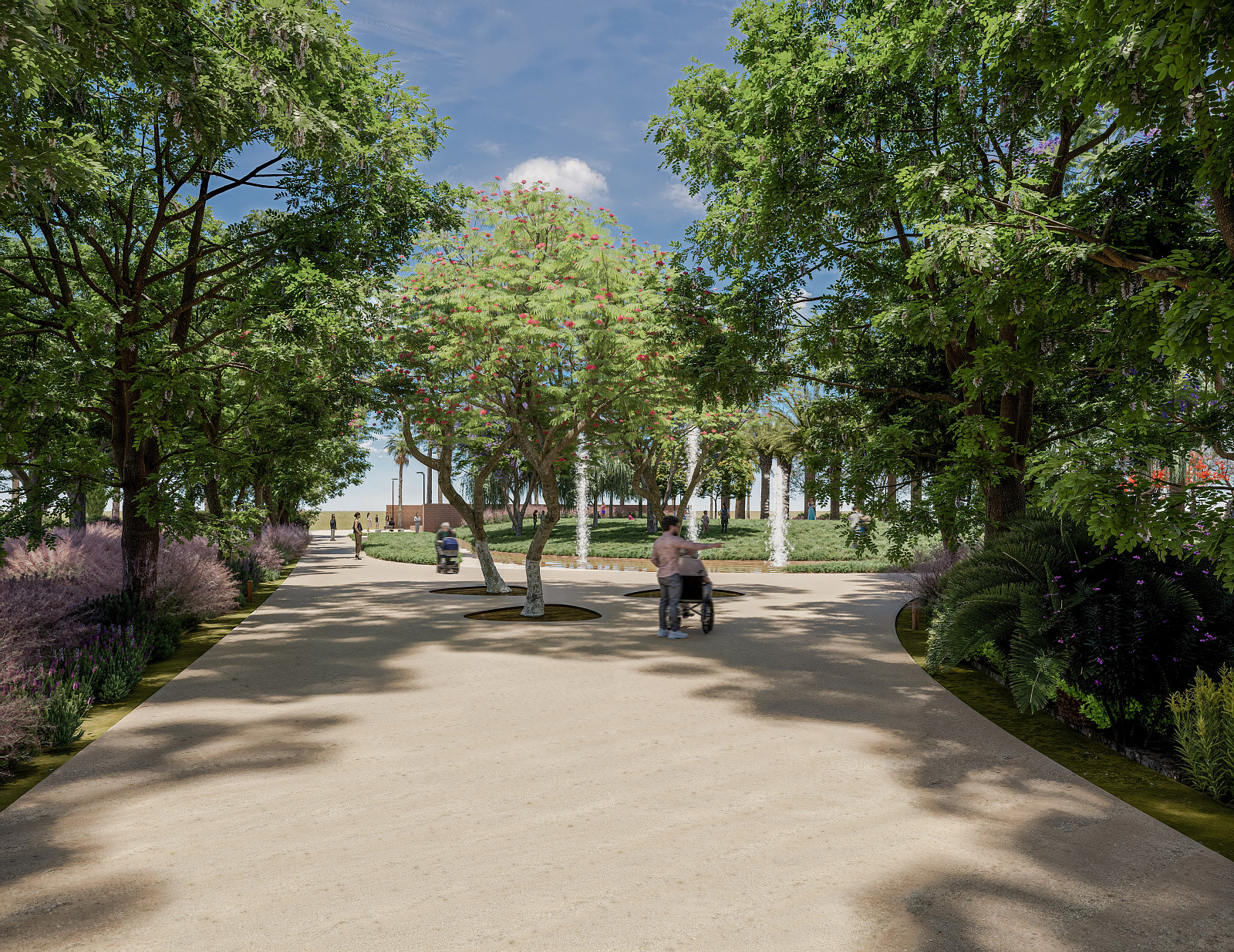
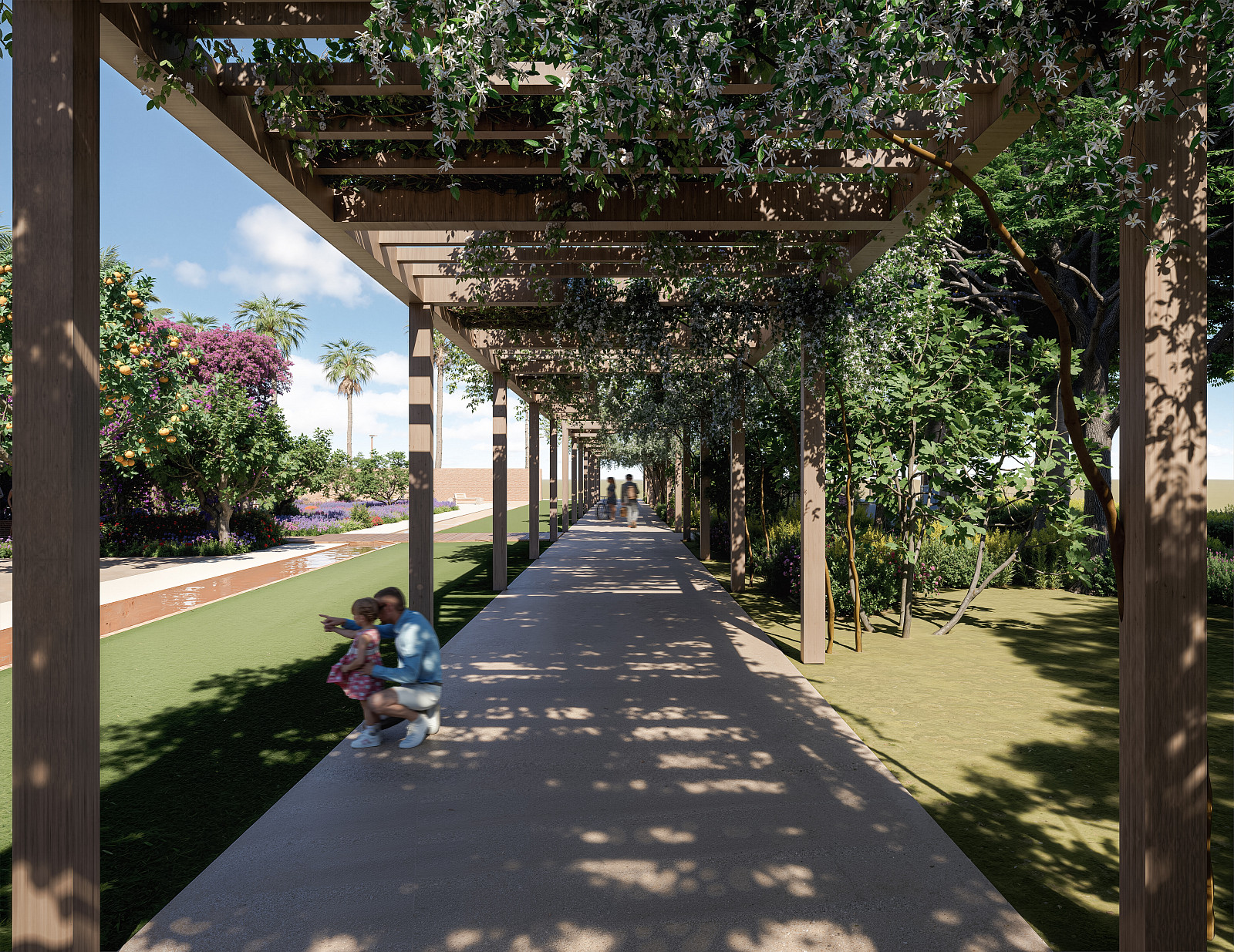
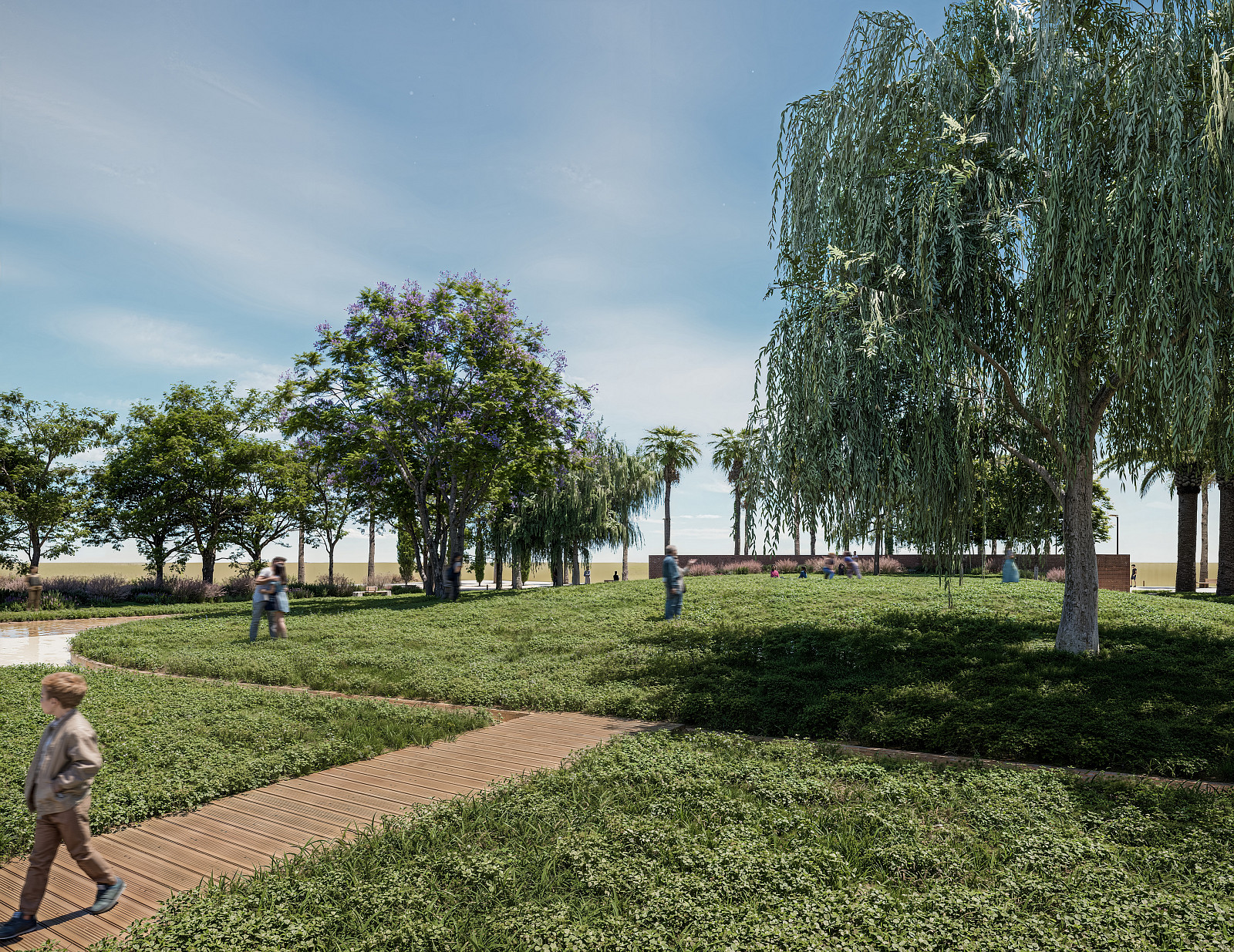
At the heart of the proposal lies the Orange Tree Pond — a linear water surface that serves as the project's visual and programmatic focal point, toward which multiple paths converge. Around it, the space is organised into two broad categories: contemplative zones to the north, closer to the residential fabric, and active spaces — a great lawn, a pergola walk, a children's play area with water jets, a dog area, and a bar-kiosk — distributed across the southern half of the park, which faces the more public, urban edge near the beach and the port.
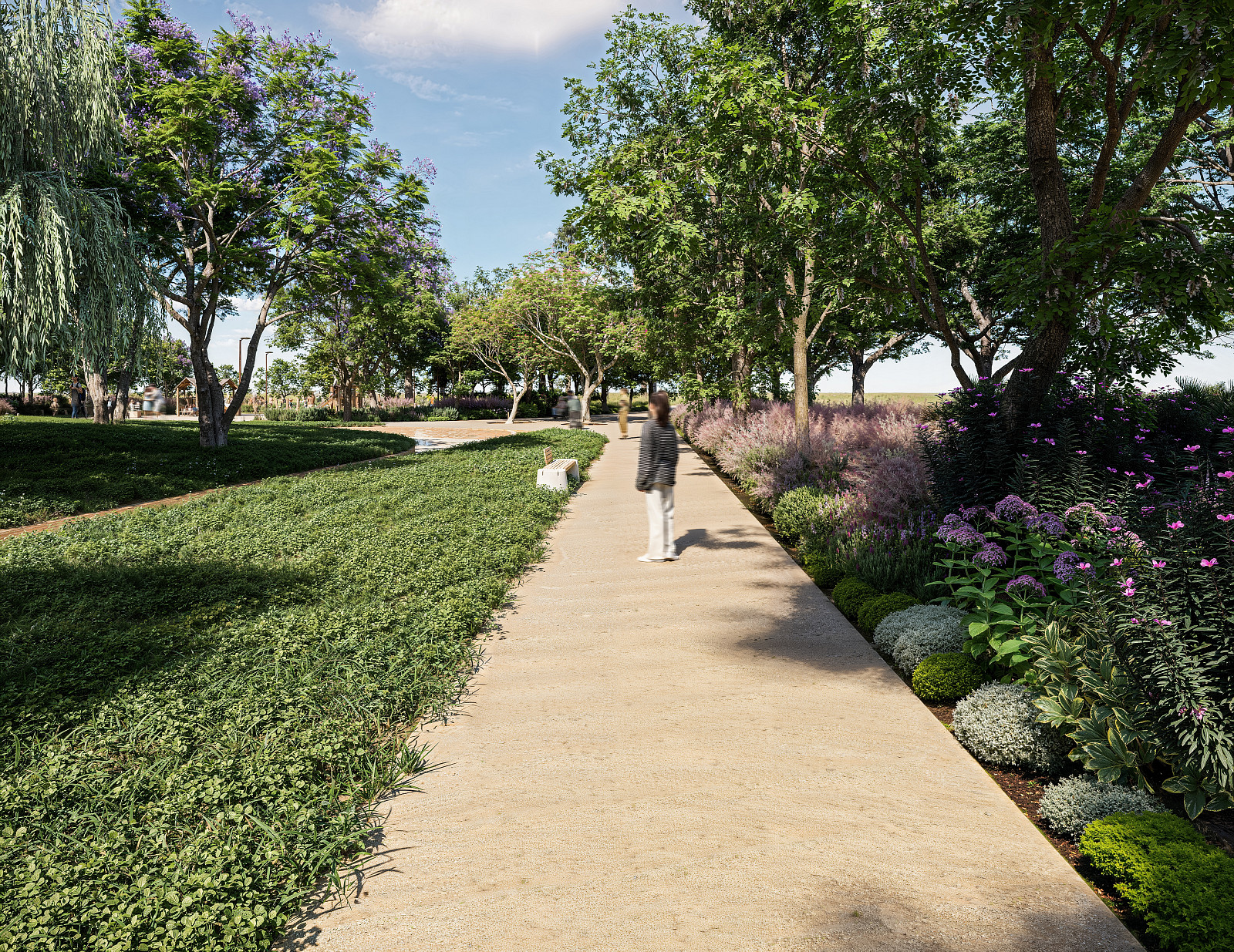
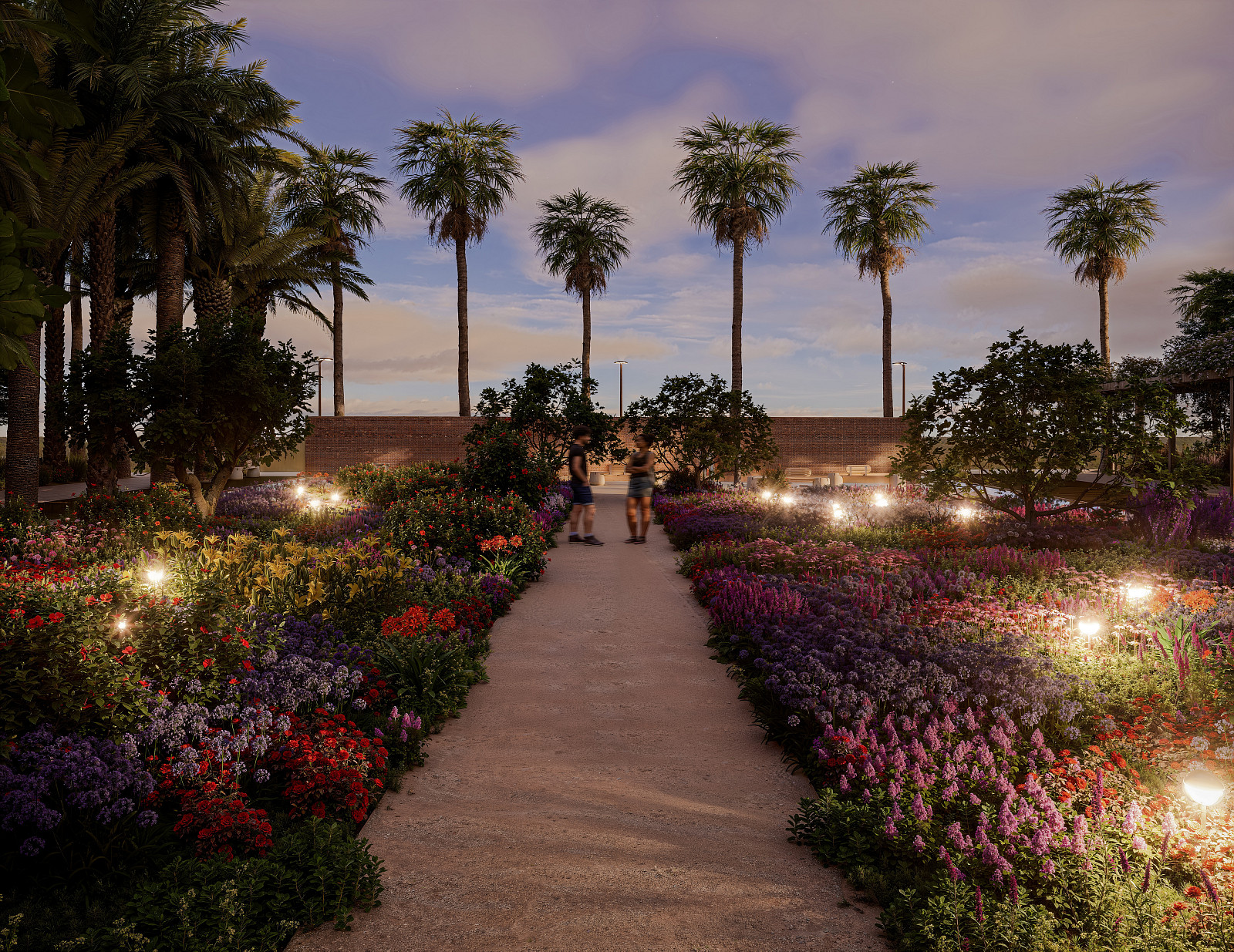
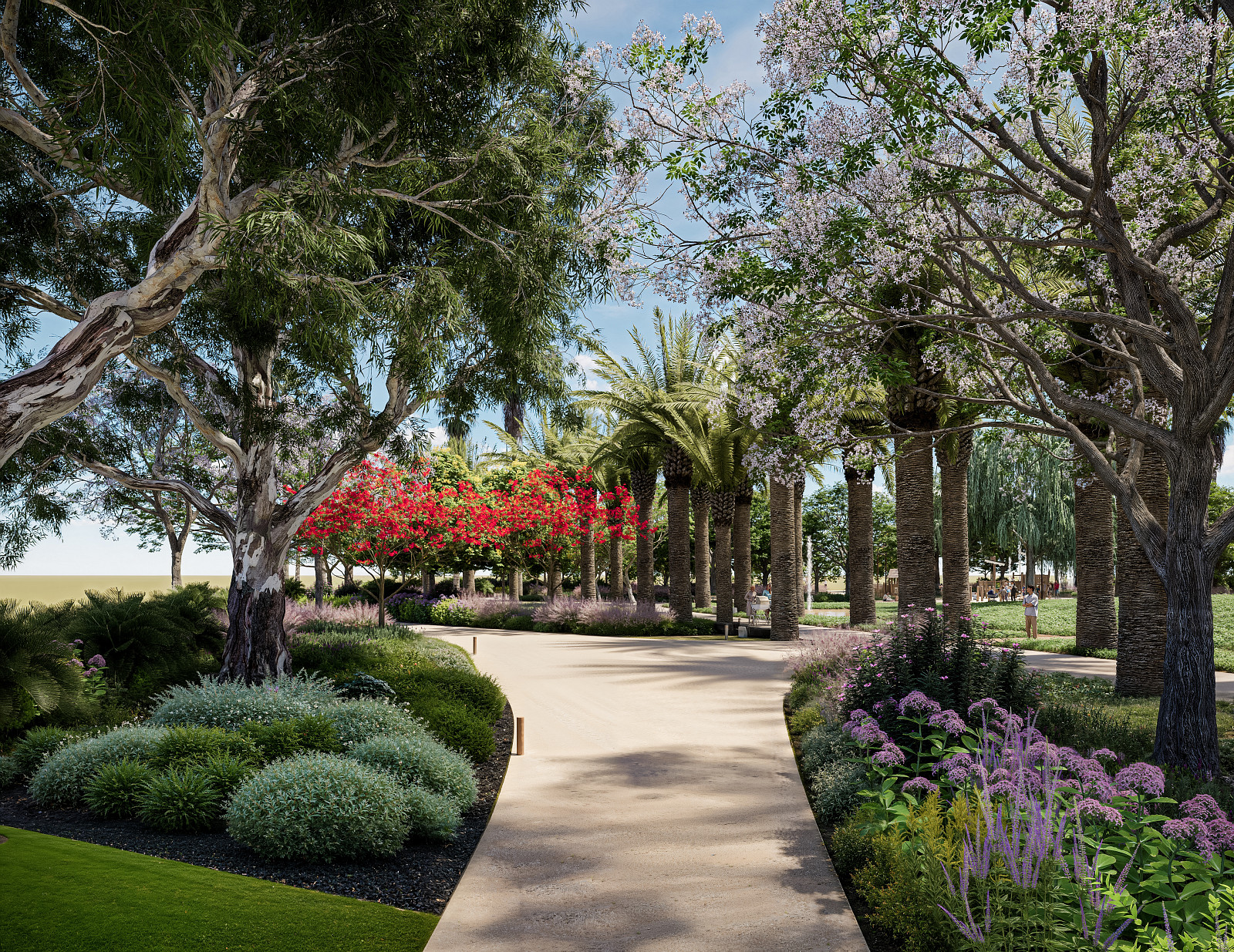
The planting strategy unfolds across three canopy layers. Existing specimens — Ficus macrophylla, Eucalyptus camaldulensis, Phoenix canariensis — are retained as anchoring presences. New tree groups are added in informal, asymmetric masses, including a dedicated Citrus Garden and a Flower Garden that reference the agricultural heritage of the Valencian huerta. Perimeter screens of deciduous species moderate light seasonally: open and luminous in winter, dense and shading in summer.
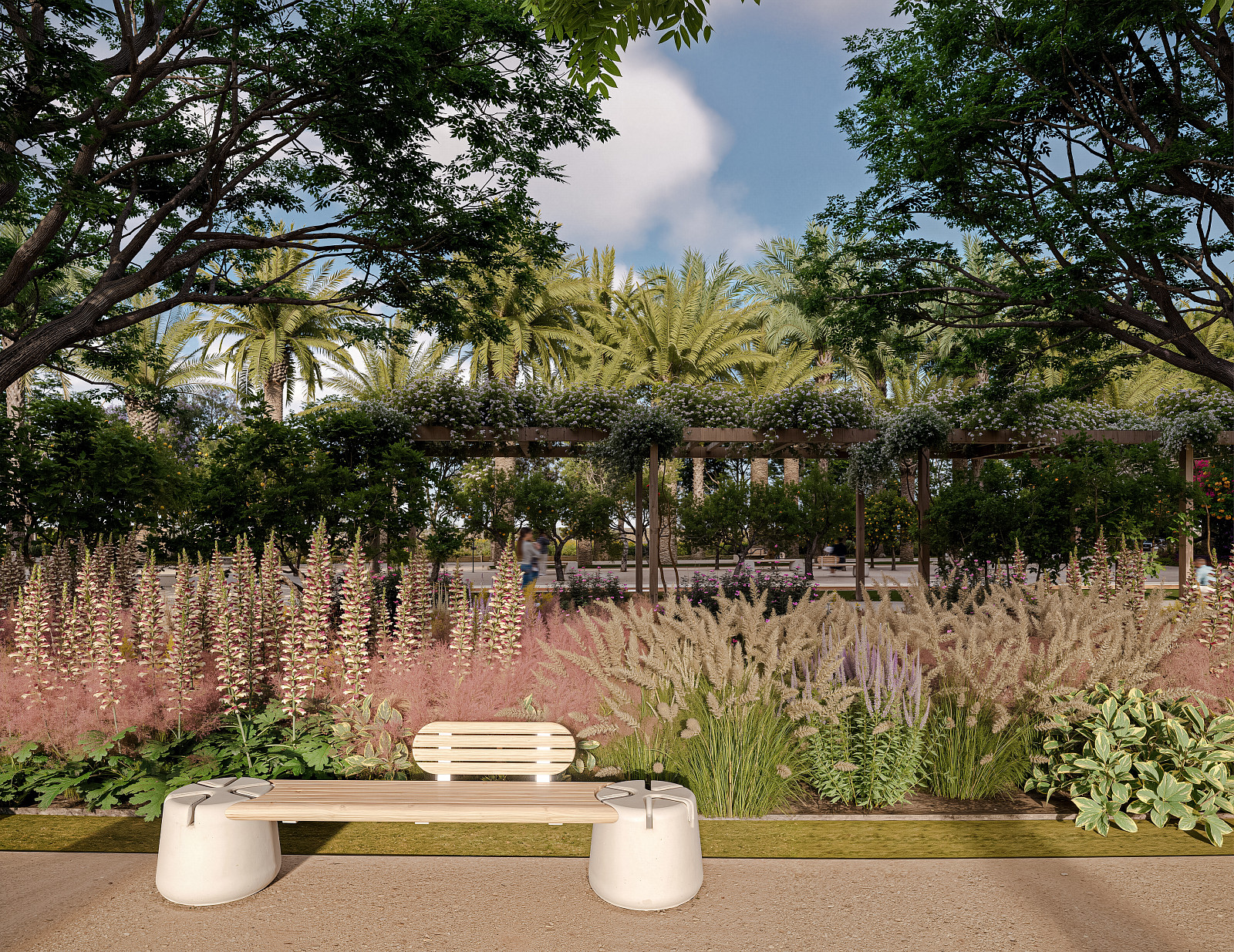
Vines — Bougainvillea, Jasminum, Lonicera — thread through the pergola structures, blurring the boundary between built element and living material. The palette is curated for salt tolerance, given the site's proximity to the sea, and designed to ensure continuous bloom across all four seasons.
The composition follows a figure-ground logic in which greenery acts as the continuous ground and pathways become the figure. Subtle curvilinear geometries avoid rigid symmetry while maintaining a legible order — asymmetrical balance rather than formal equilibrium.
Technické informace
The project is conceived as a sponge park: over 67% of its total surface area — approximately 15,290 m² — is permeable, achieved through a combination of natural earthen paving, rain gardens, vegetated drainage ditches, and porous subbase layers. Only 7,263.5 m² is sealed surface, concentrated on primary pedestrian routes and the plaza areas.
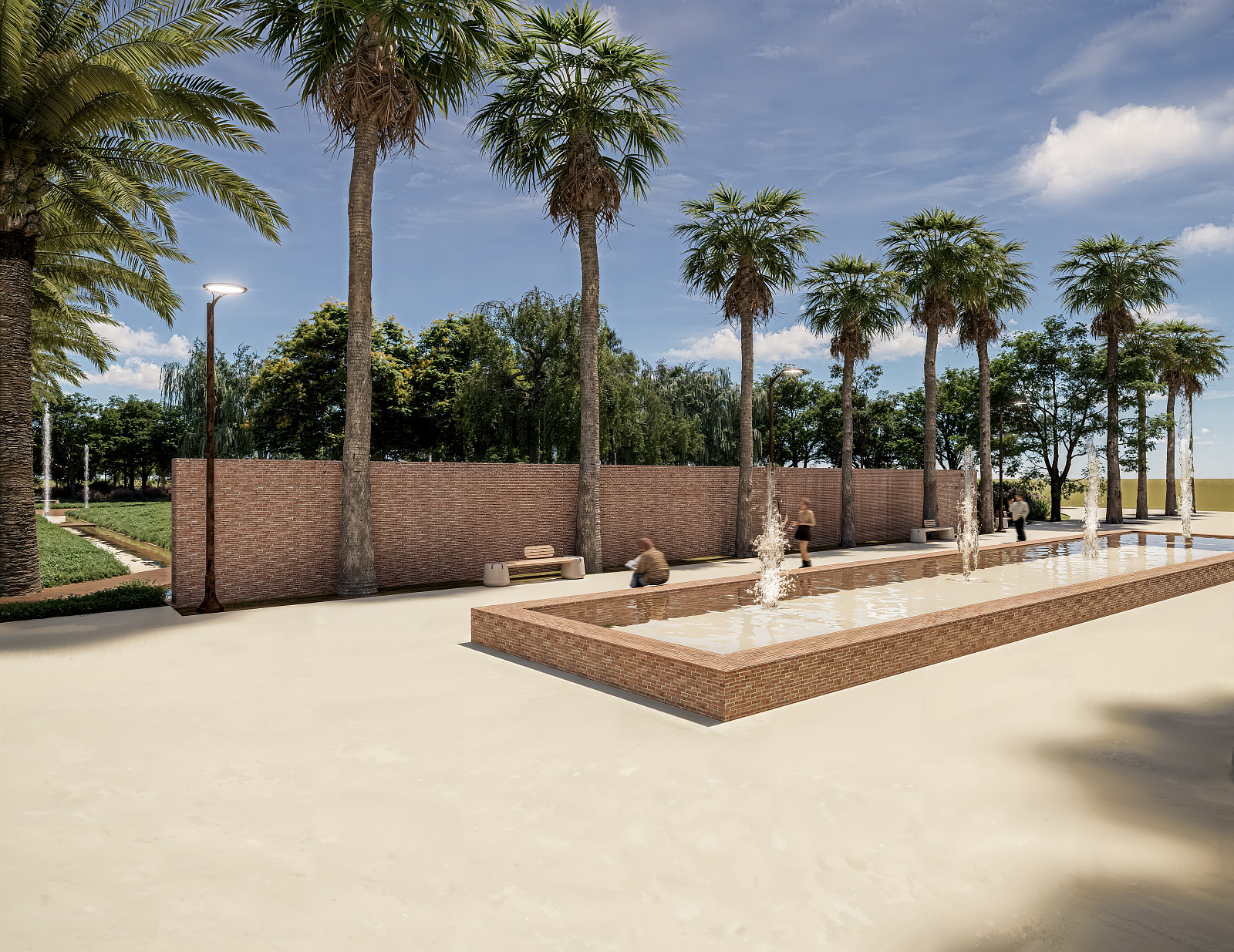
Water management is structured as an integrated SUDS system (Sustainable Urban Drainage System). The sequence runs from convex pathway crowns — which channel runoff transversally into landscaped zones — through vegetated rain gardens and drainage ditches, into the ornamental water circuit formed by the linear pond, acequias, and the central cascade. This cascade simulates a natural water form and acts as a landscape landmark; a secondary water feature near the playground introduces water as a playful and sensory element for children.
Topographic intervention is kept to a strict minimum, in line with the characteristic flatness of the Valencian garden. Only localised earthworks are introduced for water retention areas and the ornamental pond, preserving full accessibility throughout the park at all times.
The paving system employs five distinct material typologies, each calibrated for its functional and experiential role: photoluminescent concrete for nocturnal orientation along primary paths; continuous sawn-jointed concrete for secondary routes; ceramic brick for the plaza areas; natural compacted earthen paving for garden paths; and silica sand for the children's play zone. Edging is resolved with 1 cm corten-finish steel plates and double-leaf ceramic brick retaining walls in stretcher bond, with concrete foundations.
Urban furniture — benches with associated leaning rails, water fountains, and waste bins — is finished in a custom brown tone referencing corten steel. Lighting combines 5-metre street columns, 1-metre bollards, ground-level uplighting, and LED strips integrated into the pergola structures. All elements are specified from existing manufacturer catalogues (Faro Barcelona, Elbin, Robin Wood) and are designed to be co-ordinated in material and colour across the entire park.
The vegetation table encompasses 41 species across shrub, groundcover, vine, and tree strata, all selected for Mediterranean climate suitability and tolerance to saline environments. Deciduous species are deployed specifically at the perimeter to act as seasonal light filters.
Dokumentace

Copyright © 2026 INSPIRELI | All rights reserved. Use of this website signifies your agreement to the Terms of Use, Privacy Policy, and use of cookies.