The Aero-Photonic Facade


Idea projektu
CONTEXT & IDEA
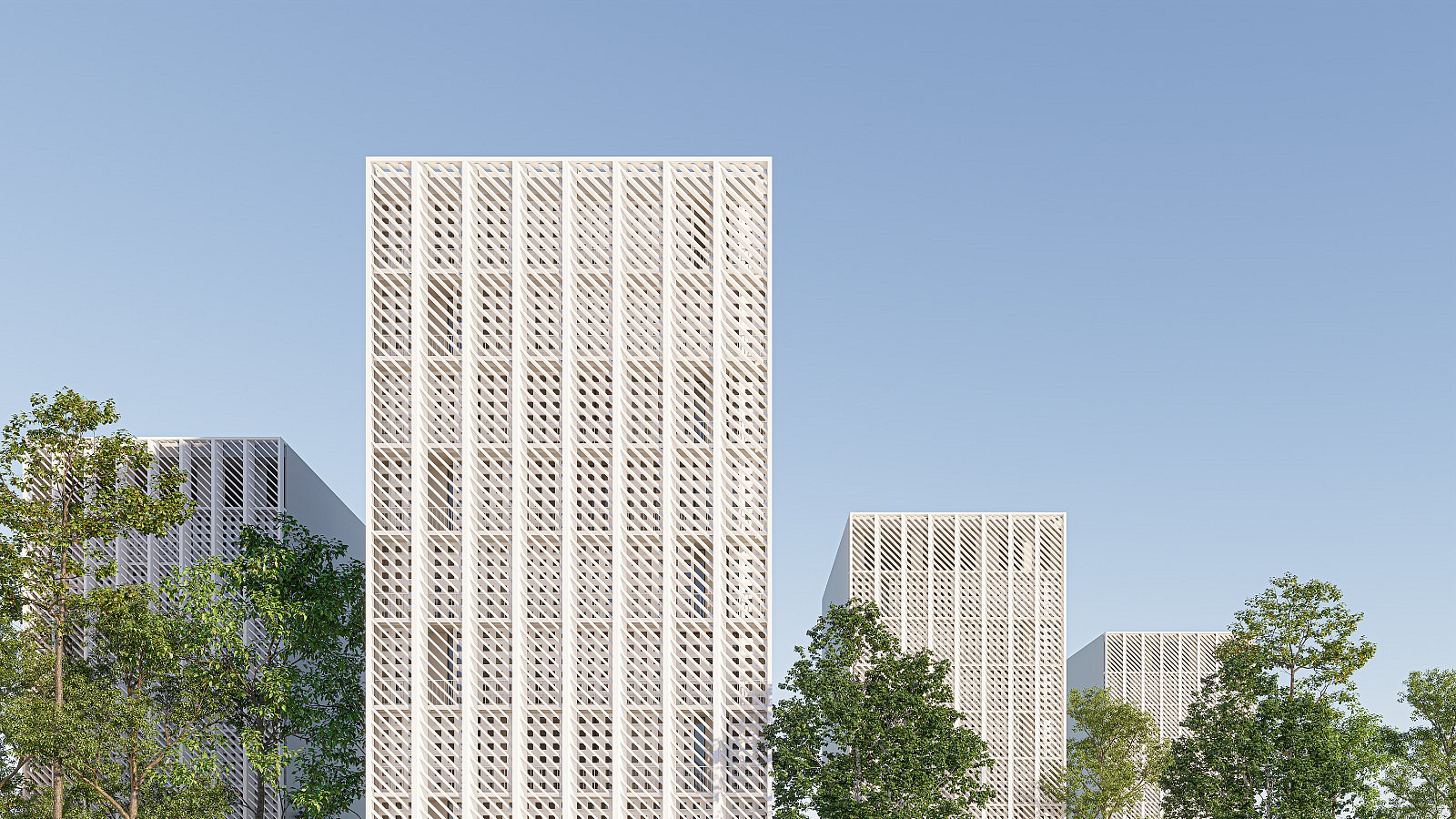
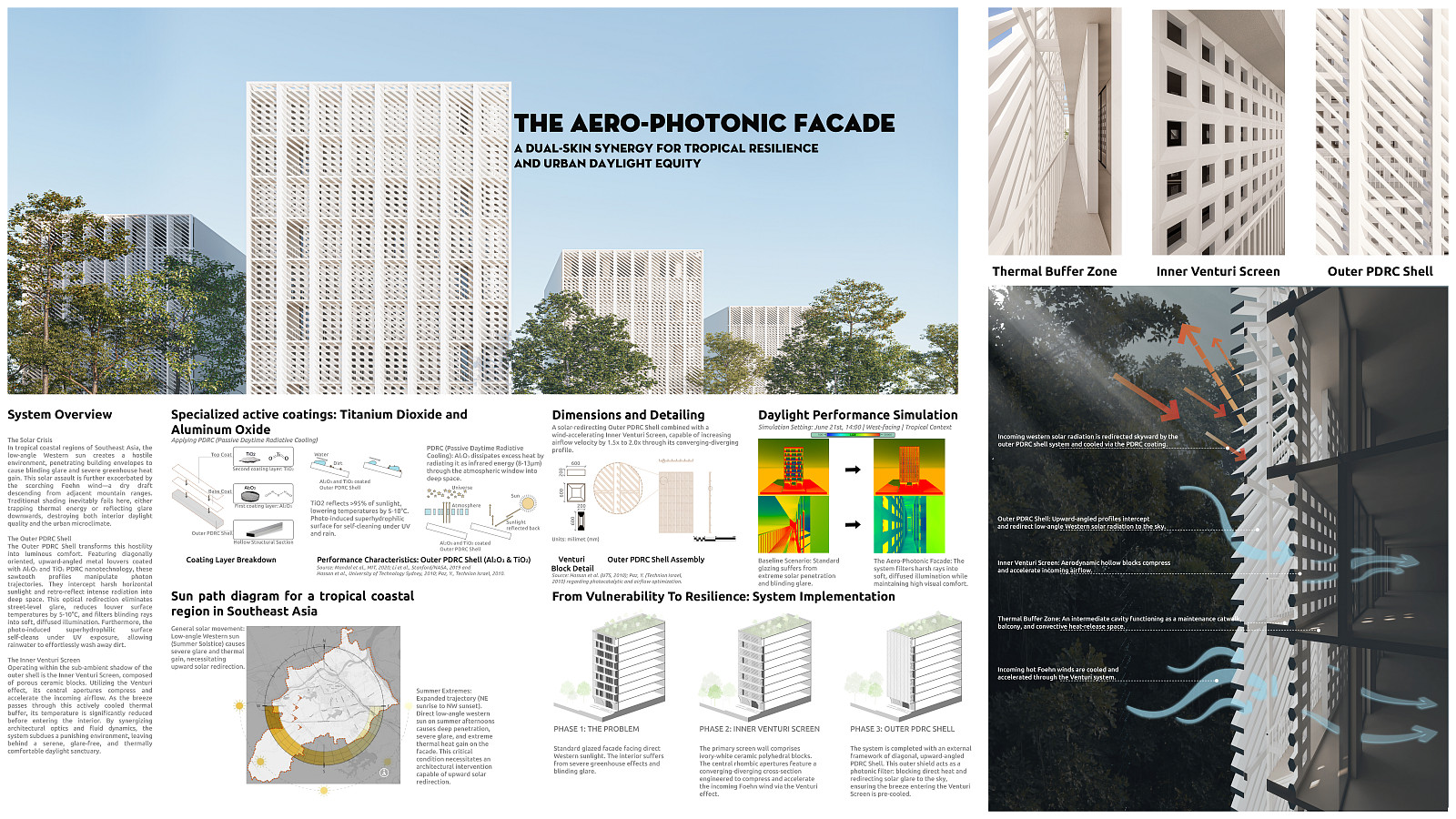
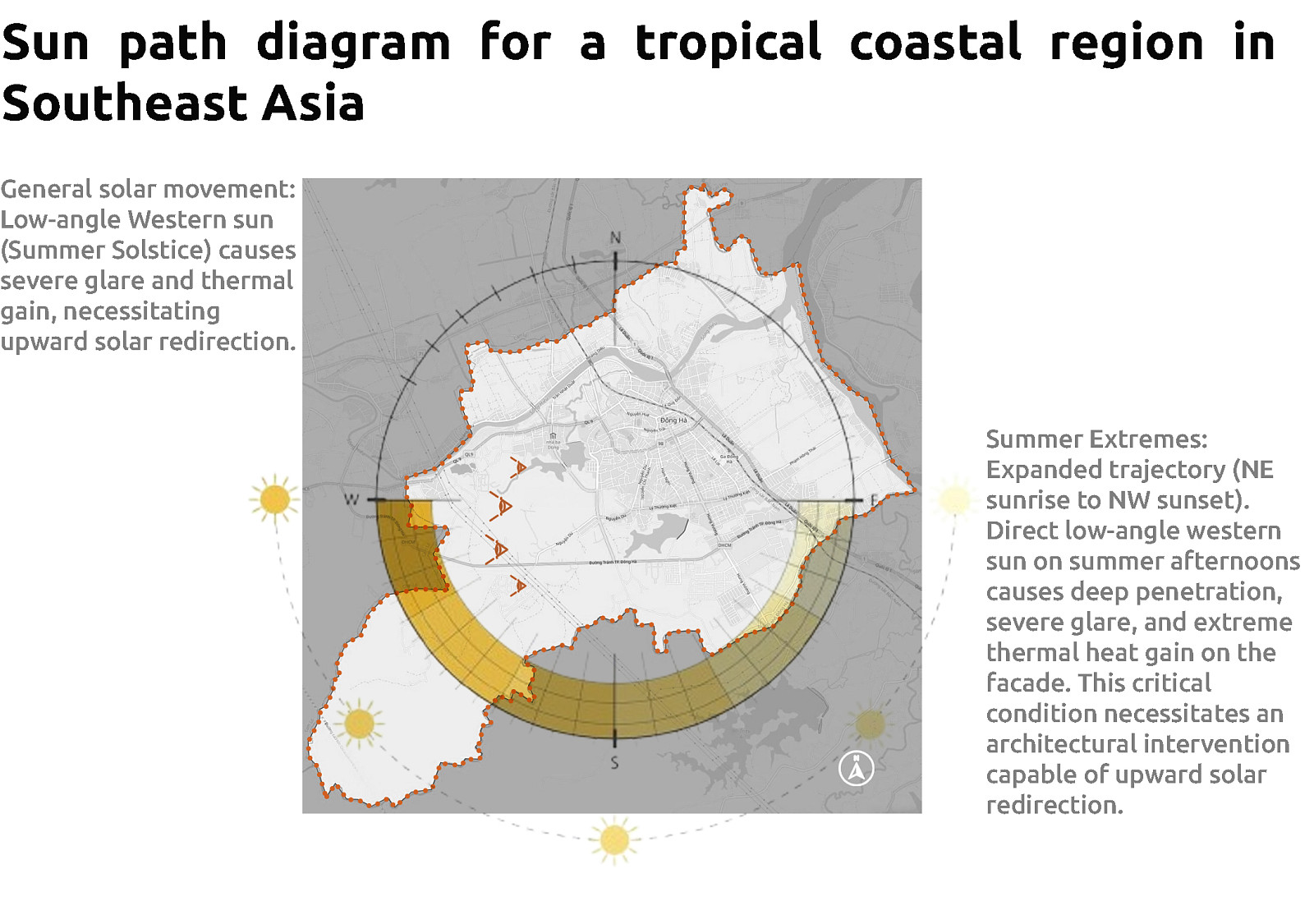
The project is situated in the context of dense tropical urban environments, where low-angle Western sunlight and dry, scorching "Foehn" winds not only cause thermal discomfort but also trigger the "Urban Heat Mirror" effect—a recursive energy reflection loop that causes exponential heating for the entire community. Our core idea is to create a "Dual-Skin Filter" capable of transforming hostile sunlight into soft illumination and accelerating cool airflow, evolving the facade from a passive barrier into a living entity that actively contributes to the urban microclimate.
GOALS & OBJECTIVES
- Daylight Equity: To ensure absolute visual comfort for internal occupants without causing glare or thermal radiation to neighboring structures.
- Tropical Resilience: To utilize PDRC nanotechnology for skyward heat rejection and the Venturi effect for autonomous wind cooling, minimizing dependence on mechanical energy.
- Community-Centric Architecture: To transform every building into an urban radiator for the city, contributing to the mitigation of the Urban Heat Island (UHI) effect.
Popis projektu
MODULAR SYSTEM SOLUTION
The scope of this project transcends a single-building design, proposing a highly adaptable modular facade system. The solution focuses on creating standardized components (the PDRC shell and Venturi blocks) that can be mass-produced and flexibly assembled onto various structural frameworks. This allows the system to be widely implemented across diverse typologies, from high-rise office towers to dense urban housing, where Western sun exposure is a universal challenge.
URBAN-SCALE IMPACT
The project expands its impact from indoor thermal comfort to the street-level microclimate. By eliminating the "Urban Heat Mirror" effect—where heat is reflected between buildings—the solution aims to reduce the overall ambient temperature of tropical urban quarters. It is a high-performance architectural strategy that harmonizes advanced nanotechnology with traditional aerodynamic principles to function as an efficient "urban thermal filter."
Technické informace
1. OUTER ENVELOPE: PDRC SHELL
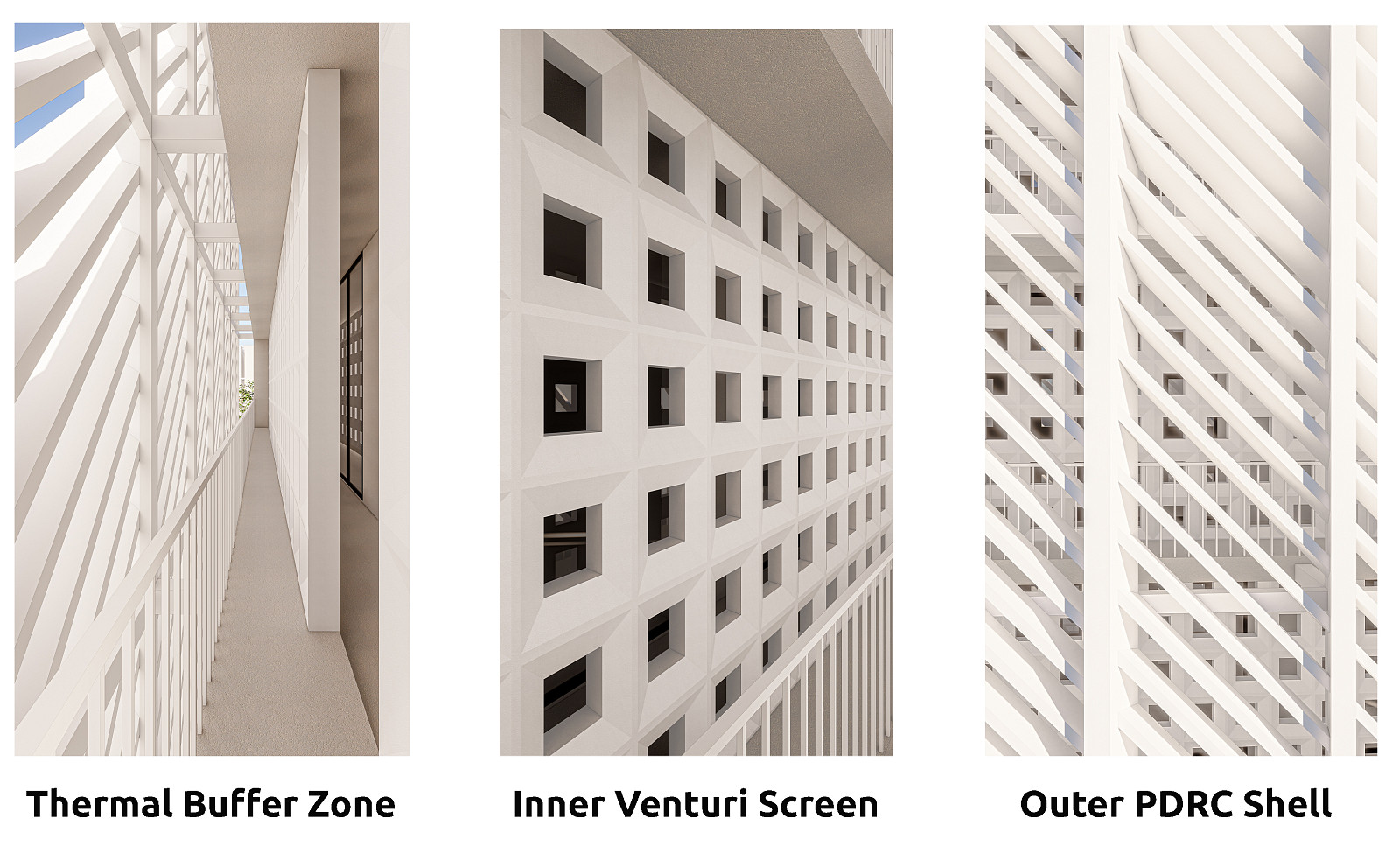
- Structure: High-strength aluminum alloy framework featuring a diagonal louver configuration.
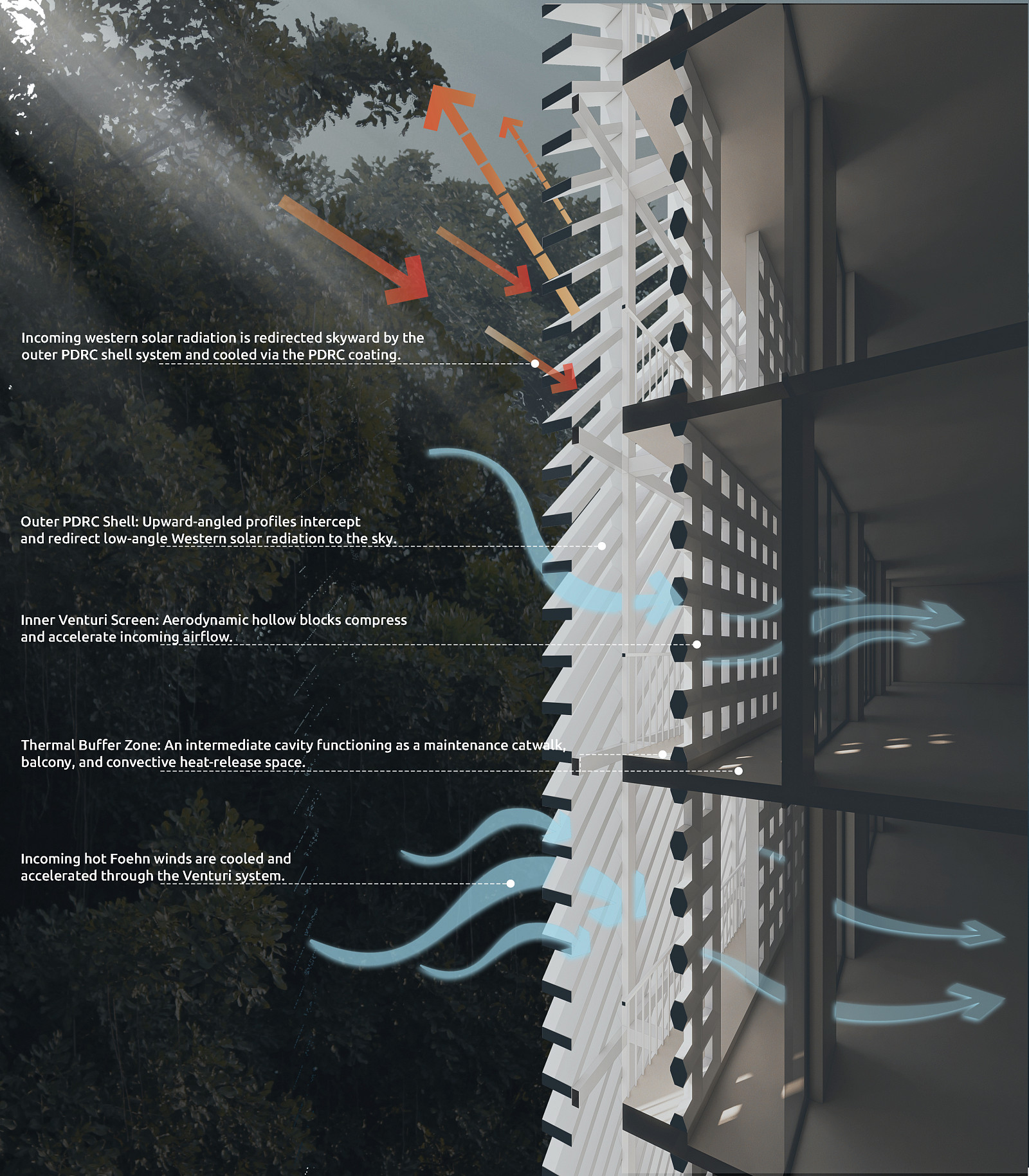
- Geometry: Upward-angled profiles engineered to intercept low-angle Western sunlight (15°-30°) and retro-reflect radiation skyward.
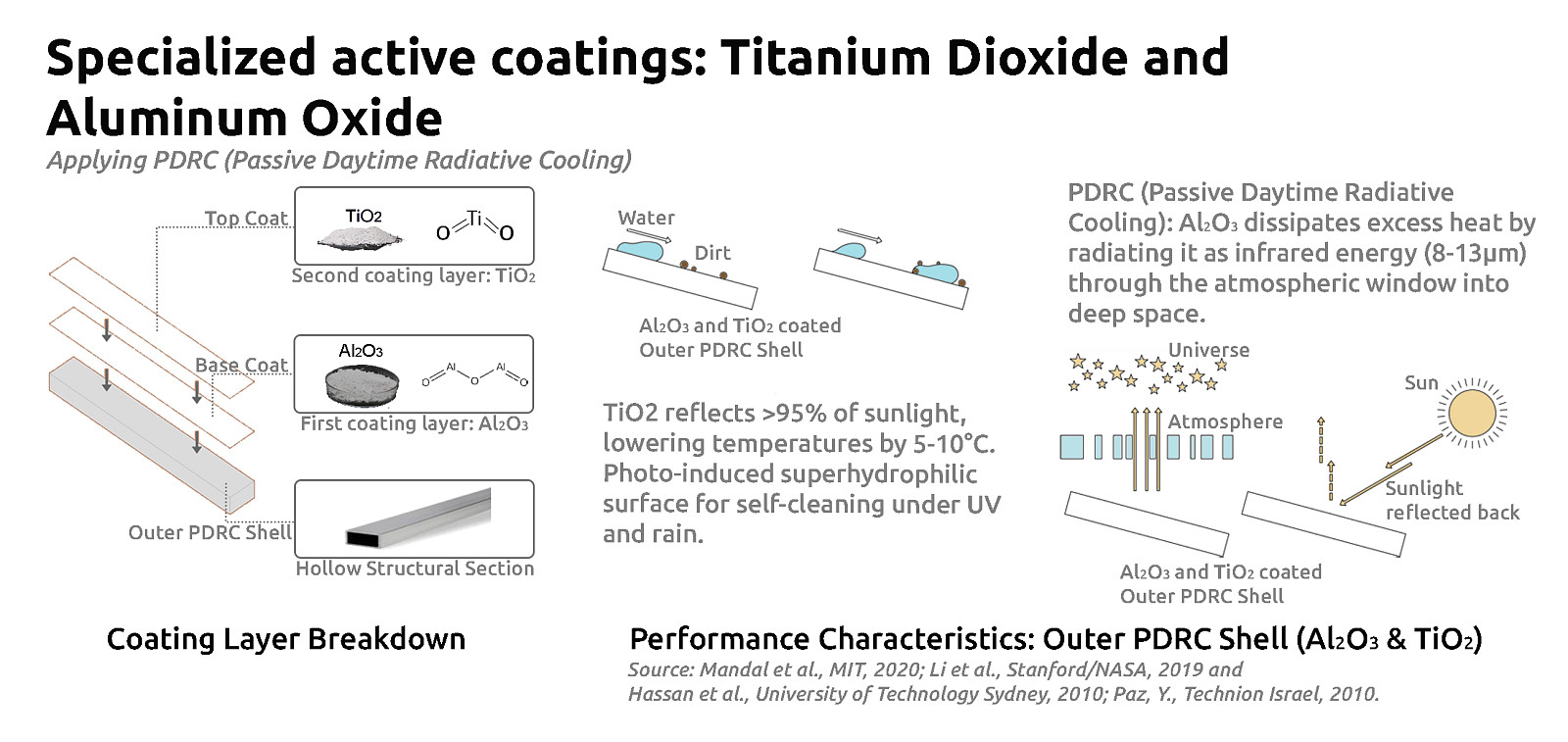
- Surface Technology: Passive Daytime Radiative Cooling (PDRC) nano-coating, integrating Al2O3 and TiO2 particles.
- Optical Performance: Solar Reflectance > 95%; Thermal Emissivity > 0.9 within the "Atmospheric Window" (8-13μm).
- Additional Features: Photo-induced superhydrophilic surface for autonomous self-cleaning via UV exposure and rainfall.
2. INNER CORE: VENTURI SCREEN
- Material: High-fired white ceramic, offering high mechanical durability and significant thermal mass.
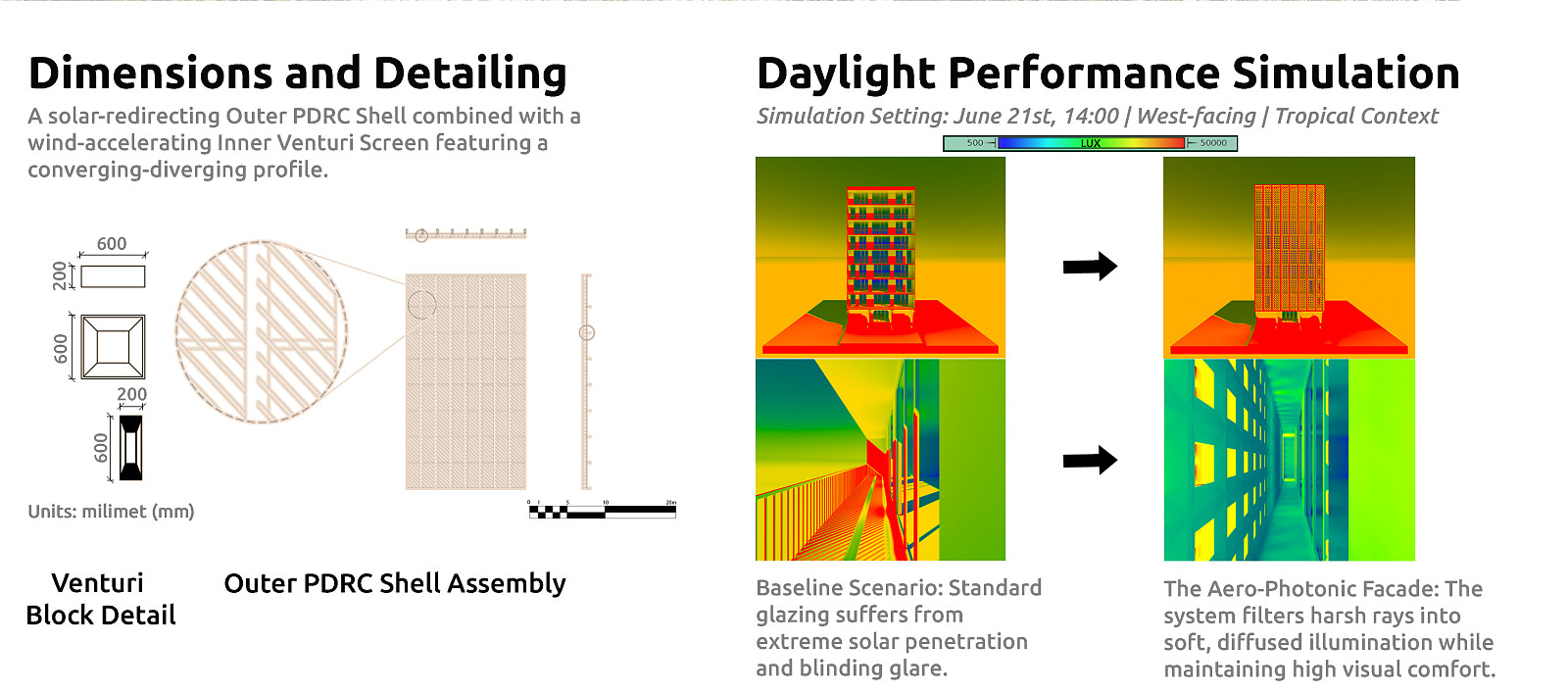
- Module Dimensions: 600 x 600 x 200 (mm).
- Aerodynamic Principle: Hollow structure featuring a "Converging-Diverging" (Venturi) profile.
- Ventilation Efficiency: Utilizes the Venturi effect to compress and accelerate airflow through narrow apertures, inducing natural forced convection into the interior even during low ambient wind speeds.
3. THERMAL BUFFER ZONE
- Spacing: 600 - 900 (mm) cavity between the two skins.
- Functionality: Provides a volume for pre-cooling intake air before it enters the Venturi apertures, while serving as a maintenance corridor and a filter for indirect daylight.


Copyright © 2026 INSPIRELI | All rights reserved. Use of this website signifies your agreement to the Terms of Use, Privacy Policy, and use of cookies.