Fading roots


Idea projektu
Project Declaration
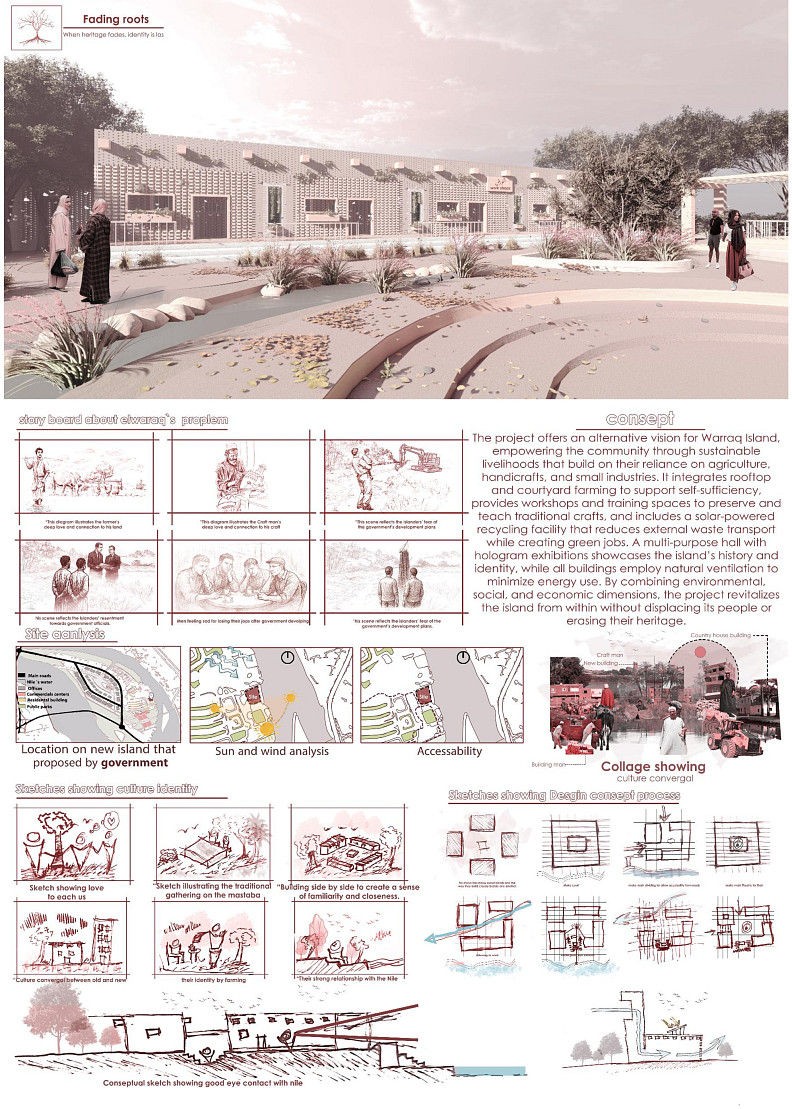
The proposed project addresses the ongoing transformation of Warraq Island, where local communities face displacement due to large-scale redevelopment plans. Current visions prioritize high-rise developments and commercial investments, often neglecting the island’s cultural identity, agricultural heritage, and artisanal economy. This project challenges such approaches by proposing a development model that integrates modernization with the preservation of local traditions.
The concept is rooted in maintaining the island’s social and economic fabric while introducing sustainable and future-oriented solutions. Agriculture is reimagined through rooftop farming systems integrated into residential buildings, ensuring continuity of local farming practices. Community courtyards function as social and educational spaces, reinforcing collective traditions and enabling knowledge transfer between generations.
To support the local economy, the project introduces a Craft Center and Market Hall, providing spaces for production, education, and commercialization of traditional crafts and agricultural products. Additionally, a recycling facility inspired by local practices addresses unemployment and waste management by transforming waste into usable materials and products, powered by renewable energy sources.
Architecturally, the project adopts locally inspired materials and passive design strategies to enhance environmental performance while preserving the visual identity of the island. Technological interventions are carefully integrated as tools for education and cultural storytelling rather than disruption.
The main objective of the project is to propose an alternative model of development that is socially inclusive, environmentally sustainable, and culturally sensitive. It aims to empower local communities, preserve their identity, and ensure their active participation in shaping the future of Warraq Island.
Popis projektu
The project proposes an integrated development model for Warraq Island that combines residential, productive, social, and environmental systems within a cohesive framework.
The design consists of medium-rise residential blocks organized around a central courtyard. These units are designed to accommodate local families while maintaining social proximity and community interaction. Rooftops are utilized as productive agricultural spaces, enabling residents to continue farming practices within an urban setting.
A central community courtyard acts as a social and cultural hub, supporting gatherings, performances, and informal activities. It also includes educational gardens where children can learn agricultural practices, ensuring the continuity of local knowledge.
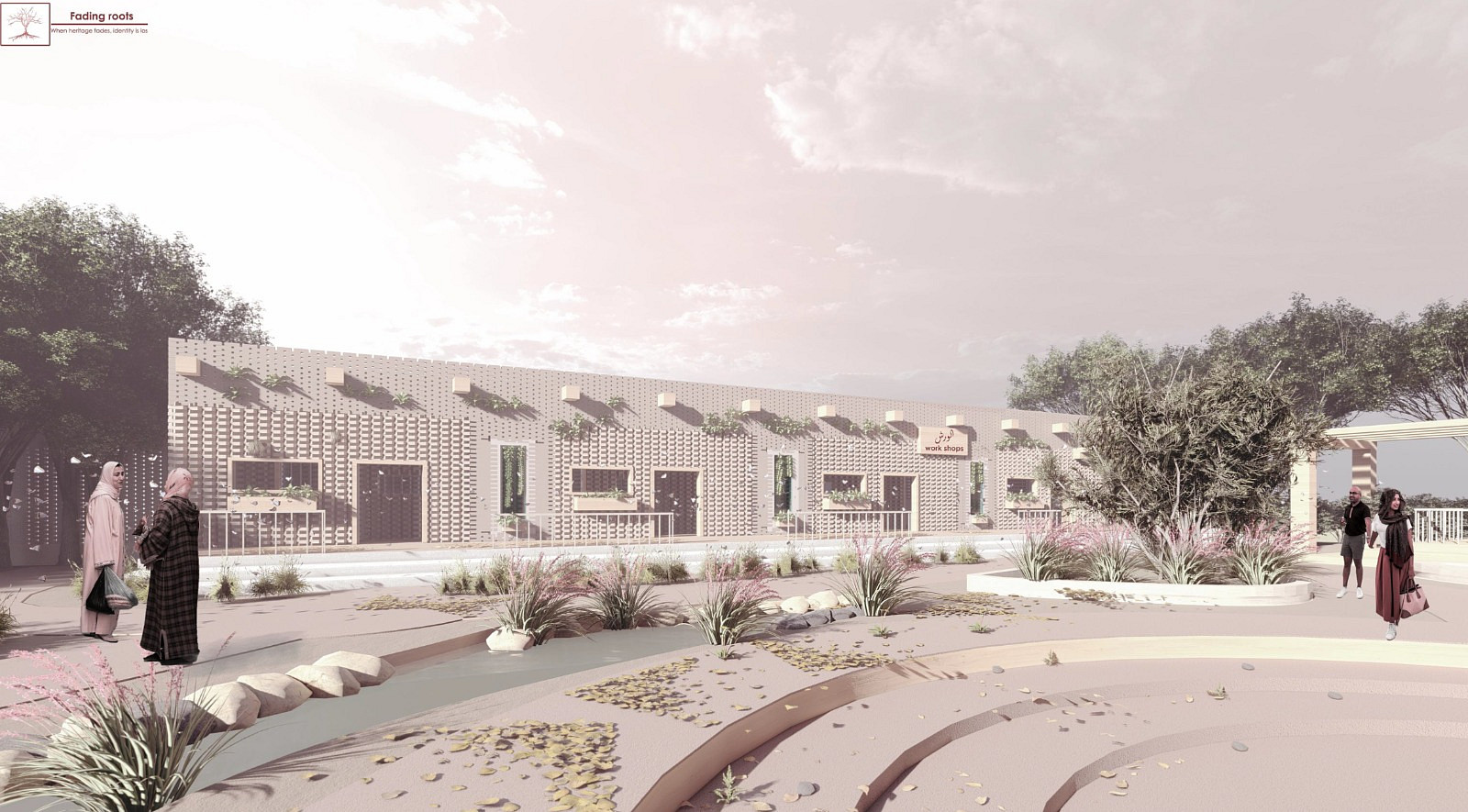
The project incorporates a Craft Center that provides workshops for traditional activities such as weaving and pottery, functioning as both a production and learning environment. Adjacent to it, a Market Hall facilitates the sale of crafts and agricultural products, supporting local economic sustainability.
A recycling facility is introduced to address waste management and unemployment. It processes plastic, paper, and metal waste into reusable materials and products, contributing to a circular economy. The facility operates using renewable energy systems, including solar panels and micro-hydroturbines along the Nile edge.
Technological features are integrated through a multi-purpose hall equipped with interactive and digital display systems, enhancing cultural awareness and education.
Overall, the project functions as a self-sustained ecosystem that merges housing, production, education, and environmental management, offering a resilient and inclusive model for the future development of Warraq Island
Technické informace
Technical Information
The project adopts a context-responsive and sustainable architectural approach, integrating local materials, passive design strategies, and renewable energy systems.
The primary construction material is treated earthen brick, selected for its low environmental impact, thermal performance, and compatibility with the local architectural identity. Structural systems are based on a modular load-bearing and reinforced concrete hybrid system, ensuring durability and adaptability for medium-rise buildings.
Environmental performance is enhanced through passive design strategies. Building facades incorporate porous stone configurations that allow natural ventilation while reducing heat gain. Courtyard planning improves air circulation and creates shaded microclimates, minimizing reliance on mechanical cooling systems.
Rooftop farming systems are designed with lightweight soil beds and integrated irrigation networks, enabling efficient agricultural production without excessive structural loads. Water management strategies include the reuse of greywater for irrigation purposes.
The project integrates renewable energy through a hybrid system combining photovoltaic solar panels and micro-hydroturbines installed along the Nile waterfront. This system supports the energy demands of residential units and communal facilities, reducing dependence on external power sources.
A dedicated recycling facility is equipped with shredding and processing units for plastic, paper, and metal waste. Materials are sorted, cleaned, and reprocessed on-site, supporting a circular economy model. Non-recyclable waste is safely stored for external collection.
Digital technologies are incorporated through interactive display systems within the multi-purpose hall, supporting educational and cultural activities.
Overall, the project applies an integrated technical strategy that combines low-tech local solutions with advanced sustainable systems to achieve environmental efficiency, structural reliability, and long-term resilience
Dokumentace

Copyright © 2026 INSPIRELI | All rights reserved. Use of this website signifies your agreement to the Terms of Use, Privacy Policy, and use of cookies.