CITY AT 95 CM / THE CHILDREN’S URBAN STRIP


Idea projektu
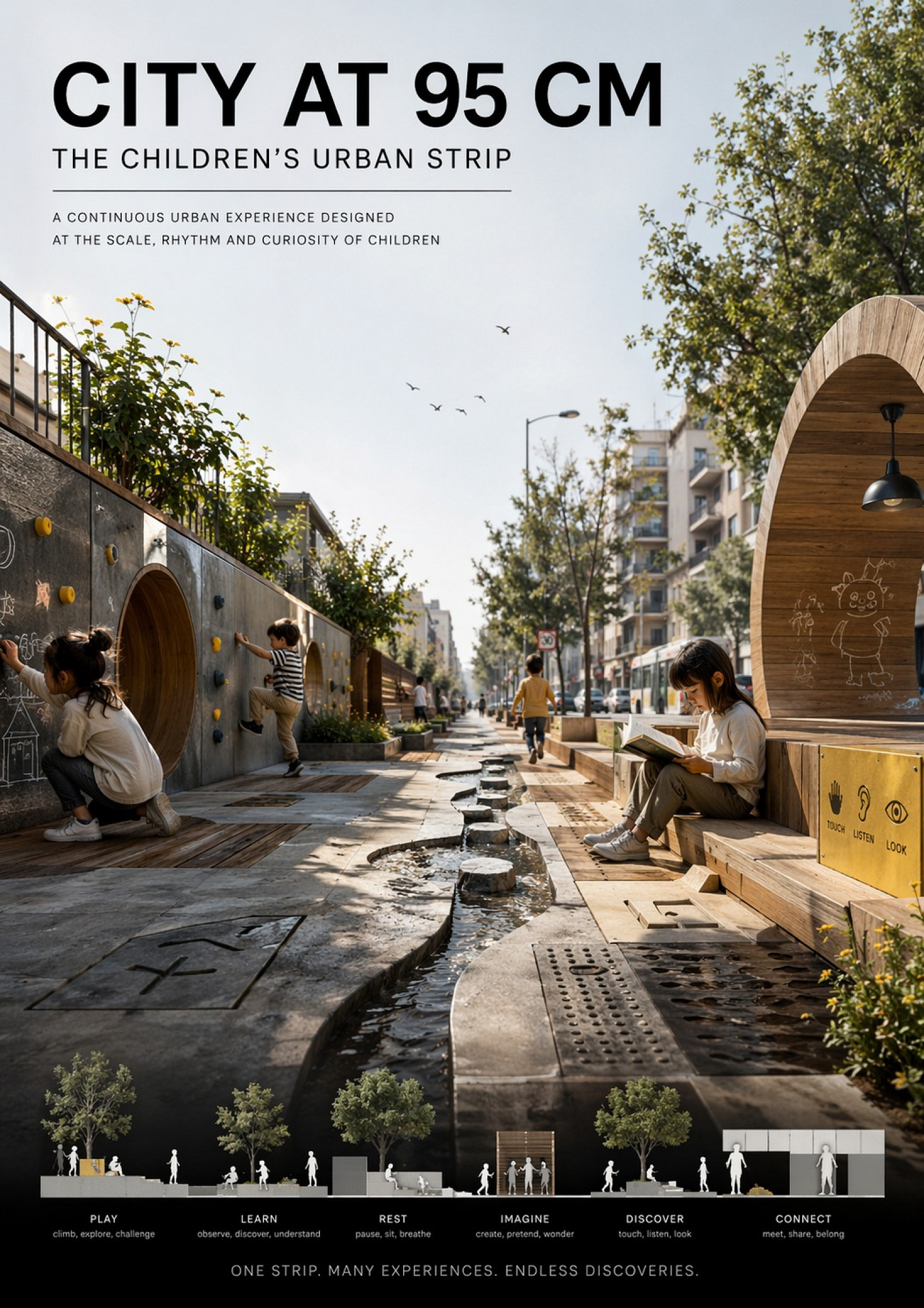
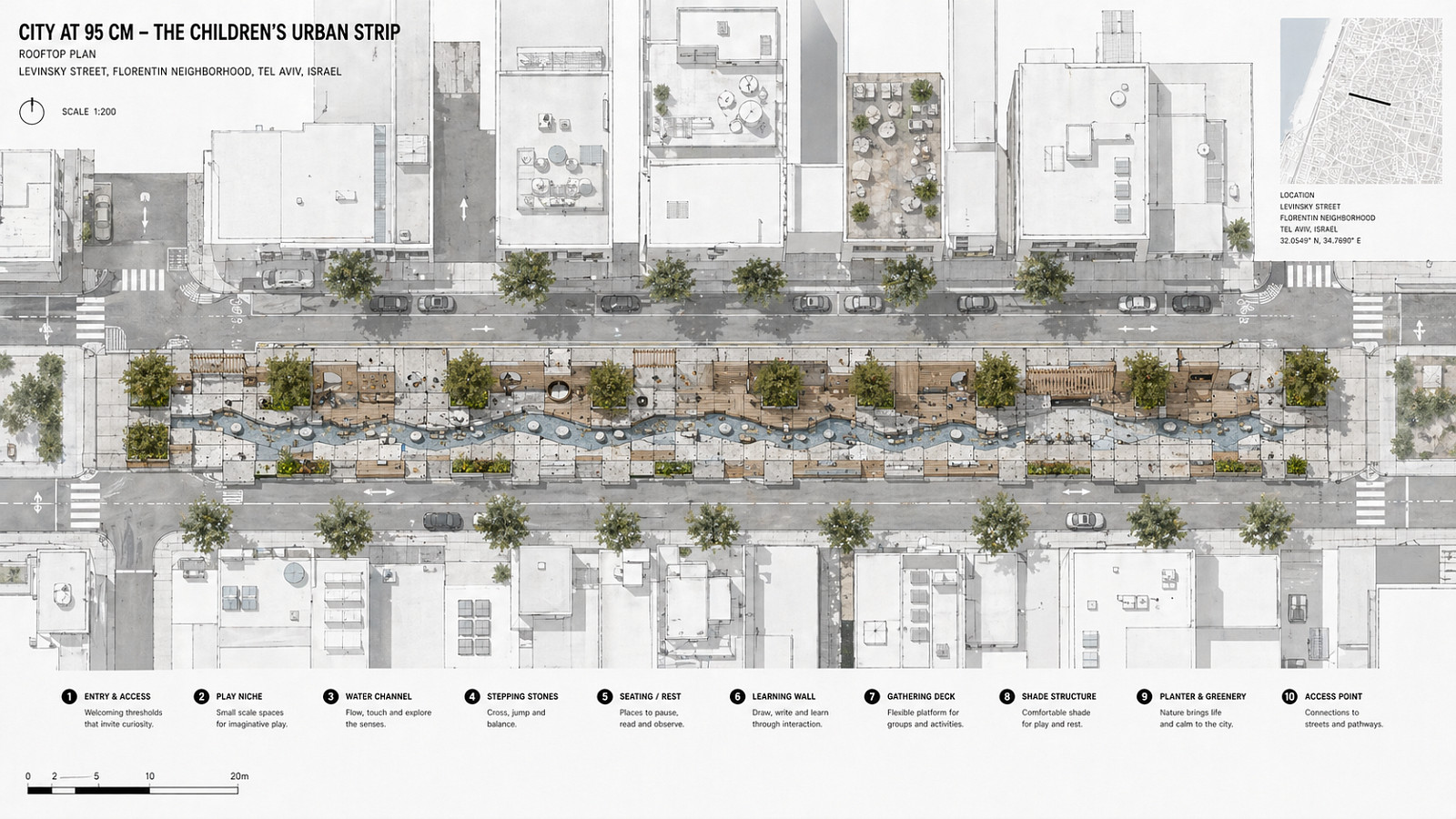
CITY AT 95 CM begins from a simple observation: the city is not designed for everyone, but for a point of view. At adult height, the city is efficient, continuous, and controlled. At 95 centimeters, it becomes fragmented, oversized, and often inaccessible. The project therefore begins by lowering the horizon and asking how urban space might be reimagined when children are not treated as secondary users, but as the measure of the city itself.
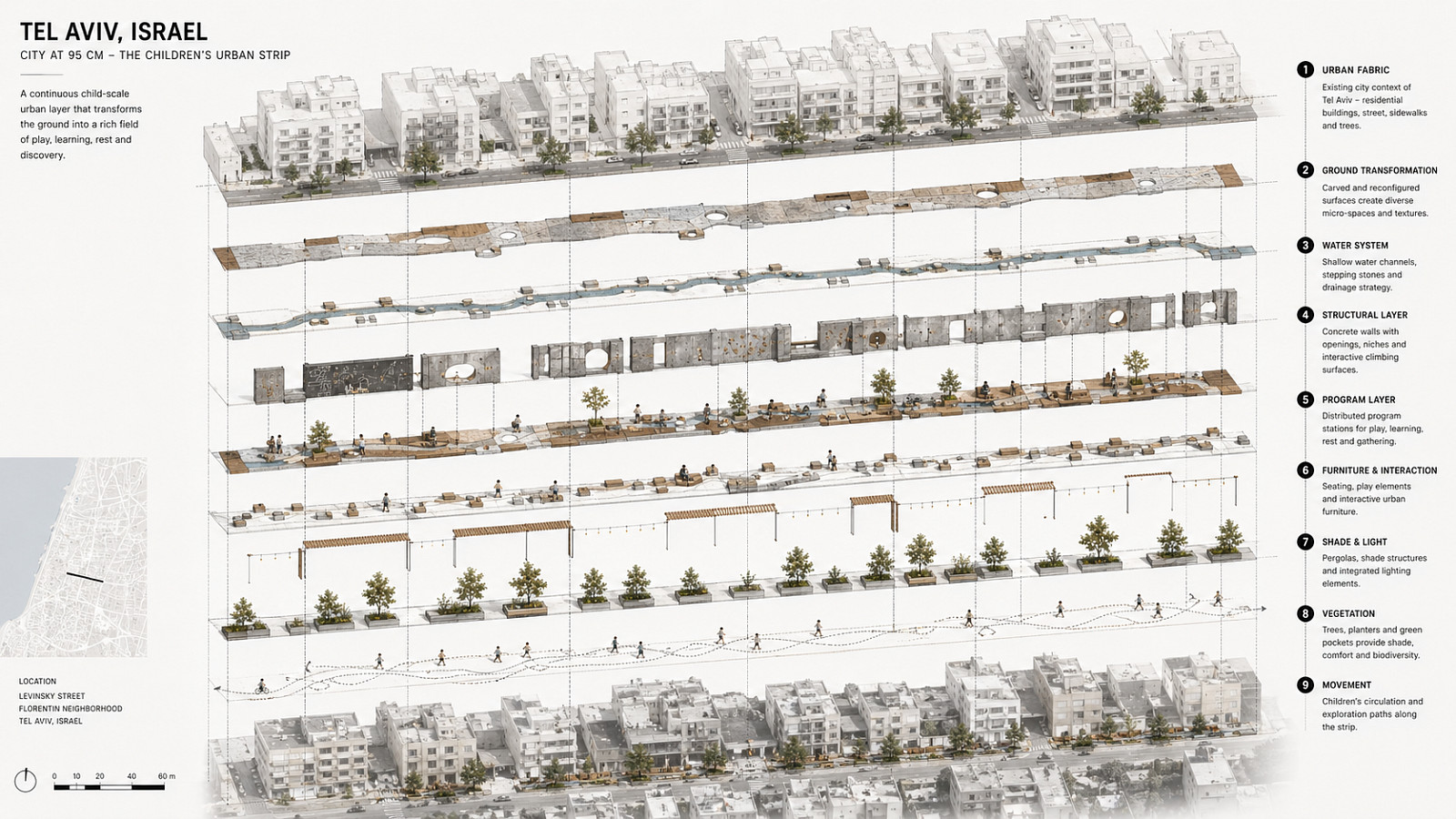
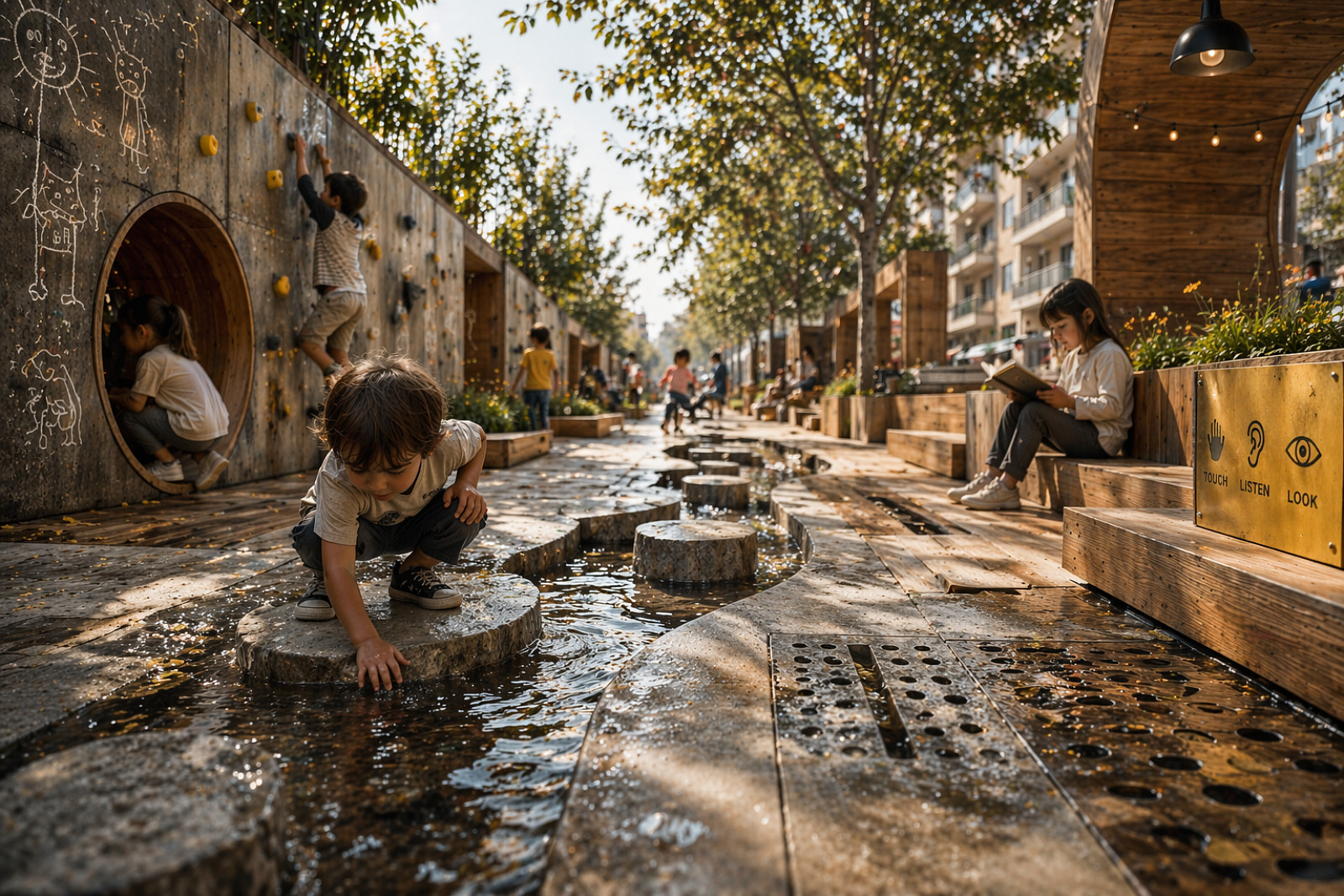
Rather than inserting a playground into the urban fabric, the proposal introduces a continuous urban strip that redefines the ground plane as an active field of interaction, learning, rest, imagination, and discovery. The goal of the project is to create a new urban layer in which movement becomes exploration, surfaces become interfaces, and the everyday city is made legible again through the scale, curiosity, and bodily experience of children.
Popis projektu
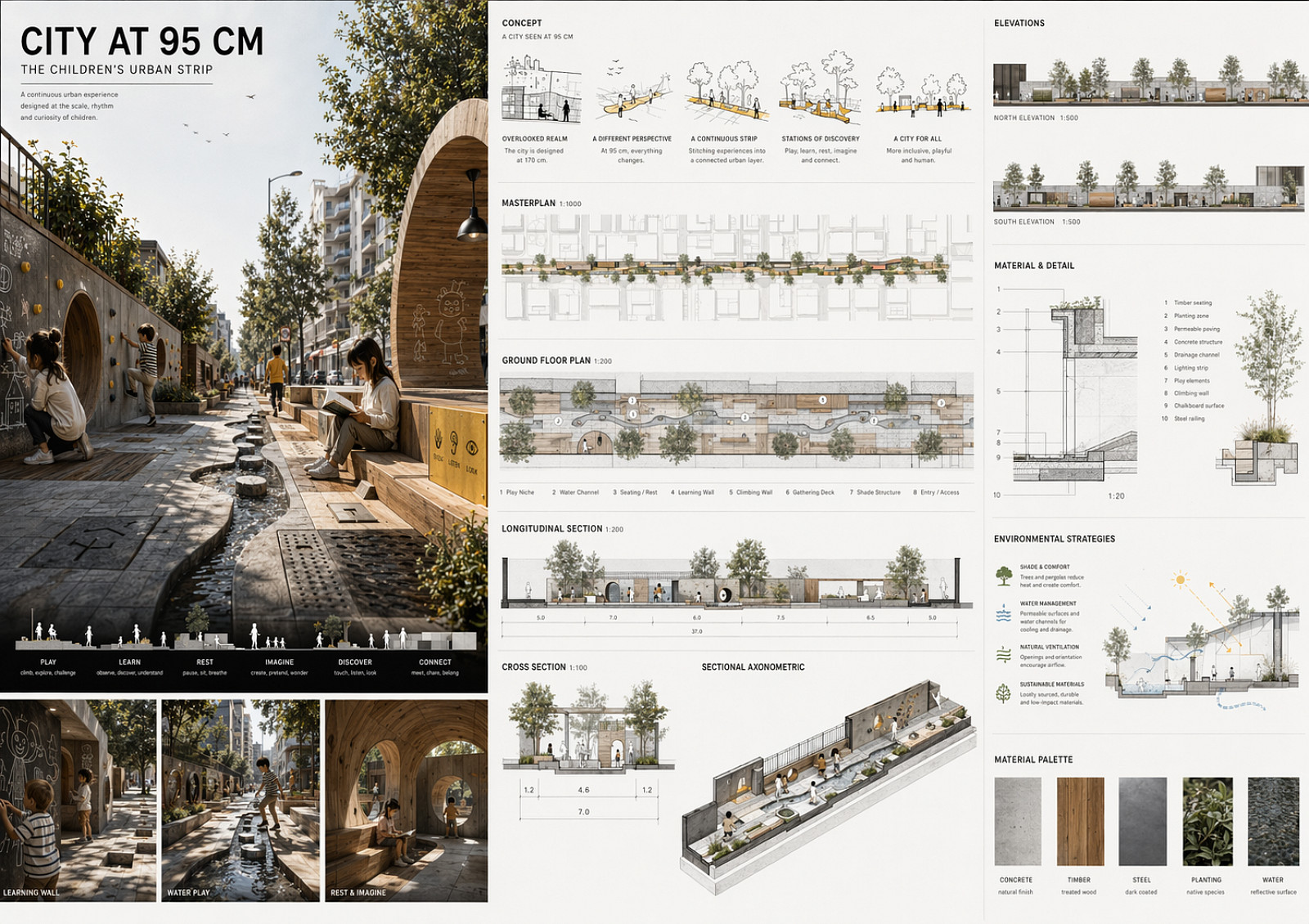
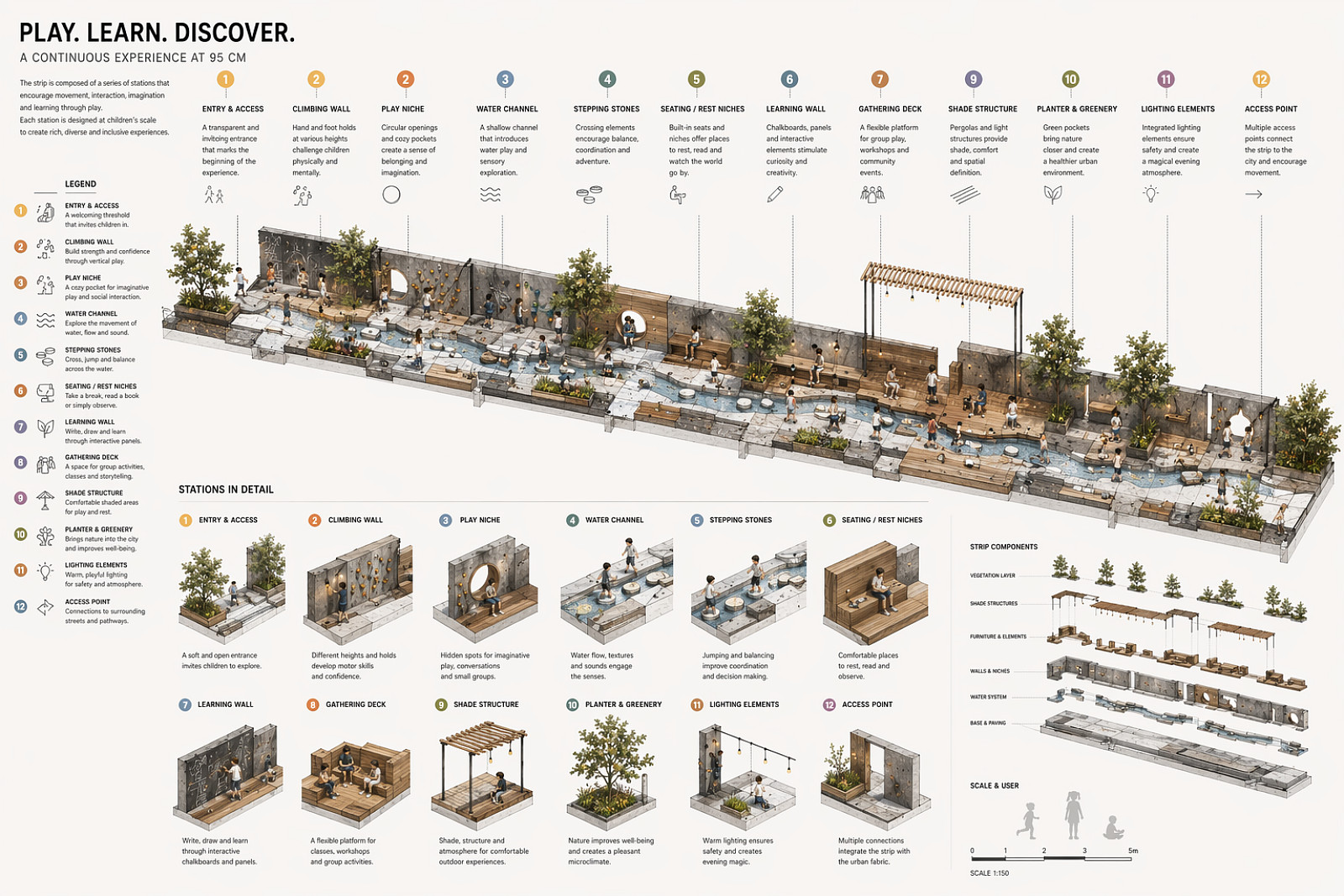
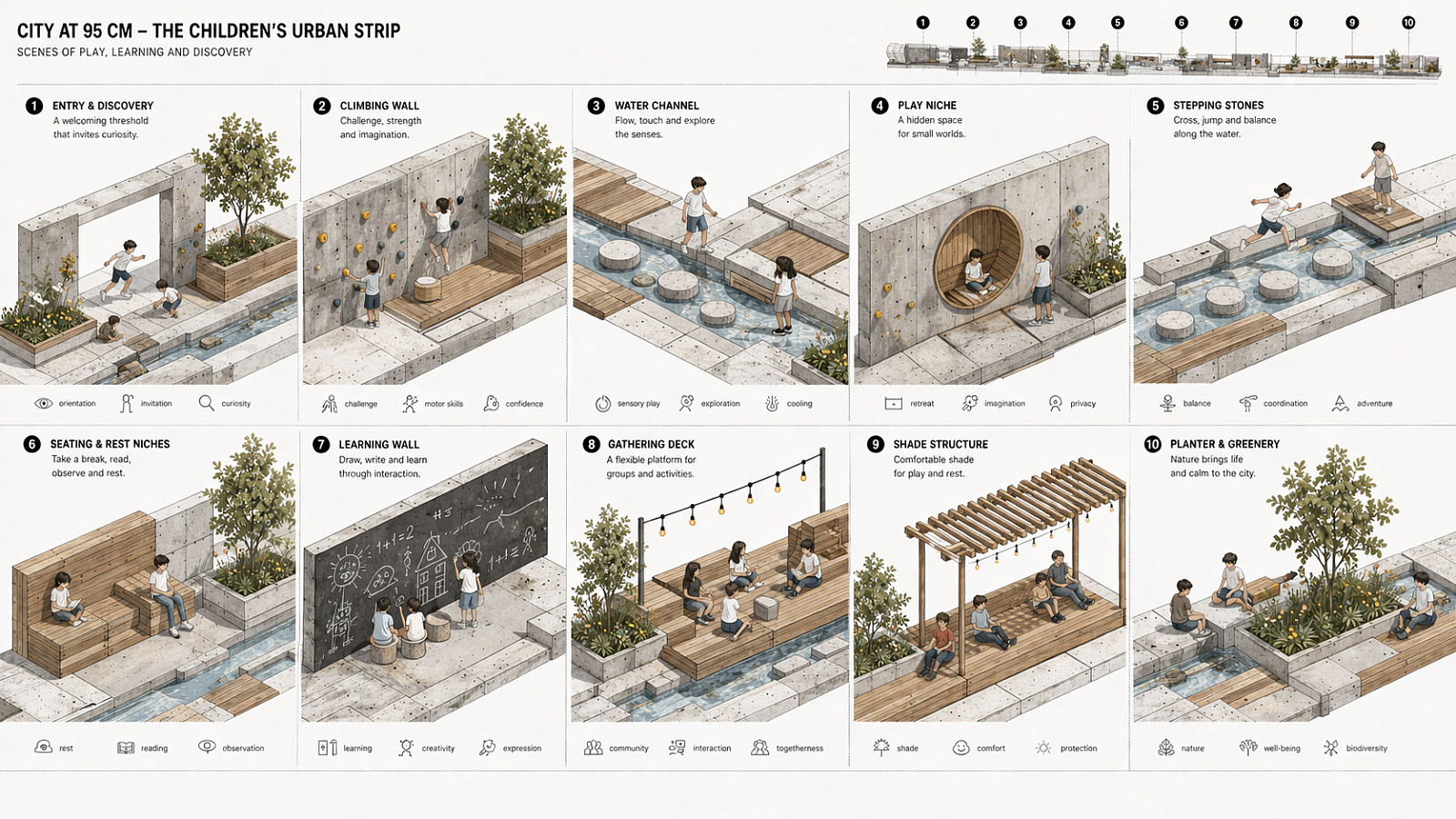
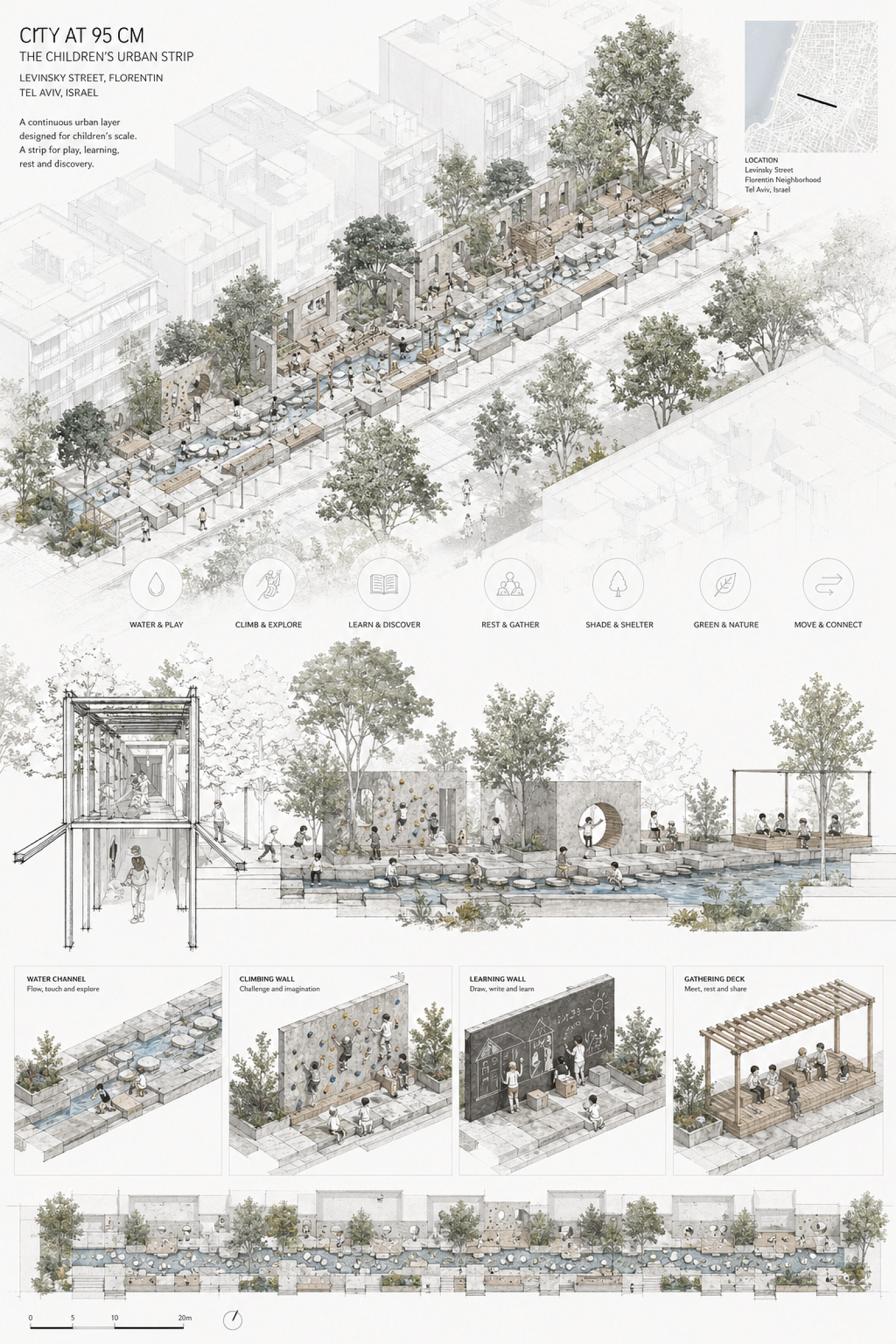
The project is organized as a continuous spatial strip embedded within the city, operating through sequence rather than through isolated objects or zones. Instead of concentrating activity in fixed playground enclosures, the architecture unfolds across the ground plane as an interconnected system of surfaces, edges, thresholds, shade, water, seating, and inhabitable topographies. The result is an urban layer that can be entered, crossed, tested, paused within, and discovered through movement.
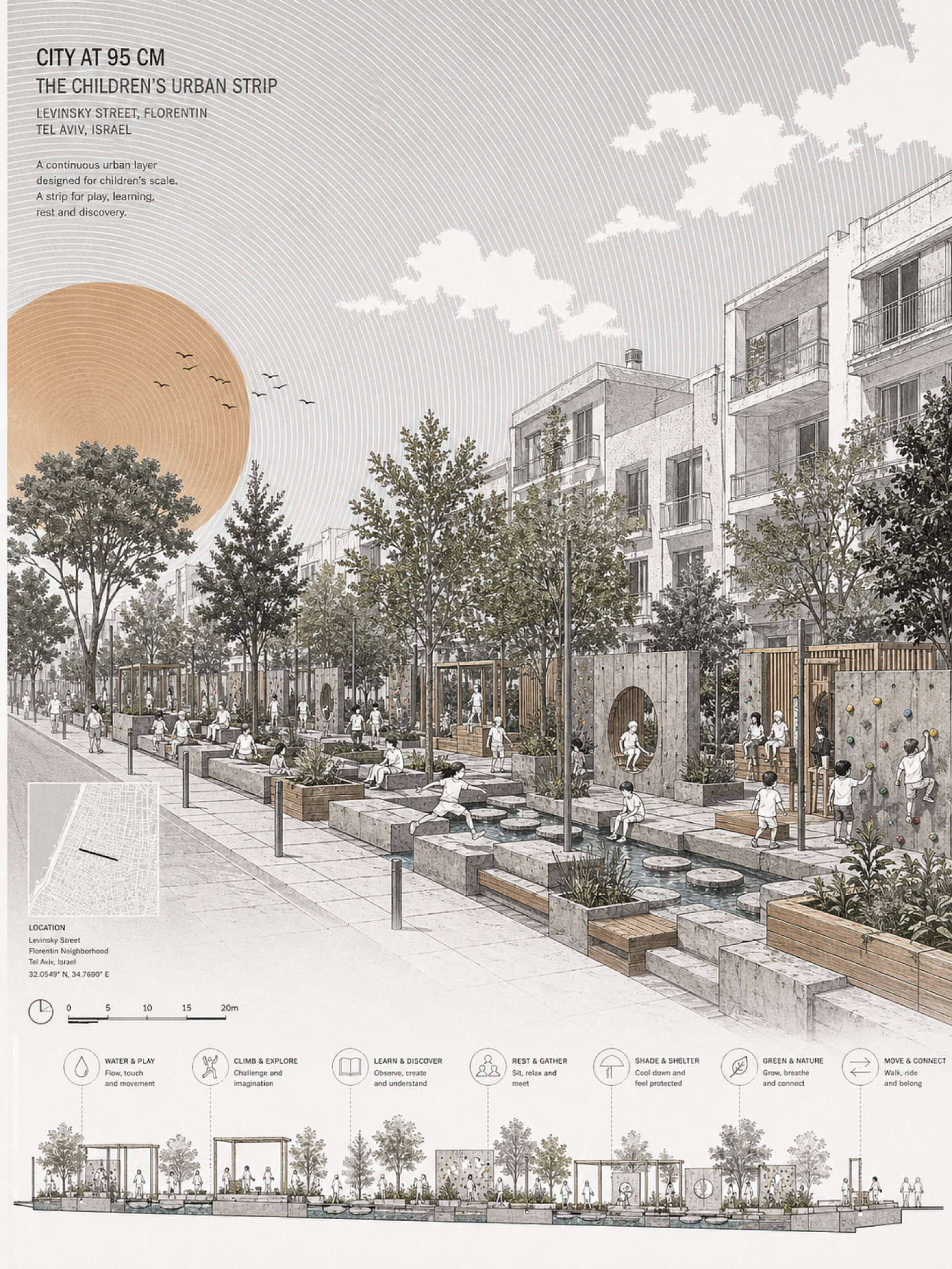
At the scale of the child, the city is no longer understood as a neutral backdrop. Edges become opportunities, benches become landscapes, walls become porous interfaces, and shade becomes a spatial room. The project translates these conditions into architectural elements that support open-ended use rather than fixed program. Movement is no longer purely linear and functional, but exploratory and imaginative, allowing children to activate space through touch, curiosity, and changing routes of occupation.
CITY AT 95 CM is therefore not only a project for children. It is also a critique of an urban model that has forgotten how to engage the body, the senses, and the act of discovery. By taking the child’s point of view as the design foundation, the project exposes hidden hierarchies of scale and proposes a more inclusive, interactive, and livable city for everyone.
The architecture is based on continuity rather than separation. Public life and emergency readiness are not treated as two different buildings or two unrelated programs, but as overlapping civic states. The spatial clarity of the courtyard supports openness, trust, and daily use, while the service spine provides the infrastructural backbone for storage, water, energy, access, and operational support. This dual structure allows the project to remain generous in ordinary time and precise in extraordinary time.
In the desert context of Antelope Valley, climatic performance is inseparable from civic performance. Shade, thermal mass, ventilation, water collection, and energy autonomy shape not only environmental comfort but also long-term resilience. CIVIC BACKBONE therefore proposes architecture as a form of continuity: a public building that does not wait for crisis to become necessary, because it is already essential in everyday life.
Technické informace
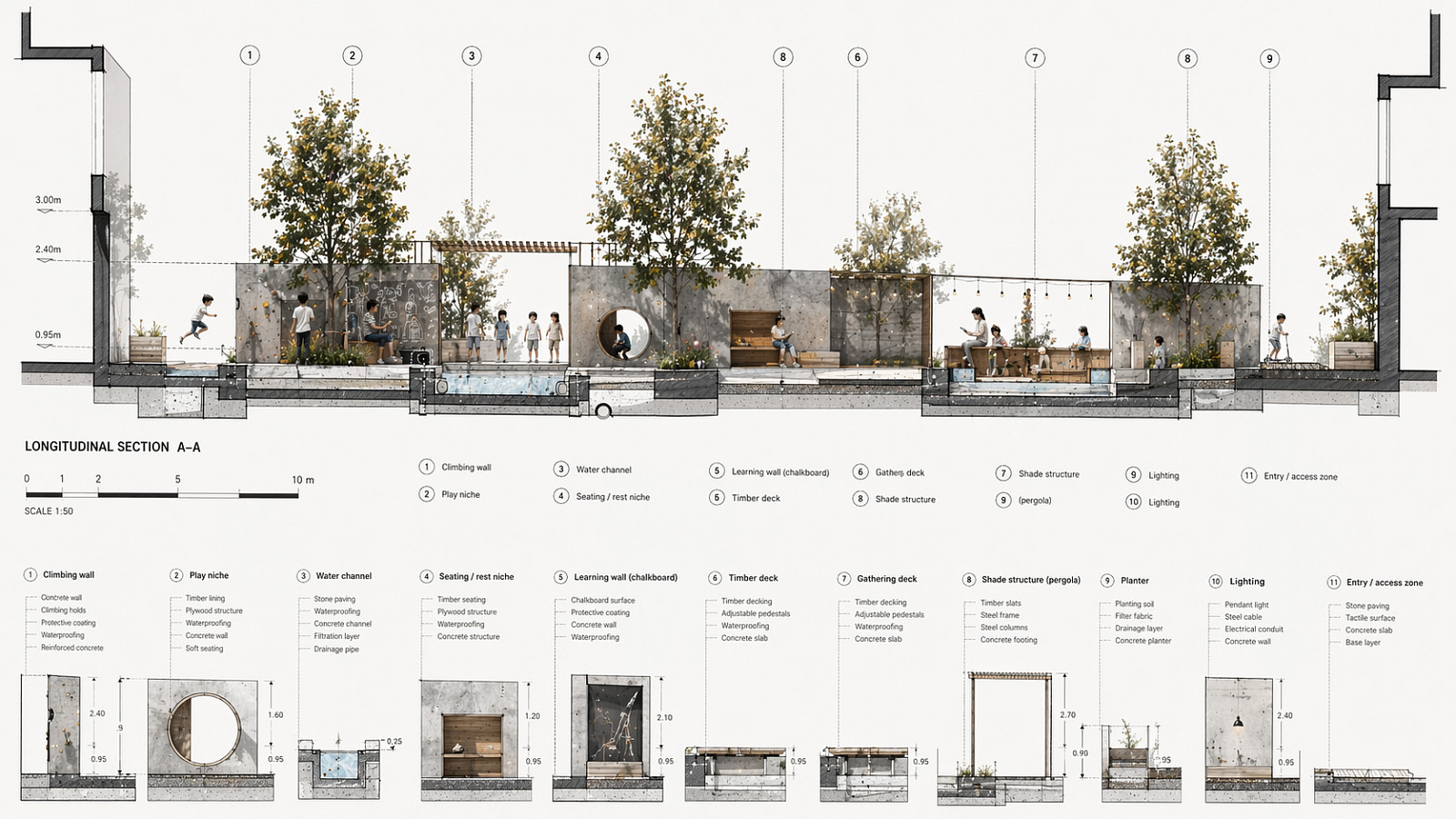
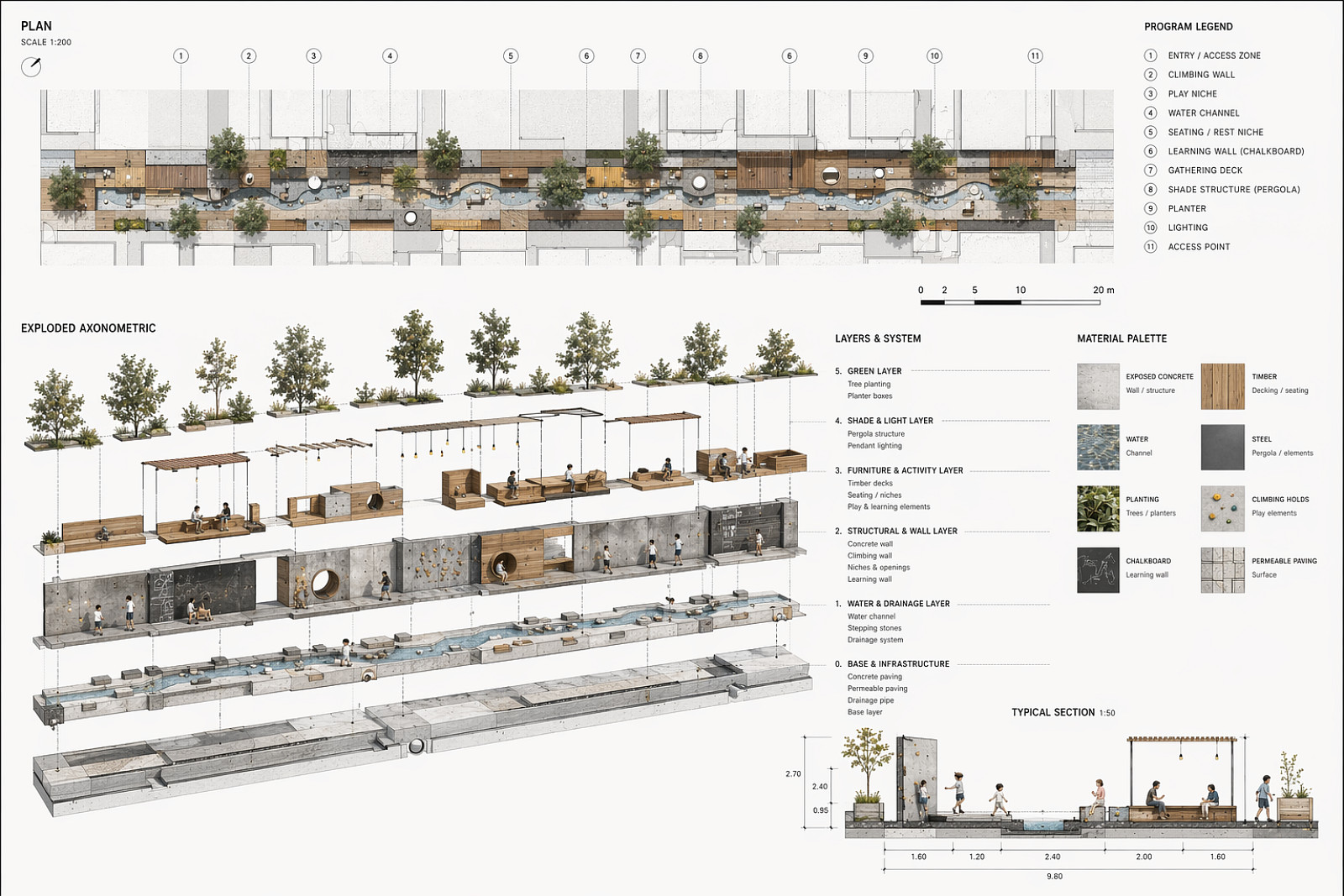
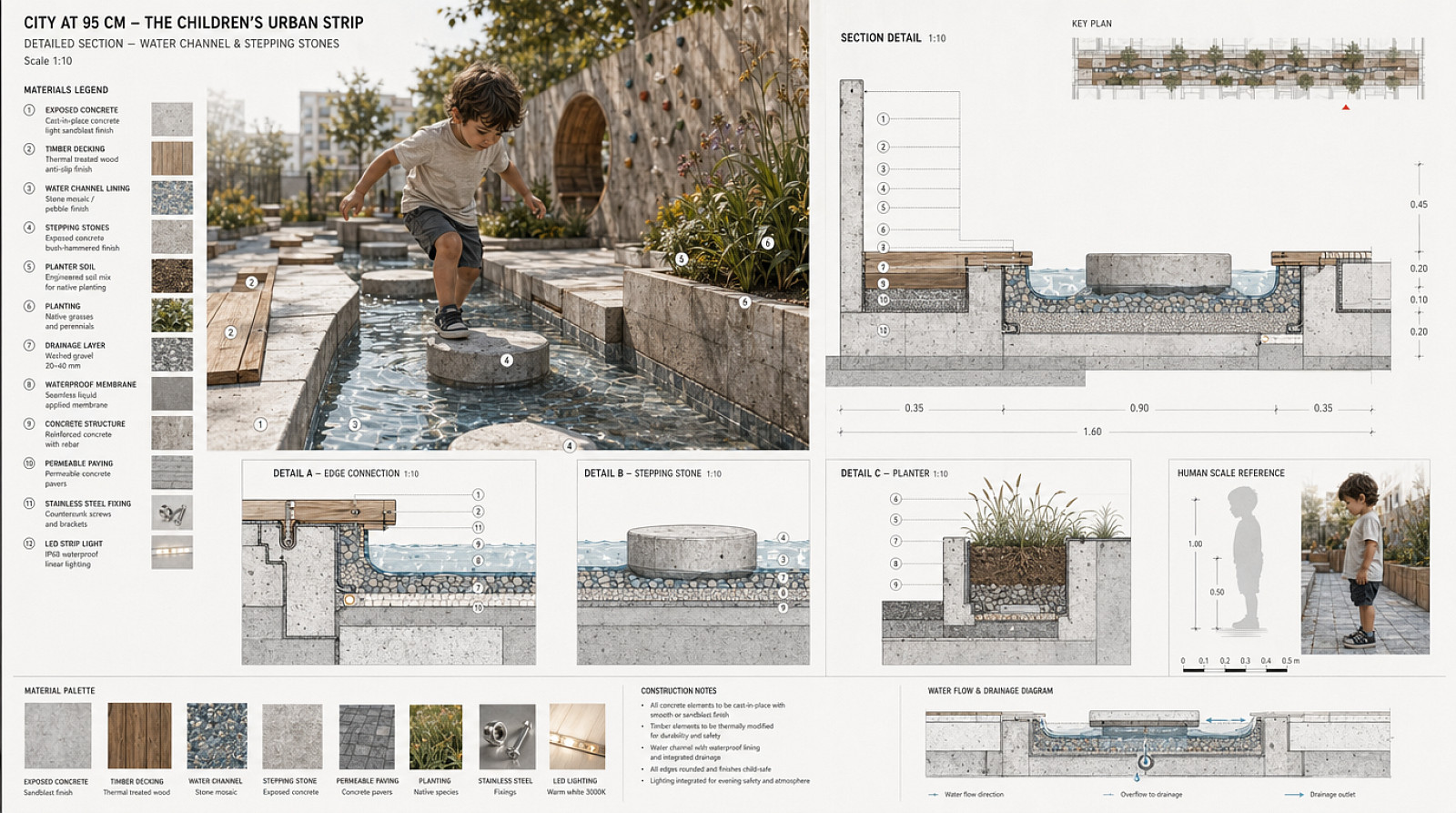
The project is designed as a modular and continuous urban ground system composed of topographic surfaces, integrated seating, porous walls, shaded structures, water elements, soft and hard play interfaces, and landscape inserts. Its architectural logic is based on continuity across the public realm rather than on isolated equipment objects, allowing the strip to extend, adapt, and connect to different urban conditions over time. The design supports multiple intensities of use through durable public materials and a layered system of interaction zones.
Environmental performance is embedded in the design of the ground plane and microclimate. Shade structures create protected zones for pause and play, water elements moderate temperature and support sensory engagement, and planted areas reconnect the strip to ecological and seasonal processes within the city. Materiality emphasizes durability, tactile variation, safety, and long-term public maintenance through concrete, timber, rubberized or soft surfaces, planting, and integrated urban furniture. In this way, the project combines public space, learning, movement, and sensory discovery within one coherent urban architecture.

Copyright © 2026 INSPIRELI | All rights reserved. Use of this website signifies your agreement to the Terms of Use, Privacy Policy, and use of cookies.