
THE FIRST INTERIOR OF MARS


Idea projektu
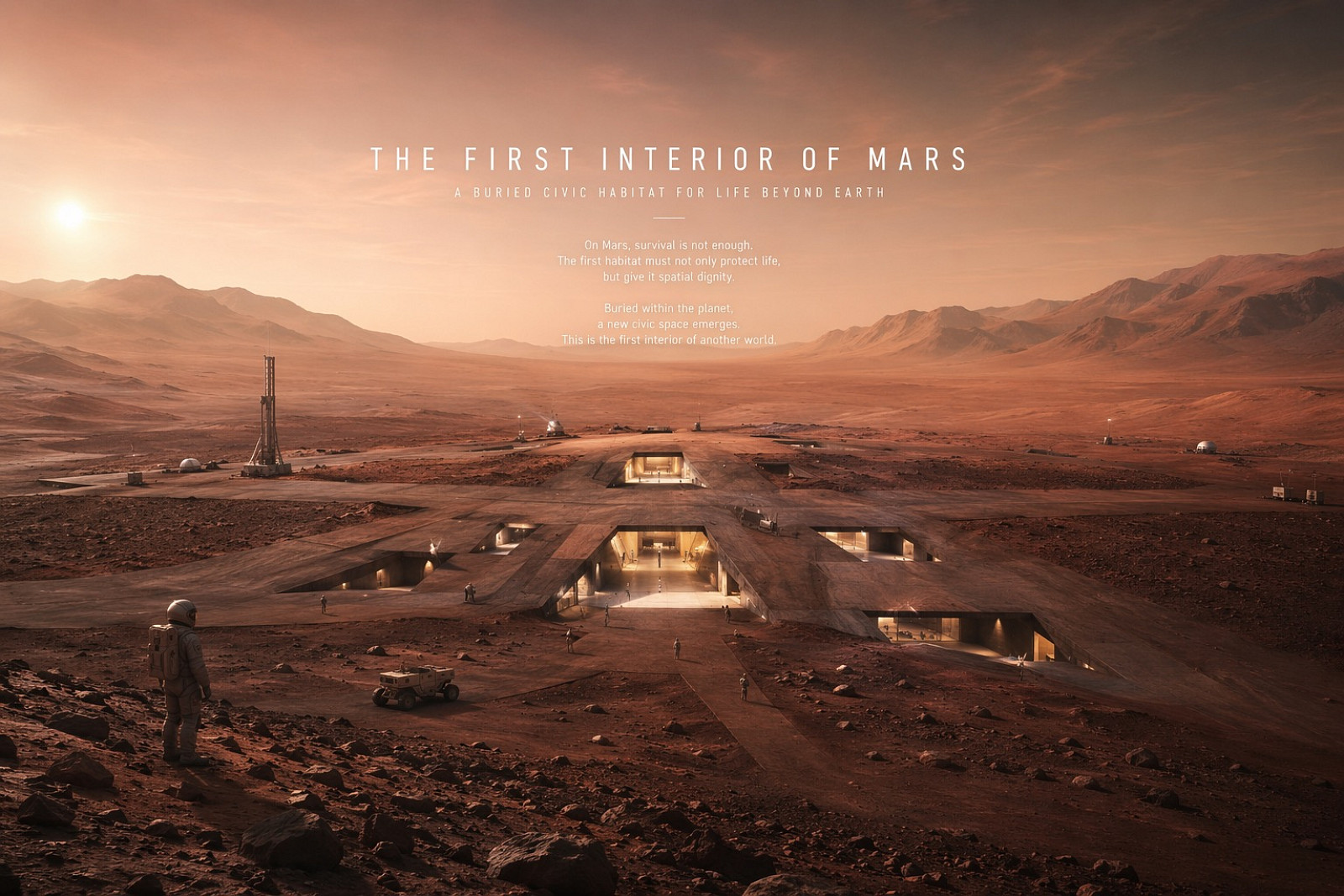
THE FIRST INTERIOR OF MARS begins from the recognition that on Mars, architecture starts where atmosphere ends. There is no climate to negotiate with, no air to soften space, and no ground that naturally supports life. In such a condition, architecture cannot begin with image or object. It must begin with necessity. The project therefore proposes that the first architectural act beyond Earth is not to place a building on the surface, but to construct an interior within it.
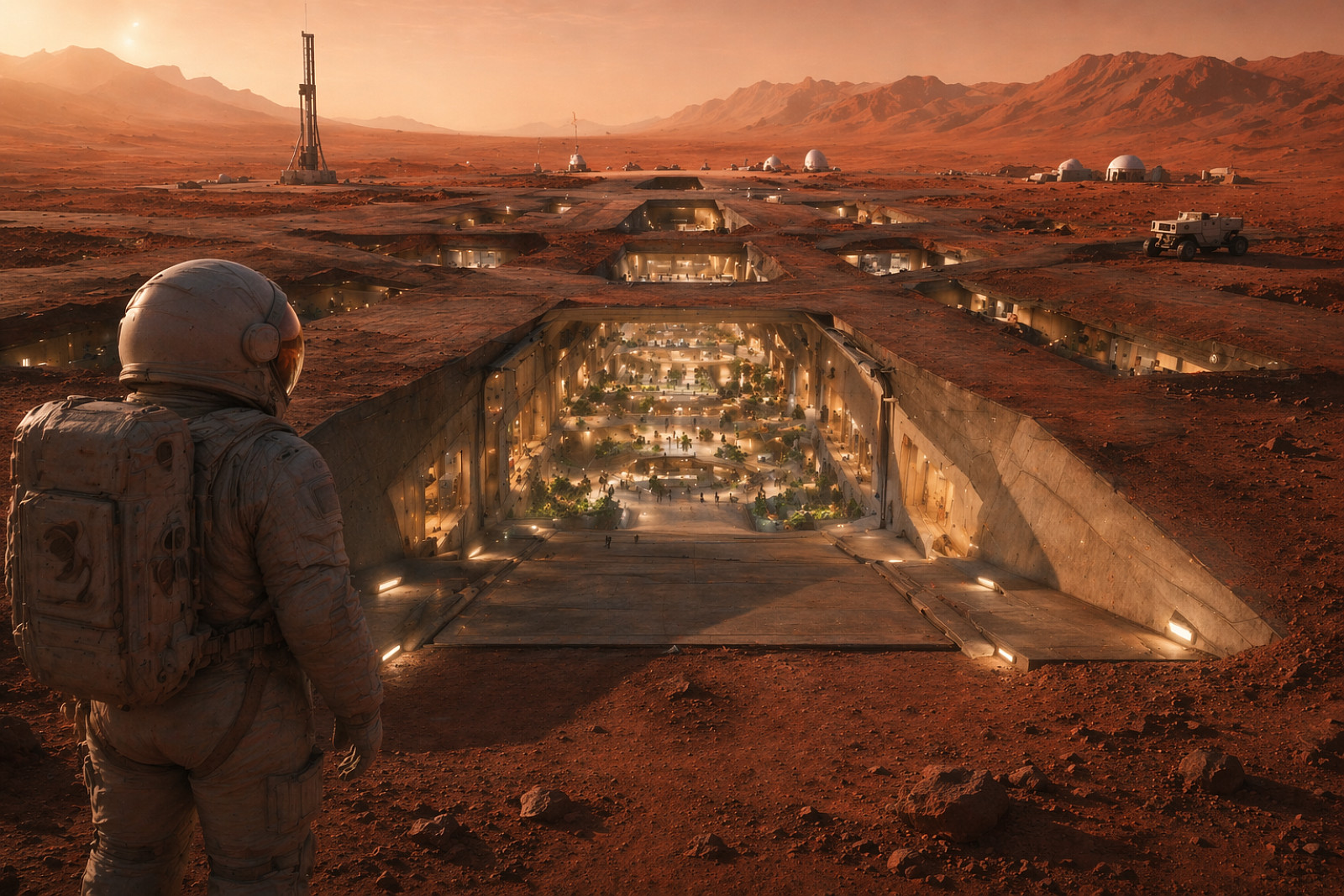
Rather than occupying the Martian landscape as an isolated object, the proposal is embedded within the ground itself. Regolith becomes structure, shield, and boundary, absorbing radiation, stabilizing temperature, and defining inhabitable space. The goal of the project is to rethink extraterrestrial architecture as a sectional condition of protection, collective life, and atmospheric care, where survival is transformed into dignity and shared interiority.
Rather than occupying the Martian landscape as an isolated object, the proposal is embedded within the ground itself. Regolith becomes structure, shield, and boundary, absorbing radiation, stabilizing temperature, and defining inhabitable space. The goal of the project is to rethink extraterrestrial architecture as a sectional condition of protection, collective life, and atmospheric care, where survival is transformed into dignity and shared interiority.
Popis projektu
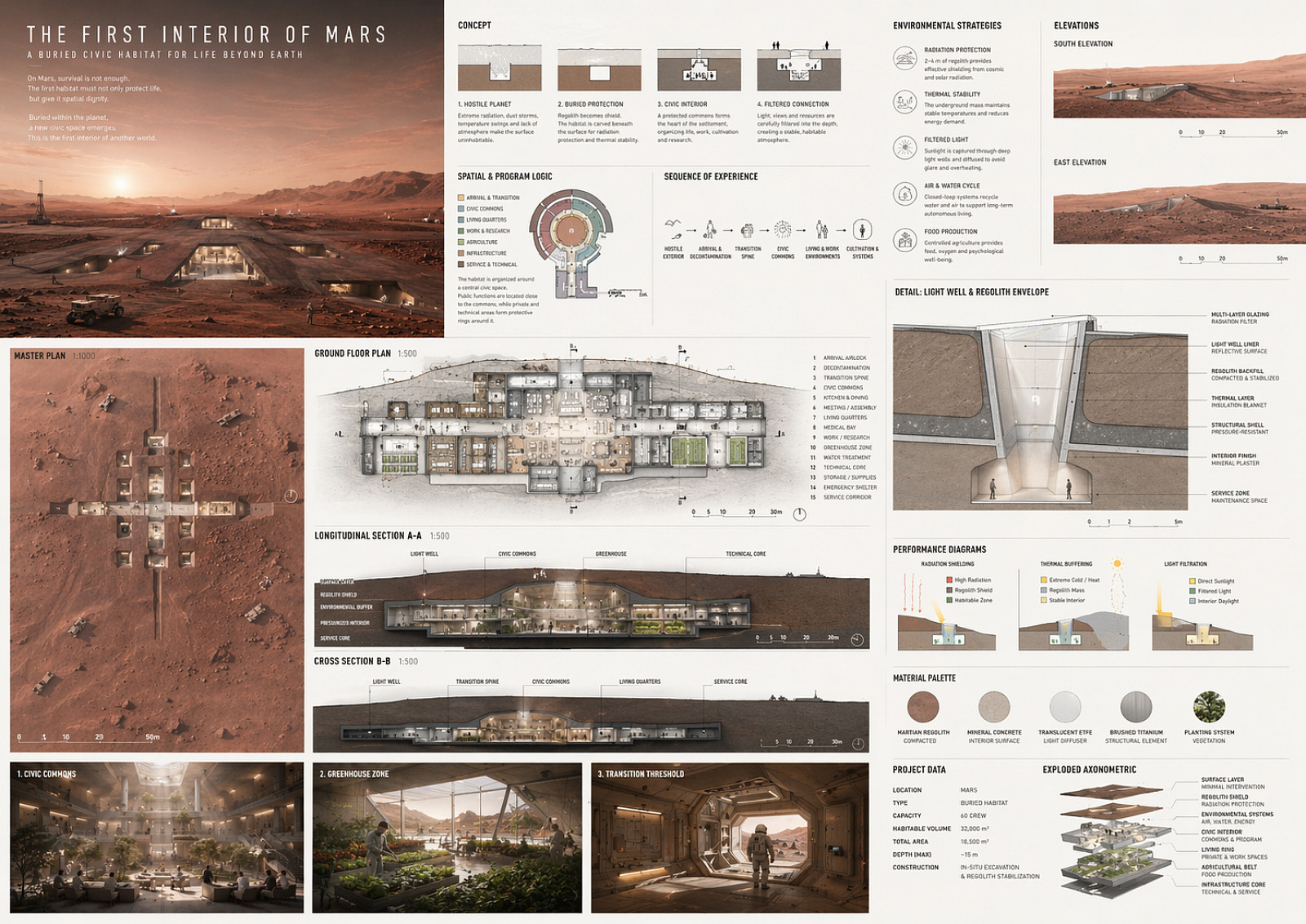
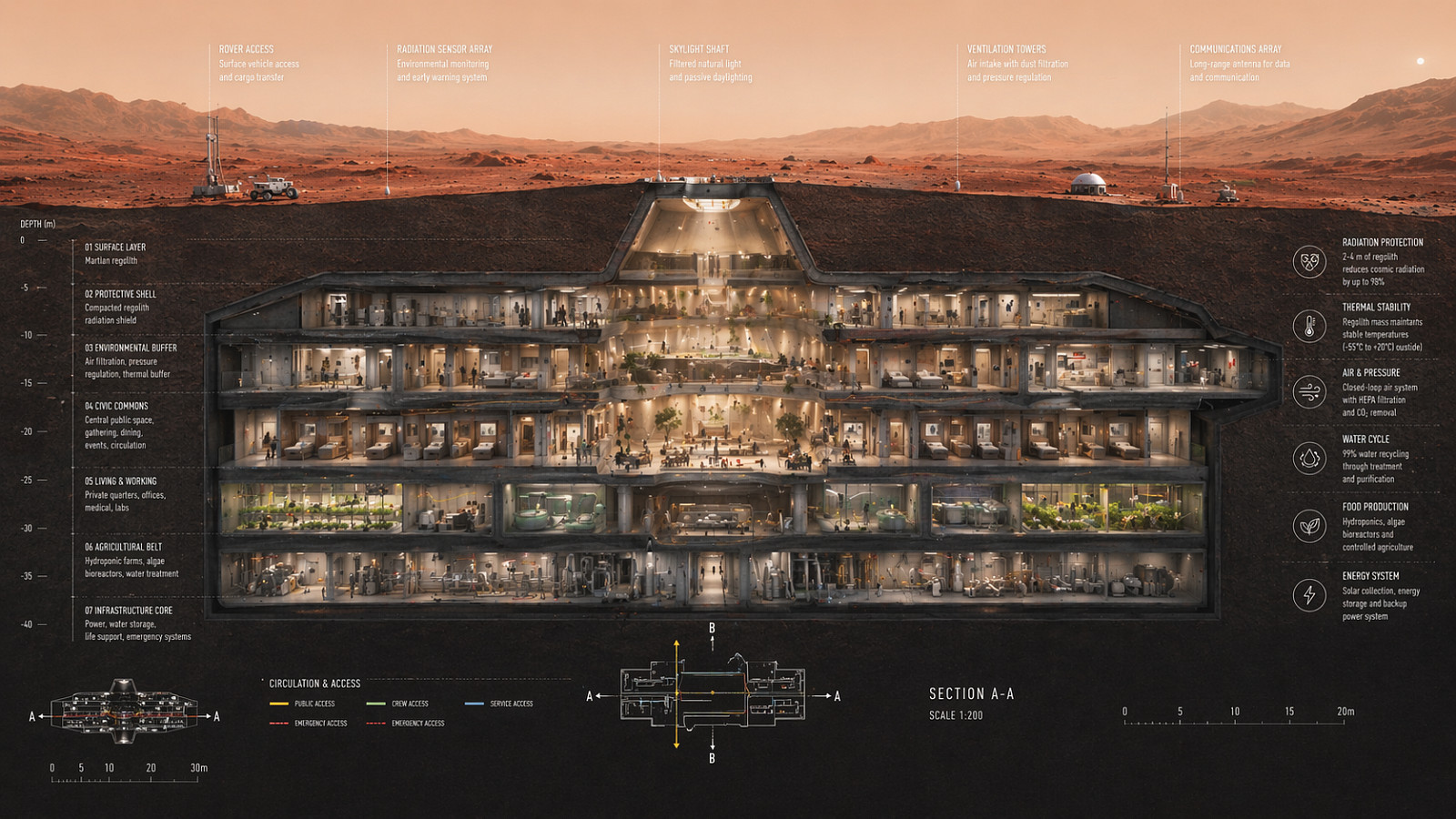
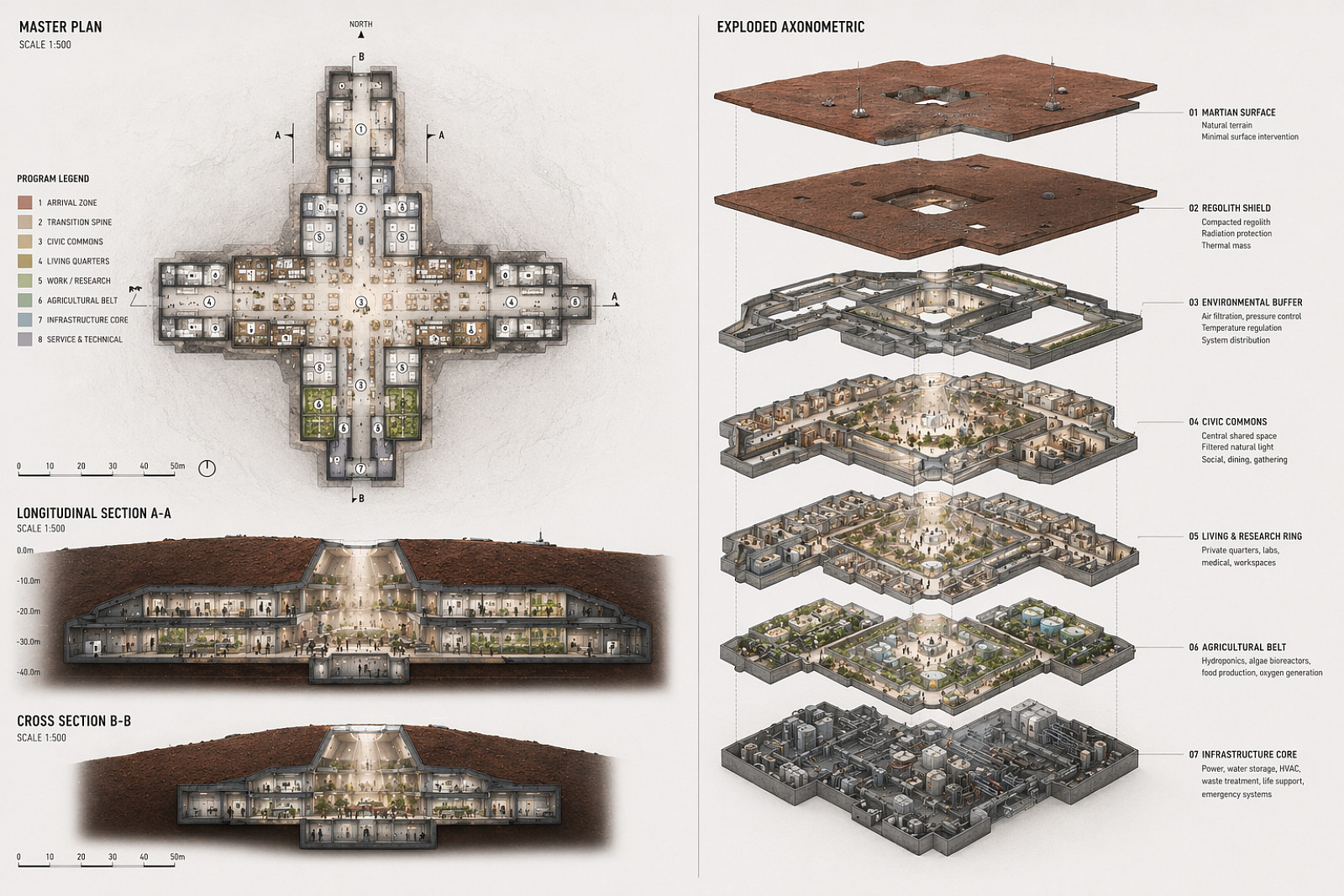
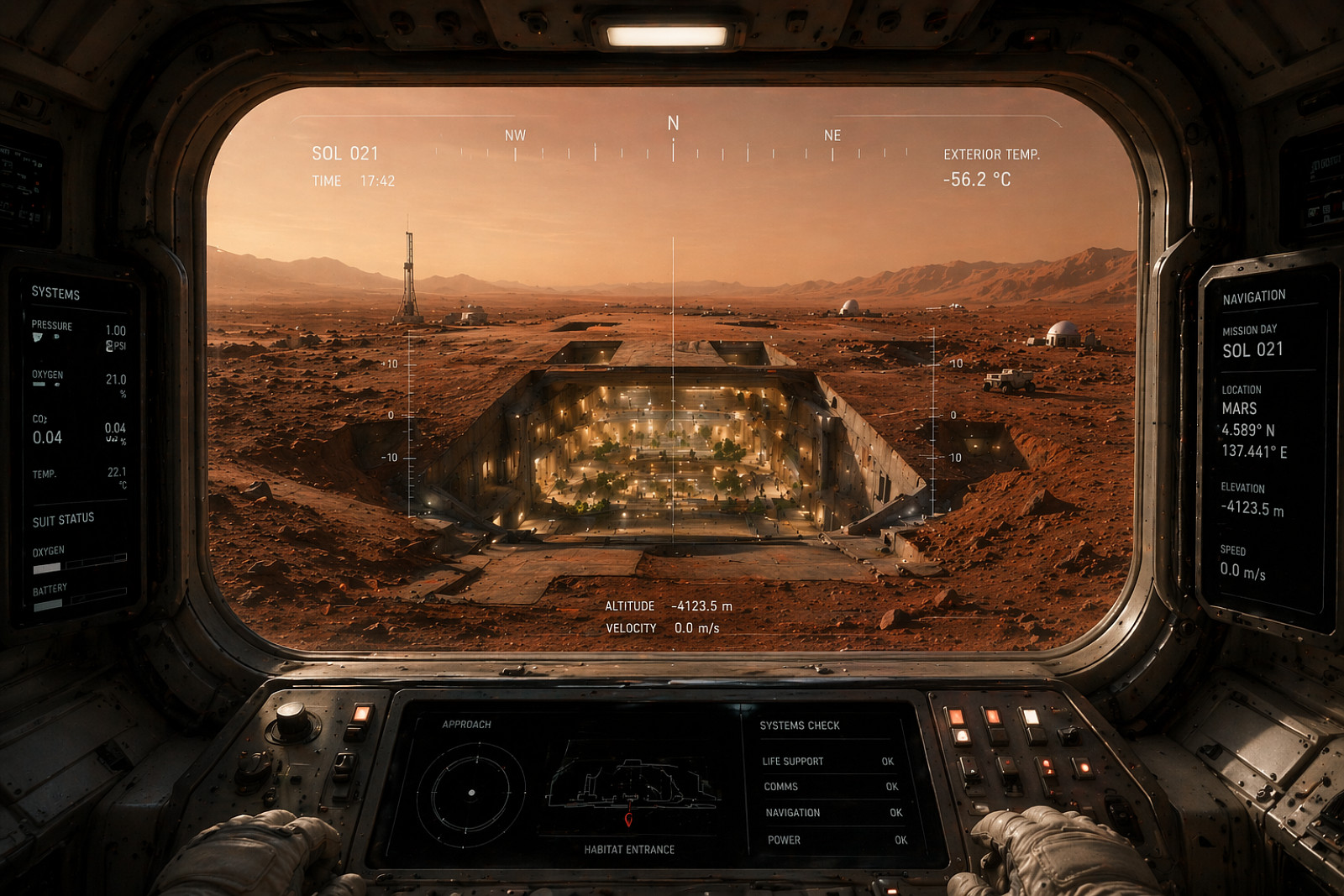
The project is organized as a layered subterranean interior embedded within the Martian ground. Instead of relying on conventional building massing above the surface, the architecture is developed through section and depth. The surface remains almost untouched, marked only by minimal access and light interfaces, while the true inhabitable environment unfolds below. This interior is structured through gradients of pressure, temperature, light, and proximity between bodies, systems, and cultivated life-support spaces.
At the center of the proposal is a civic commons. This shared interior is not treated as residual circulation or technical void, but as the spatial core of the habitat. It accommodates the essential acts of collective daily life: meeting, resting, observing, cultivating, and gathering. In this way, the project suggests that architecture on Mars must exceed pure survival and begin to construct civic meaning. The commons becomes the place where the isolated individual becomes part of a larger interior condition.
Light is introduced as a controlled event rather than as a free environmental given. It is filtered, deepened, and delayed through the thickness of the ground, allowing illumination to reveal the depth and protective mass above. Vegetation is integrated not as decoration, but as evidence of a living system, signaling the presence of water, air, cultivation, and care. THE FIRST INTERIOR OF MARS therefore proposes an architecture of coexistence under extreme constraint, where the role of design is to mediate precisely between the human body and an otherwise uninhabitable world.
Technické informace
The project is designed as an earth-integrated Martian habitat based on excavation, regolith shielding, pressure-controlled interior chambers, and layered life-support infrastructure. Its primary architectural system uses the surrounding ground as a structural and environmental envelope, reducing exposure to radiation, thermal extremes, and surface instability. The habitat is organized through a series of protected subterranean spaces connected by controlled circulation and service interfaces, with minimal above-ground exposure.
Environmental performance is inseparable from the architecture itself. Regolith mass provides radiation shielding and thermal buffering, while interior pressure zones, controlled daylight apertures, and atmospheric regulation systems create stable inhabitable conditions below the surface. Light is introduced through measured shafts or filtered interfaces, allowing it to penetrate deep into the section without compromising environmental protection. Vegetation and cultivation areas are integrated into the habitat as functional life-support systems contributing to oxygen production, food growth, humidity regulation, and psychological well-being. Material logic emphasizes compactness, redundancy, protective layering, and the precise coordination between structure, environment, and human occupation.

Copyright © 2026 INSPIRELI | All rights reserved. Use of this website signifies your agreement to the Terms of Use, Privacy Policy, and use of cookies.
