SECOND HALF — Civic Arena


Idea projektu
SECOND HALF begins from a simple observation: contemporary cities have perfected the architecture of spectacle, but not the architecture of continuity. Stadiums and arenas are designed for short moments of intensity, while outside these events they often remain oversized, underused, and silent. At the same time, when crisis arrives, cities frequently lack immediate, organized, and dignified spaces for collective support. The project therefore proposes a new role for the sports arena as a dual-state civic infrastructure.
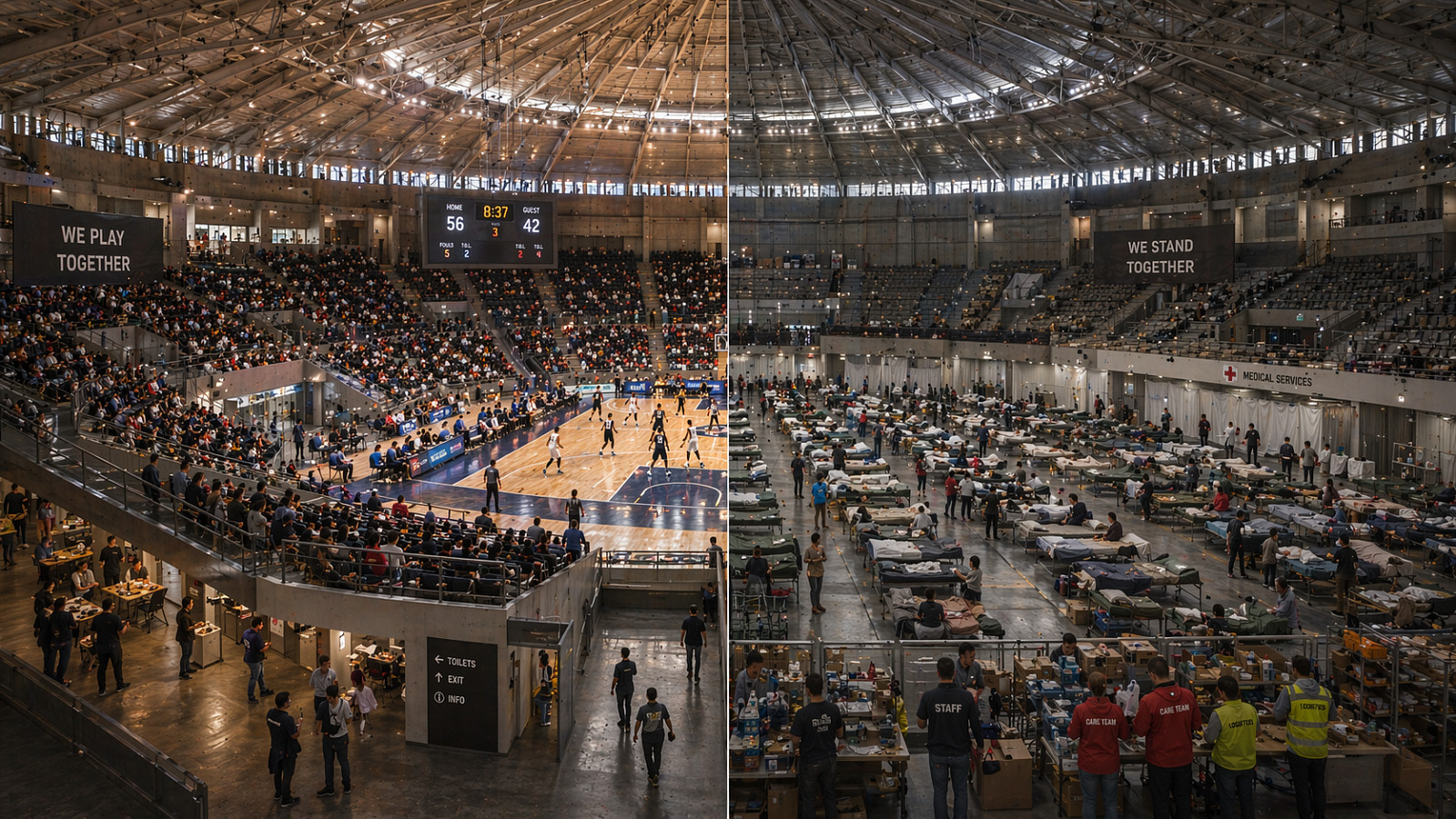
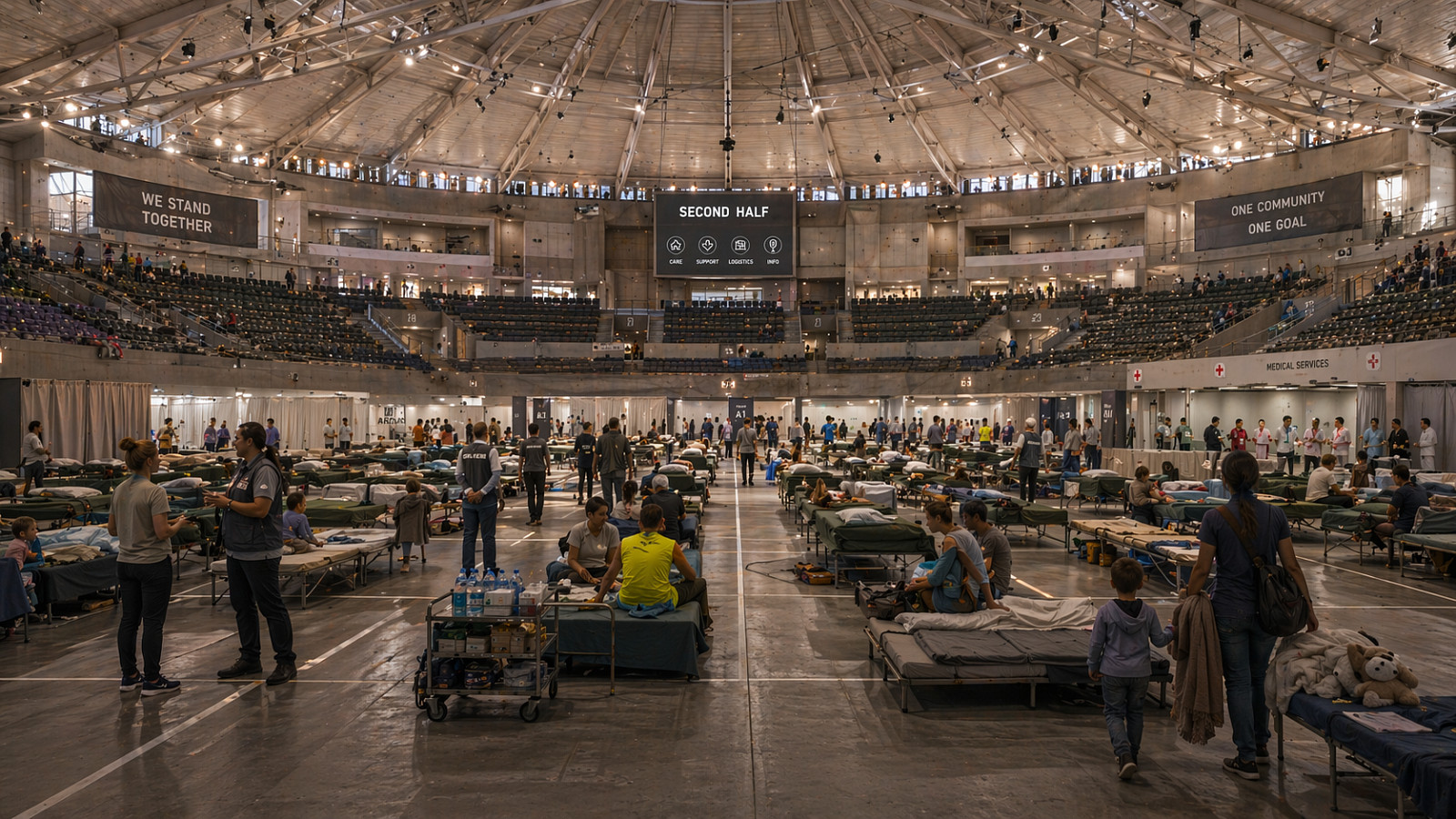
In routine, the building hosts movement, performance, and collective experience. In crisis, it transforms into a framework for protection, care, logistics, and continuity. This transformation is not improvised after the fact, but embedded in the architectural logic of the project from the beginning. The goal of the proposal is to redefine unused capacity not as inefficiency, but as civic potential.
Popis projektu
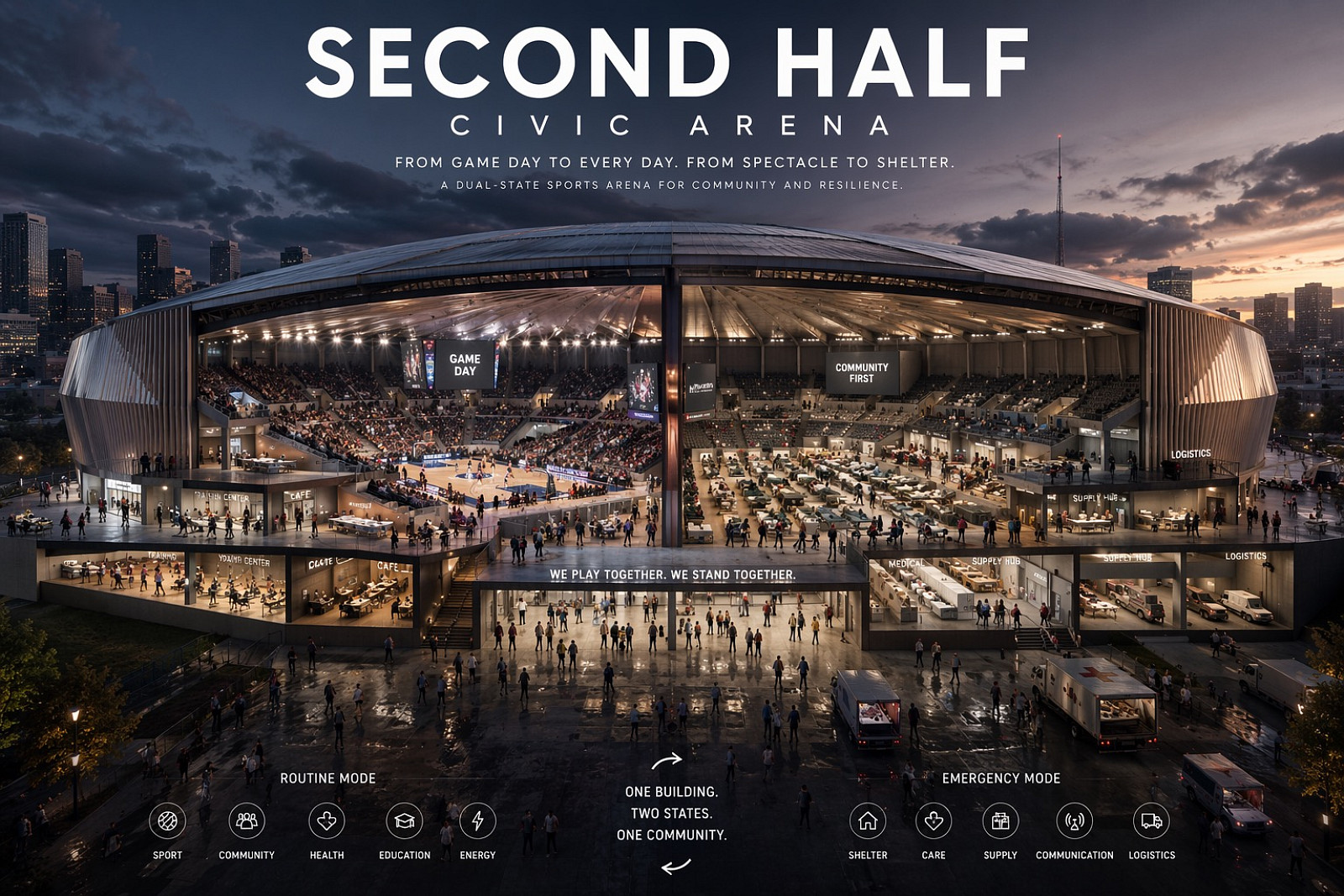
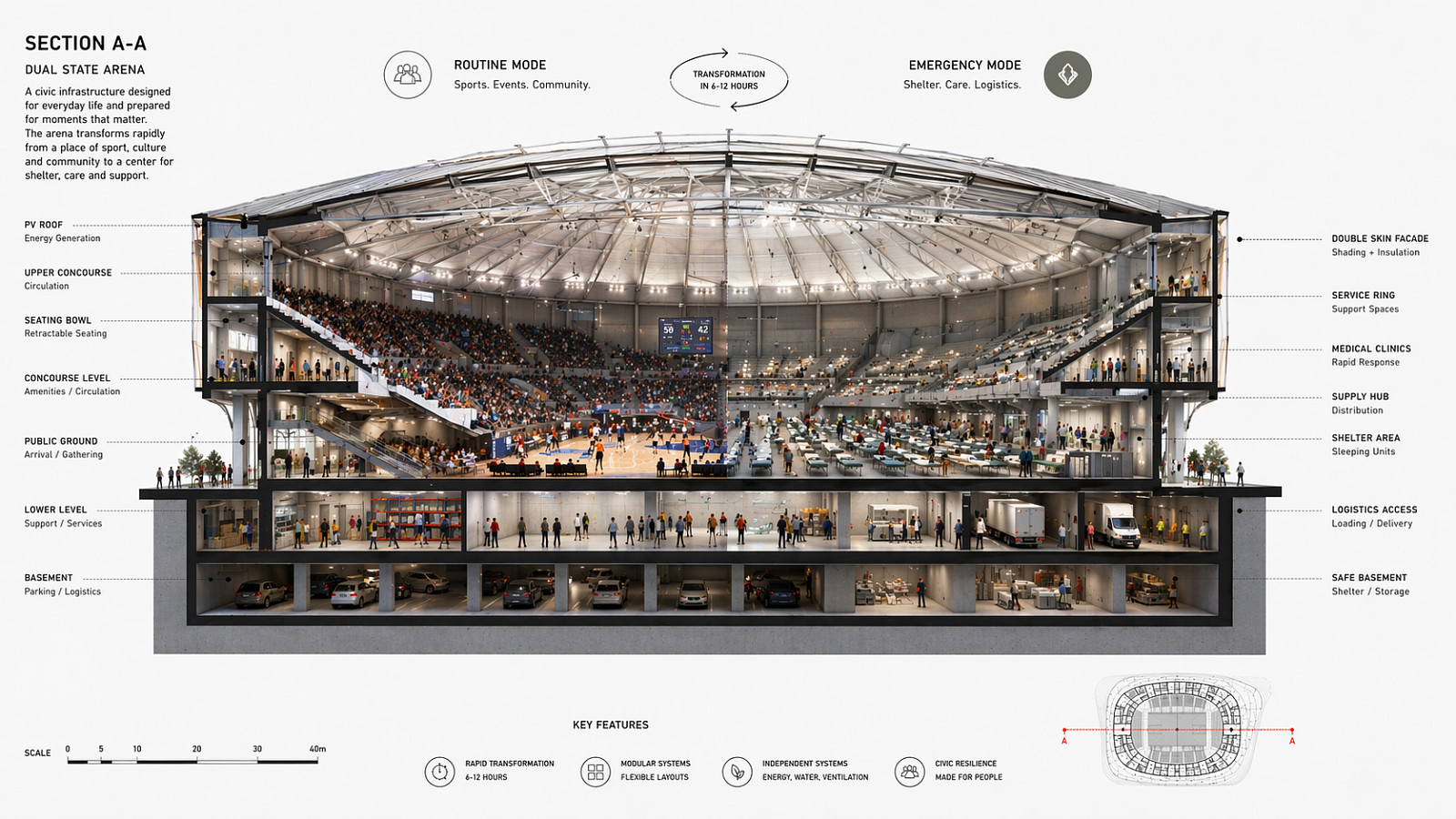
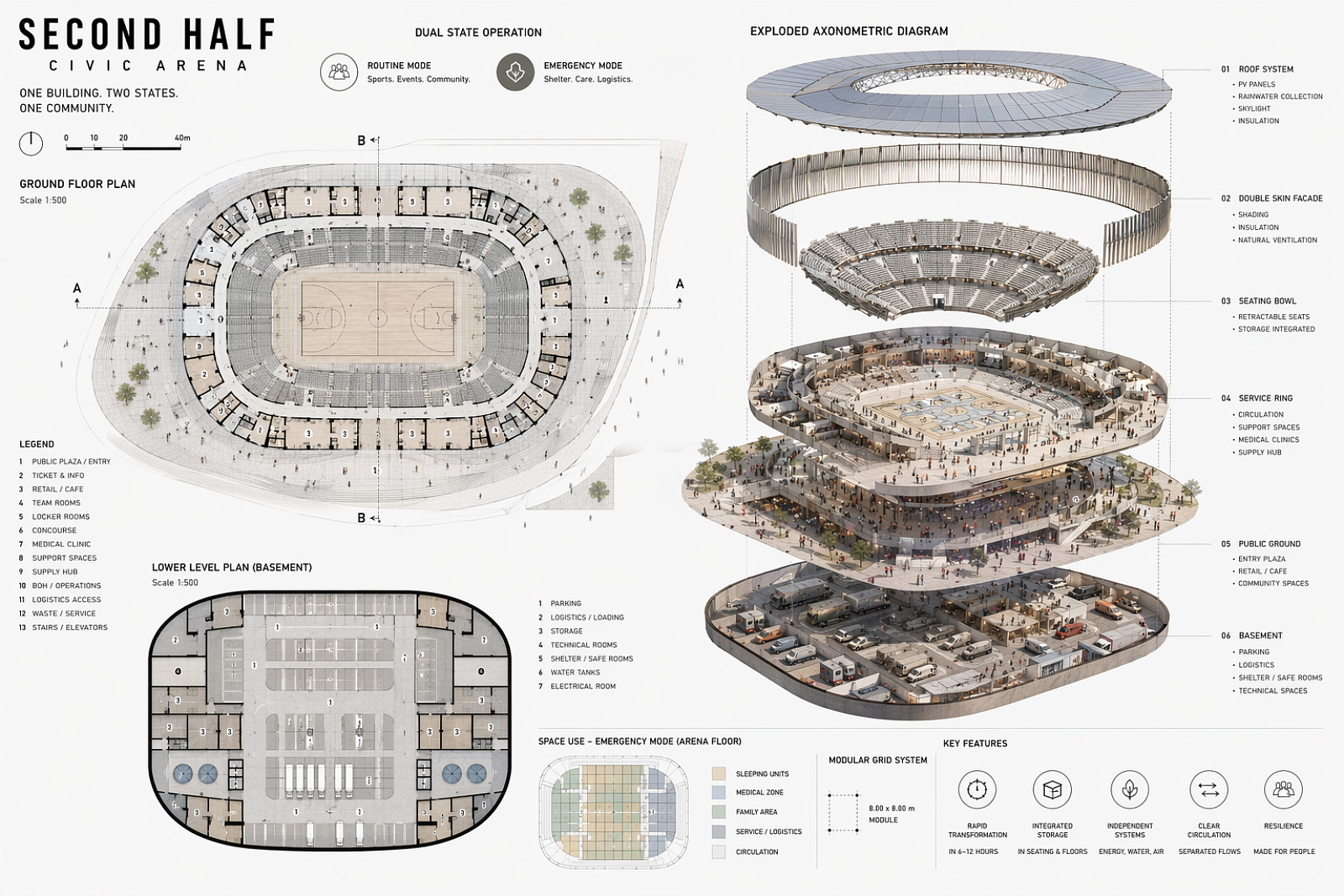
The project is organized as a layered architectural system composed of public ground, arena core, and service ring. Each layer operates in everyday conditions as part of the sports and event infrastructure, while also containing latent capacities that can be activated within hours in response to emergency conditions. Through this dual organization, the arena is able to shift from a place of gathering and performance into a place of refuge, distribution, care, and collective endurance without losing its identity as a public building.
In routine mode, the public ground acts as an accessible civic platform, the arena core accommodates sport and spectacle, and the surrounding service ring supports circulation, technical systems, and operational needs. In emergency mode, these same components are reinterpreted. Seating areas are converted into storage and support zones, circulation routes become logistical and distribution systems, and the field becomes a flexible living and gathering space. This transformation is not based on temporary improvisation, but on spatial clarity, embedded infrastructure, and the capacity of the building to operate in more than one civic state.
SECOND HALF therefore challenges the conventional idea of efficiency in architecture. It argues that resilience can emerge not from adding separate emergency infrastructure to the city, but from revealing the civic potential already embedded within existing building typologies. The arena is no longer only a place to gather for exceptional events. It becomes a place where the city can also endure together under pressure.
Technické informace
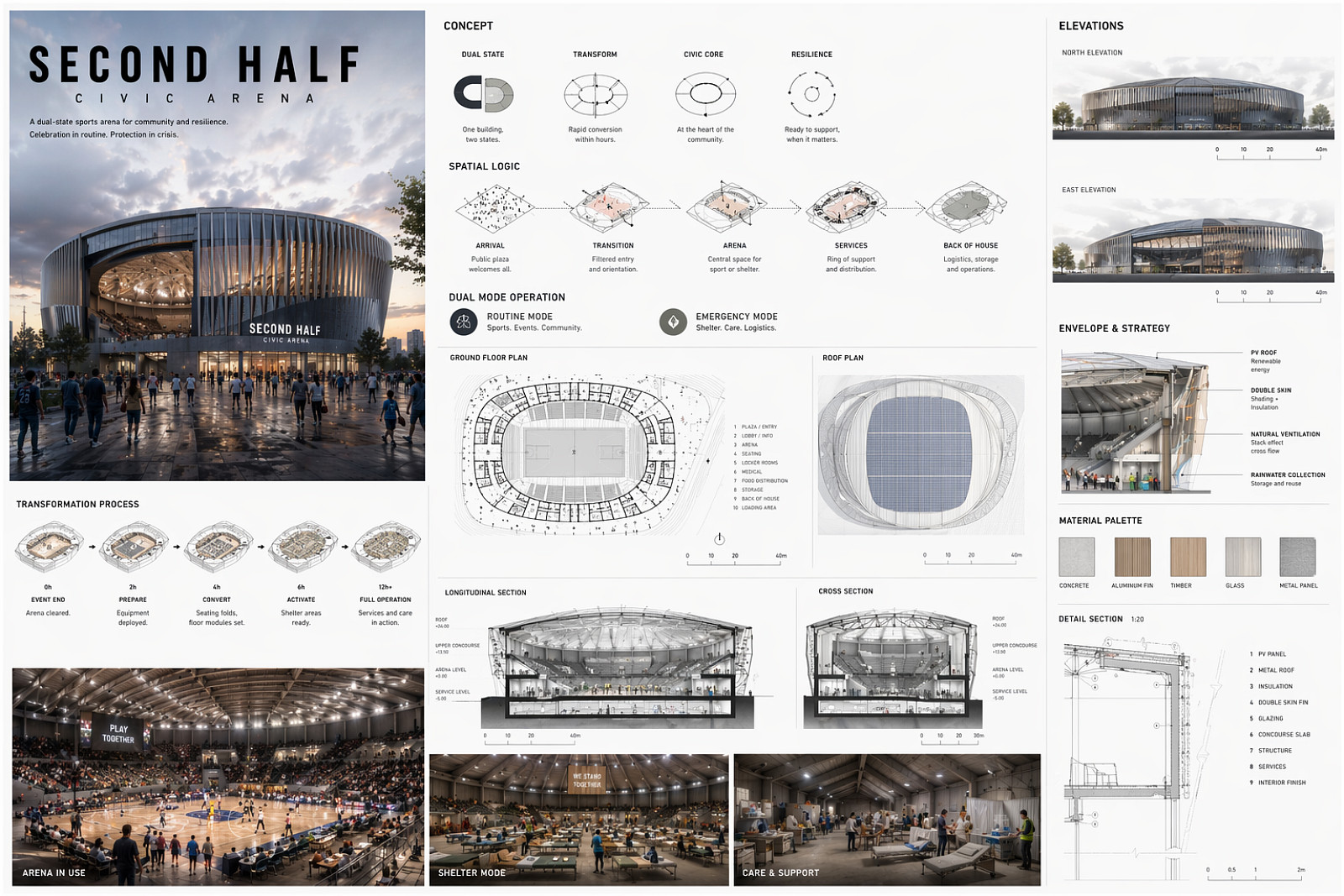
The project is designed as a multifunctional arena complex organized through a clear three-part system: a public ground plane, a central arena bowl, and a perimeter service and operations ring. Its architectural logic allows the same structural and circulation systems to support both everyday event use and rapid emergency conversion. Seating, concourses, storage areas, service corridors, field access, and technical infrastructure are coordinated so that public assembly, logistics, temporary shelter, resource distribution, and care functions can coexist within one adaptable framework.
Environmental and operational performance are integrated into the building’s long-term civic role. The arena incorporates robust service infrastructure, flexible storage capacity, clear zoning between public and operational flows, and durable materials suited to high-frequency use in both routine and emergency conditions. The design can also integrate passive shading, natural ventilation strategies in peripheral public zones, water storage, backup energy systems, and adaptable utilities to strengthen resilience. Materiality emphasizes civic clarity, durability, and maintainability, allowing the building to remain effective both as an arena and as a support structure in times of crisis.

Copyright © 2026 INSPIRELI | All rights reserved. Use of this website signifies your agreement to the Terms of Use, Privacy Policy, and use of cookies.
