El Pliegue de la Memoria


Idea projektu
DECLARATION OF PROJECT
El Pliegue de la Memoria – Arsenal Memory Park
Submitted to the INSPIRELI Competition – Faculty of Architecture and Urbanism, National University of Tucumán
Project Identity
Project title: El Pliegue de la Memoria (The Fold of Memory)
Location: Former Miguel de Azcuénaga Arsenal Company, San Miguel de Tucumán, Argentina
Site area: 350 hectares
Park area: 120 hectares
Competition categories: Urban Design (A) and Architectural Design (B) – comprehensive proposal
Context and Historical Background
Between 1976 and 1978, the military dictatorship that ruled Argentina operated a clandestine detention, torture, and extermination centre within the Arsenal site. Hundreds of people – estimates range up to nearly one thousand – were illegally detained, tortured, and murdered. Their bodies were buried in mass graves on the premises.
After the dictatorship fell, the site was abandoned and remained inaccessible for decades due to an ongoing judicial investigation. Forensic excavations have identified one mass grave a few dozen metres from Galpón 9, but the full extent of the burial sites remains unknown. The judicial process is expected to conclude soon, releasing the land for a new public use.
The competition calls for an Arsenal Memory Park – an urban park that houses an Interpretation Centre dedicated to preserving and conveying the memory of the crimes committed there, while also serving as a vibrant public space for the metropolitan area of Tucumán. The park must embody the concept of active memory: not passive remembrance, but present‑day action aimed at preventing the repetition of past atrocities.
Core Idea – El Pliegue de la Memoria
El Pliegue de la Memoria (The Fold of Memory) proposes that the park itself becomes a topography of absence. Instead of a conventional monument or museum, the land is folded into five descending terraces that lead the visitor toward the crater – the 200‑metre‑radius restricted zone that contains the identified mass grave and possible undiscovered remains. The fold is both physical (the terraces retain stormwater and shape the visitor’s journey) and metaphorical (memory is not flat or static; it is layered, fragile, and sometimes painful).
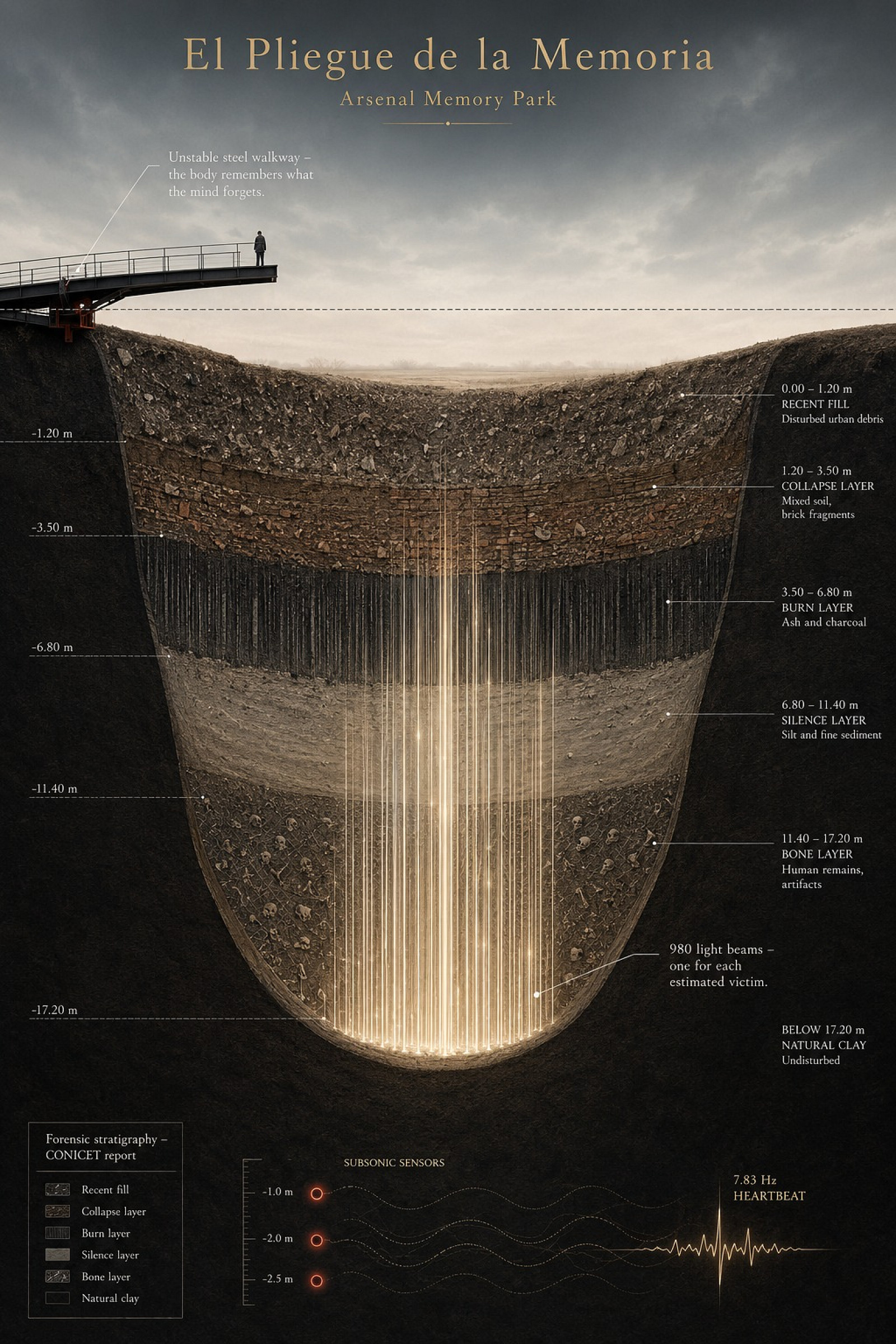
The design rejects the consoling monument. It offers instead a landscape that forces the body to remember through mechanisms that engage all senses: an unstable steel walkway that sways subtly underfoot, subsonic sensors that transmit a 7.83 Hz heartbeat from the soil (felt, not heard), 980 light beams (one for each estimated victim) rising from the crater at night, and a Dome of Ashes where victims’ names are read aloud every month.
Goals
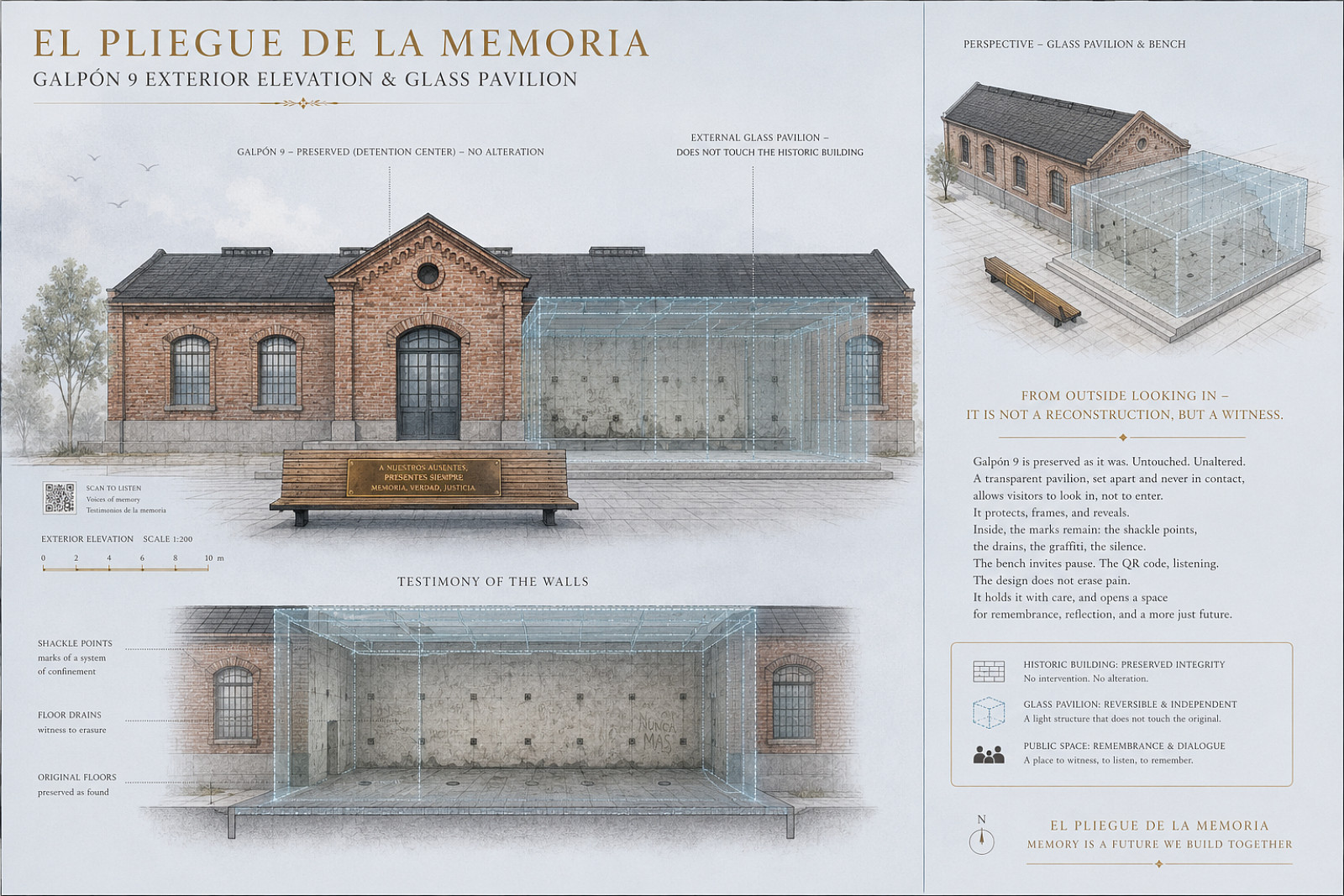
Goal 1 – Preserve and reveal: Galpón 9 and the barracks are preserved intact. A separate glass viewing pavilion allows visitors to look into Galpón 9 without altering the historic fabric. The restricted zone is untouched; the unstable walkway encircles it, never entering.
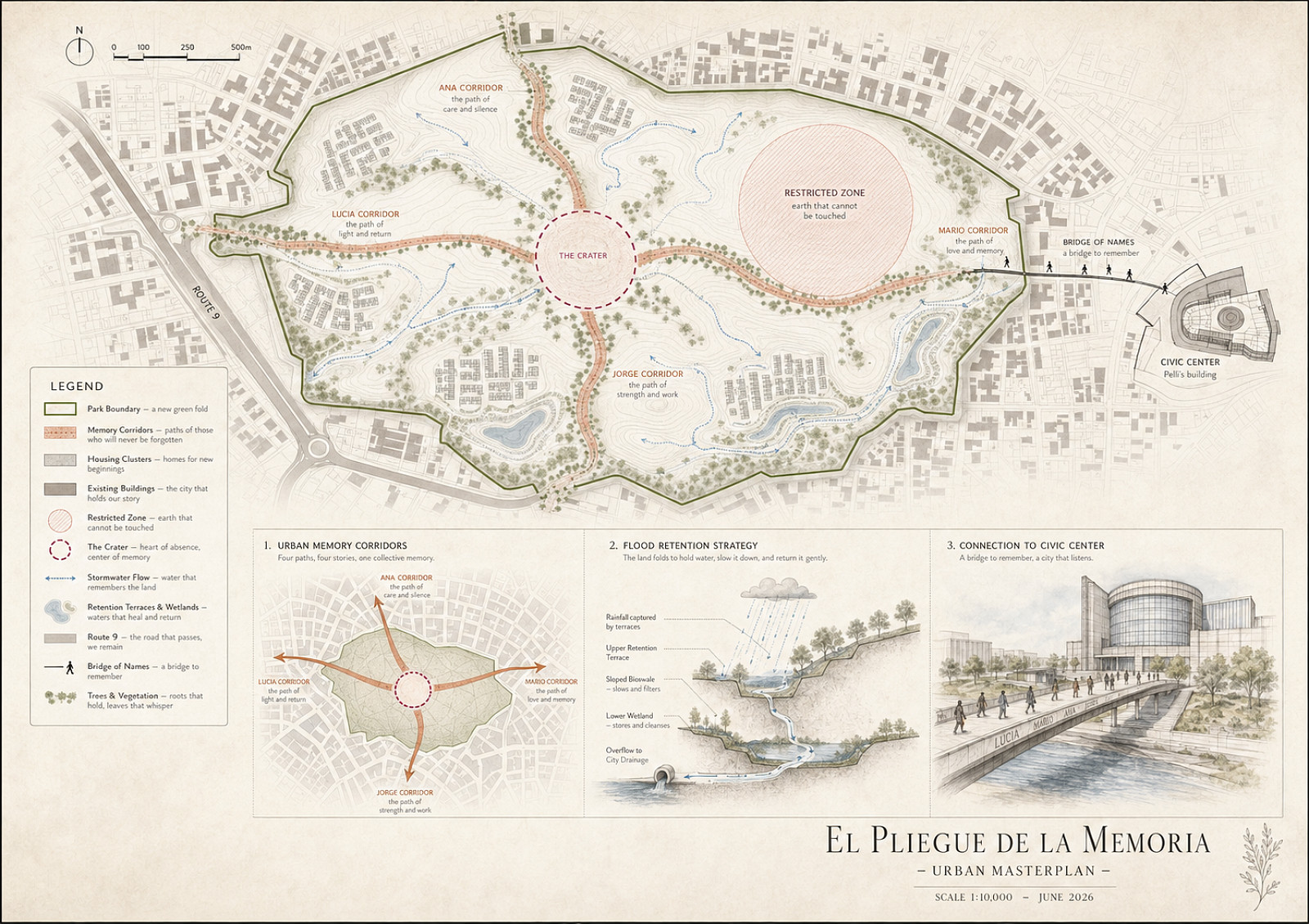
Goal 2 – Restore urban fabric: Four memory corridors (named after victims) extend the city grid through the site, carrying housing, green spaces, and silent paths. The Bridge of Names connects the park to the planned Civic Centre by Cesar Pelli.
Goal 3 – Manage water symbolically: The five terraces act as retention basins, slowing stormwater runoff and directing it into the crater, where it slowly infiltrates – a daily ritual of cleansing that mirrors the slow work of justice.
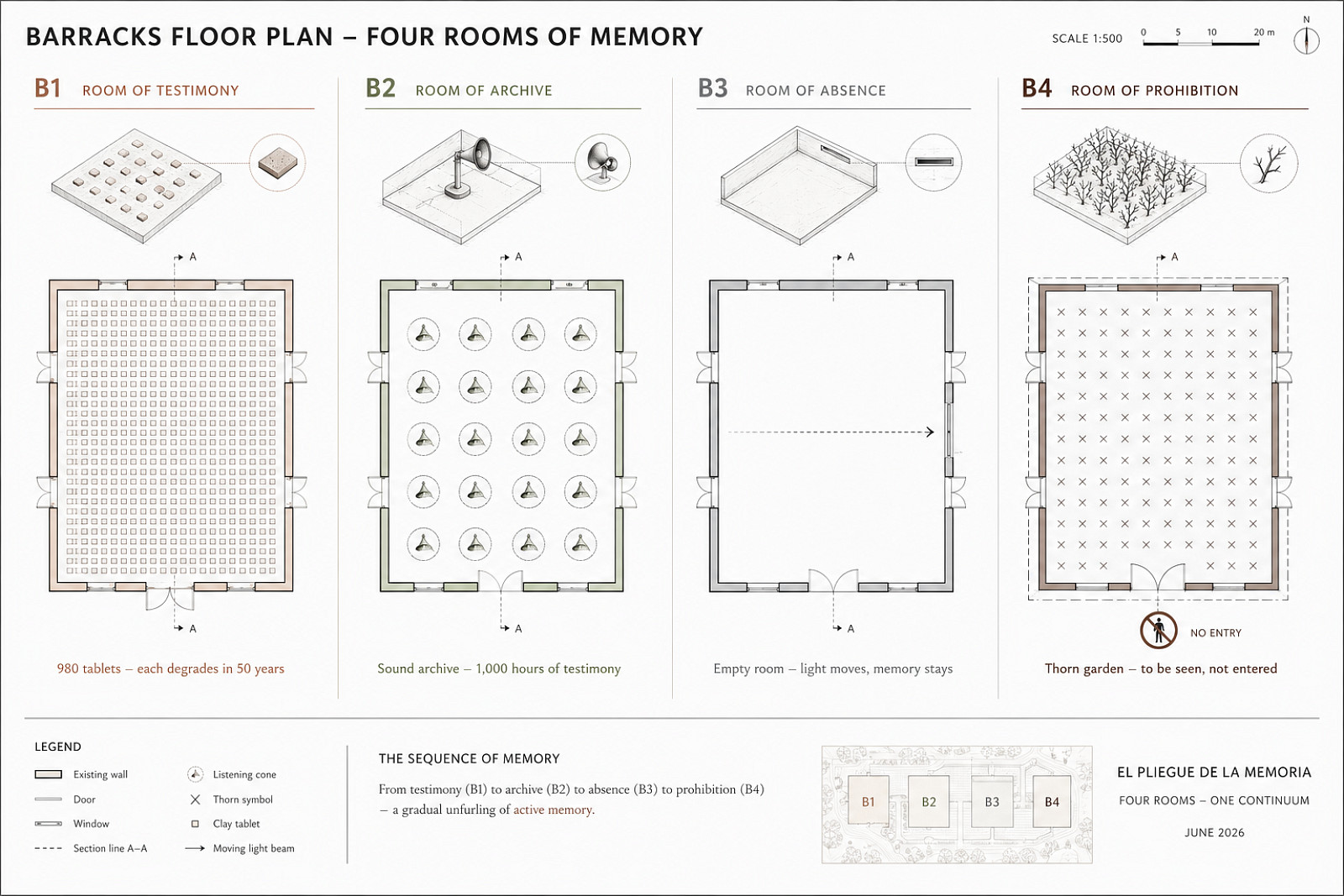
Goal 4 – Create active memory: The Interpretation Centre is not a single building but a distributed system: clay tablets that degrade over 50 years (B1), a sound archive of 1,000 hours of testimony (B2), an empty room where only light moves (B3), a thorn garden that cannot be entered (B4), a Dome of Ashes for public readings, and a Floating Classroom suspended above the crater for study and reflection.
Goal 5 – Engage all senses: Memory is embodied through balance (unstable walkway), vibration (subsonic heartbeat), sight (980 light beams), touch (micro‑oscillation), and collective voice (naming ceremonies).
Objectives to be Reached
Objective 1 – Compliance: All required programs of the Interpretation Centre (thematic and complementary) are included, with areas meeting or exceeding the brief’s suggestions.
Objective 2 – Preservation: Galpón 9, the barracks, and the 200 m restricted zone are fully respected. No construction or public access occurs inside the restricted zone.
Objective 3 – Urban integration: The masterplan restores connectivity across the 350 ha site, including affordable housing (8,000 units), mixed‑use corridors, and a direct pedestrian link to the Civic Centre.
Objective 4 – Flood management: The five terraces and the crater together retain and slowly release stormwater, mitigating flood risk for downstream neighbourhoods.
Objective 5 – Sensory experience: Visitors experience at least four distinct sensory modes of active memory (balance, subsonic vibration, visual light, and participatory ritual).
Objective 6 – Feasibility: All materials and technologies (rammed earth, glulam timber, steel cable, LED lighting, subsonic transducers) are proven and locally available.
Objective 7 – Legacy: The park becomes a model for post‑dictatorship memorial landscapes: not a place of closure, but a place of ongoing vigilance and civic dialogue.
Active Memory – A Declaration of Principle
El Pliegue de la Memoria does not seek to heal. Some wounds must remain open to remind us why we fight. The design does not offer comfort; it offers confrontation. It asks visitors to walk an unstable path, to feel the earth’s heartbeat, to stand in an empty room where only light moves, and to hear names read aloud in a dome built of earth.
This is active memory: memory as a verb, not a noun. Memory as imbalance, erosion, water, light, and voice. Memory as a future we build together.
Popis projektu
PROJECT DESCRIPTION – SCOPE OF THE SOLUTION
El Pliegue de la Memoria – Arsenal Memory Park
The project covers the entire 350‑hectare former Arsenal site in San Miguel de Tucumán, Argentina, with a specific focus on the 120‑hectare Arsenal Memory Park and its Interpretation Centre. The scope is structured into three integrated scales: urban, park, and architectural.
Urban Scale (350 ha)
The urban proposal restores the fragmented city fabric by extending four memory corridors across the site. These corridors – named Lucia, Mario, Ana, and Jorge after identified victims – run east‑west and accommodate mixed‑use development, green infrastructure, and pedestrian paths. A total of 8,000 affordable housing units (rammed earth, 4‑storey blocks) are distributed along the corridors, addressing the metropolitan housing shortage.
The edge along Route 9 is activated by a 30‑metre‑wide pedestrian Bridge of Names, which connects the park directly to the planned Civic Centre by Cesar Pelli. Beneath the bridge, a bus terminal and market halls maintain active street life. The existing barracks complex is preserved and integrated as an emblematic urban landmark.
Stormwater management is addressed at the urban scale: the site’s natural topography channels runoff from higher ground into the park’s retention system.
Park Scale (120 ha)
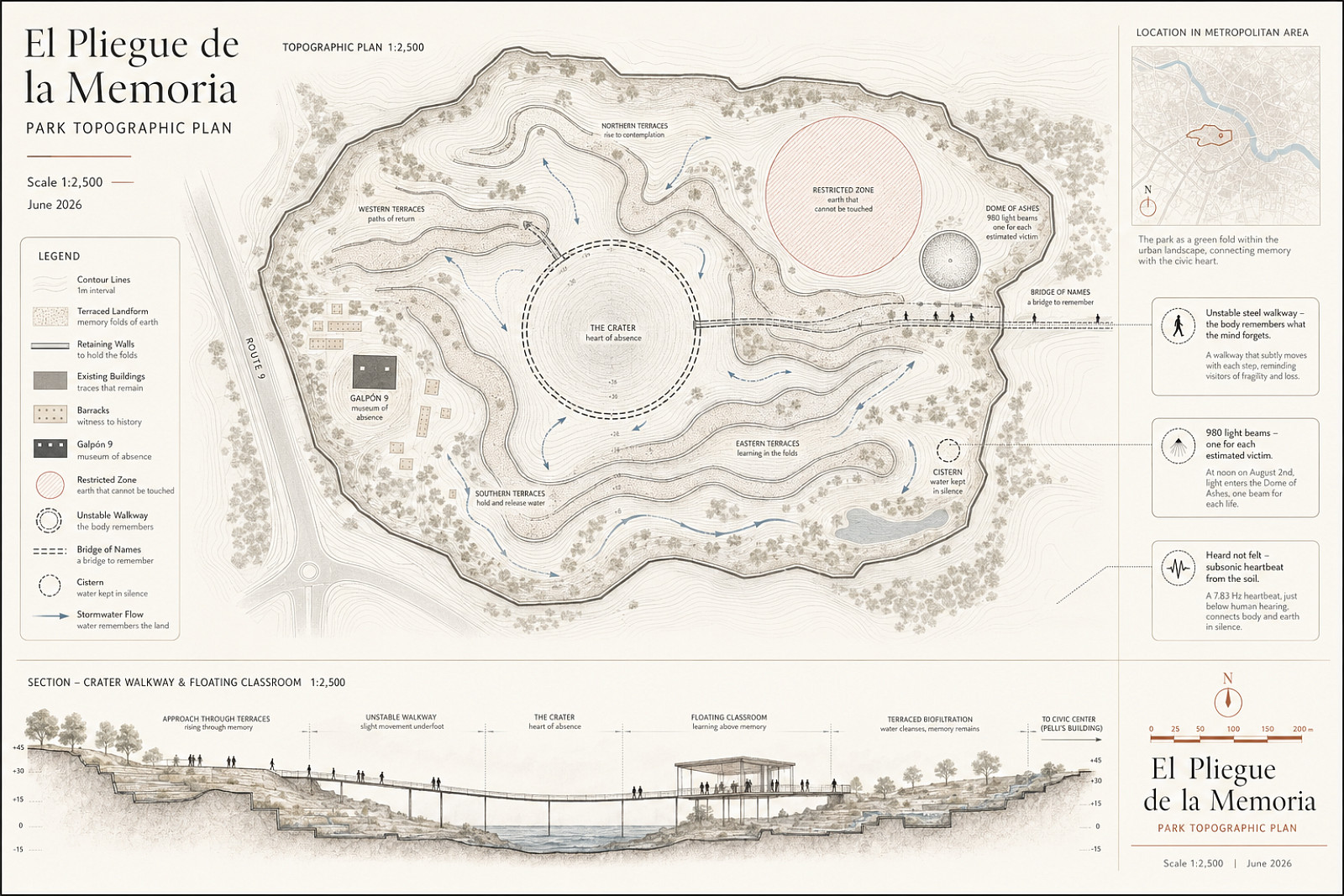
The park is designed as a descending sequence of five terraces (T1 to T5), each 0.5 m lower than the previous, ranging from +0.0 m at the west to -2.0 m at the east. Contour lines at 0.5 m intervals reinforce the topography. The terraces are surfaced with white quartz gravel, which changes appearance when wet, and are planted with native grasses, forest, and wetland zones.
At the heart of the park lies the restricted zone – a 200‑metre‑radius circle centred on the identified mass grave. No construction or public access is permitted inside this zone. The zone is marked by a red hatched circle and contains the excavated crater floor at -3.0 m.
Surrounding the restricted zone is an unstable steel walkway (1.2 m wide), consisting of two parallel dashed circles at radii 201 m and 199.8 m. The walkway is engineered with a micro‑oscillation actuator (0.3 Hz, ±2 mm) and has no railings – only a steel cable. This embodied instability forces visitors to experience fragility and care.
Other park elements include:
Galpón 9 (preserved, no alteration) – a solid black rectangle with two rows of shackle points visible through an external glass pavilion.
Four barracks (B1 to B4) – preserved externally, reprogrammed internally:
B1: 980 degrading clay tablets.
B2: 1,000 hours of testimony (listening cones).
B3: empty room with a moving light beam.
B4: thorn garden (visual access only).
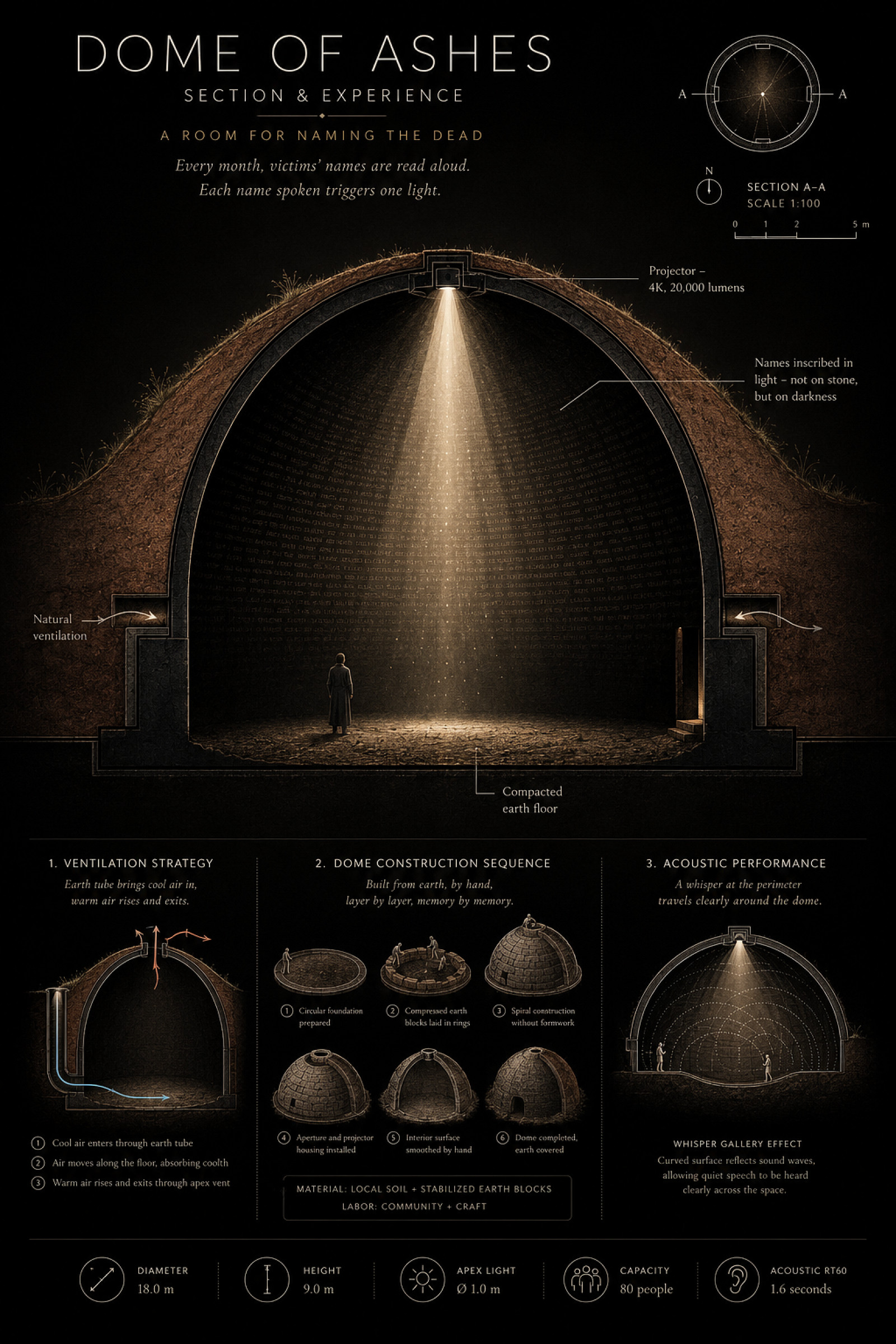
Dome of Ashes – a 20 m diameter compressed‑earth dome for monthly name‑reading ceremonies.
Underground Cistern – a repurposed 30 m diameter echo chamber.
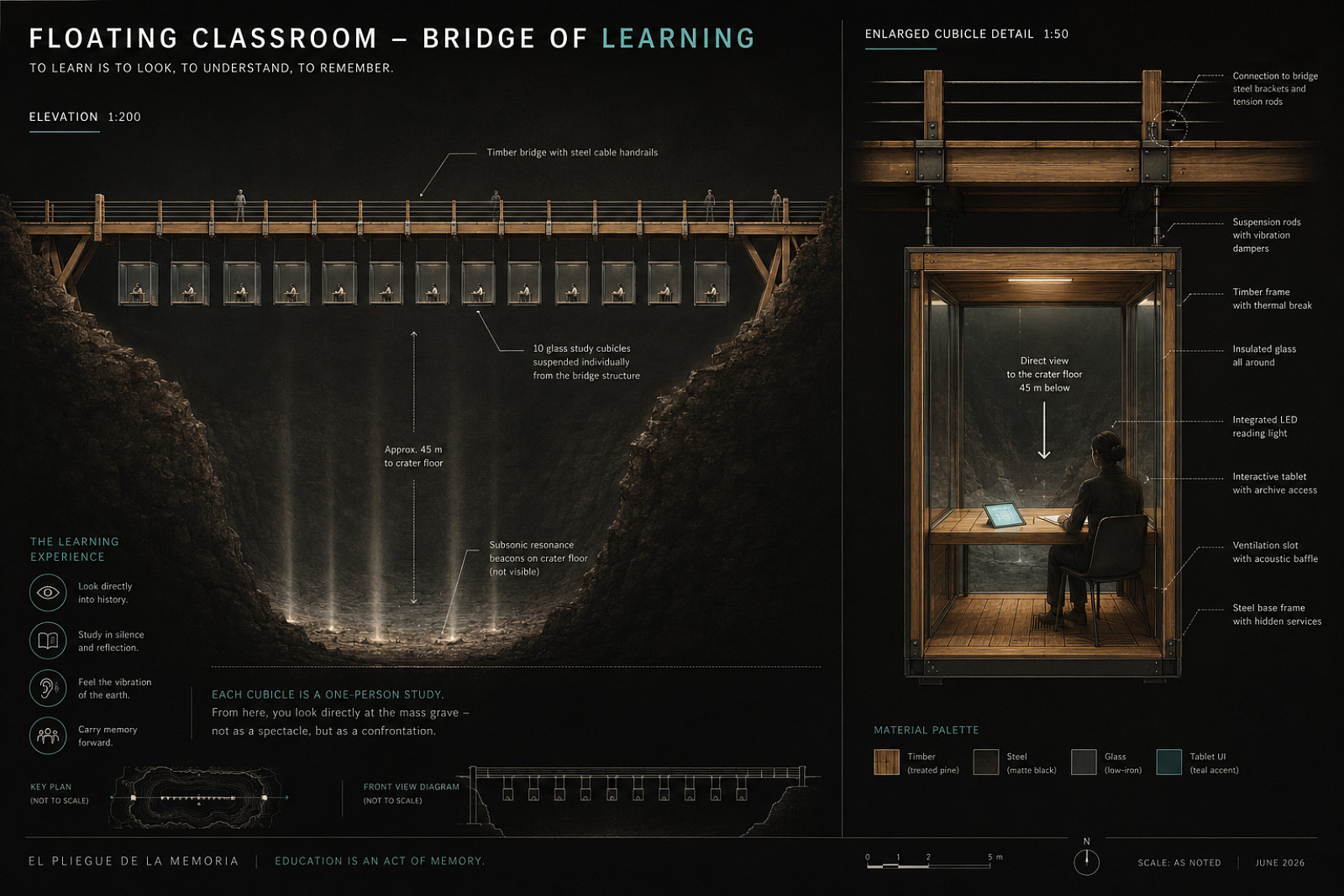
Floating Classroom – a 100 m long timber bridge spanning the crater, with ten suspended glass study cubicles.
Stormwater arrows – five arrows of increasing thickness guiding water flow from the terraces into the crater, where it infiltrates symbolically.
Architectural Scale (Interpretation Centre)
The Interpretation Centre is not a single building but a distributed system. Thematic activities (historical exhibition, memorial art gallery, memory plaza, administration, café/bookstore, regular parking) are accommodated in a new pavilion adjacent to the restricted zone and in adapted barracks spaces. Complementary activities (concert hall, classroom complex, conference centre, amphitheater, event parking) are placed in the repurposed cistern, the floating classroom, and terraced landscapes.
The total covered area is 13,500 m², with 26,800 m² of open space (plazas, amphitheater, parking). All required programs from the brief are met or exceeded.
Key architectural elements:
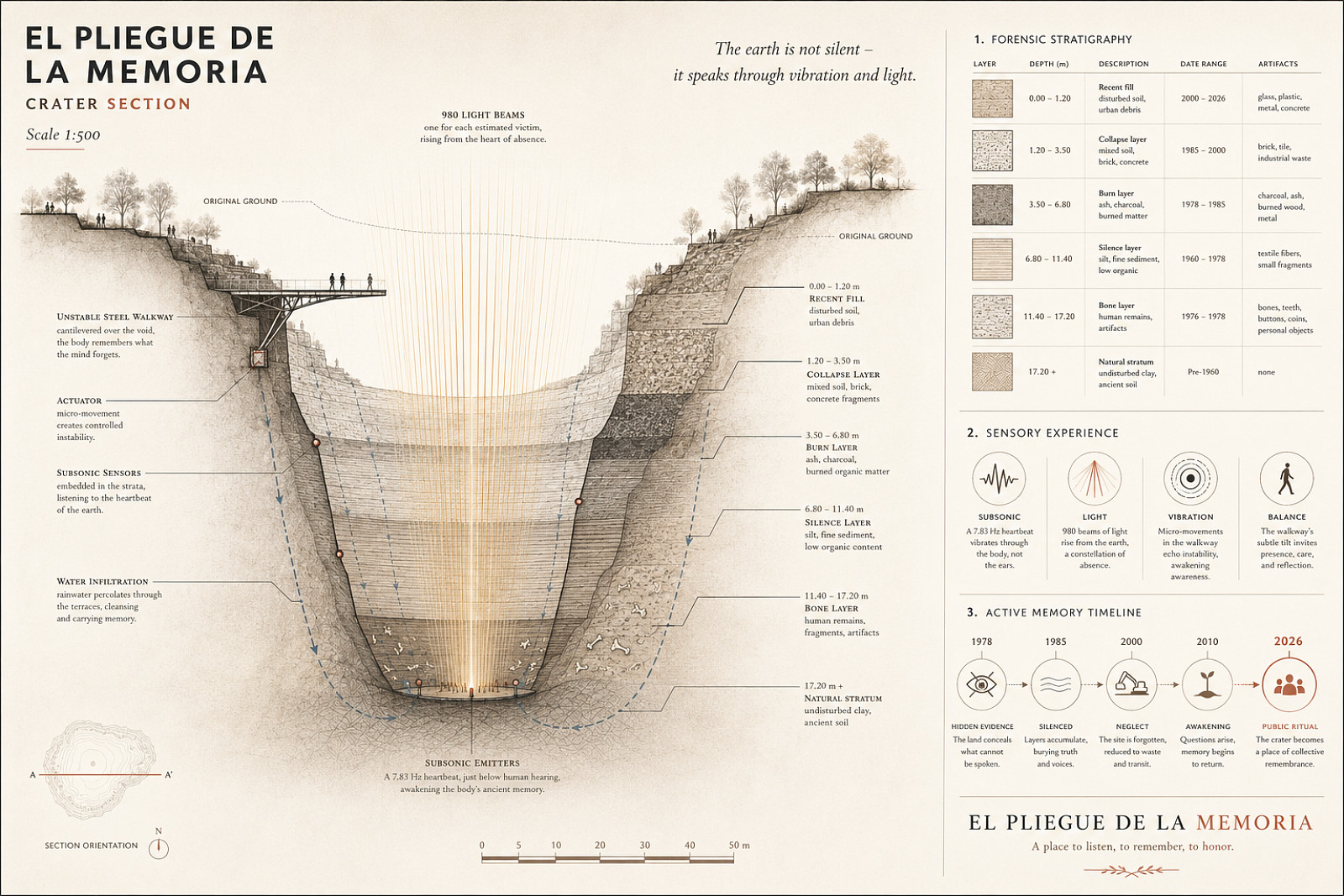
The crater section (1:500) reveals forensic soil strata (fill layer, ash/lime, clay, bone fragments) and subsonic sensors that broadcast a 7.83 Hz heartbeat.
The glass viewing pavilion (external to Galpón 9) allows unobstructed views into the historic interior without touching the original fabric.
The Dome of Ashes section (1:100) shows a 4K projector at the apex, a compacted earth floor, and natural ventilation.
The floating classroom detail (1:50) illustrates a single cubicle with a desk, tablet, and floor window looking directly into the crater.
Active Memory Mechanisms
The scope explicitly addresses the brief’s requirement for “active memory”. Beyond passive viewing, the design includes:
Monthly public readings of victims’ names inside the Dome of Ashes.
A subsonic heartbeat (felt, not heard) transmitted from the soil.
980 light beams (one per estimated victim) rising from the crater at night.
An unstable walkway that physically engages balance and instability.
Degrading clay tablets – memory is not eternal, and that vulnerability is part of the message.
Educational workshops in the floating classroom, where students study above the mass grave.
Feasibility and Sustainability
All materials are locally available and low‑carbon: rammed earth for housing, compressed earth blocks for the dome, glulam timber for the bridge, steel for the walkway. The terraces require no mechanical pumping – water moves by gravity. The park doubles as a flood retention basin, reducing risk for downstream neighbourhoods. The design avoids any alteration to Galpón 9 or the barracks, ensuring full heritage compliance.
Deliverables Summary (in scope)
Urban masterplan (1:10,000) with memory corridors, housing, Route 9 bridge, and park boundary.
Park topographic plan (1:2,500) with five terraces, restricted zone, walkway, and all park elements.
Crater section (1:500) with forensic stratigraphy and sensory devices.
Galpón 9 elevation (1:200) with external glass pavilion.
Barracks floor plan (1:500) with four reprogrammed rooms.
Dome of Ashes section (1:100) with ventilation and acoustic diagrams.
Floating Classroom elevation and detail (1:200 / 1:50).
Four analytical diagrams (water management, memory circuit, active memory concept, forensic overlay).
Three perspective renders (Bridge of Names at dusk, Barrack 3 interior, aerial rainwater cascade).
Design narrative, compliance table, and this project description.
The project is submitted as a comprehensive proposal covering both Urban Design (Category A) and Architectural Design (Category B).
Technické informace
Here is the **technical information** rewritten in **paragraph format** (no tables, no bullet points). All text is in English, copy‑paste ready.
---
TECHNICAL INFORMATION – PROJECT SPECIFICATIONS
El Pliegue de la Memoria – Arsenal Memory Park
**Site and Earthworks**
The total site area is 350 hectares, of which the park occupies 120 hectares. Earthworks include the excavation of the crater, which has a radius of 200 metres and a depth of 3 metres below original grade, resulting in an approximate excavation volume of 94,000 cubic metres. The five terraces (T1 at +0.0 metres, T2 at -0.5 metres, T3 at -1.0 metres, T4 at -1.5 metres, and T5 at -2.0 metres) are formed by rebalancing approximately 280,000 cubic metres of soil on site. Retaining walls between terraces are cast‑in‑place reinforced concrete, ranging in height from 0.5 metres to 1.5 metres, with an exposed aggregate finish. The terrace surfaces are covered with 25 millimetre nominal size white quartz gravel laid to a depth of 50 millimetres over a drainage layer, covering 120,000 square metres in total.
**Structural Systems**
Housing clusters comprising 8,000 affordable units are built from rammed earth stabilised with 5 percent cement. These load‑bearing walls rise to four storeys, using local soil for low embodied carbon and excellent thermal mass. The Dome of Ashes is a hemispherical shell 20 metres in diameter with a wall thickness of 0.5 metres, constructed from compressed earth blocks and finished with soil‑lime plaster, built using a spiral construction technique without formwork. The Floating Classroom is a timber bridge made of glulam (LVL) grade GL28h, spanning 100 metres with a width of 2 metres, using prefabricated bolted connections. The unstable steel walkway is fabricated from hot‑dip galvanised steel S355, forming a cantilevered double circle 1.2 metres wide with a 1.5 metre cantilever; it incorporates a micro‑oscillation actuator operating at 0.3 hertz. The glass viewing pavilion is a freestanding structure of low‑iron laminated glass (8+8 millimetres) on a steel frame, measuring 4 metres by 8 metres by 4 metres, and is fully reversible, never touching the historic Galpón 9. The existing barracks are preserved without structural alteration; only internal reversible partitions are permitted.
**Materials and Finishes**
The terraces are surfaced with white quartz gravel from a local quarry, which is bright white, produces a crunching sound underfoot, and is fully permeable. Rammed earth walls use local soil with 5 percent cement, giving a warm terracotta to ochre colour. The Dome of Ashes exterior is finished with lime plaster over compressed earth blocks, resulting in a sandy beige, breathable surface. The dome interior has a compacted earth floor with clay plaster, dark brown and smooth, offering natural hygroscopic regulation. The bridge timber is glulam spruce or pine with a natural oiled finish, FSC certified. The walkway steel is galvanised and allowed to weather to a dark grey, fully recyclable. The glass pavilion uses low‑iron glass with a slight blue‑green edge. Paths and plazas are pigmented warm grey concrete with a non‑slip finish, using local aggregates.
**Water Management**
The five terraces collectively retain up to 15,000 cubic metres of stormwater, releasing it gradually to the crater over a 24‑hour drawdown period. The crater itself can infiltrate 8,000 cubic metres per event, thanks to a gravel base and geotextile layer achieving an infiltration rate of 0.5 metres per day. Stormwater arrows are graded swales with a 0.5 percent slope, vegetated to guide flow. A permanent constructed reed bed wetland of 2,500 square metres treats initial runoff.
**Sensory and Memory Devices**
The unstable walkway is equipped with a micro‑oscillation actuator that produces ±2 millimetre displacement at 0.3 hertz, engaging the visitor’s sense of balance. Subsonic contact microphones (geophones tuned to 8 hertz resonance) are embedded at depths of 1.0, 2.0, and 2.5 metres, transmitting a 7.83 hertz heartbeat that is felt, not heard. Nine hundred and eighty LED light beam projectors (3,000 kelvin, 5 watts each) rise vertically from the crater floor, one for each estimated victim, providing nighttime illumination. The Dome of Ashes contains a 4K laser projector with 20,000 lumens, capable of projecting names and imagery onto the dome interior. The underground cistern has a natural reverberation time of 12 seconds and includes a subwoofer array, creating an echo chamber for spoken names.
**Energy and Environmental Performance**
Passive heating and cooling are achieved through rammed earth thermal mass and an earth tube ventilation system for the dome, reducing HVAC demand by an estimated 30 percent. All lighting is LED, and the 980 light beams operate on a dusk‑dawn sensor, using 80 percent less energy than conventional park lighting. Water is managed entirely on site: rainwater harvested from the terraces and greywater reused for the wetland, allowing 100 percent of irrigation from captured water. Embodied carbon is estimated at 35 kilograms of CO₂ equivalent per square metre, well below the regional average, due to the use of earth construction, local timber, and minimal concrete.
**Construction Sequence**
The construction is planned in six phases over a total of 40 months. Phase 1 (6 months) includes demolition of non‑heritage buildings, site clearance, and forensic protection of the restricted zone. Phase 2 (8 months) comprises terrace formation, crater excavation, soil stabilisation, and retaining walls. Phase 3 (4 months) installs stormwater drainage, utility connections, and paths. Phase 4 (12 months) builds the rammed earth housing, Dome of Ashes, glass pavilion, and barracks adaptation. Phase 5 (6 months) involves prefabrication and installation of the floating classroom and the unstable walkway. Phase 6 (4 months) completes planting, quartz gravel placement, lighting, and sensor installation.
**Heritage Compliance**
Galpón 9 is preserved intact with no alteration: no wall removal, no attachment. The glass viewing pavilion is separate and fully reversible. The barracks exteriors remain unchanged; only internal partitions may be modified, and those changes are reversible. The restricted zone (200‑metre radius) has no construction and no public access – the walkway is placed at a 201‑metre radius. The identified mass grave is protected from disturbance, allowing forensic investigations to continue if needed.
**Maintenance and Operation**
Maintenance tasks are distributed: the white quartz gravel is raked monthly by park staff; subsonic sensors are calibrated annually by a technical contractor; LED light beams are replaced every ten years by an electrical team; the dome earth plaster is repaired every five years by traditional craftspeople; and the walkway actuator is inspected quarterly by a structural engineer.
**Key Dimensions Summary**
The site (350 hectares) is drawn at 1:10,000 on the masterplan, while the park (120 hectares) appears at 1:2,500 on the topographic plan. The crater radius of 200 metres scales to 80 millimetres on the 1:2,500 drawing. The unstable walkway width of 1.2 metres becomes 0.48 millimetres. Galpón 9 (10 metres by 40 metres) measures 4 millimetres by 16 millimetres at 1:2,500. The Dome of Ashes diameter of 20 metres scales to 200 millimetres on the 1:100 section. The floating classroom bridge span of 100 metres becomes 500 millimetres on the 1:200 elevation.


Copyright © 2026 INSPIRELI | All rights reserved. Use of this website signifies your agreement to the Terms of Use, Privacy Policy, and use of cookies.
