The RUSTSCAPE-Revival of leftover and abandoned railway landscapes in Nanu Oya, Sri Lanka


Idea projektu
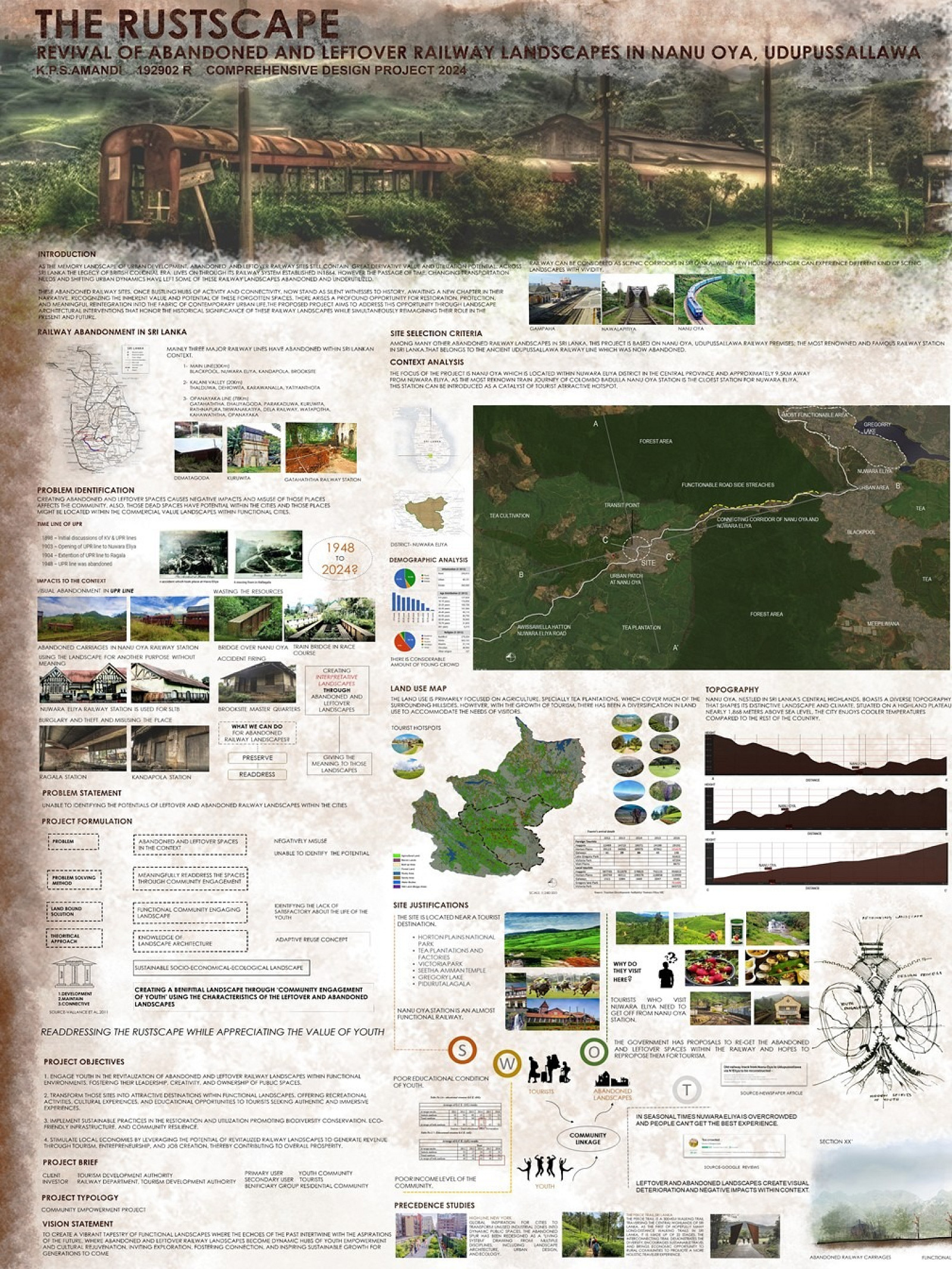
The idea of this project is to transform abandoned and leftover railway landscapes into a productive socio-ecological and cultural corridor that reconnects people, landscape, and history.
This project is inspired by the neglected condition of the Nanu Oya–Udupussallawa Railway (UPR) corridor in Sri Lanka, a colonial-era infrastructure that has been abandoned and left as fragmented “dead space” within a high-value tourism and ecological region.
The core need addressed by this project is the revival of underutilized linear infrastructure landscapes, which currently contribute to environmental degradation, social insecurity, and visual decay. At the same time, the surrounding communities—especially rural youth—face limited employment opportunities, lack of skill development platforms, and minimal participation in the tourism economy.
Therefore, this project aims to reimagine the abandoned railway as a living landscape system, where ecological restoration, tourism development, and youth empowerment are integrated into a single spatial framework.
The project also responds to the broader need for sustainable adaptive reuse of heritage infrastructure, turning forgotten railway corridors into active public landscapes that support cultural memory, environmental resilience, and economic upliftment.
Popis projektu
This project consists of the adaptive reuse and landscape transformation of the abandoned Udupussallawa Railway corridor into a continuous eco-cultural and socio-economic landscape system.
The main design intervention is structured as a linear but flexible landscape framework, which reactivates the railway corridor through a sequence of programmed spatial zones connected by an eco-loop trail.
The project is organized into six main spatial components:
1. Interactive Core
This is the primary arrival and community interface zone. It acts as a central activation node where visitors and local users are introduced to the site. It includes basic facilities, information spaces, and social interaction areas to initiate engagement.
2. Trail Head & Youth Marketplace
This zone functions as the entry point to the eco-trail system. It includes a youth-driven marketplace that provides opportunities for local entrepreneurship, craft selling, food vending, and tourism-related services.
3. Viewing Vista Zone
A landscape-based experiential area designed to highlight the natural topography of Nuwara Eliya. It provides panoramic viewing platforms overlooking tea plantations and surrounding highland scenery.
4. Tea Forest Integration Zone
This area connects the abandoned railway corridor with the active Edinburgh Tea Estate. It integrates agricultural landscapes with tourism pathways, allowing visitors to experience tea cultivation landscapes as part of the journey.
5. Memory Landscape Zone
This is the cultural and historical core of the project. It preserves and narrates the history of the UPR railway through interpretive installations, spatial storytelling elements, and experiential landscape design.
6. Trail Exit Gateway
This is the concluding zone of the experience. It functions as a transition space that reconnects visitors back to the surrounding urban or tourism network while maintaining continuity of the landscape experience.
Overall, the project transforms a neglected infrastructure corridor into a continuous public landscape system that combines ecology, economy, and memory.
Technické informace
Site Context & Background
The project is located along the abandoned Udupussallawa Railway (UPR) corridor, a colonial-era railway line constructed between 1903 and 1904 and fully abandoned in 1948.
Today, the remaining railway fragments exist as underutilized linear landscapes embedded within a highly sensitive ecological region and a major tourism destination. The corridor holds strong historical value while simultaneously functioning as a neglected spatial asset.
Nanu Oya functions as the primary railway gateway to Nuwara Eliya, and currently experiences high visitor pressure, particularly due to concentrated tourism activity within the town center. This project addresses the need to redistribute tourism experience along the broader landscape, reducing congestion while enhancing spatial and experiential quality.
Project Typology
Landscape Architecture and Adaptive Reuse Intervention
Socio-Ecological Tourism Corridor Development
Heritage Landscape Revitalization Project
Youth Empowerment and Community-Based Development System
Key Stakeholders
Sri Lanka Railways Department
Sri Lanka Tourism Development Authority
Local communities of Nuwara Eliya District
Youth population and informal labor groups
Domestic and international tourists
Design Strategy
The project is based on an “Octopus Form Master Plan”, which transforms the linear railway corridor into a flexible, branching landscape system extending from a central activation node into multiple experiential zones.
The Master Plan has been developed and provided, illustrating spatial zoning, circulation systems, ecological buffers, and programmatic distribution along the railway corridor.
This strategy enables:
Activation of abandoned railway edges as public landscapes
Integration with tea estates and surrounding ecological systems
Distributed tourism flow instead of concentrated urban pressure
Adaptive and phased development potential
Heritage & Experiential Framework
The design reinterprets the historical Udupussallawa Railway line as a living cultural landscape, aiming to reconnect people with the forgotten legacy of Sri Lanka’s highland railway system.
The intervention enhances the identity of Nanu Oya as the key entry point to Nuwara Eliya by train, reinforcing the scenic railway experience as a national tourism asset.
In response to current tourism overcrowding in Nuwara Eliya, the project introduces an alternative landscape experience corridor, encouraging visitors to engage with railway-edge landscapes, ecological systems, and cultural memory zones.
Ecological Sensitivity & Landscape Approach
The site is located within a fragile montane ecosystem, requiring strict environmental control and minimal intervention strategies.
Illumination Strategy:
Artificial lighting is restricted strictly to essential functional areas such as access nodes, safety pathways, and activity hubs. This reduces light pollution, protects nocturnal ecosystems, and preserves the natural highland nightscape.
Endemic Planting Strategy:
The landscape design prioritizes Sri Lankan endemic and native species, ensuring ecological restoration, biodiversity enhancement, and reinforcement of regional landscape identity.
Sustainability Framework
The project is grounded in the Vallance et al. (2011) sustainability triad:
Social Sustainability: Youth engagement, cultural heritage preservation, community participation
Environmental Sustainability: Ecosystem restoration, endemic planting, ecological corridor rehabilitation
Economic Sustainability: Tourism redistribution, local entrepreneurship, job creation
Maintenance & Management Strategy
A structured long-term maintenance framework is integrated into the design:
Community-Based Maintenance: Local youth groups participate in operational care, landscaping, and trail management
Institutional Coordination: Oversight by Sri Lanka Railways and Tourism Development Authority
Zonal Maintenance System: High-intensity maintenance in active nodes; low-intervention ecological management in sensitive zones
Seasonal Management Plan: Maintenance activities aligned with Nuwara Eliya’s climatic cycles to ensure ecological stability
Key Infrastructure Components
Eco-loop pedestrian and cycling trail system
Adaptive reuse of railway infrastructure
Youth-led marketplace and incubation zones
Viewing platforms and experiential nodes
Tea estate integration landscape corridors
Heritage interpretation and memory installations
Controlled lighting and safety infrastructure
Emergency access and service pathways
Expected Outcome
The project transforms the abandoned Udupussallawa Railway corridor into a multi-layered socio-ecological landscape system that:
Revives neglected infrastructure and cultural heritage
Distributes tourism flow beyond congested urban cores
Creates livelihood opportunities for local youth
Enhances ecological resilience through endemic planting
Strengthens Nanu Oya as a gateway experiential landscape
Dokumentace

Copyright © 2026 INSPIRELI | All rights reserved. Use of this website signifies your agreement to the Terms of Use, Privacy Policy, and use of cookies.