THE LIVING FILTER

Idea projektu
THE LIVING FILTER
A Civic Ecology for the Recovery of the Yarkon
The Yarkon River does not need another object on its banks. It needs a new relationship between water, city and life.
THE LIVING FILTER is a civic wetland infrastructure that transforms river recovery into a public health project. Located along the
Yarkon River in Tel Aviv, the proposal addresses one of the most fundamental urban health conditions: the quality of the shared
environment. Polluted water, fragmented habitats, overheated public landscapes and disconnected ecological systems are not
only environmental issues; they are public health issues. They shape the daily wellbeing of entire communities.
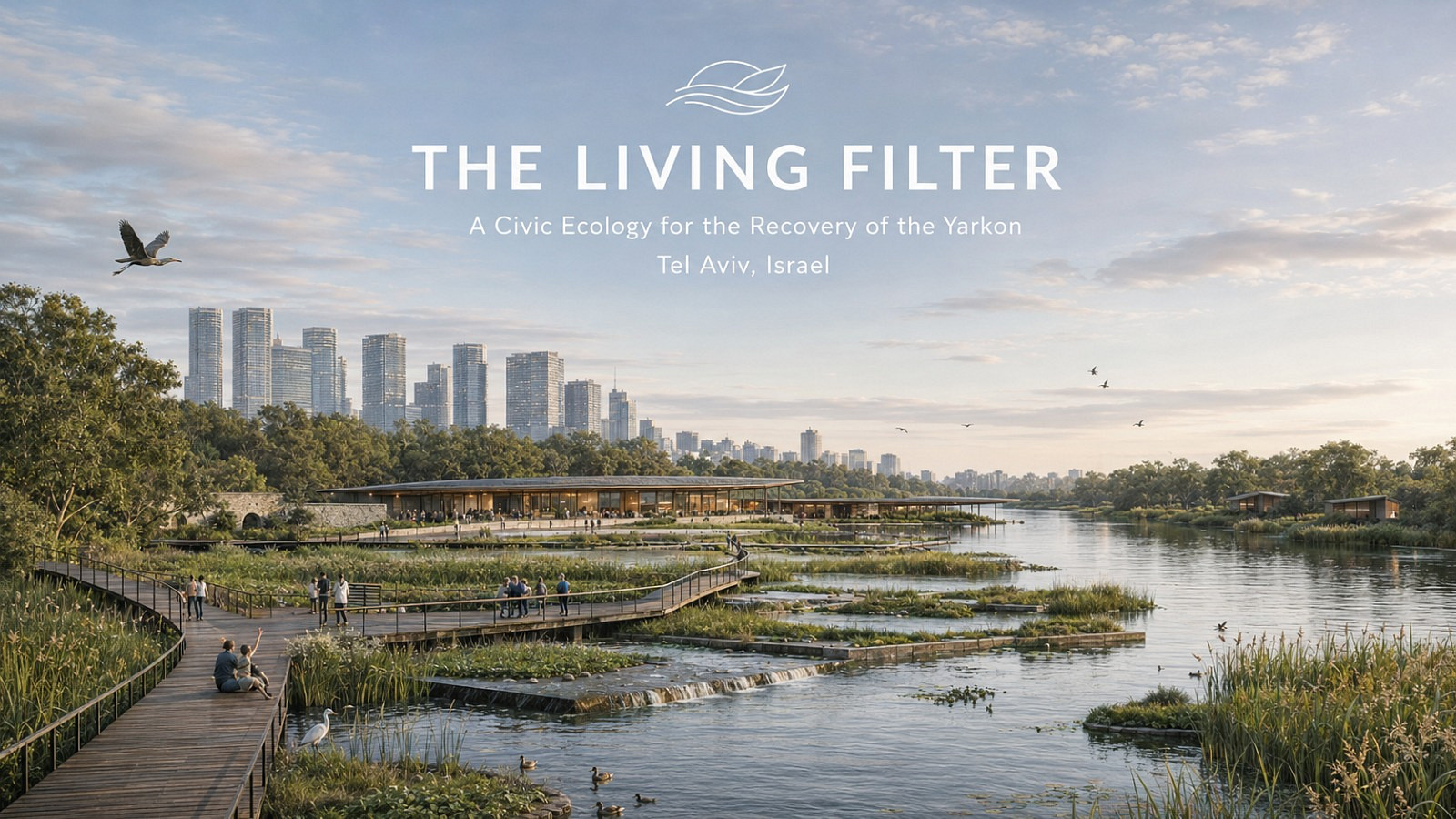
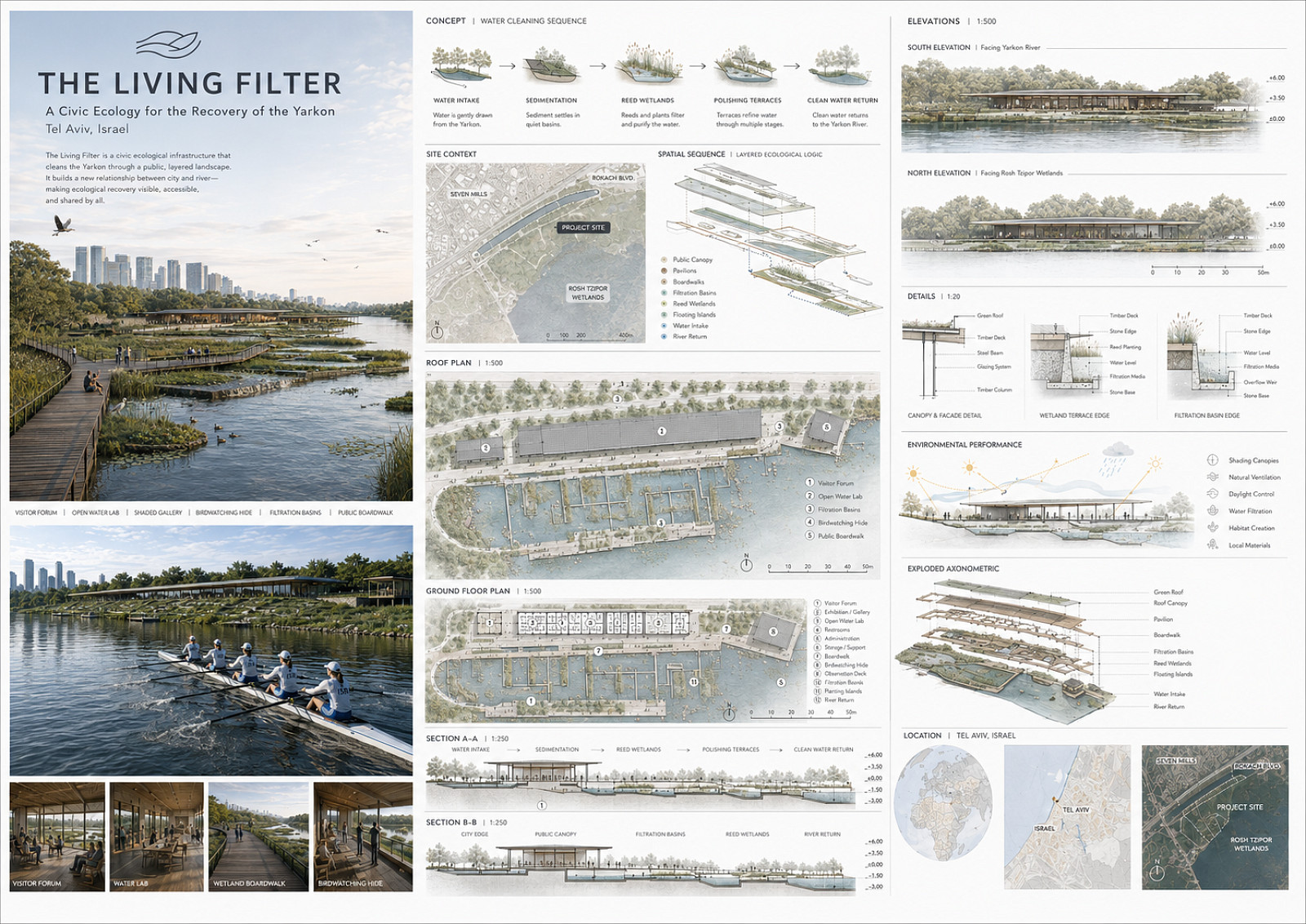
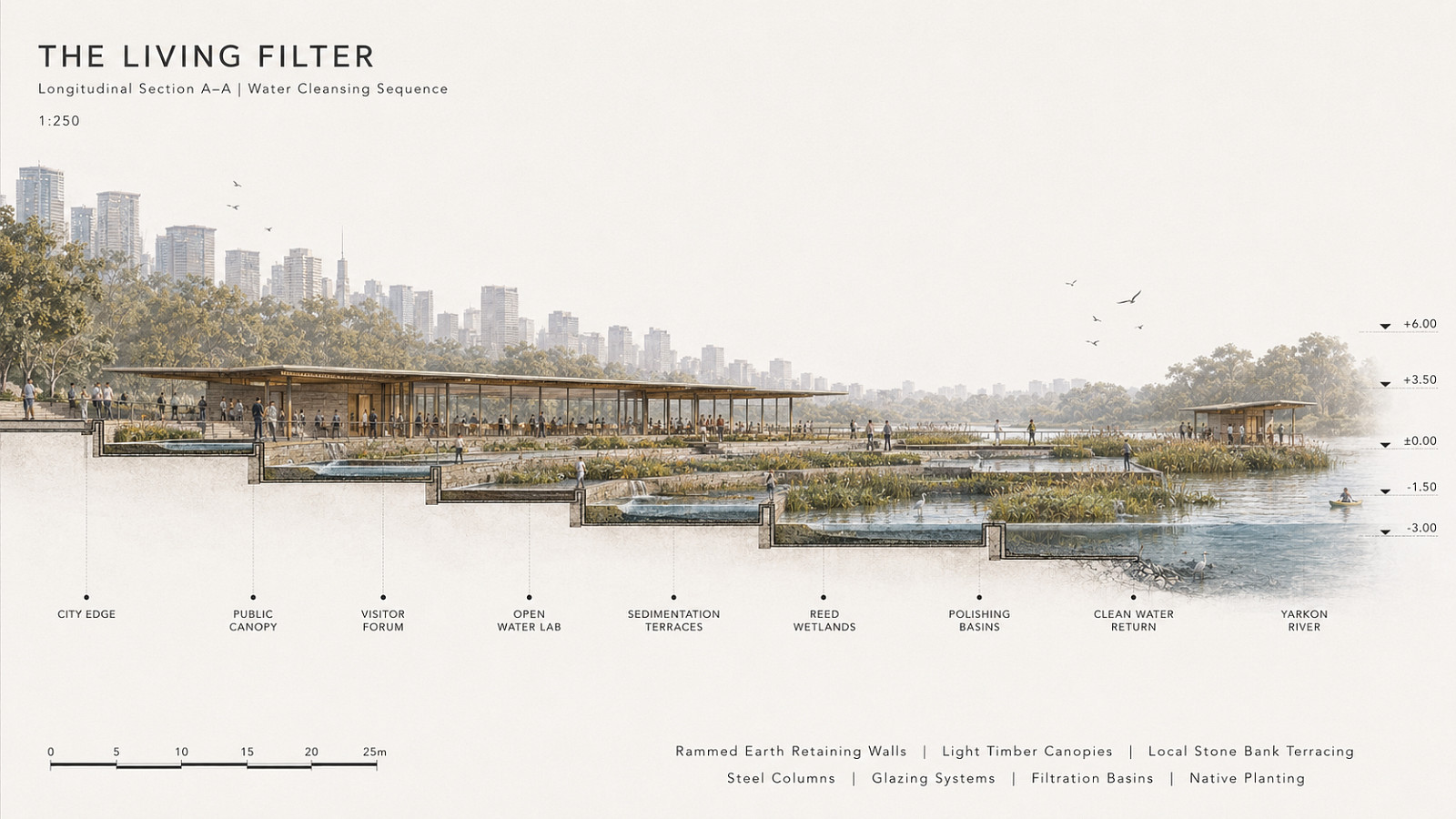
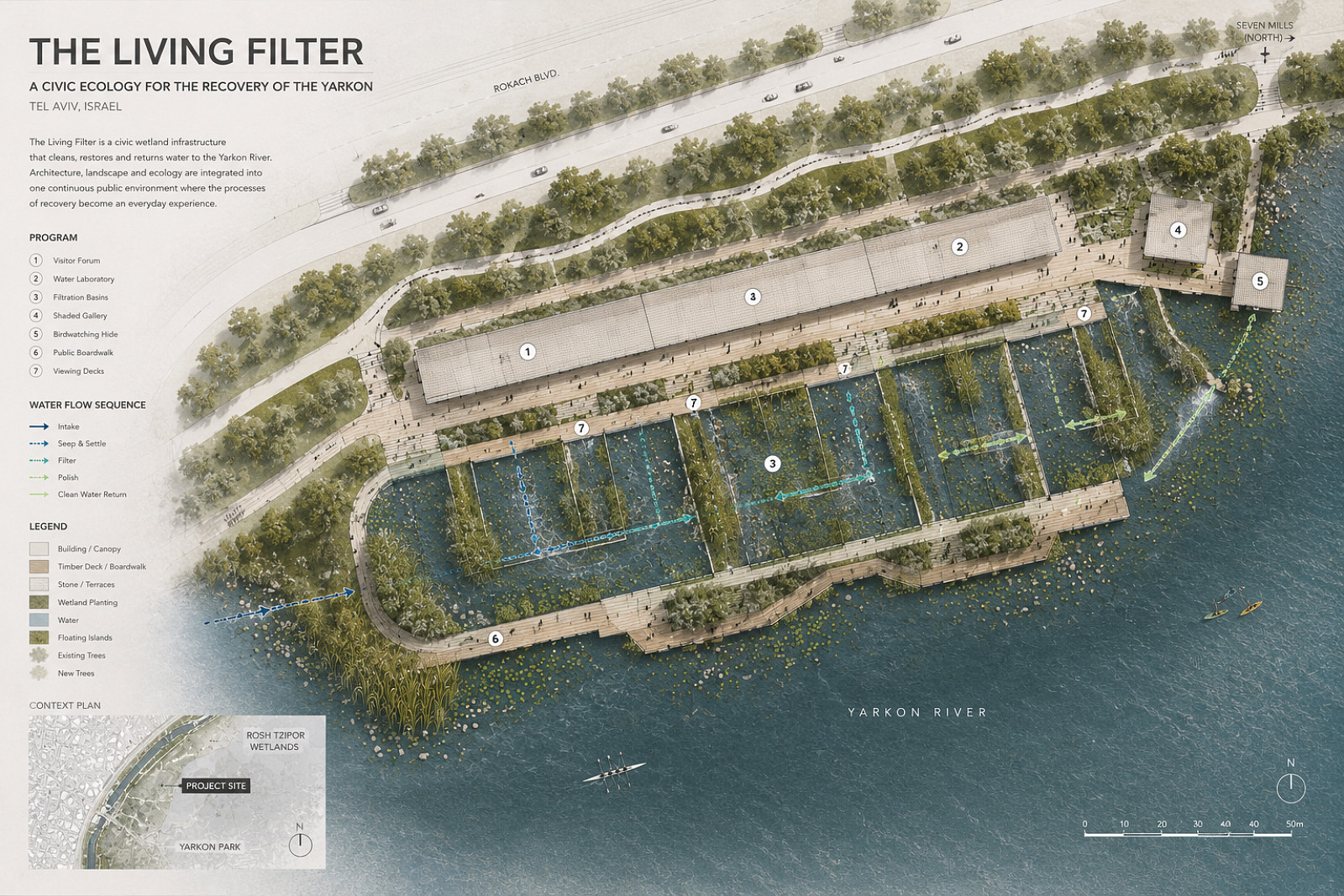
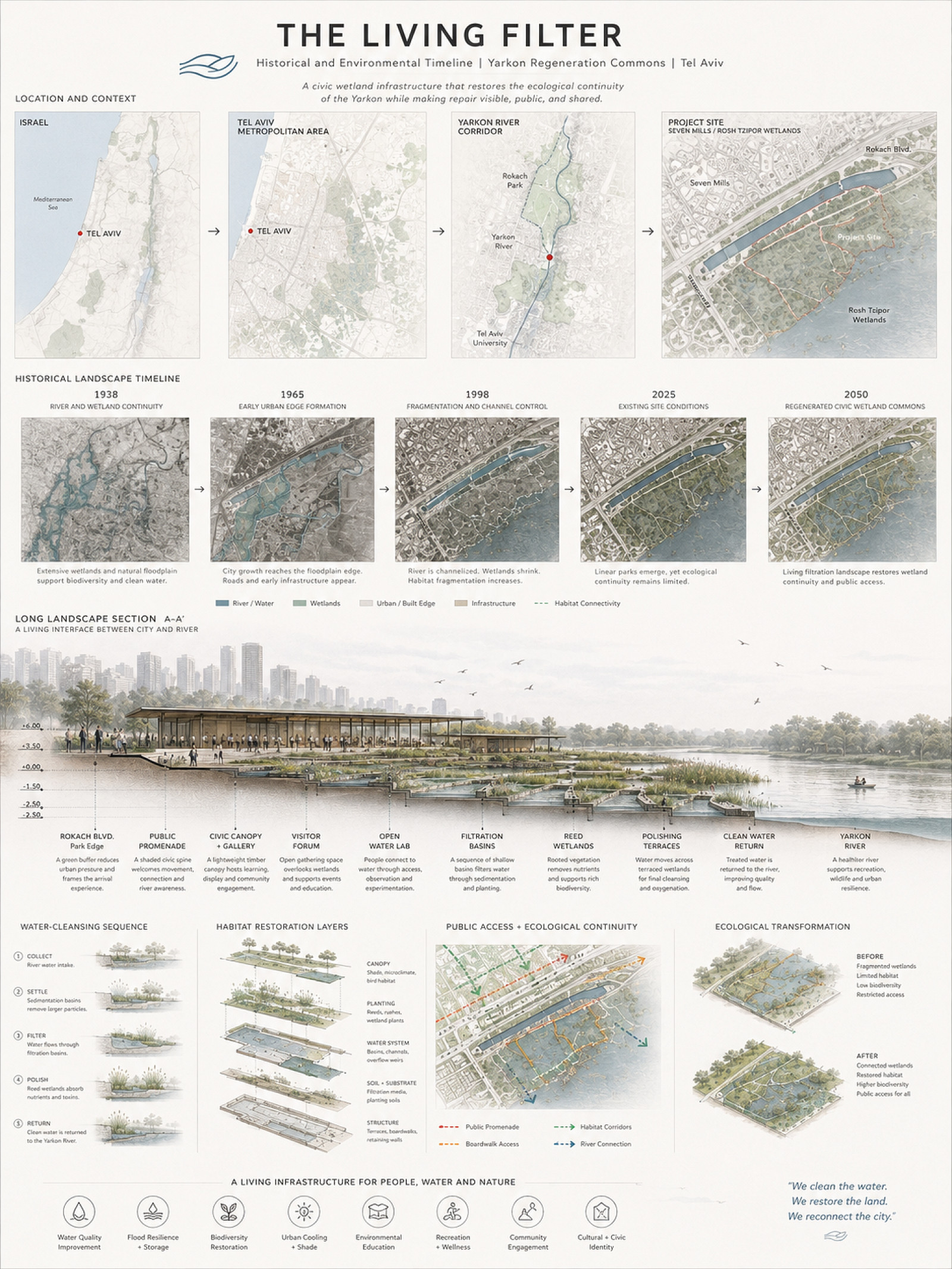
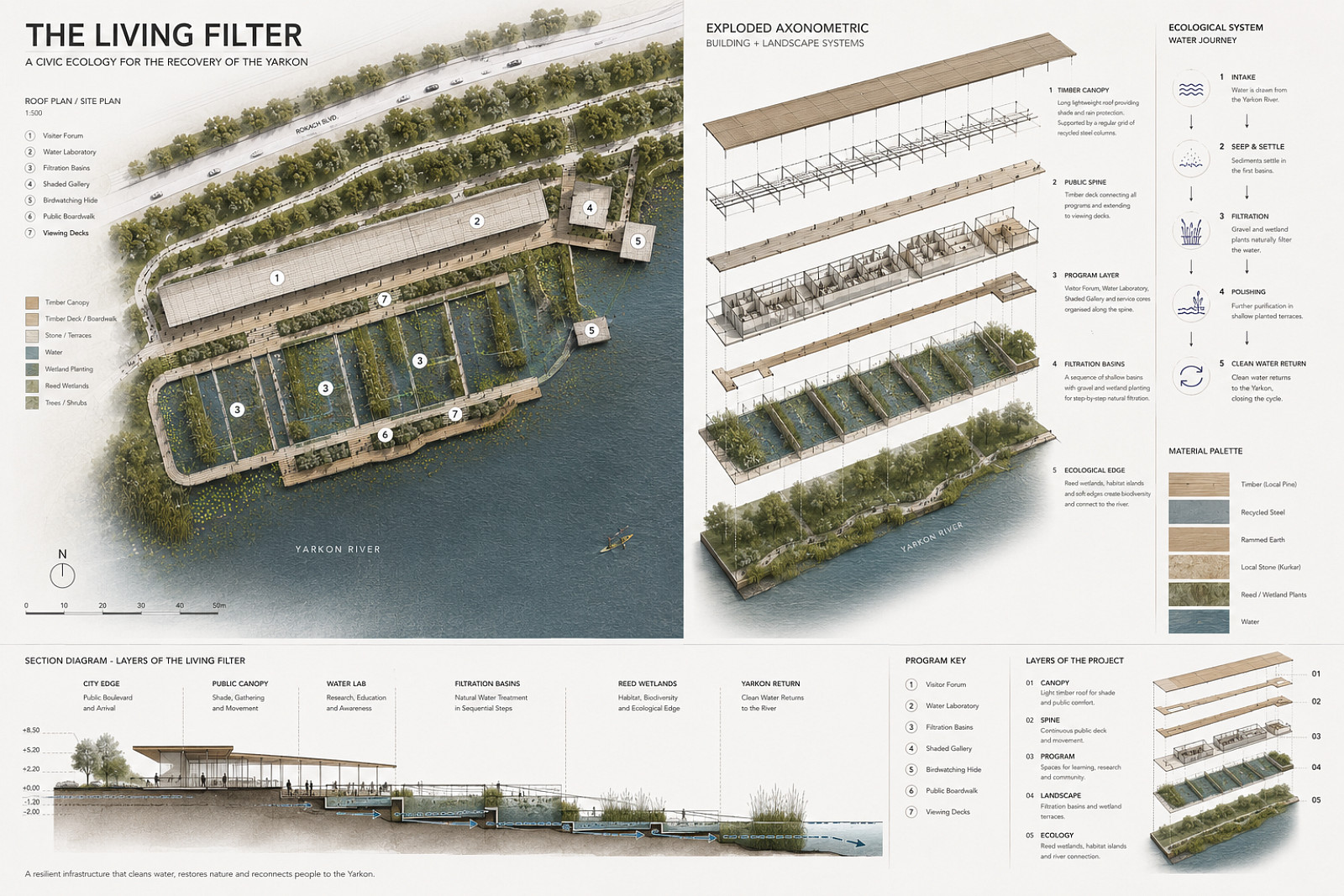
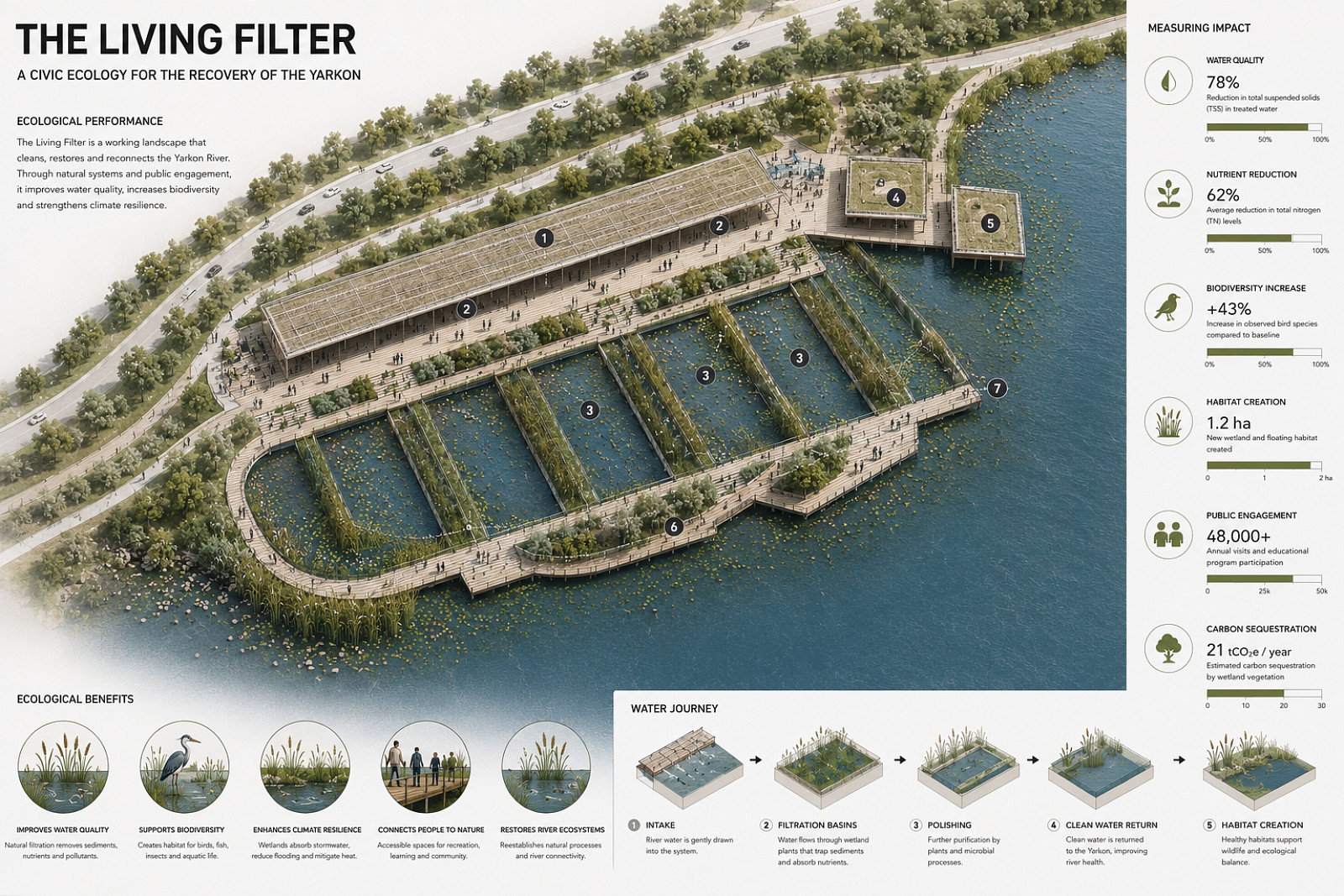
The project proposes architecture as a visible process of repair. Water is drawn gently from the river, slowed down, settled,
filtered through reed wetlands and planted basins, polished through shallow ecological terraces, and returned to the Yarkon as
part of a continuous living cycle. Instead of hiding infrastructure behind fences, pipes and technical systems, the project opens it
to the public. The act of cleaning water becomes legible, spatial and shared.
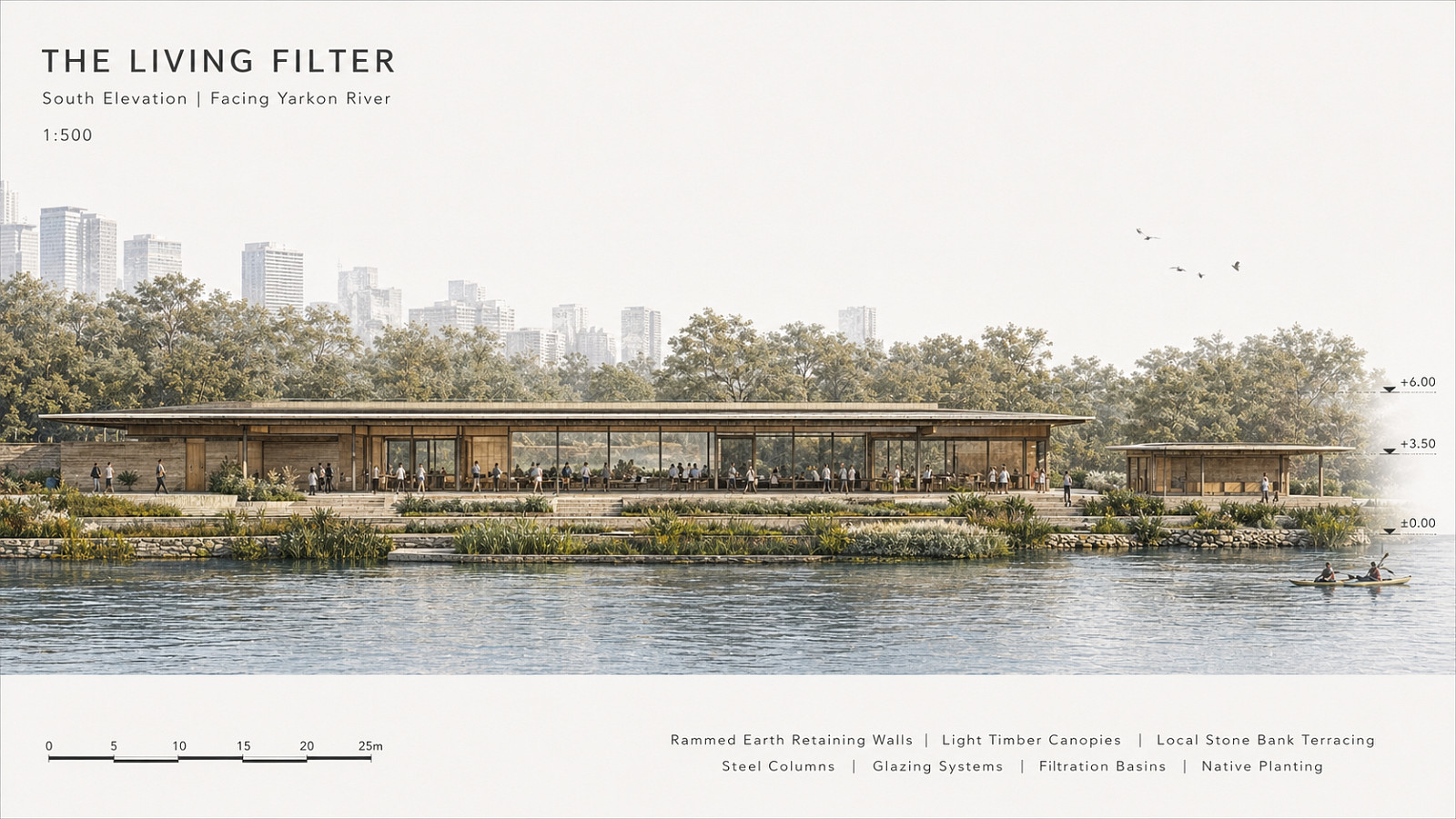
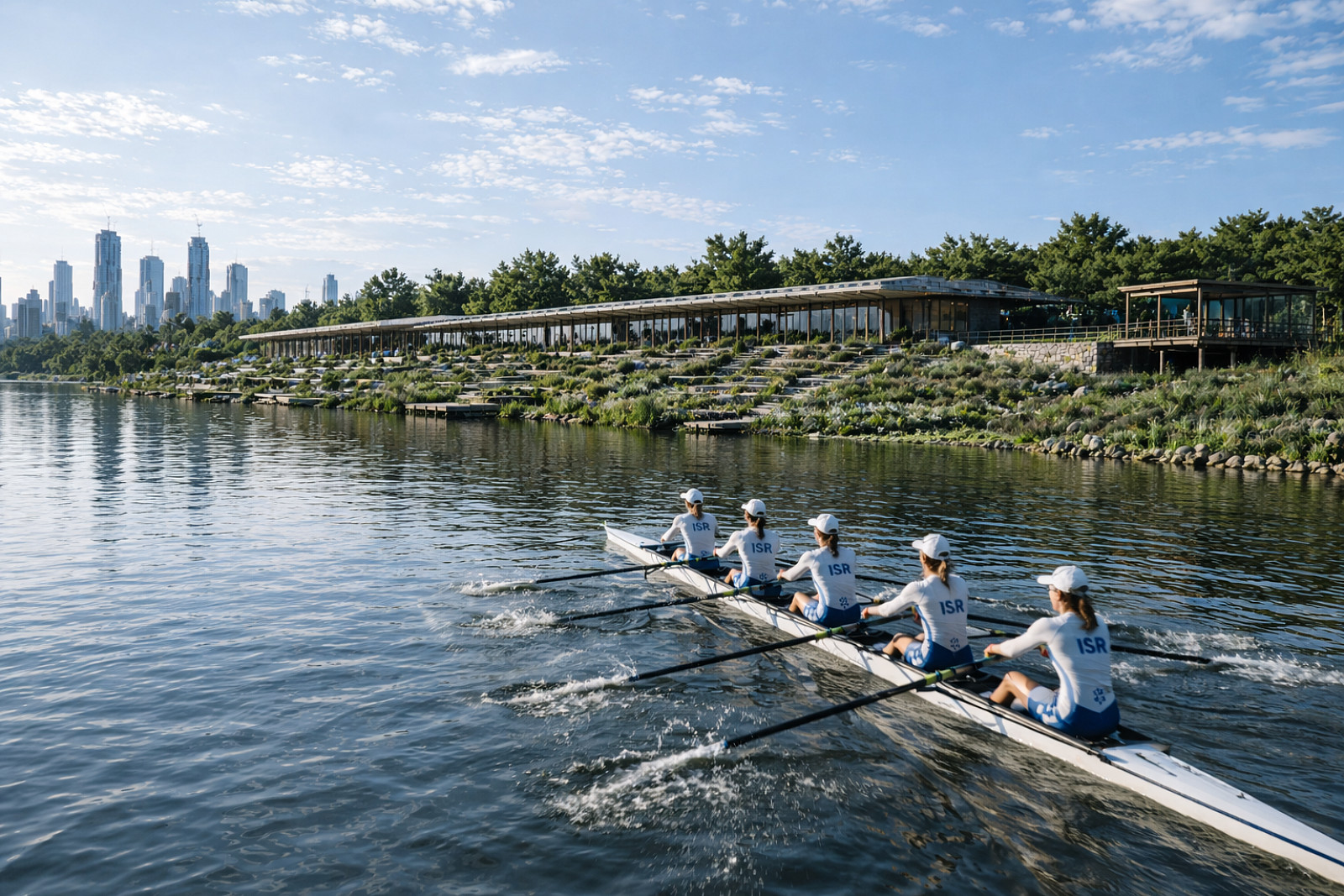
The building is not conceived as a monument, but as a civic threshold between the city and the river. A long, low timber canopy
shelters a sequence of public programs: a visitor forum, open water laboratory, shaded gallery, educational spaces, birdwatching
hides, viewing decks and boardwalks. These spaces allow residents, children, researchers, visitors and local communities to
inhabit the process of ecological regeneration rather than merely observe it from a distance.
In this sense, the project works directly within the category of Public Health. It confronts environmental pollution as a root cause
of urban inequality and reduced wellbeing. By improving water quality, supporting biodiversity, reducing heat, creating shaded
public access and reconnecting people to a healthier river landscape, the project expands the meaning of health beyond the
clinic. Health is understood here as clean water, breathable landscapes, ecological resilience, public access and everyday civic
care.
At the same time, THE LIVING FILTER belongs to Creative Health and Wellbeing. It uses architectural experience, landscape,
education and environmental storytelling as tools for long-term wellbeing. The project creates places for walking, resting,
learning, observing, gathering and reconnecting with natural processes. It invites the public to understand the river not as a
background image, but as a living system that can be cared for collectively.
The wetlands are not decorative. They are active public infrastructure. The reeds, floating islands, stone terraces, timber
walkways and filtration basins form a working landscape where ecological performance and human experience are inseparable.
Every element has a double role: to clean, to shade, to host, to teach, to restore and to reconnect.
The project does not use sustainability as an aesthetic image. It treats ecology as an ongoing civic practice. It asks how a city can
make the systems that support life visible again, and how public space can participate in healing damaged environments. In a
dense metropolitan context, the project offers a model for riverfront regeneration that is not based on consumption or spectacle,
but on care, slowness, education and shared responsibility.
THE LIVING FILTER is therefore both an environmental proposal and a health proposal. It improves the conditions through which
urban life becomes healthier: water, shade, habitat, access, knowledge, community and contact with living systems.
It is a landscape that cleans water, restores habitats and supports public wellbeing.
It is architecture as care.
It is a civic ecology for the recovery of the Yarkon.
Popis projektu
THE LIVING FILTER is a civic wetland infrastructure located along the Yarkon River in Tel Aviv. The project proposes a new relationship between the river, the city and public health by transforming water recovery into an open public landscape. Instead of treating ecological infrastructure as a hidden technical system, the project makes the process of cleaning water visible, accessible and educational.
The proposal consists of a sequence of reed wetlands, planted filtration basins, shallow ecological terraces, floating islands, timber boardwalks, viewing decks and shaded public spaces. Water is gently drawn from the Yarkon, slowed down, settled, filtered through living vegetation systems and returned to the river as part of a continuous ecological cycle.
Alongside the filtration landscape, a long low timber canopy creates a civic threshold between the city and the river. It shelters public programs including a visitor forum, open water laboratory, educational spaces, shaded gallery, birdwatching hides and gathering areas. The project supports walking, learning, resting, observing and reconnecting with the river as a living system.
The project addresses public health through clean water, shade, biodiversity, ecological resilience, public access and environmental education. It is both an environmental recovery project and a civic wellbeing project: architecture as care, and public space as an active participant in healing the Yarkon River.
Technické informace
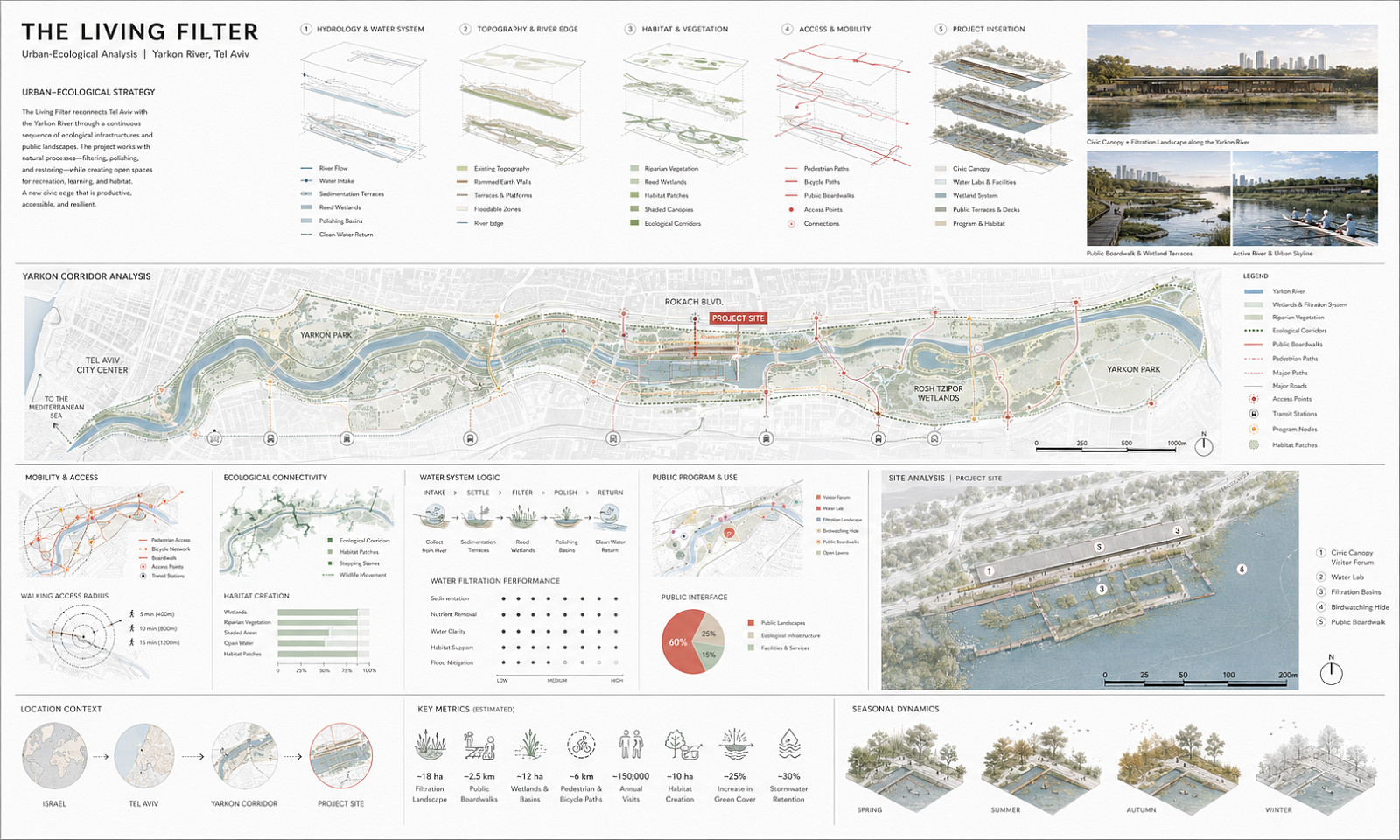
The project is based on a low-impact ecological infrastructure system combining landscape architecture, lightweight construction and natural water filtration. The main technical components include river water intake, settling zones, reed-bed wetlands, planted biofiltration basins, shallow polishing terraces and controlled water return to the Yarkon River.
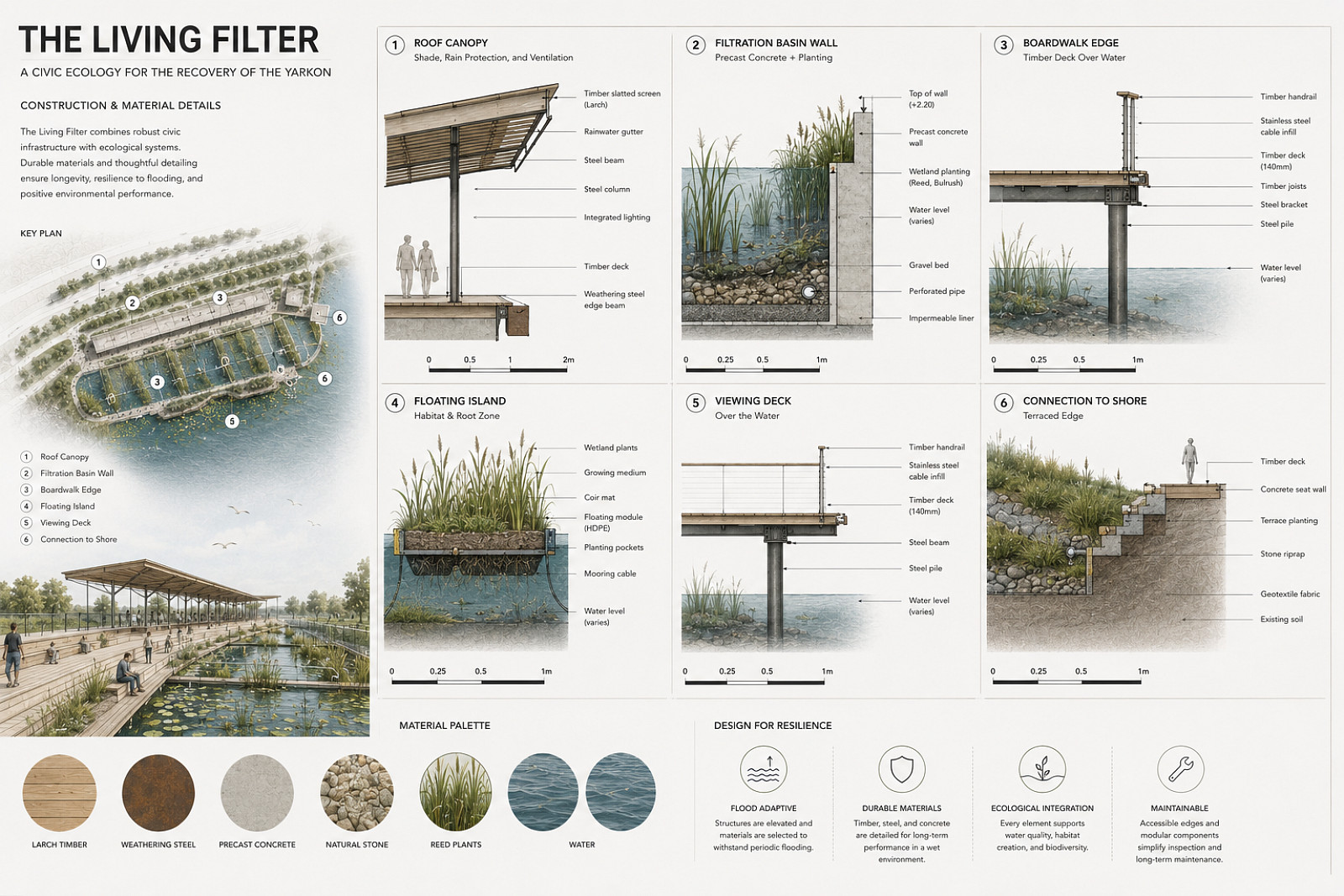
The architectural structure is conceived as a long, low timber canopy supported by a lightweight structural frame. Timber boardwalks, decks and bridges allow visitors to move through the wetland without damaging the ecological systems below. The structure is designed to minimize ground disturbance and to allow water, vegetation and wildlife habitats to remain continuous.
The filtration system uses natural processes such as sedimentation, plant-based filtration, oxygenation, microbial activity and shallow water terraces. Reeds, wetland plants, floating islands, stone edges and planted basins work together as an active living filter rather than as decorative landscape elements.
Materials include exposed timber, stone terraces, permeable walking surfaces, lightweight railings, shaded canopy elements and planted wetland zones. The project uses passive environmental strategies such as shading, evaporative cooling, habitat creation, reduced hard surfaces and direct public access to the river landscape. The technical logic of the project is therefore both infrastructural and civic: every element is designed to clean, shade, host, teach and restore.

Copyright © 2026 INSPIRELI | All rights reserved. Use of this website signifies your agreement to the Terms of Use, Privacy Policy, and use of cookies.