THE GATEWAY PROTOCOL

Idea projektu
THE GATEWAY PROTOCOL
Architecture for Reprogramming Perception
We live in an age of uninterrupted stimulation.
A reality of permanent notifications, accelerated information, artificial light, endless visibility, and constant psychological occupation. The contemporary individual no longer experiences silence as absence, but as discomfort. Attention has become fragmented, perception has become conditioned, and consciousness itself is increasingly shaped by external systems of control.
THE GATEWAY PROTOCOL emerges from this condition.
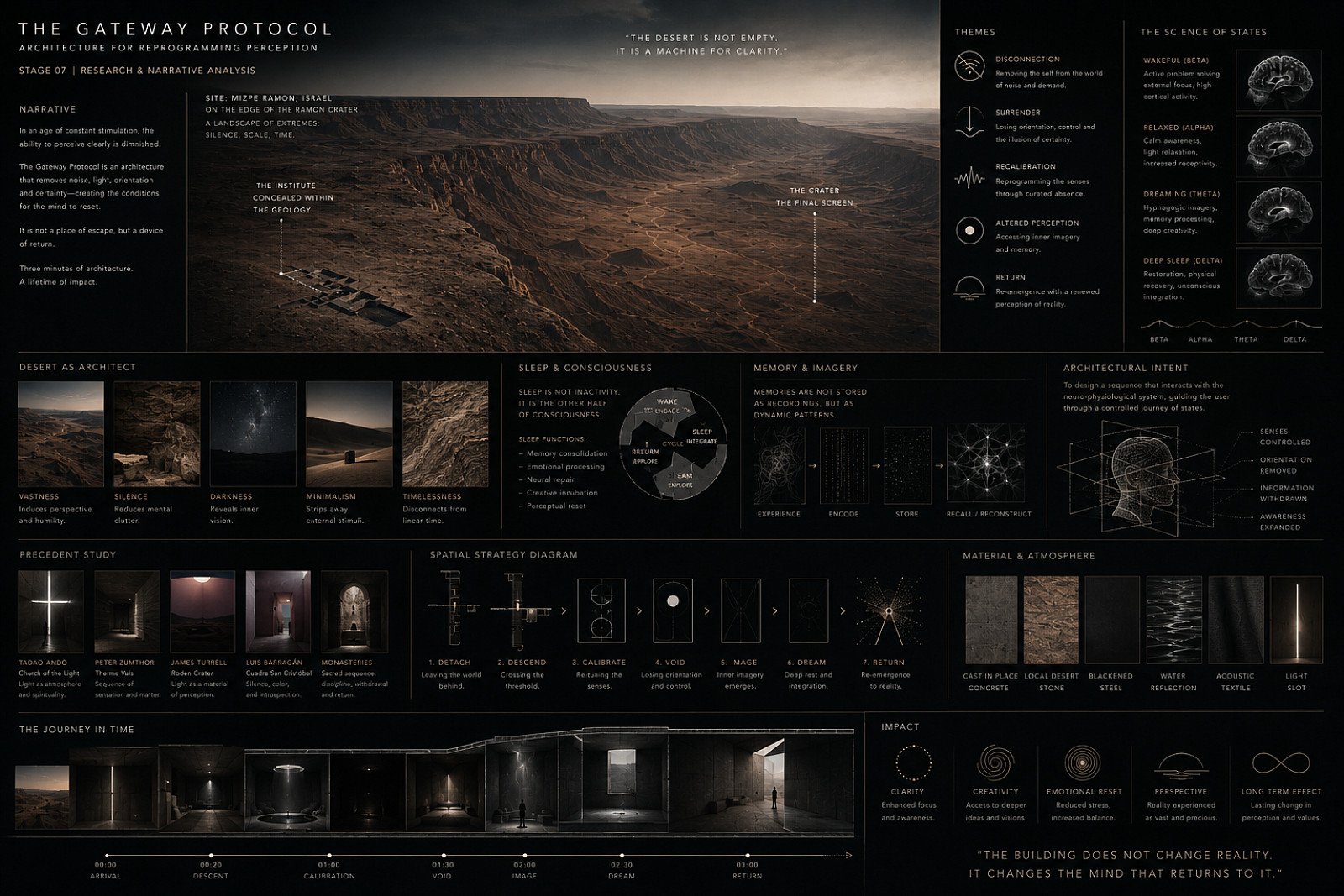
The project proposes architecture not as shelter, object, or image, but as a neurological interface — a spatial instrument capable of recalibrating human perception through controlled sequences of withdrawal, silence, darkness, and sensory reduction.
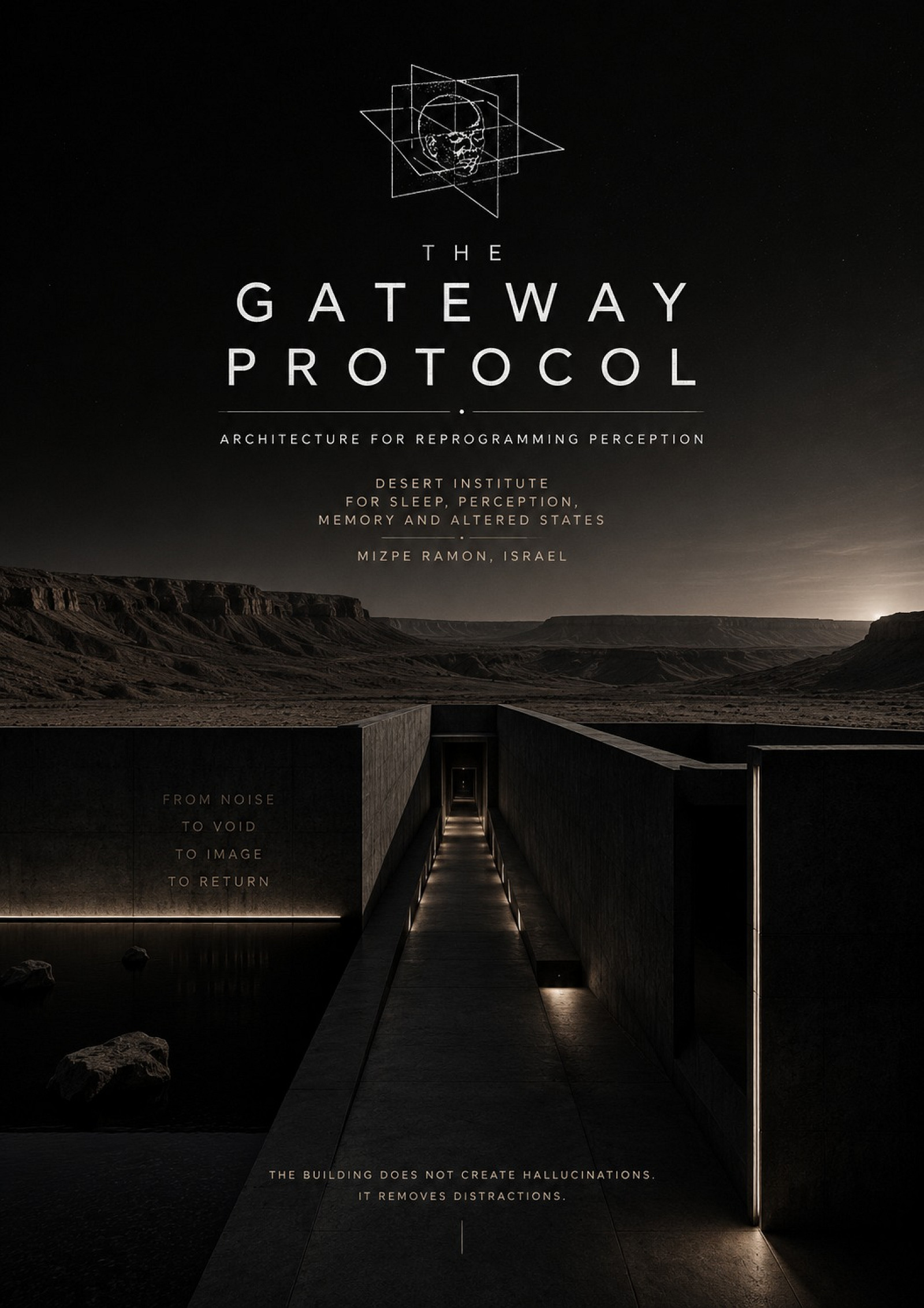
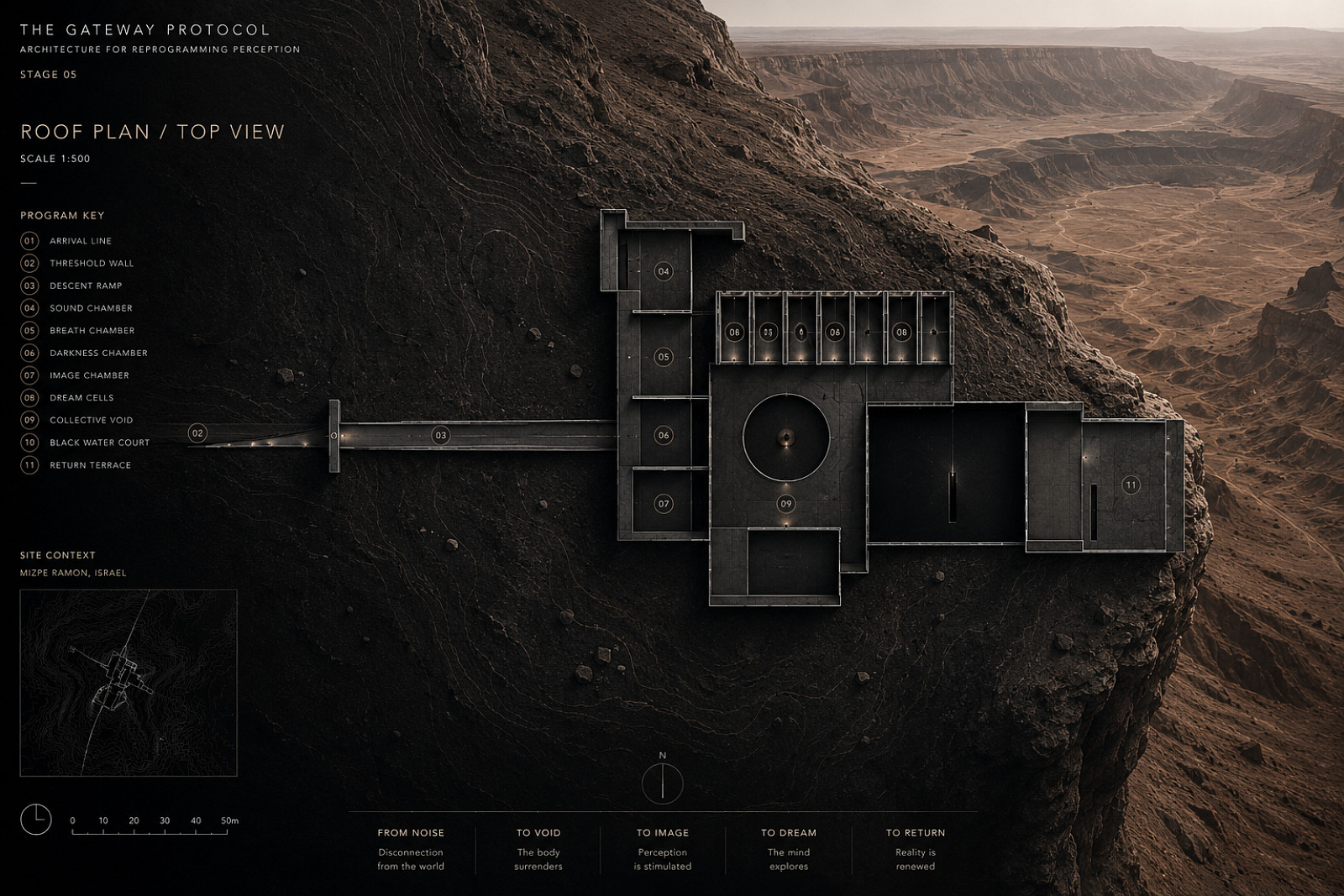
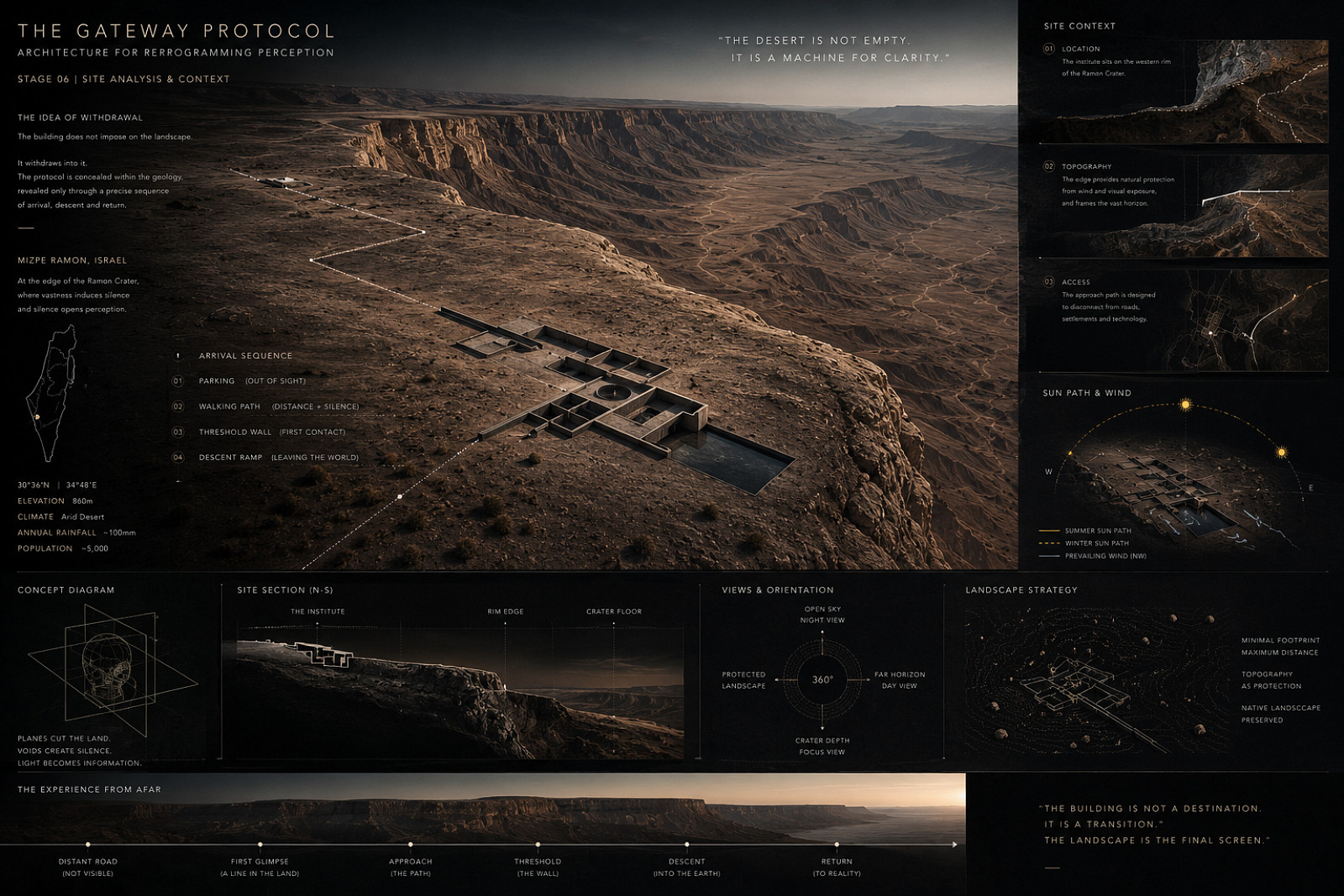
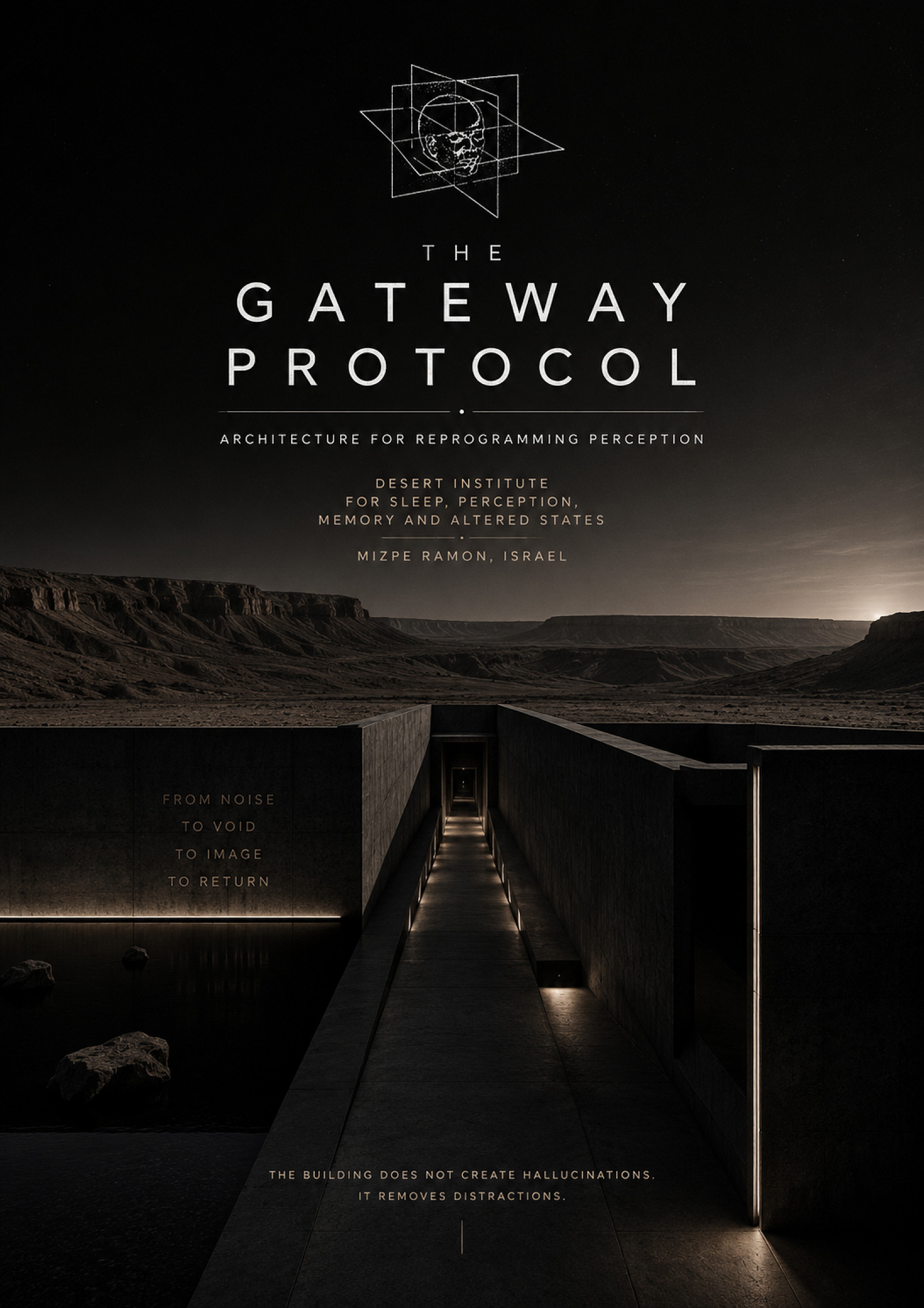
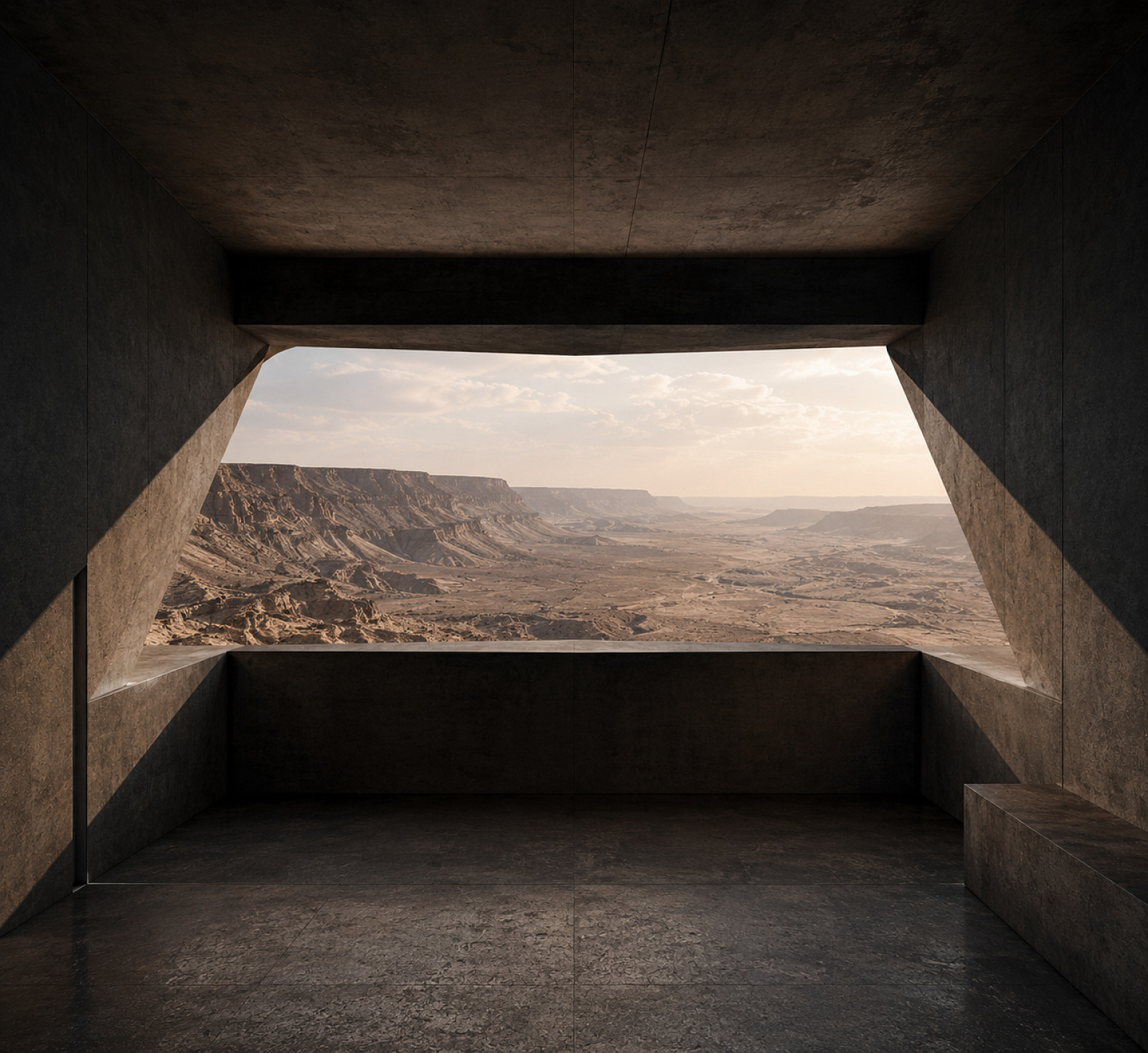
Located on the edge of the Ramon Crater in the Israeli desert, the institute is partially buried within the geological landscape. The building does not dominate the site; it disappears into it. From afar, only thin cuts in the terrain, dark retaining walls, and traces of light reveal its existence. The desert becomes both context and mechanism — an environment of vastness, stillness, and psychological exposure.
The project draws inspiration from the historical idea of the “Gateway Process,” a controversial protocol that explored altered states of consciousness and the relationship between perception, memory, and mental conditioning. Yet the architecture does not attempt to reproduce hallucinations or simulate artificial experiences. Instead, it removes distraction. It constructs the conditions through which the mind may encounter itself differently.
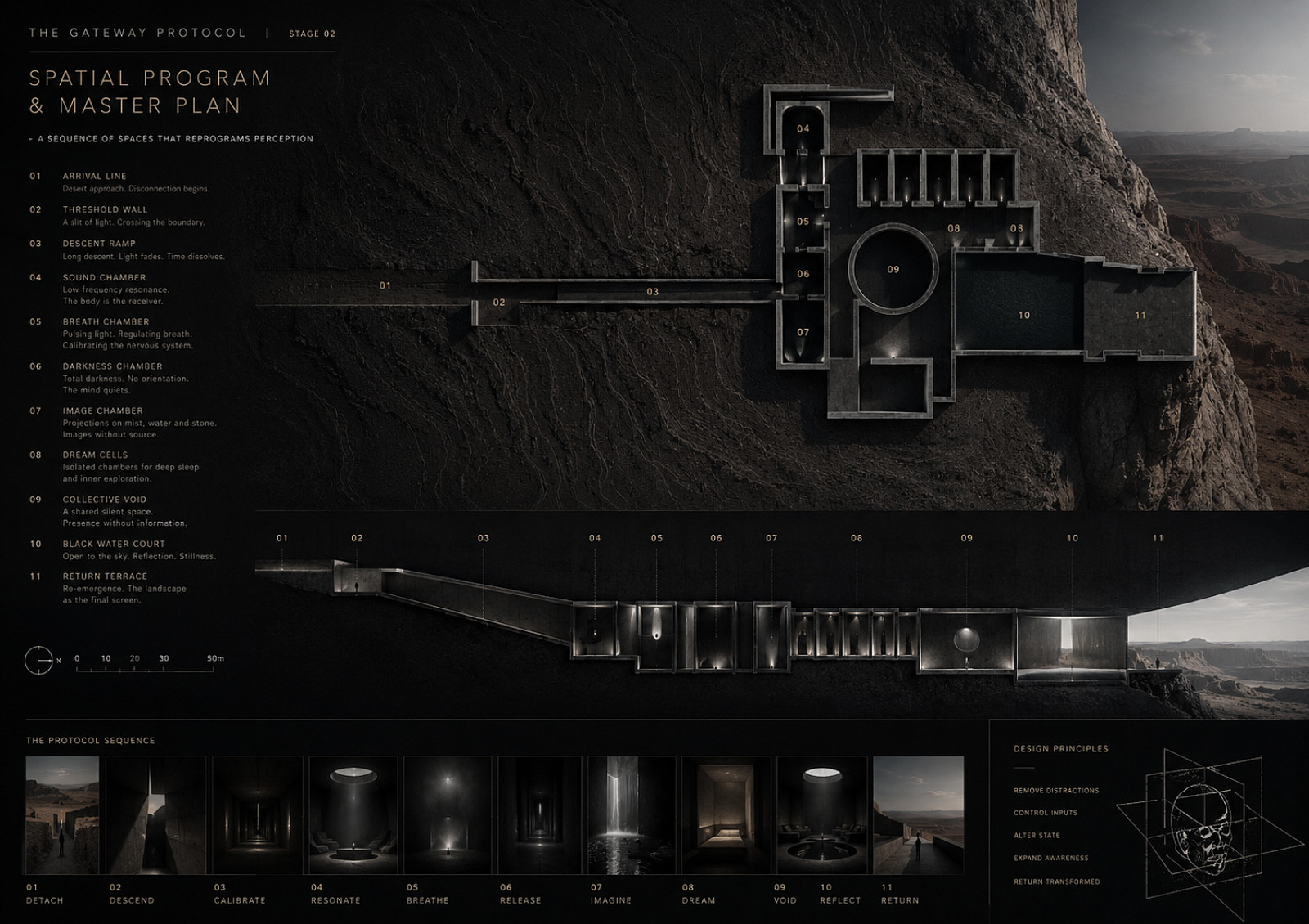
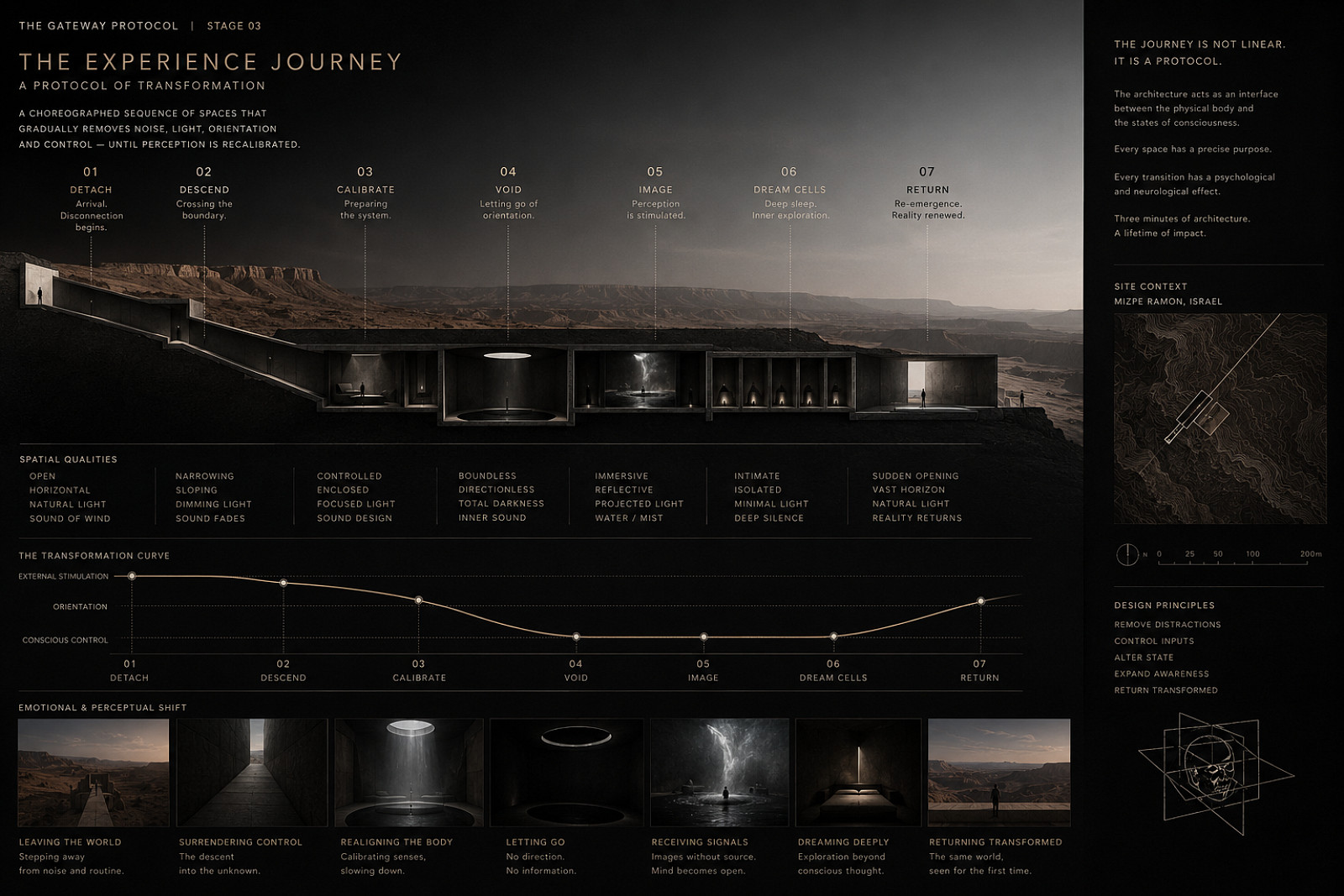
The spatial journey is organized as a precise architectural protocol.
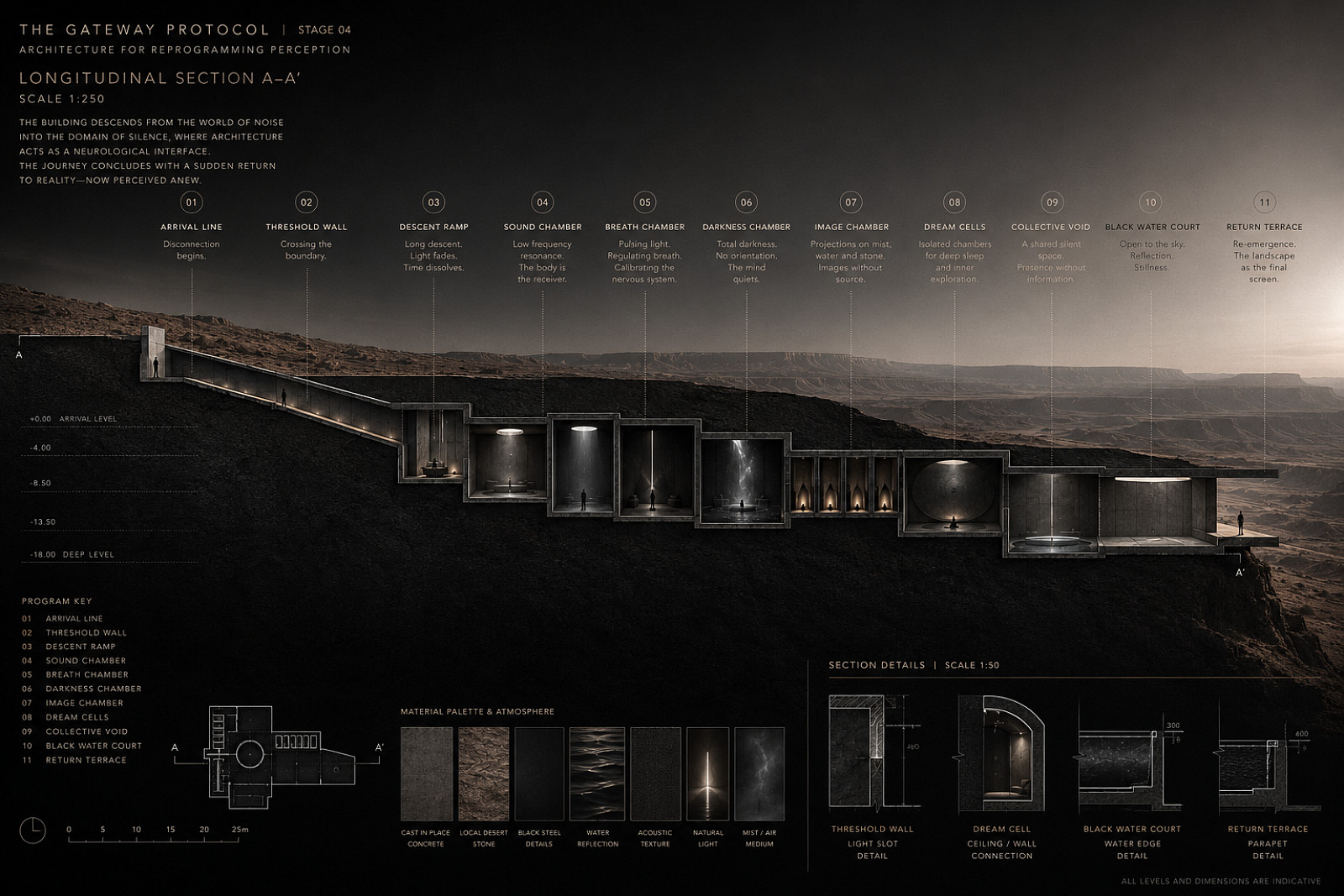
The visitor arrives at dusk and enters through a long isolated path carved into the landscape. The movement away from roads, screens, noise, and civilization begins before crossing the threshold itself. A narrow wall of concrete marks the entrance. Beyond it, a descending ramp slowly removes orientation, daylight, and external reference.
The body begins to recalibrate.
Inside the complex, a sequence of chambers manipulates perception through architectural means alone: proportion, darkness, acoustics, temperature, reflection, isolation, rhythm, and silence. Sound chambers resonate at low frequencies felt physically through the body. Breath chambers pulse with dim atmospheric light. Void chambers remove visual information entirely. Dream cells isolate the individual in deep silence beneath minimal openings to the sky.
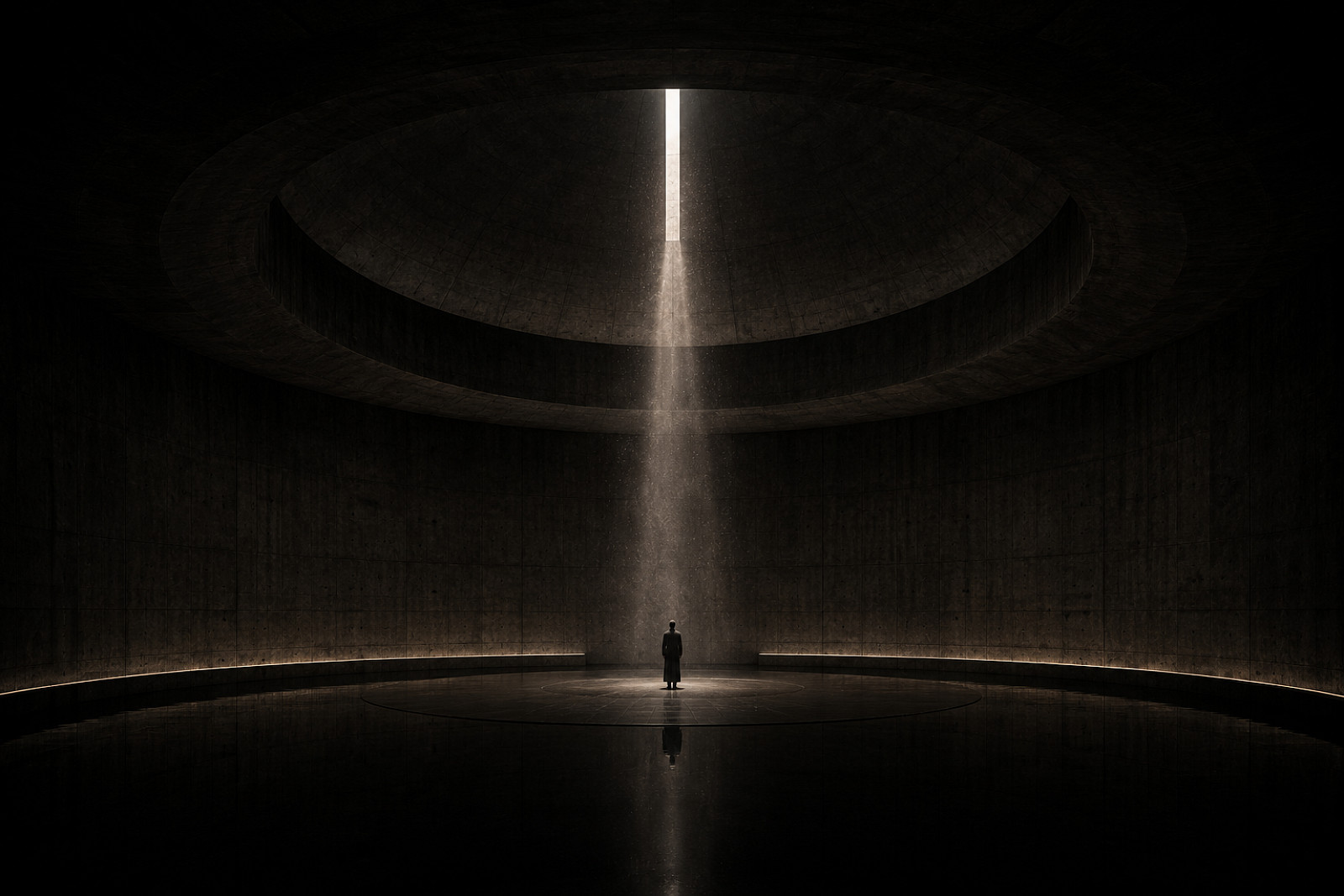
At the center of the institute lies the Collective Void — a circular chamber stripped of image, narrative, and distraction. It is not designed for spectacle, but for confrontation with stillness.
The architecture operates through subtraction.
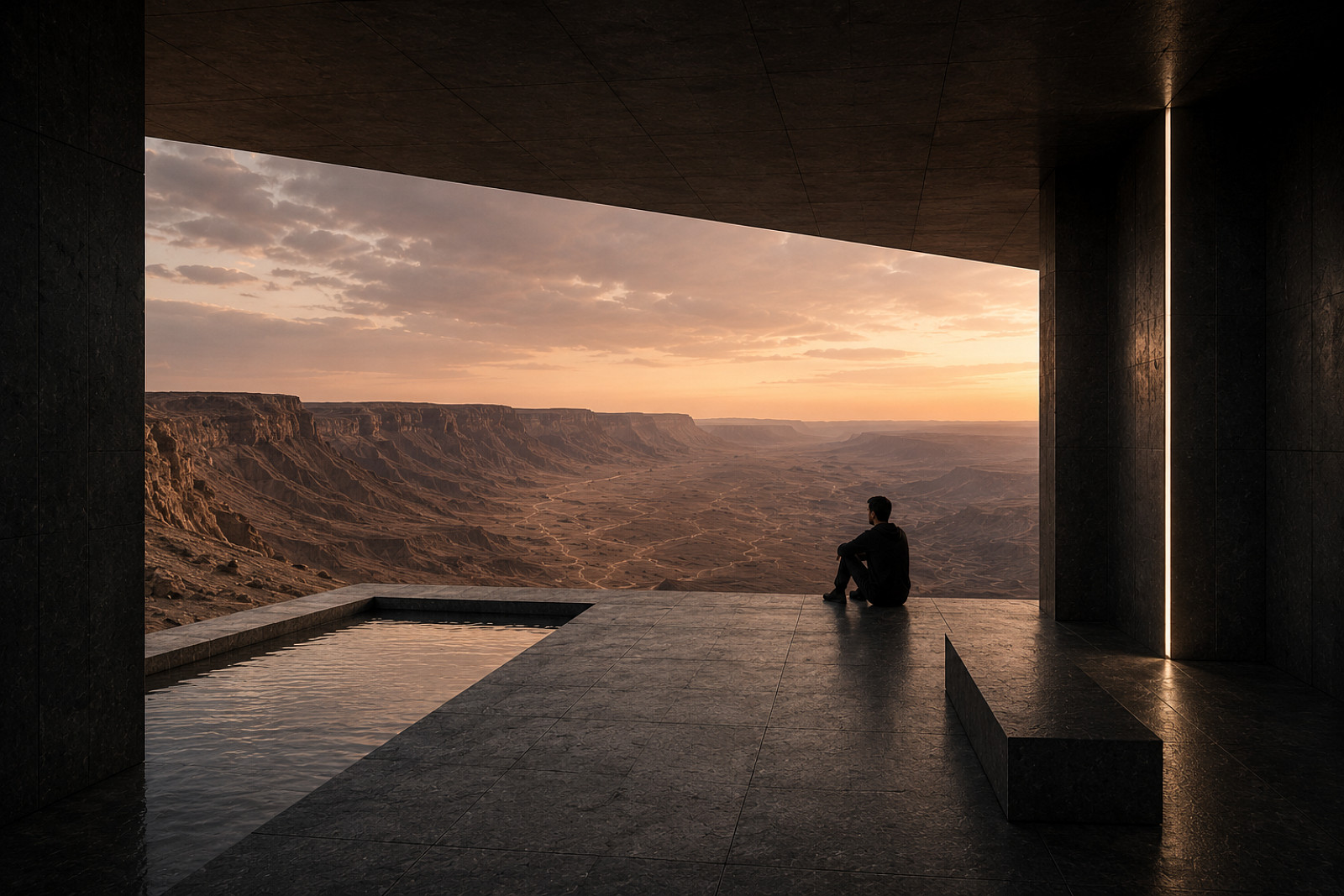
The final space, the Return Terrace, opens suddenly toward the immensity of the crater. After prolonged darkness and sensory compression, the landscape reappears with amplified clarity. The horizon becomes the final projection surface. Nothing in the world has changed — yet perception itself has been altered.
THE GATEWAY PROTOCOL questions the role of architecture within a culture saturated by stimulation and information. Rather than producing more content, more spectacle, or more visual noise, the project proposes an architecture of controlled disappearance. A building that withdraws in order to intensify awareness.
It is not a monument to technology.
It is not a therapeutic retreat.
It is not a machine for escape.
It is a framework for return.
The project suggests that architecture still possesses the power to influence consciousness — not through digital interfaces or immersive media, but through mass, light, silence, gravity, and time.
THE GATEWAY PROTOCOL ultimately asks a fundamental question:
What if architecture could become a tool not for occupying space, but for reprogramming the way reality itself is perceived?
The building does not change reality.
It changes the mind that returns to it.
Popis projektu
THE GATEWAY PROTOCOL is an architectural institute located on the edge of the Ramon Crater in the Israeli desert. The project proposes architecture as a neurological and perceptual interface: a spatial protocol designed to reduce stimulation, slow down perception and allow the visitor to encounter silence, darkness and stillness in a controlled architectural sequence.
The building is partially buried within the desert landscape and is revealed only through thin cuts in the terrain, retaining walls and controlled openings of light. Rather than standing as an object in the landscape, the project withdraws into the geology of the crater and uses the desert itself as part of the experience.
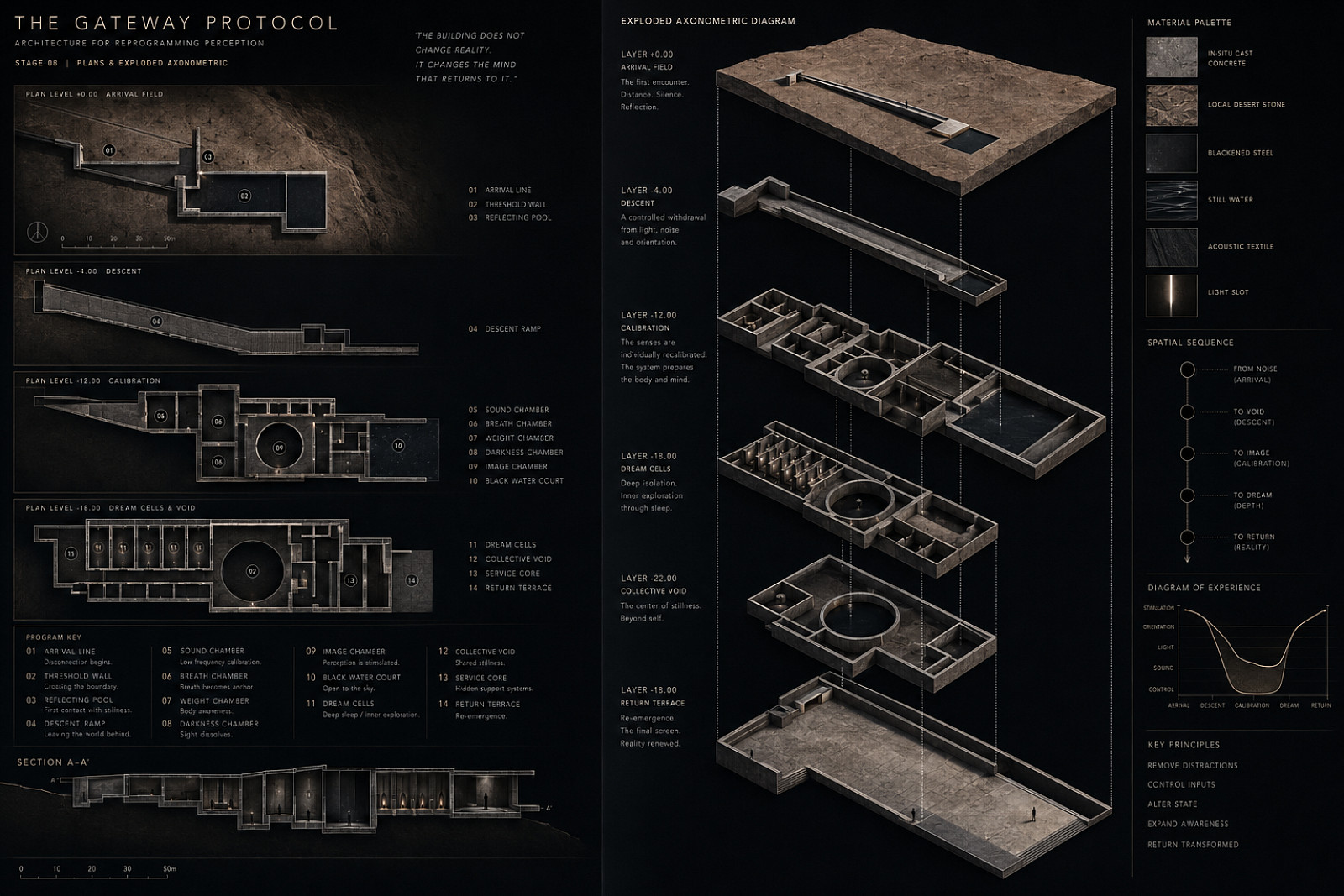
The visitor moves through a carefully structured journey: an isolated arrival path, a narrow entrance wall, a descending ramp, sensory chambers, sound spaces, breath chambers, void rooms, dream cells, a central Collective Void and finally a Return Terrace facing the vast horizon of the Ramon Crater. Each space is designed to manipulate perception through architecture alone: proportion, light, darkness, acoustics, temperature, material, rhythm and silence.
The project questions the role of architecture in a culture of constant stimulation, screens, notifications and visual noise. Instead of producing spectacle, it creates conditions for withdrawal, attention and mental recalibration. It is not a retreat, a monument or a digital simulation, but a framework for returning to reality with altered awareness.
Technické informace
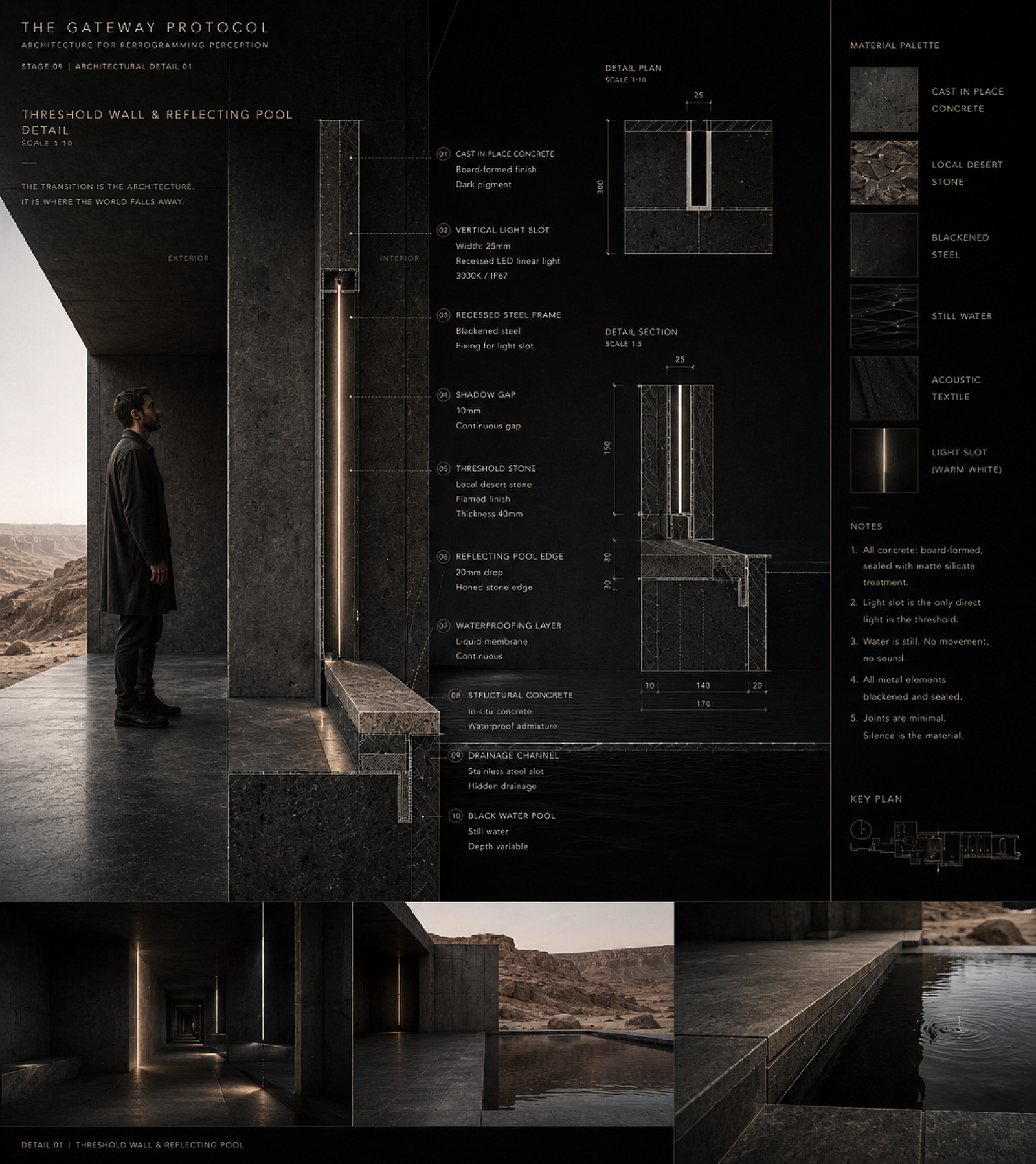
The project is based on a partially buried architectural structure integrated into the desert terrain of the Ramon Crater. The main construction system consists of reinforced concrete retaining walls, underground chambers, carved circulation routes, heavy thermal mass and controlled openings to light and sky. The building uses the natural slope and geology of the site to create a sequence of enclosed, compressed and exposed spaces.
The spatial system includes an isolated entrance path, descending ramp, sensory chambers, acoustic chambers, breath chambers, void chambers, individual dream cells, a central circular Collective Void and an open Return Terrace. These spaces are organized as a continuous architectural protocol, moving from external landscape to deep interior darkness and finally back to the open desert horizon.
The project uses passive environmental strategies suitable for the desert climate. Its buried mass provides thermal stability, protection from extreme heat and reduced exposure to direct solar radiation. Narrow openings, deep walls, shaded transitions and controlled courtyards regulate light, temperature and atmosphere. The architecture relies on natural darkness, earth contact, thermal mass and carefully framed daylight rather than artificial visual effects.
Materials include exposed concrete, dark retaining walls, compacted desert stone, mineral surfaces, acoustic interior finishes, minimal metal details and controlled skylight openings. The technical logic of the project is not decorative but experiential: every structural, environmental and material decision supports the perceptual journey of silence, withdrawal, compression, darkness and return.

Copyright © 2026 INSPIRELI | All rights reserved. Use of this website signifies your agreement to the Terms of Use, Privacy Policy, and use of cookies.
