ERASURE: Light Occupies What the Body Cannot


Project idea
Named ERASURE, the concept draws its logic from Galpón 9, the warehouse where 80 prisoners were shackled within 95cm partitioned cells. This single measurement becomes the architectural module of the entire project.
Absence is made physical. Voids replace solids. Fragments replace wholeness. The visitor does not read history; they feel it first in the body. Compressed corridors suddenly release into open voids. Volumes are buried below ground. Light enters only as narrow fractures. The architecture replicates the emotional arc of confinement, loss, and release without a single word of explanation. The space speaks before the mind can understand.
80 chairs. 80 prisoners. Light fills the empty seat when no body occupies it, because when they are gone, only light remains.
Project description
The Arsenal Memory Park is a conceptual design proposal for the Arsenal site in the metropolitan area of San Miguel de Tucumán, Argentina. The site was formerly the base of the Miguel de Azcuénaga Arsenal Company, where a clandestine detention, torture, and extermination centre operated between 1976 and 1983 under the military dictatorship.
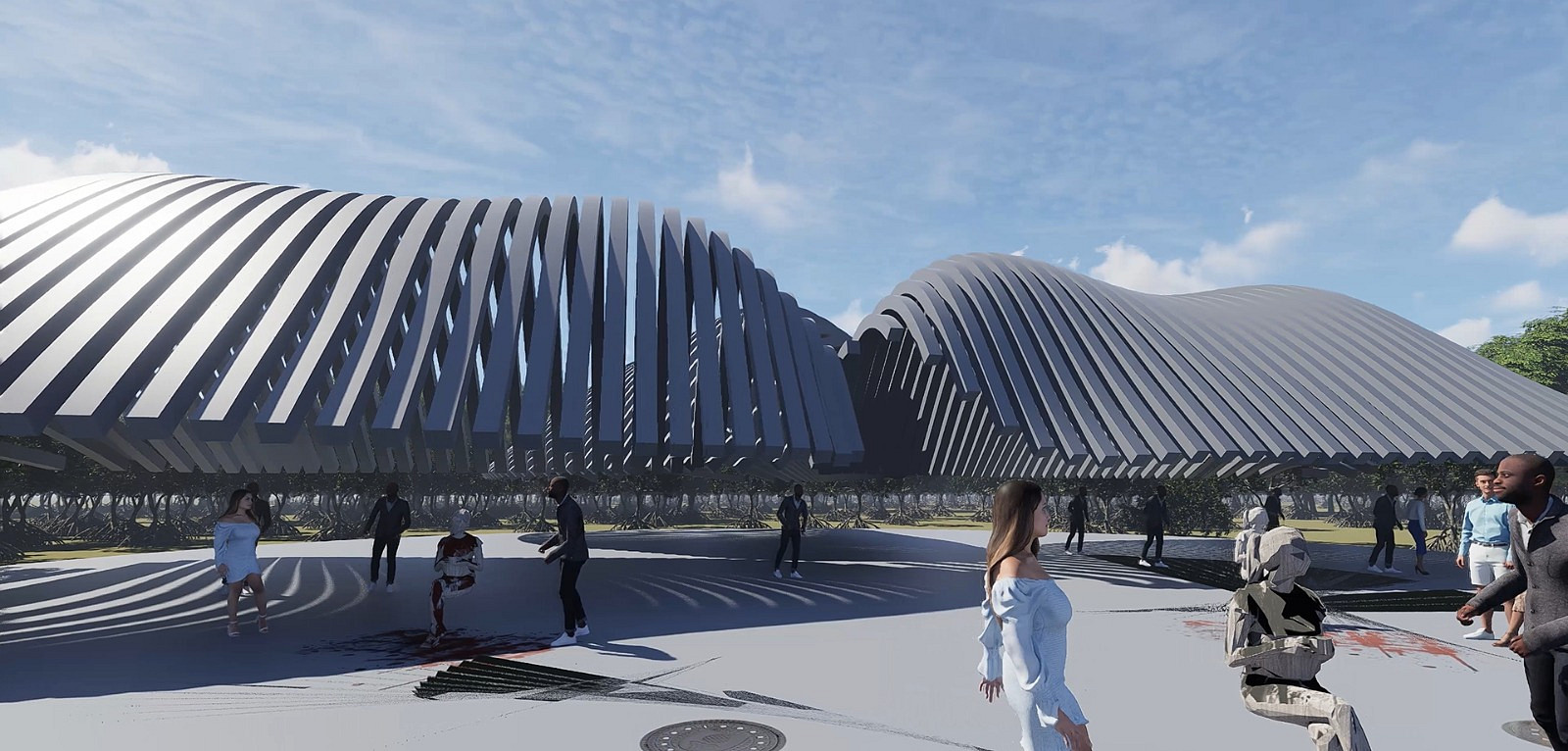
The project is organised into two integrated systems. The Thematic Activities System forms the memorial core, comprising the Historical Exhibition Pavilion, Memorial Art Gallery, Memory Plaza, Immersive Audiovisual Showroom, and Administration. The Complementary Activities System forms the civic layer, comprising the Concert Hall (8,000 capacity), Amphitheatre, Classroom Complex, Conference Hall Complex, Shade House, and Commercial Premises. Both systems connect through a continuous pedestrian spine that moves visitors from the memorial core outward into the public city.
Across all spaces, architecture becomes a medium of active memory. Light, void, form, and movement are used to translate absence into spatial experience. Exposed concrete, translucent skins, and fractured geometries create a restrained material palette rooted in the emotional weight of the site.
Technical information
Structural system - Reinforced concrete frame with thin-shell gunite vaulting for the Art Gallery arches.
Primary materials - Rammed earth using local Tucumán terracotta subsoil and exposed board-formed concrete, chosen for thermal mass, and tonal continuity with the Argentine landscape.
Roof systems - PTFE-coated fibre glass membrane for the Audiovisual Dome. Aluminium composite panel parametric canopy for the Conference Hall. Titanium zinc cladding over gunite vaults for the Art Gallery. Anodised aluminium standing-seam faceted roof with SRI of approximately 90 for the Concert Hall. Weathering Corten steel canopy ribs for the Memory Plaza. Pre-patinated copper parametric fins for the Shade House.
Climate strategy - The site has a subtropical humid climate with summers reaching 35 to 40°C and intense solar radiation year-round. The below-grade Exhibition Pavilion ramp is earth-cooled passively at 18 to 20°C year-round. Rammed earth and concrete thermal mass moderate interior temperatures without mechanical systems. Permeable ground surfaces manage Tucumán's storm runoff, fulfilling the brief's requirement for the park to serve as a stormwater retention basin.
Site area - Approximately 119.7 hectares total, with covered programme of 13,500 m² and open landscape programme of 26,800 m².
Documentation

Copyright © 2026 INSPIRELI | All rights reserved. Use of this website signifies your agreement to the Terms of Use, Privacy Policy, and use of cookies.