

Ambivalence - Constrained Freedom


Project idea
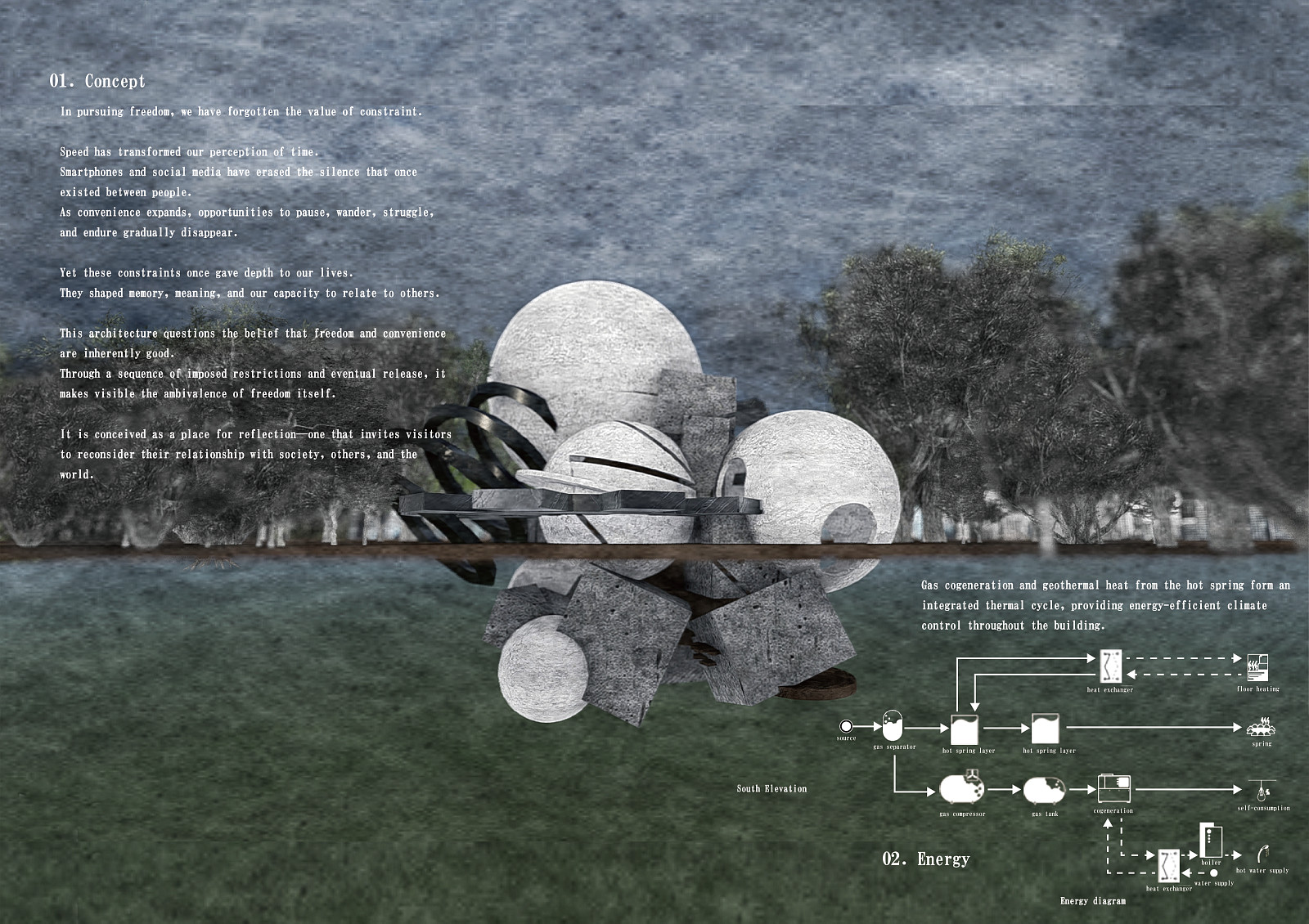
Ambivalence: Constrained Freedom explores the paradox that, in pursuing freedom, convenience, and efficiency, contemporary society may have lost the value of constraint.
Speed, connectivity, and safety have transformed everyday life, yet they have also reduced opportunities to pause, wander, struggle, and reflect. The project questions whether these lost constraints once provided meaning, empathy, and depth to human experience.
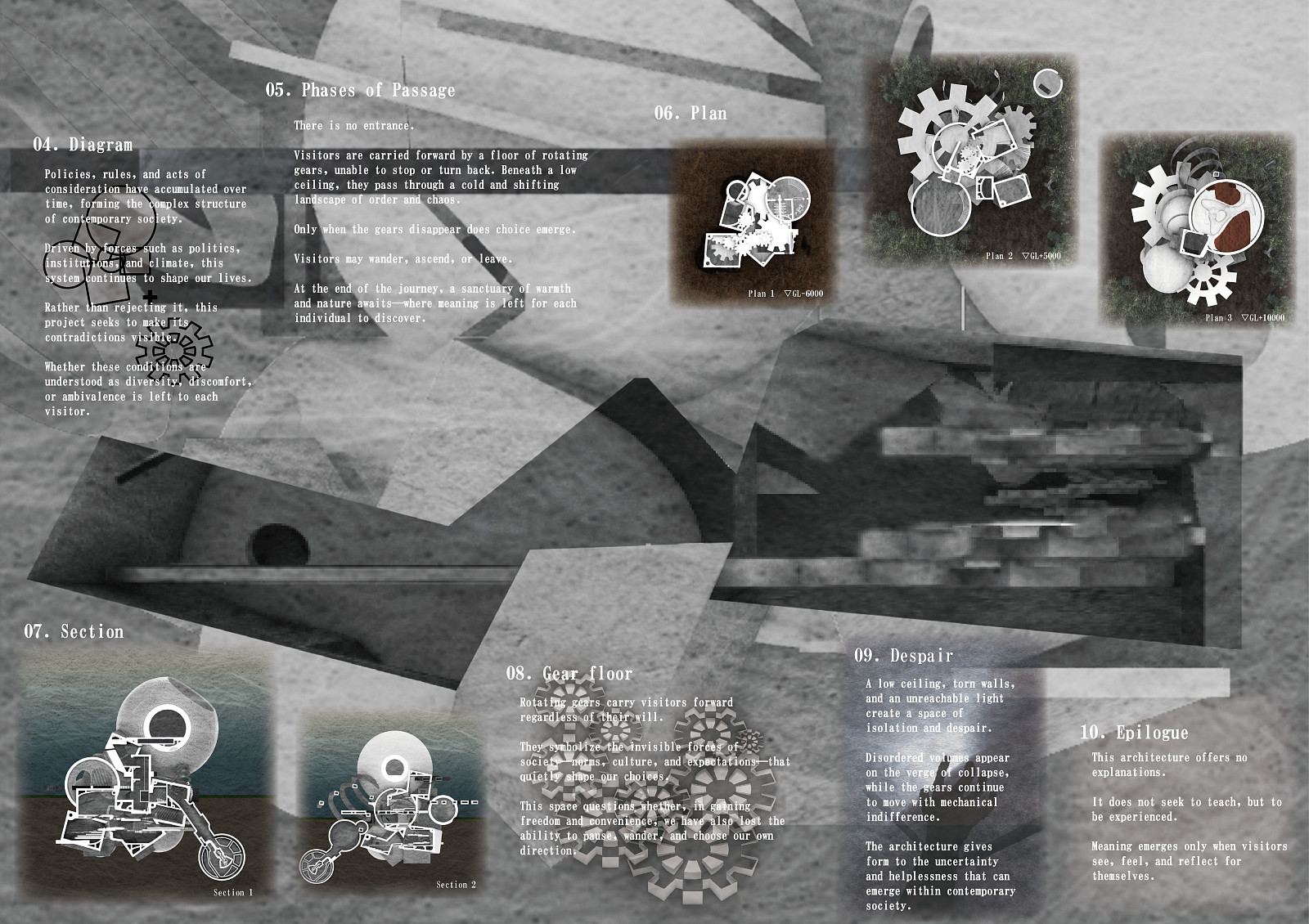
Through architecture, visitors are invited to physically experience the tension between restriction and freedom, and to reconsider their relationship with society, others, and themselves.
Project description
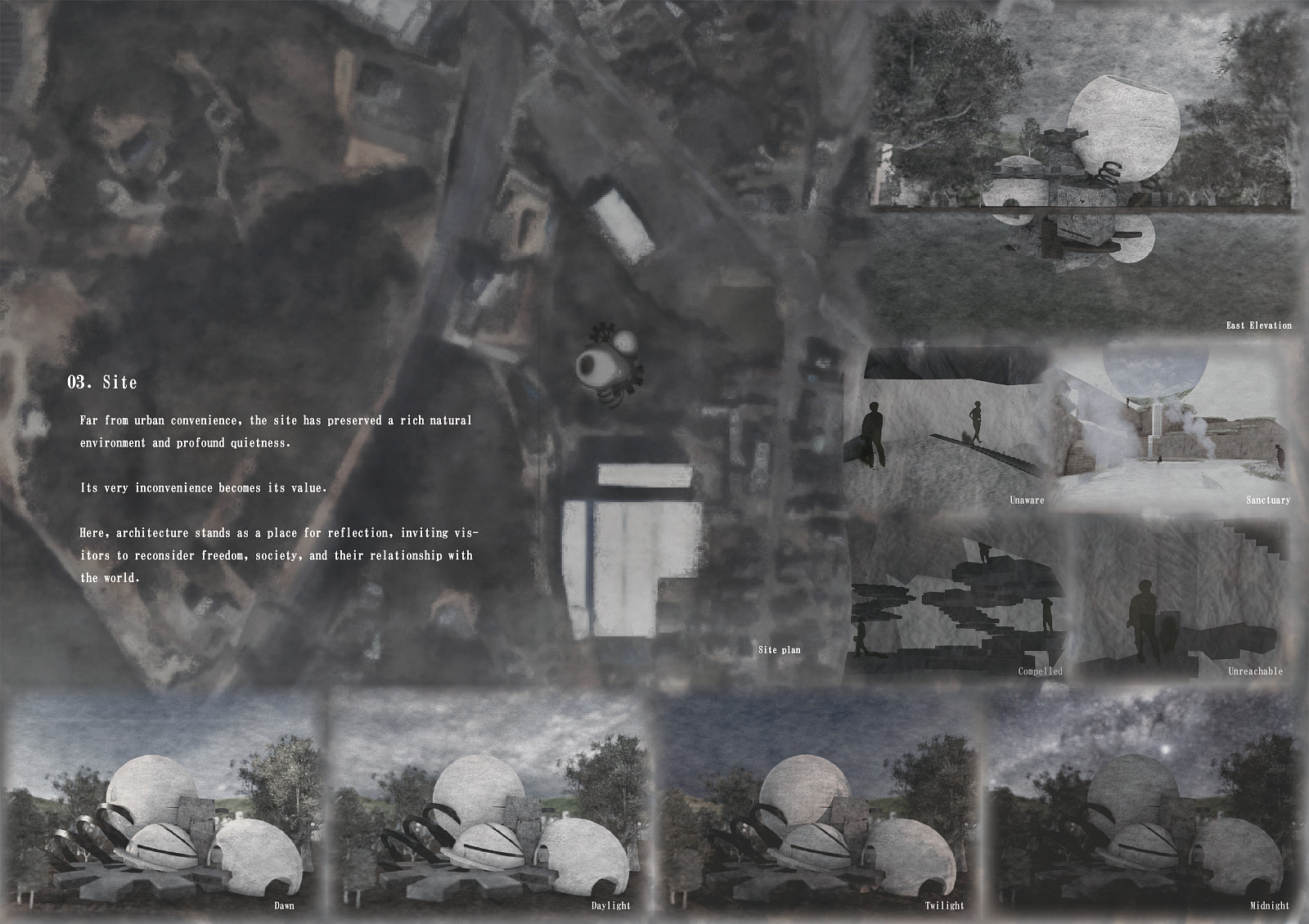
The project is located at a former emergency exit site of the Linear Chuo Shinkansen, where geothermal water continues to emerge from deep underground.
Visitors enter through a hidden annex and descend below ground into a sequence of spaces shaped by mechanical movement, compression, uncertainty, and eventual release. Rotating gears, shifting volumes, and contrasting spatial conditions translate invisible social forces into physical experience.
As the journey progresses, imposed movement gradually gives way to personal choice, culminating in a sanctuary-like bathing space powered by geothermal energy. The architecture functions not as a place that provides answers, but as a setting for reflection and self-discovery.
Technical information
The project utilizes geothermal energy from the site's hot spring source together with a gas cogeneration system to provide electricity and thermal energy throughout the building.
Geothermal heat is reused for underfloor heating and environmental conditioning, creating an integrated thermal cycle that maximizes energy efficiency. The building consists of interconnected subterranean and above-ground volumes organized around a sequence of experiential spaces and a mechanically driven circulation system.

Copyright © 2026 INSPIRELI | All rights reserved. Use of this website signifies your agreement to the Terms of Use, Privacy Policy, and use of cookies.
