Hacia La Luz - Towards Light


Project idea
HACIA LA LUZ – TOWARDS THE LIGHT
"Hacia La Luz" (Towards the Light) is conceived as a spatial journey through memory, suffering, reflection, and hope. The project explores how architecture can transform remembrance into an immersive experience that engages the senses and emotions of visitors.
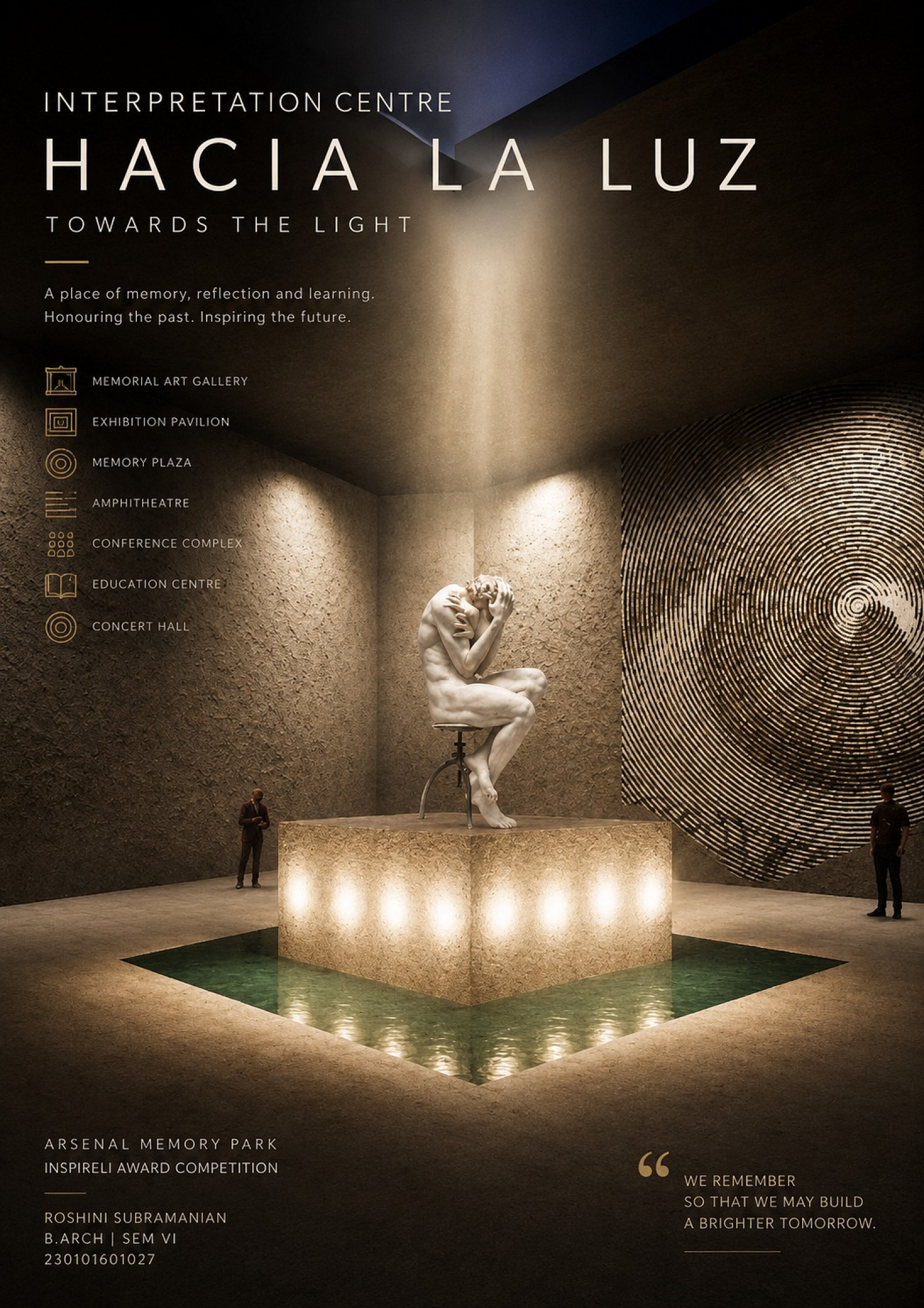
The journey begins at the Memory Plaza, an open gathering space designed to accommodate and organize visitors before they enter the memorial sequence. From the plaza, visitors are guided through a narrow and intentionally dark bridge, creating a moment of transition from the outside world into a realm of reflection. Water flows on either side of the bridge while light cascades onto textured walls like a waterfall, establishing a serene atmosphere and symbolizing purification, remembrance, and passage.
This transition leads to the Audio-Visual Room and Memorial Gallery, where visitors encounter a curated sequence of symbolic sculptures and installations. Rather than relying on uniform illumination, light is carefully controlled and directed only onto the sculptures and water elements. The surrounding darkness heightens focus and emotion, allowing each exhibit to communicate stories of memory, loss, resilience, and human experience. Water channels become subtle guides, leading visitors through the exhibition and reinforcing the continuous movement of the journey.
The Exhibition Pavilion is conceived as a maze-like experiential space that encourages exploration and discovery. As visitors progress through the project, spaces gradually become brighter, representing a symbolic movement from darkness toward understanding and hope. Landscape pathways integrated with vegetation, ponds, and resting spaces provide moments of pause and contemplation throughout the experience.
The journey culminates in the Chamber of Silence, a contemplative sanctuary where light, water, and sound create an atmosphere of peace and emotional release. Here, visitors are invited to reflect on the past, reconnect with themselves, and emerge with a renewed sense of hope.
Through the integration of memorial, educational, cultural, and public spaces, the Interpretation Centre transforms collective memory into a living experience. The project ultimately demonstrates how architecture can preserve remembrance while guiding society toward healing, understanding, and a brighter future.
Project description
HACIA LA LUZ (Towards the Light) is an Interpretation Centre and Memorial Park designed to transform collective memory into an immersive spatial experience of learning, reflection, and hope. Located within Arsenal Memory Park, the project integrates cultural, educational, commemorative, and public functions within a unified landscape framework.
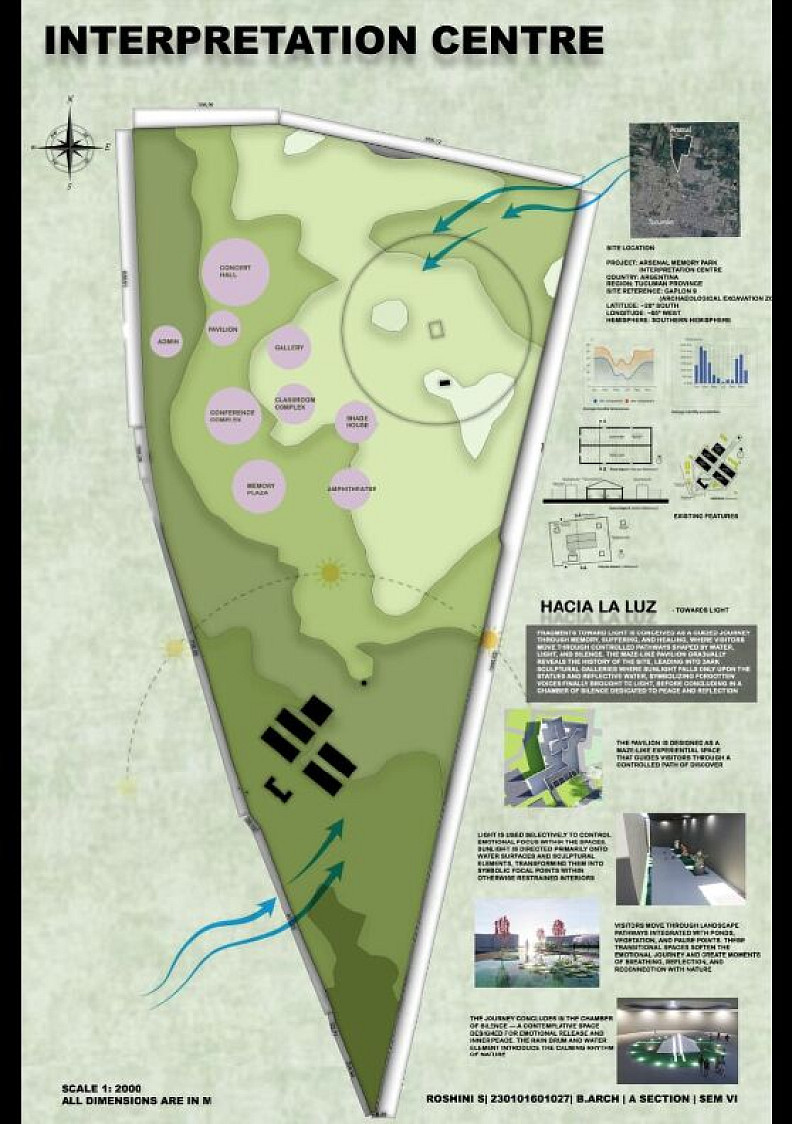
The master plan is conceived as a collection of fragmented yet interconnected built forms distributed across the site. Rather than relying on a single dominant structure, the project uses landscape as the primary organizing element, stitching together the various buildings and creating a continuous experiential journey. Through pathways, water features, vegetation, and open spaces, visitors are guided between moments of learning, reflection, and public engagement.
The Memory Plaza forms an important point within this sequence, leading visitors toward the Memorial Art Gallery and Audio-Visual Room, which constitute the interpretive core of the project. The Exhibition Pavilion accommodates temporary and permanent displays, while the Classroom Complex and Conference Complex support educational programs, workshops, research activities, and public discussions.
To strengthen community participation, the project incorporates a Concert Hall, Amphitheatre, Commercial Facilities, and Administrative Block, creating a multifunctional destination that remains active throughout the year. These facilities collectively support cultural events, performances, exhibitions, and educational initiatives, ensuring that the site functions as both a memorial and a vibrant public institution.
Landscape plays a fundamental role in shaping the visitor experience. Acting as a connective tissue between the fragmented buildings, it creates a network of movement, pause, and discovery. Water bodies, shaded pathways, and green spaces provide moments of contemplation while maintaining visual and physical continuity across the site.
The architectural language emphasizes simplicity, permanence, and emotional resonance through the use of textured surfaces, controlled natural light, water features, and minimal forms. Light is strategically employed to enhance spatial quality and reinforce the project's underlying themes of remembrance, understanding, and renewal.
By combining memorial, educational, cultural, and recreational functions, the Interpretation Centre becomes more than a place of remembrance. It serves as a living institution where history is preserved, knowledge is shared, and future generations are encouraged to engage with collective memory. The project ultimately seeks to create a meaningful dialogue between the past and the future, transforming memory into a source of learning, healing, and hope.
This version highlights one of the strongest architectural aspects of your design: the landscape is not decoration—it is the connector that unifies the fragmented program. That's a sophisticated design idea and worth emphasizing in a competition submission.
Technical information
The project is located at Arsenal Memory Park Interpretation Centre in Tucuman Province, Argentina (latitude -26° South, longitude -65° West). The site reference is Galpón 9, an archaeological excavation zone. The masterplan at 1:2000 scale includes a concert hall, pavilion, admin building, gallery, conference complex, classroom complex, shade house, memory plaza, and amphitheatre.
Documentation

Copyright © 2026 INSPIRELI | All rights reserved. Use of this website signifies your agreement to the Terms of Use, Privacy Policy, and use of cookies.
