AFFORDABLE HOUSING FOR URBAN MARGINALIZED


 Maruf Hossain
Project idea
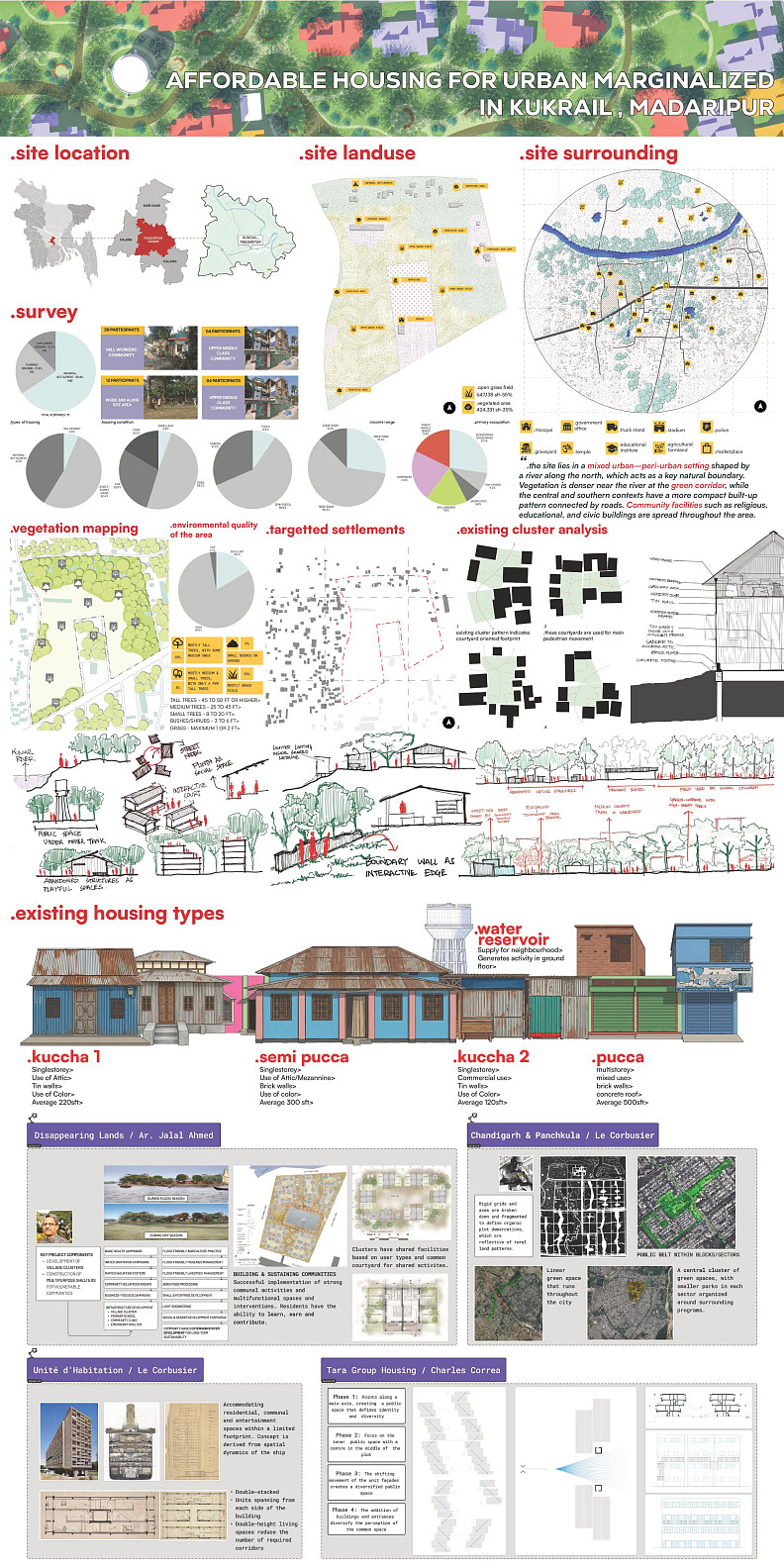
The project is situated in the mixed urban-to-peri-urban environment of Kukrail, Madaripur, a site structurally defined by a northern river boundary and a dense green corridor. The targeted demographics are urban marginalized communities currently living in single-story kuccha and semi-pucca settlements (ranging from 120 to 300 sq. ft.), who face severe vulnerabilities such as unsustainable financial management and reliance on temporary labor. The core architectural idea leverages traditional vernacular intelligence by transitioning families into sustainable, high-density housing through the integration of mezzanine-based units, which drastically minimize building footprints. The primary goals and objectives are to replace isolating boundary walls with interactive edges, create intentional voids and shared courtyards for communal interaction, introduce economic cross-subsidies to foster long-term financial autonomy, and anchor the entire layout around the existing green belt axis to provide microclimate regulation, natural shading, and mild-flood control.
Project description
The scope of the project solution spans a multi-tiered master plan that seamlessly scales from a resilient, 27-acre regional landscape down to compact, modular residential blocks. At the urban scale, the master plan establishes a multi-functional green belt to safeguard local biodiversity, alongside a dedicated walking network divided into pathways to maximize pedestrian safety and optimize walking distances to key community facilities. The residential programming introduces three controlled cluster formations—ranging in building footprint from approximately 18,747 to 26,096 sq. ft.—which combine specific module variations to achieve targeted high density. Within these clusters, the spatial solution delivers three distinct mezzanine unit types tailored to varying family sizes and income brackets: Type A (500 sq. ft.) featuring integrated space-saving furniture like pullable dining tables, Type B (340 sq. ft.), and Type C (250 sq. ft.), all designed to optimize vertical volume over horizontal sprawl.
Technical information
The technical specification of the project achieves a targeted 18% to 20% reduction in production costs by prioritizing material efficiency, structural modularity, and simplified architectural detailing. The structural frame utilizes a robust Reinforced Cement Concrete (RCC) jacketed onto steel skeleton, while transitioning standard building infill to Hollow Blocks for walls and lightweight Ferro Cement for intermediate mezzanine floor slabs to minimize overall concrete volume and thermal mass. Economically, the base construction cost per unit is precisely specified across material, labor, and infrastructure allocations: Unit A costs 2,184,000 TK (incorporating 191,200 TK for hollow blocks and 97,414 TK for labor), Unit B costs 1,554,000 TK, and Unit C costs 1,312,500 TK, with common circulation pathways (stairs, corridors, and terraces) factored directly into each module's cost breakdown. Affordability-achieving cost estimations are based purely on material and construction costing. Environmentally, the technical design relies on passive climate systems, using strategic cluster voids and dense tree screening for natural air filtration, paired with an integrated central water reservoir system that gravity-supplies the neighborhood while activating the ground floor public realm.
Documentation

Copyright © 2026 INSPIRELI | All rights reserved. Use of this website signifies your agreement to the Terms of Use, Privacy Policy, and use of cookies.
