Hybridný mestský dom


Project idea
Hybrid urban building that combines seemingly incompatible functions: an active ground floor focused on the social economy, specialized social infrastructure (both residential and outpatient services), and affordable rental housing.
The aim of the design is to create a building that introduces a new typology into the city, provides high-quality public space for everyone, fosters a sense of community among its residents, and, in a way, connects the town square with the park while simultaneously forming a boundary between these two spaces.
Project description
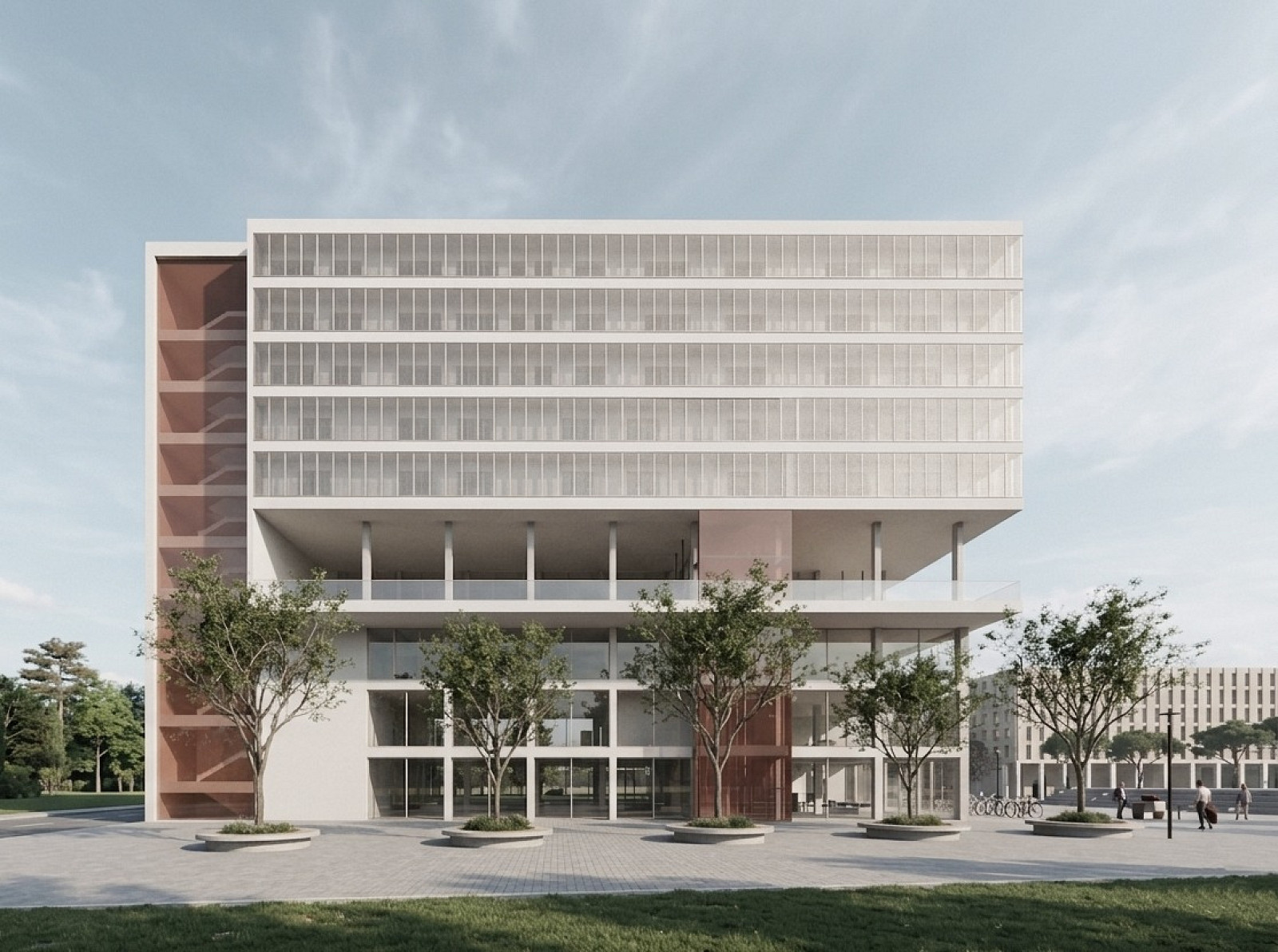
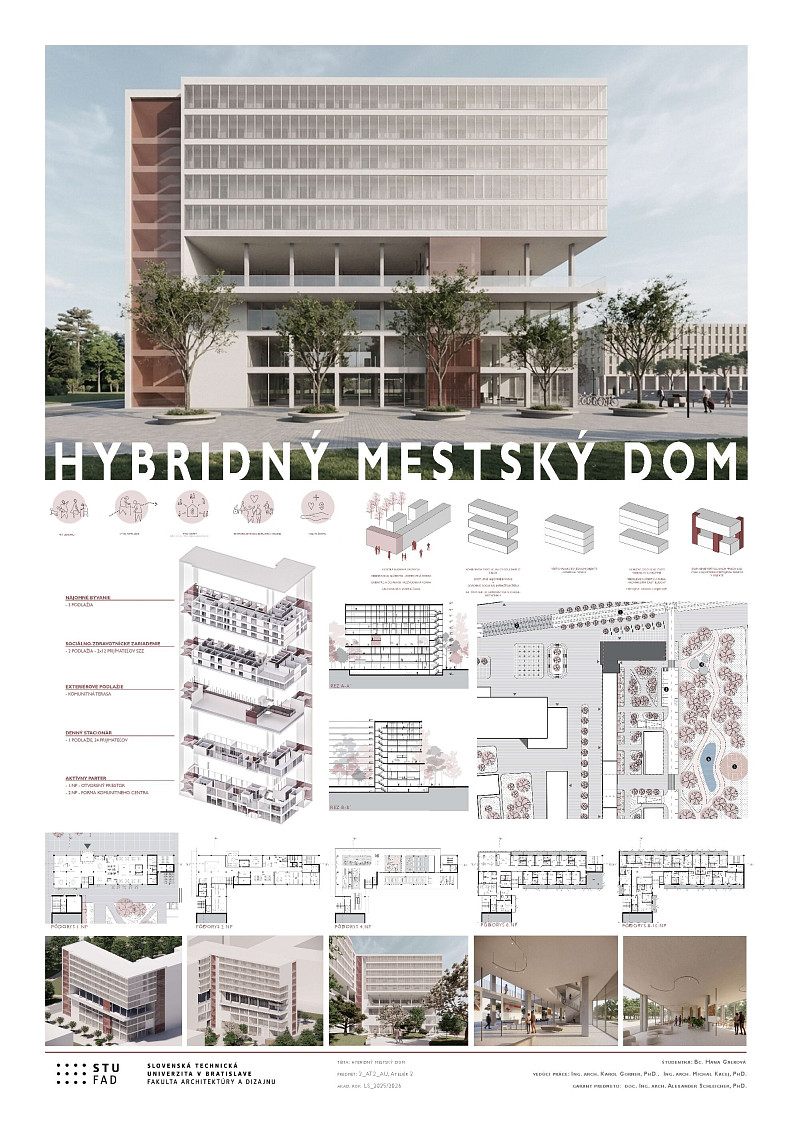
The proposed hybrid urban building is a multi-storey structure divided into three functional zones: a public zone, a community terrace, and a private zone.
The public zone consists of two levels of an active ground floor and one level dedicated to a day-care social facility. Above this, two levels of open-air space form a community terrace that connects the adjacent park with the square on the opposite side, while simultaneously acting as a buffer between the public and private parts of the building.
The private zone comprises two levels of a social and healthcare facility and three levels of affordable rental housing, offering two- and three-bedroom apartments.
The public section features predominantly glazed façades to maximize natural daylight within the interior spaces and to establish a strong visual connection with the surrounding public realm. The private section is enclosed by perforated metal façade panels that can be opened and adjusted as needed. On the southern façade, these panels provide solar shading, while on the northern side they serve as a visual screen, ensuring privacy from the adjacent square.
Technical information
The building’s structural system is designed as a reinforced concrete frame structure based on the grid of the underground parking garage. The spans are adapted to the requirements of different spaces and measure 5.4 m, 6.6 m, and 7.2 m. Vertical circulation cores are designed using a reinforced concrete shear-wall system.
The combination of reinforced concrete columns, floor slabs, and vertical cores ensures maximum structural stability throughout the building. Non-load-bearing partition walls on individual floors are constructed from aerated concrete blocks and can be removed if future changes in function are required.
The partitions between residential units are designed with increased thickness to meet acoustic performance requirements.
The building envelope is designed as an insulated external thermal insulation composite system (ETICS) with a fine render finish. However, on the first three above-ground floors, the majority of the façade is glazed, featuring aluminium frames and triple-glazed insulating glass units.
The upper volume of the building is clad with lightweight perforated metal façade panels mounted in front of the main façade, providing both solar protection and visual screening while contributing to the architectural character of the building.
Documentation

Copyright © 2026 INSPIRELI | All rights reserved. Use of this website signifies your agreement to the Terms of Use, Privacy Policy, and use of cookies.