Port of Piraeus - Adaptive Reclamation


Project idea
A key concern has been the question of how the historical and industrial heritage of Mediterranean cities can remain an active part of contemporary reality, rather than being treated as a static remnant of the past or an obstacle to present-day urban needs. Instead, the focus lies on how this inherited layer can be transformed into a framework of continuity, adaptation, and reinterpretation within changing social, environmental, and urban conditions. Rather than treating construction and implementation as a linear process with a fixed end state, it becomes relevant to understand the entire duration of intervention as an active phase of the project itself. In this sense, phasing is not merely a technical or sequential tool, but a conceptual framework that allows the site to remain active, inhabited, and evolving throughout the transformation process.
Project description
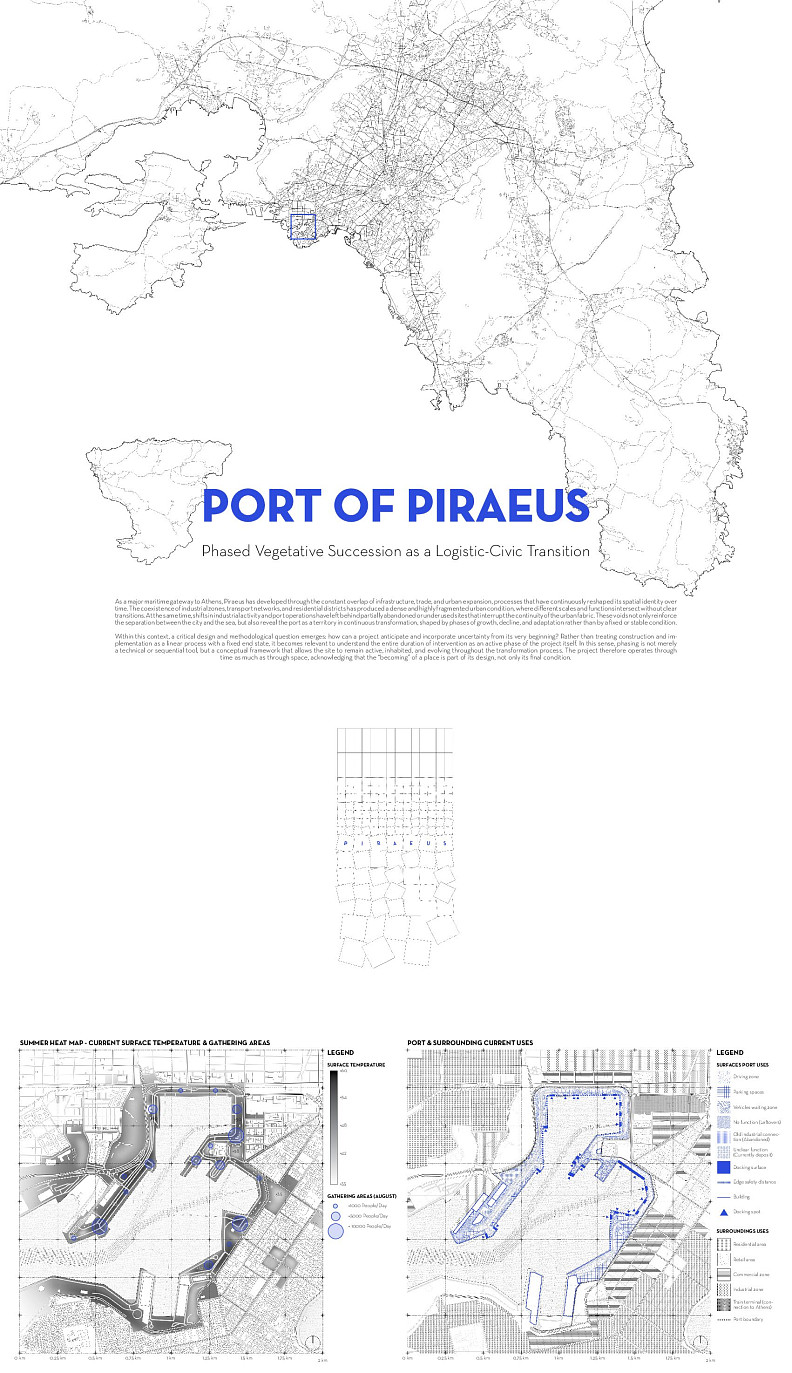
As a major maritime gateway to Athens, Piraeus is structured by overlapping systems of infrastructure, trade, and urban development
that have continuously reshaped its spatial identity over time. This has produced a dense urban condition in which industrial zones, transport infrastructures, and residential areas are tightly intersected, often without clear spatial or functional
transitions. Despite this density, the port is characterized by fragmentation and discontinuity. Large-scale industrial and logistical sites remain partially abandoned or underused, generating voids within the urban fabric that simultaneously act as barriers between the city and the sea. These conditions restrict access to the waterfront and reinforce a spatial separation in which proximity to the coast does not translate into everyday use or lived connection for local communities. The waterfront therefore operates as a highly seasonal system.
During the summer months, it is intensified by tourism flows, ferry activity, and temporary economic dynamics, while in the rest of the year it is marked by inactivity and underuse. This oscillation produces an unsustainable urban condition, where vast infrastructural surfaces alternate between peak intensity and vacancy, rather than supporting continuous urban life.
Within this framework, Piraeus is part of a broader territorial infrastructure of the Saronic Gulf, extending towards Elefsina
and other coastal industrial zones. Historically connected through shipping, production, and logistics, these areas once formed a continuous industrial landscape supporting Athens metropolitan economy. Today, however, they appear as fragmented remnants of that system: partially decommissioned, spatially disconnected, and often in decline, yet still occupying strategic coastal positions. Their gradual abandonment not only intensifies the discontinuity of Piraeus itself but also reveals the latent potential of this wider coastline as a continuous field of redevelopment, ecological repair, and spatial reconnection.
The ground condition of the Port of Piraeus is the result of successive phases of artificial construction and land reclamation, rather than a natural stratification. The existing substrate is largely composed of engineered infill materials, predominantly limestone aggregates extracted from nearby quarries and deposited to expand and stabilize the coastal edge. Over time, this has created a layered ground structure in which compacted fill, construction debris, and heterogeneous sediments form a dense and highly modified soil profile. The resulting condition is both structurally functional for port operations and environmentally limited, with low permeability, minimal organic content, and reduced capacity for vegetation. In this context, the ground itself can be understood as an infrastructural layer, produced through extraction, transport, and deposition processes, rather than a natural soil system.
This understanding of the port’s substrate is fundamental for exploration on how this existing artificial ground can be reworked
and reactivated as a productive landscape system. By reconsidering the material already present on site as a resource, the project develops a strategy for transforming the infill into a Technosol, enabling new ecological and spatial conditions to emerge directly from the existing surface.
The Port of Piraeus is currently characterized by a fragmented landscape where active logistical infrastructures coexist with abandoned industrial sites and underused transitional spaces. Large portions of the waterfront remain inaccessible, occupied by fenced operational zones, obsolete facilities, and extensive hardscape surfaces that disconnect the city from the sea.
Many of these areas exist in an uncertain condition, partially used, temporarily occupied, or continuously shifting in terms of future development. Within this context, the intervention focuses on large asphalt and concrete surfaces where heat accumulation, lack of vegetation, and environmental discomfort are most intense. By targeting these critical zones, the project proposes a gradual transformation that combines ecological improvement, adaptive reuse, and the progressive reconnection of the port with the surrounding urban fabric.
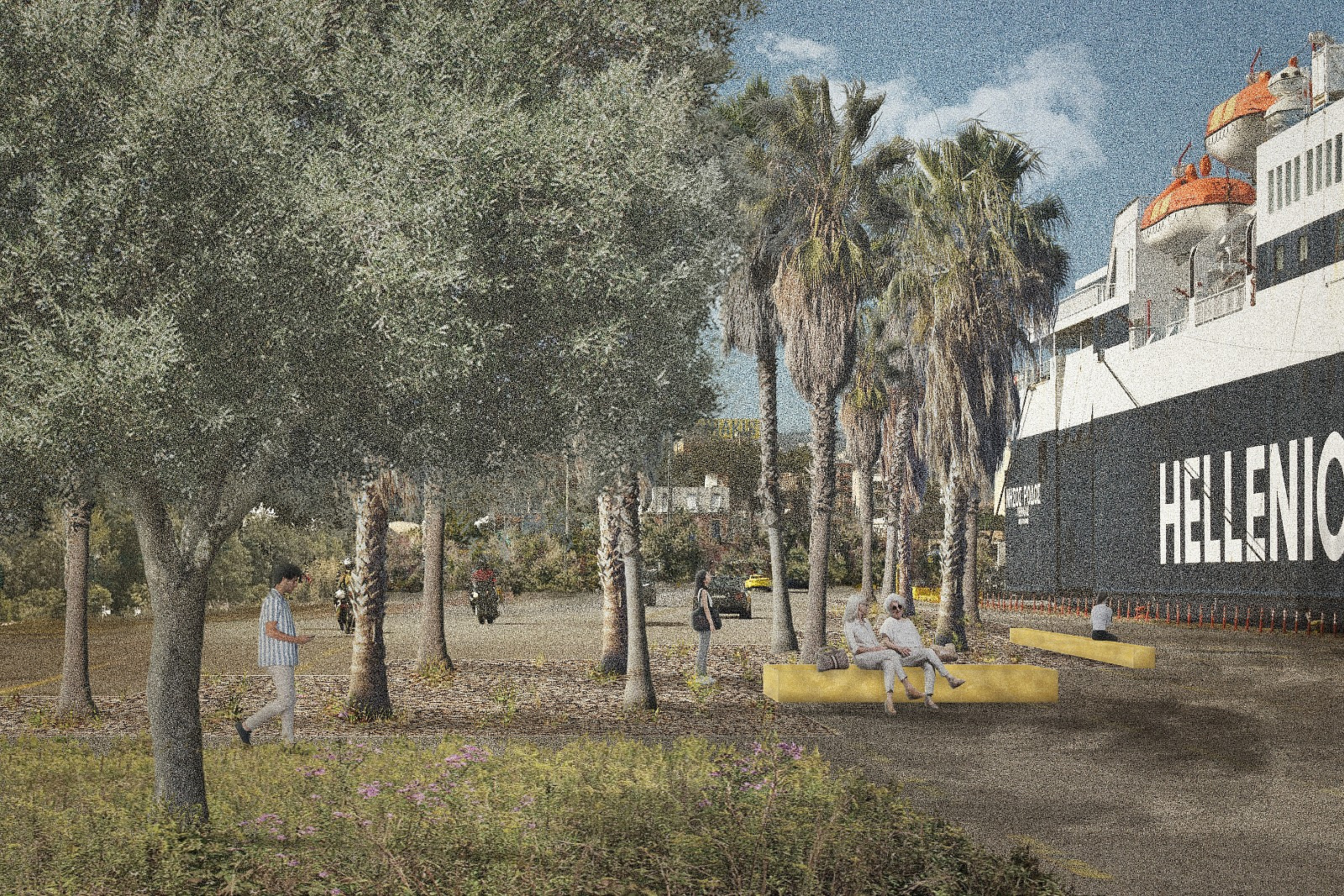
The first phase of the intervention focuses on the reactivation of abandoned and underused areas through temporary and low-impact strategies that can operate within the existing conditions of the port. Rather than relying on large-scale demolition or fixed redevelopment, this phase introduces adaptable interventions capable of responding to the uncertainty and continuous operation of the site. Initial actions include the creation of shaded public zones, temporary planting areas, pedestrian connections, and accessible open spaces that begin to soften the rigid hardscape character of the waterfront.
By intervening in strategically located vacant areas, the project establishes the first points of continuity between the port and the surrounding neighborhoods. These interventions function as catalysts for gradual transformation, allowing previously inaccessible or residual spaces to become part of everyday urban life without disrupting the logistical functionality of the port. In this sense, the first phase is conceived not as a final condition, but as the beginning of a progressive reconnection process between infrastructure, landscape, and the city.
The second phase focuses on spaces that currently exist in a transitional condition: partially active, underused, or lacking a clearly defined function within the port system. These transitional areas are gradually reprogrammed through interventions that introduce hybrid uses capable of accommodating both logistical operations and public activity. Rather than separating infrastructure from civic space, the project explores forms of coexistence where movement, waiting, leisure, and operational functions can overlap within a shared landscape framework.
This phase introduces more permanent spatial structures, expanded planting systems, and civic programs that support year-round use while remaining adaptable to the evolving needs of the port. Through the gradual integration of public access, temporary activities, and environmental improvements, these spaces begin to operate as mediating zones between the industrial character of the waterfront and the everyday life of the city.
The final phase proposes development of the port as a continuous hybrid urban landscape, where ecological systems, public space, and infrastructural operations coexist within an integrated spatial framework. Building upon the previous phases, the intervention expands into a connected network of planting zones, public routes, and open spaces that establish continuity between the waterfront, the surrounding neighborhoods, and the wider territorial landscape.
At this stage, the port begins to accommodate a broader range of civic, cultural, and recreational functions while maintaining its operational identity as an active logistical infrastructure. Rather than replacing the industrial character of the site, the project seeks to reinterpret it through environmental improvement and spatial adaptation. The coexistence of public life and port activity becomes a defining condition of the landscape, allowing the waterfront to operate simultaneously as ecological infrastructure, civic space, and productive territory.
The final objective of the strategy is to move beyond the seasonal logic that currently dominates the port, establishing conditions for continuous year-round use. By diversifying functions and introducing accessible public spaces, the intervention shifts the port from a predominantly touristic and transient environment toward a more stable and locally oriented urban condition.
This includes the creation of spaces for daily activities, social interaction, and leisure, ensuring that the waterfront remains active beyond peak tourist periods. Through this process, the port is gradually reconnected to the urban fabric, reinforcing its role not only as an infrastructural gateway but also as a shared civic landscape within the city.
This project proposes the transformation of Piraeus into a civic landscape that responds to environmental, spatial, and social conditions. It addresses the reduction of urban heat through the introduction of vegetation and the reconfiguration of extensive hardscaped surfaces, improving both ecological performance and the overall environmental comfort of the port. At the same time, the intervention operates as a process of reappropriation, reopening underused or inaccessible areas and gradually returning parts of the waterfront to the city. In doing so, it strengthens the relationship between the port and the surrounding neighborhoods, shifting its role from a closed infrastructural system to a more open urban interface.
This transformation also changes how the port is experienced on a daily basis. Instead of being defined mainly by seasonal tourism and intermittent activity, it begins to support continuous forms of use where movement, leisure, and informal social interaction coexist with the operational logic of the port. Piraeus is therefore no longer read only as a space of passage, but as a landscape of overlapping conditions, where infrastructure and public life are no longer strictly separated but continuously negotiated. In this way, its identity shifts from an in-between condition toward a destination in its own right, where transit and permanence can exist simultaneously.
Technical information
Rather than replacing the existing substrate through extensive importation of external soil, the project proposes a circular methodology based on the reuse and transformation of materials already present on site. Excavated limestone and mineral materials generated through the intervention are processed and recombined to form a Technosol capable of supporting planting and ecological development. In this way, the project works directly with the existing landfill condition, transforming it from a purely infrastructural surface into a productive landscape layer.
The methodology operates through selective excavation, sorting, crushing, and re-stratification of materials in order to create differentiated planting conditions adapted to the specific requirements of the port environment. By reusing 100% of the extracted material, the intervention minimizes waste production and reduces the environmental and economic costs associated with importing new substrate. At the same time, the formation of Technosol allows the integration of vegetation within an otherwise hardscape environment, enabling the creation of planting zones capable of responding to drought, salinity, heat, and logistical constraints.
This approach understands the ground not simply as a surface to build upon, but as an active ecological and spatial system. The transformation of the landfill therefore, becomes both an environmental strategy and a design tool, allowing the port landscape to evolve through processes of material reuse, adaptation, and gradual ecological regeneration.
The planting strategy develops a flexible green framework that responds to the existing logic of the port. It is based on the idea that vegetation can be integrated into a highly operational landscape without compromising its logistical function, using adaptability rather than fixed design solutions.
Within these conditions, a flexible grid is introduced as both an organizational and planting system. It is derived from the logic of the port’s artificial geometry and the surrounding urban fabric. This structure allows vegetation to be inserted in a controlled but adaptable way, maintaining clear operational corridors while gradually introducing continuity between the city and the waterfront.
Plant selection is based on resilience rather than decorative purpose. Species are chosen for their ability to withstand salinity, drought, heat, and poor soil conditions. These typologies allow vegetation to establish itself within a heavily artificial environment, creating stable ecological systems that can perform under extreme and variable conditions.
Beyond ecological performance, planting is used as a spatial tool. Vegetation defines shaded areas for rest and social interaction, creates buffer zones between industrial and public activities, and structures movement through the site. In this way, landscape elements actively shape how the port is experienced, softening its hard infrastructure and introducing moments of pause and orientation.
The final condition is a hybrid landscape where ecological, civic, and industrial functions coexist. The system is designed to adapt across seasons and levels of intensity, ensuring year-round usability. This approach improves environmental comfort, reduces heat exposure, and enhances the overall quality of stay within the port, while maintaining its operational identity.
Documentation

Copyright © 2026 INSPIRELI | All rights reserved. Use of this website signifies your agreement to the Terms of Use, Privacy Policy, and use of cookies.