Lump of Sugar


Project idea
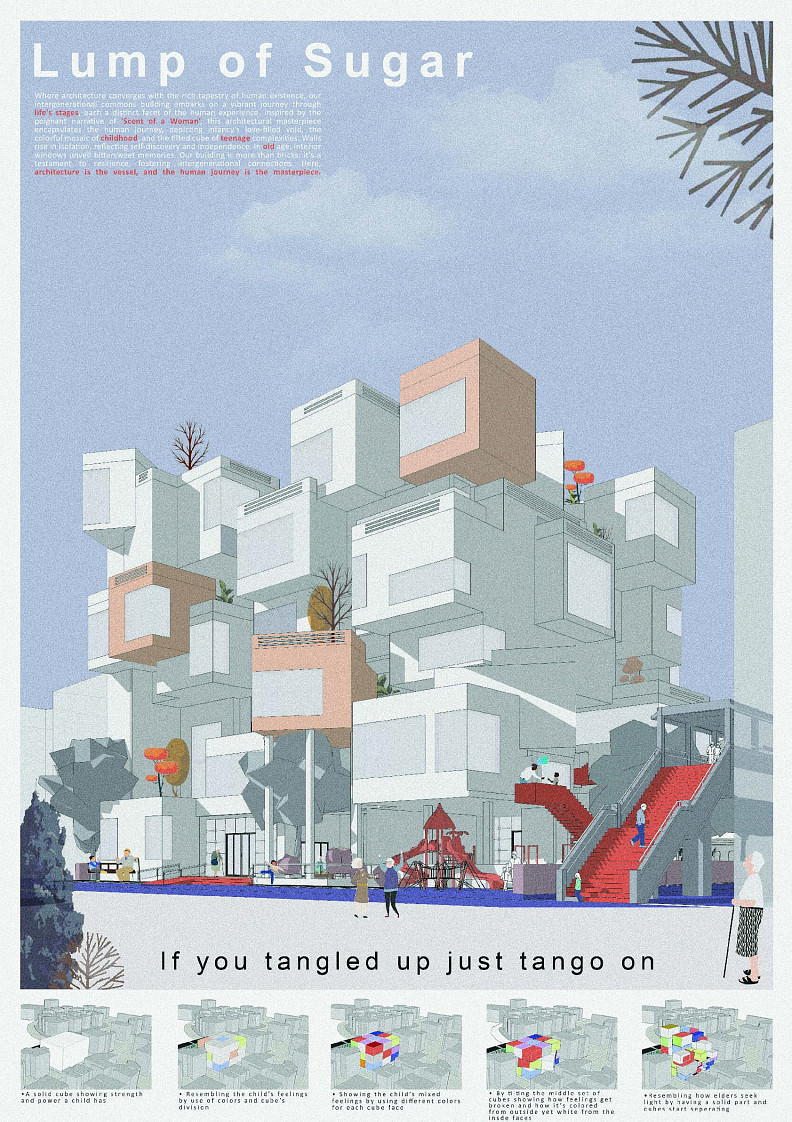
Lump of Sugar is an intergenerational community center inspired by a real encounter with an elderly resident of a senior care home in Maadi who felt isolated, unwanted, and emotionally abandoned by her family. The project draws its name from the film *Scent of a Woman*, in which Frank Slade's brother describes him by saying, "Down deep, the man is a lump of sugar." Although Frank appears harsh and distant, he is deeply vulnerable beneath the surface. This characterization closely reflected the elderly woman interviewed during the research phase and became the foundation of the project.
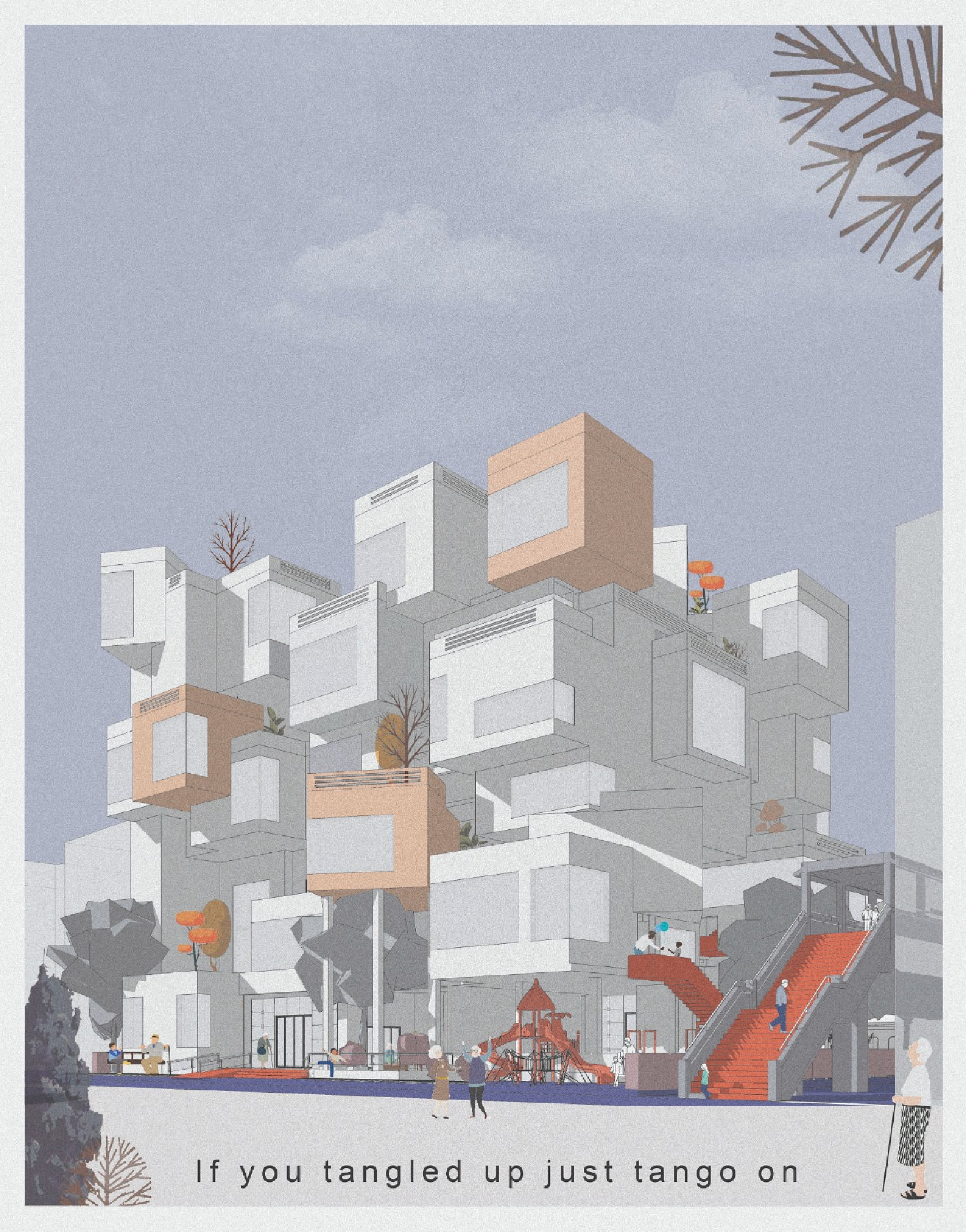
The design explores the emotional journey of human life, beginning with childhood innocence and progressing through stages of neglect, confusion, disappointment, isolation, and depression before reaching healing and reconnection. These psychological states are translated into a sequence of transforming cubic forms. A simple cube representing innocence gradually becomes fragmented, tilted, disconnected, and enclosed, symbolizing the emotional impact of loneliness and abandonment. The project ultimately seeks to reconnect generations, challenge social isolation, and create meaningful relationships between children and elderly people through shared experiences and everyday interaction.
Project description
The project functions as an intergenerational community center that brings together children, teenagers, adults, and elderly residents within a shared environment designed to encourage communication and mutual support. The building is organized as a vertical journey through a series of activity spaces that correspond to different emotional and developmental stages of life. Programs include art and painting workshops, sculpting spaces, puzzle and game rooms, digital and media activities, communal gathering areas, dining facilities, playgrounds, planting and gardening spaces, recreational activities, multipurpose spaces, and social interaction zones.
Rather than separating age groups, the project creates opportunities for meaningful encounters through collaborative activities, allowing younger generations to learn from older generations while providing elderly users with companionship and a renewed sense of purpose. Interviews conducted with senior residents informed the spatial design, activity selection, and environmental qualities of the building. The project transforms architecture into a tool for social healing by creating spaces where loneliness is replaced by engagement, interaction, and belonging.
Technical information
The building is designed as a modular composition of prefabricated cubic volumes stacked, shifted, rotated, and interconnected to express the project's conceptual narrative. The primary structural system consists of reinforced concrete foundations and a prefabricated modular construction system utilizing wall, floor, and roof panels connected through standardized structural joints. The modular approach allows efficient construction, flexibility, future adaptability, and clear expression of the conceptual transformation process.
The building envelope incorporates insulated wall assemblies to improve thermal performance and indoor comfort. Vertical and horizontal circulation is established through a network of interconnected staircases, bridges, and transitional spaces that physically and symbolically connect the different stages of the architectural journey. Large openings, terraces, and communal spaces enhance visual connectivity between users and encourage social interaction throughout the building. The structural and spatial systems work together to translate emotional experiences into architecture while creating a safe, accessible, and engaging environment for multiple generations.
Documentation

Copyright © 2026 INSPIRELI | All rights reserved. Use of this website signifies your agreement to the Terms of Use, Privacy Policy, and use of cookies.