The Crime Scene


Project idea
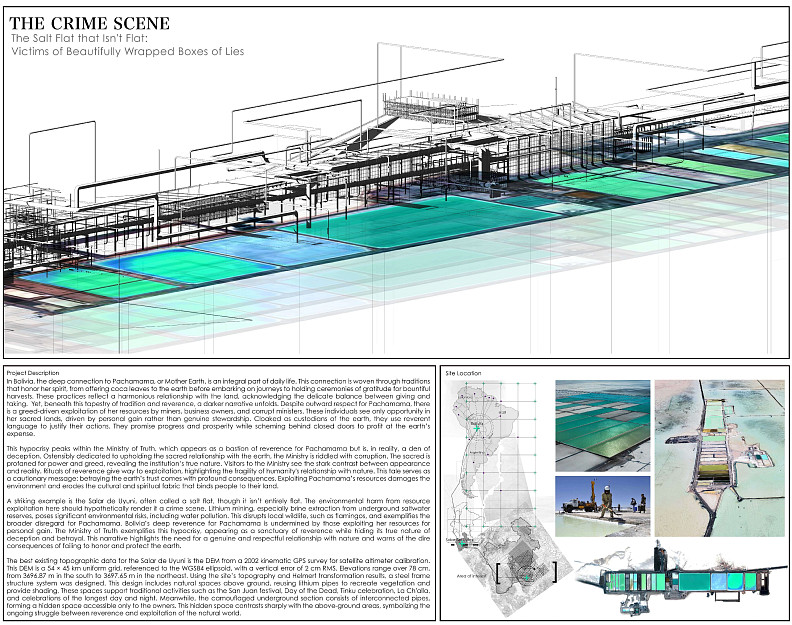
The Crime Scene is a speculative architectural investigation into the environmental and social consequences of lithium extraction in Bolivia's Salar de Uyuni. Inspired by the cultural significance of Pachamama, or Mother Earth, and the contradiction between environmental reverence and resource exploitation, the project exposes the hidden realities concealed beneath the surface of the world's largest salt flat.
The project is presented as a fictional crime scene in which the victim is the natural environment and the perpetrators are systems of extraction, corruption, and profit-driven resource exploitation. Through architectural storytelling, narrative sequences, and spatial experiences, the project reveals the invisible infrastructure and ecological damage associated with lithium mining. By transforming concealed industrial processes into visible public spaces, the design encourages visitors to question the relationship between sustainability, consumption, environmental responsibility, and the true cost of renewable energy technologies.
Project description
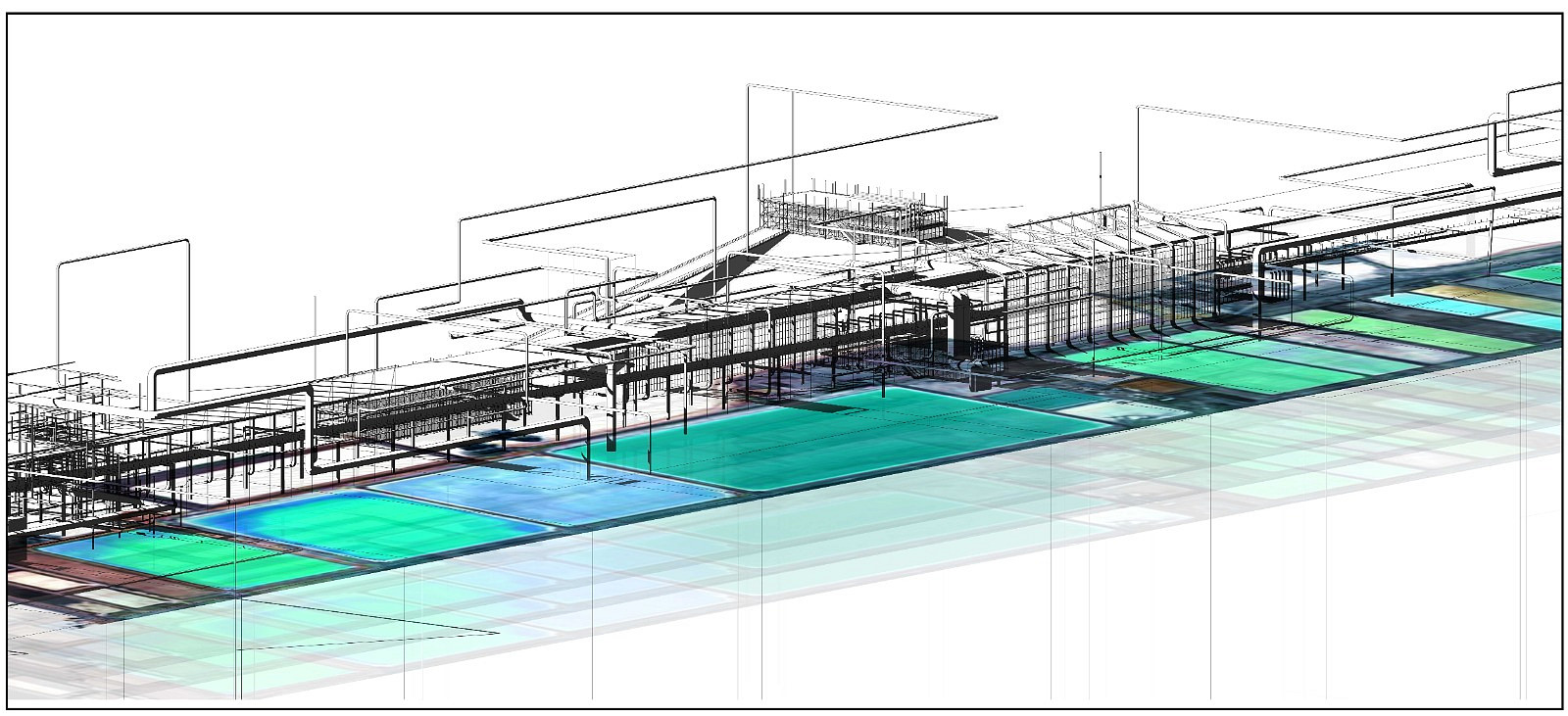
The project functions as a public investigative and educational facility located within the Salar de Uyuni. Organized as a linear journey through a sequence of elevated pathways, observation spaces, exhibition zones, and industrial landscapes, the design allows visitors to experience the hidden processes of lithium extraction while simultaneously confronting their environmental impacts.
The spatial narrative follows the structure of a crime investigation, gradually revealing evidence, hidden infrastructures, and ecological consequences. Visitors move through elevated circulation routes overlooking lithium evaporation ponds, processing systems, pipelines, pumping stations, and concealed underground operations. Narrative installations, educational exhibits, viewing platforms, and immersive spaces communicate the relationship between resource extraction, environmental degradation, and political manipulation. The project transforms industrial infrastructure into an architectural experience that exposes what is normally hidden from public view and creates awareness of the environmental cost of modern technological advancement.
Technical information
The project utilizes a lightweight steel structural system elevated above the salt flat to minimize direct intervention within the sensitive landscape while providing continuous public access across the site. The primary structure consists of steel columns, beams, trusses, catwalks, and modular platform systems that support circulation routes, observation decks, exhibition spaces, and service facilities.
The architectural framework integrates industrial elements derived from lithium extraction infrastructure, including pipelines, pumping systems, processing equipment, elevated walkways, and mechanical networks. Large-span steel structures accommodate exhibition and public spaces, while enclosed volumes are suspended within the structural framework. The design incorporates modular construction techniques to allow phased assembly and future adaptation. Water channels, evaporation ponds, and extraction basins form an integral part of the project's spatial and environmental systems, creating a direct physical relationship between visitors and the industrial processes being revealed. The exposed structural and mechanical systems intentionally communicate transparency, transforming hidden infrastructure into an educational and architectural experience.
Documentation

Copyright © 2026 INSPIRELI | All rights reserved. Use of this website signifies your agreement to the Terms of Use, Privacy Policy, and use of cookies.
