Paudwar Tatopani: A Geothermal Wellness Retreat

Project idea
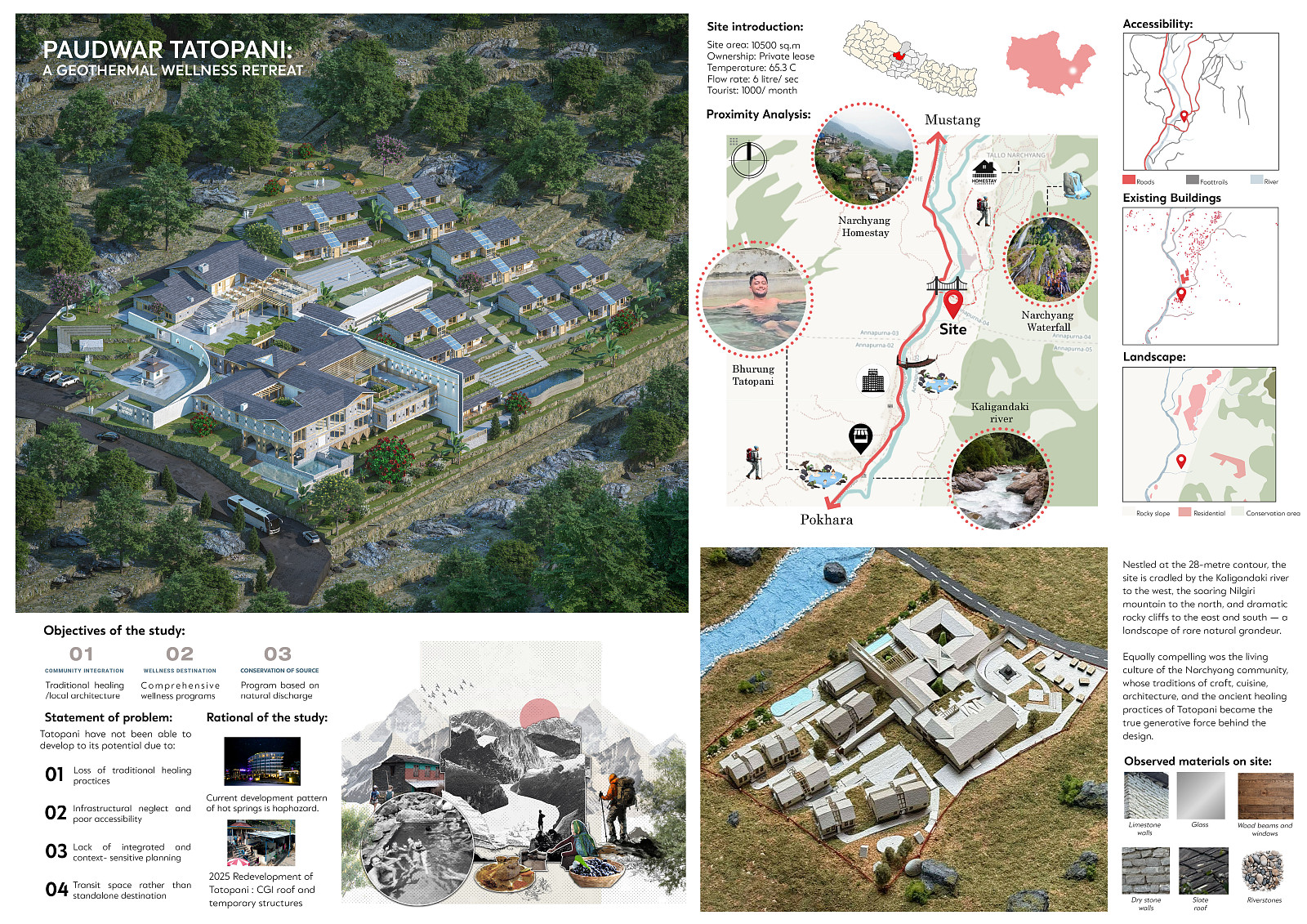
Nepal has more than twenty-eight geothermal hot water springs. Locally, they are called Tatopani - it means, simply, "hot water." For centuries, people have come to these springs to bath, to pray, to heal, to meet. They are not dramatic landmarks or tourist attractions in the conventional sense. They are, more quietly, places where life gathers.
And yet, for all that history and all that meaning, they are in a sorry state.
Walk up to most Tatopani today and what you find is a place that has been forgotten by everyone except the people who need it most. There is little infrastructure, rarely a changing room, often no thought given to hygiene or privacy or the simple dignity of the experience. The landscape around them - mountains, forests, river valleys of staggering beauty - goes almost entirely unacknowledged by whatever structure has been thrown up nearby. This is what passes for development.
The visit that changed everything for me was to a Tatopani in Myagdi. The pools were crowded. There were no changing facilities. The surrounding landscape - one of the most arresting in the world - was essentially ignored by everything built there. And yet people came. Every day, in real numbers, with real enthusiasm. Elderly men easing themselves into the water. Women laughing across the pools. Children running on the stones. A sense, unmistakable and quietly moving, that this place mattered to people — that it had always mattered - regardless of how little care had been put into it.
That contradiction stayed with me. If people show up in such numbers to a place so poorly made, what happens when the place itself is made well? What becomes possible when a site like this is designed with genuine thought — for the body, for the community, for the landscape, for the experience of simply being there?
Those questions are what this thesis is trying to answer.
The project sets out to reimagine Tatopani as a complete destination in its own right - not an afterthought attached to a trekking route, not a footnote in a regional tourism plan, but a place people travel to specifically, and leave changed by. The architecture draws from Himalayan vernacular traditions not as aesthetic borrowing but as genuine structural and environmental logic, suited to a region that is seismically active, climatically demanding, and culturally specific. The design does not try to impose itself on the landscape. It tries, instead, to move through it - to open it up, to make it legible, to let people feel where they are.
Project description
Tatopani has never belonged to just one kind of person, and the design does not pretend otherwise. The local community comes regularly - their connection to the spring runs deep, held in place by the temple that has always marked the arrival. Pilgrims come seeking ritual cleansing, and for them the water must be exactly as it emerges from the earth: unaltered, untreated, honest. The elderly and the unwell come because the water helps - joint pain, skin ailments, the kind of relief that traditional herbs and healing practices have quietly offered for generations. And then there are the walkers, the wanderers, the people who simply need to stop for a while and let the mountains do their work.
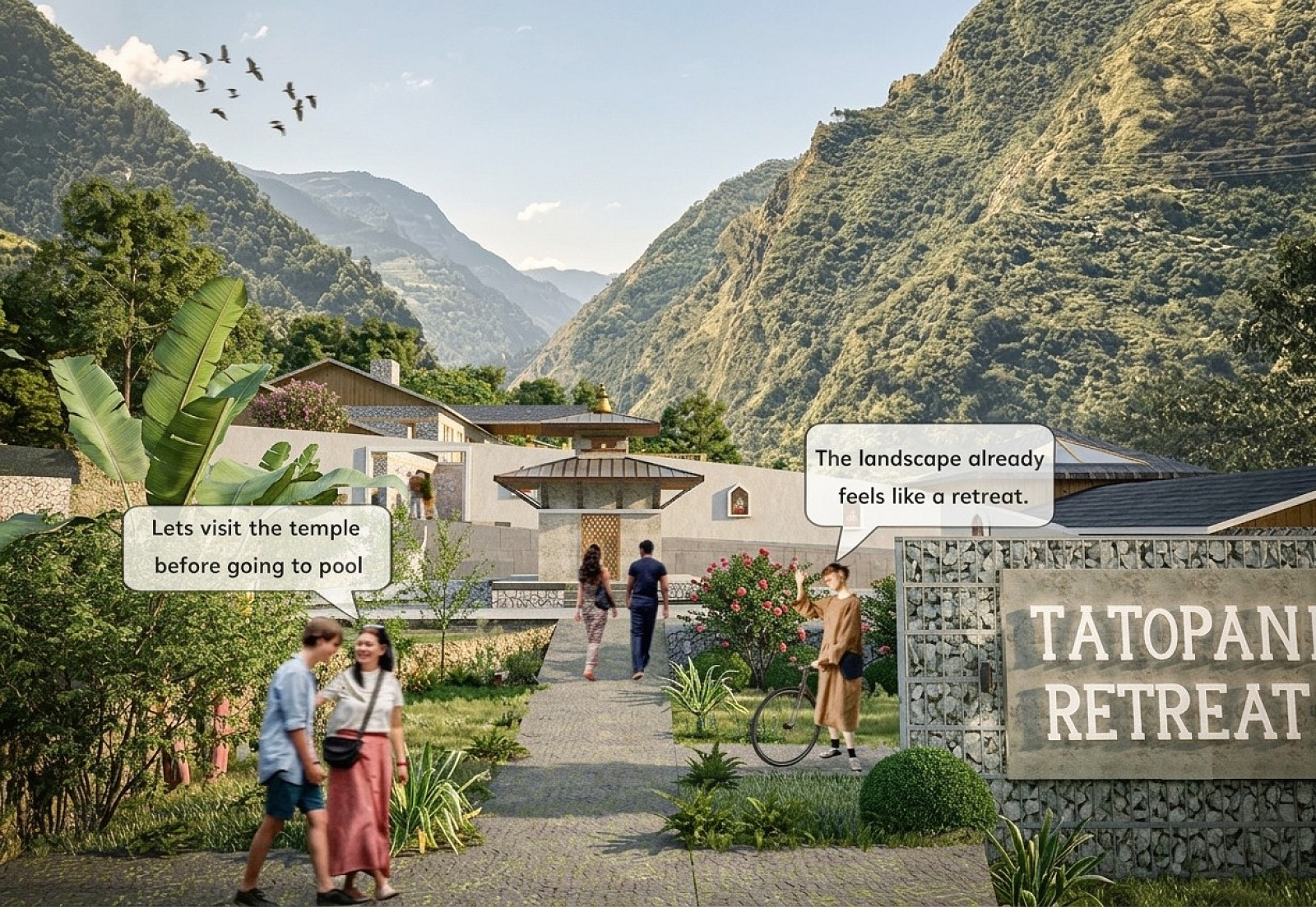
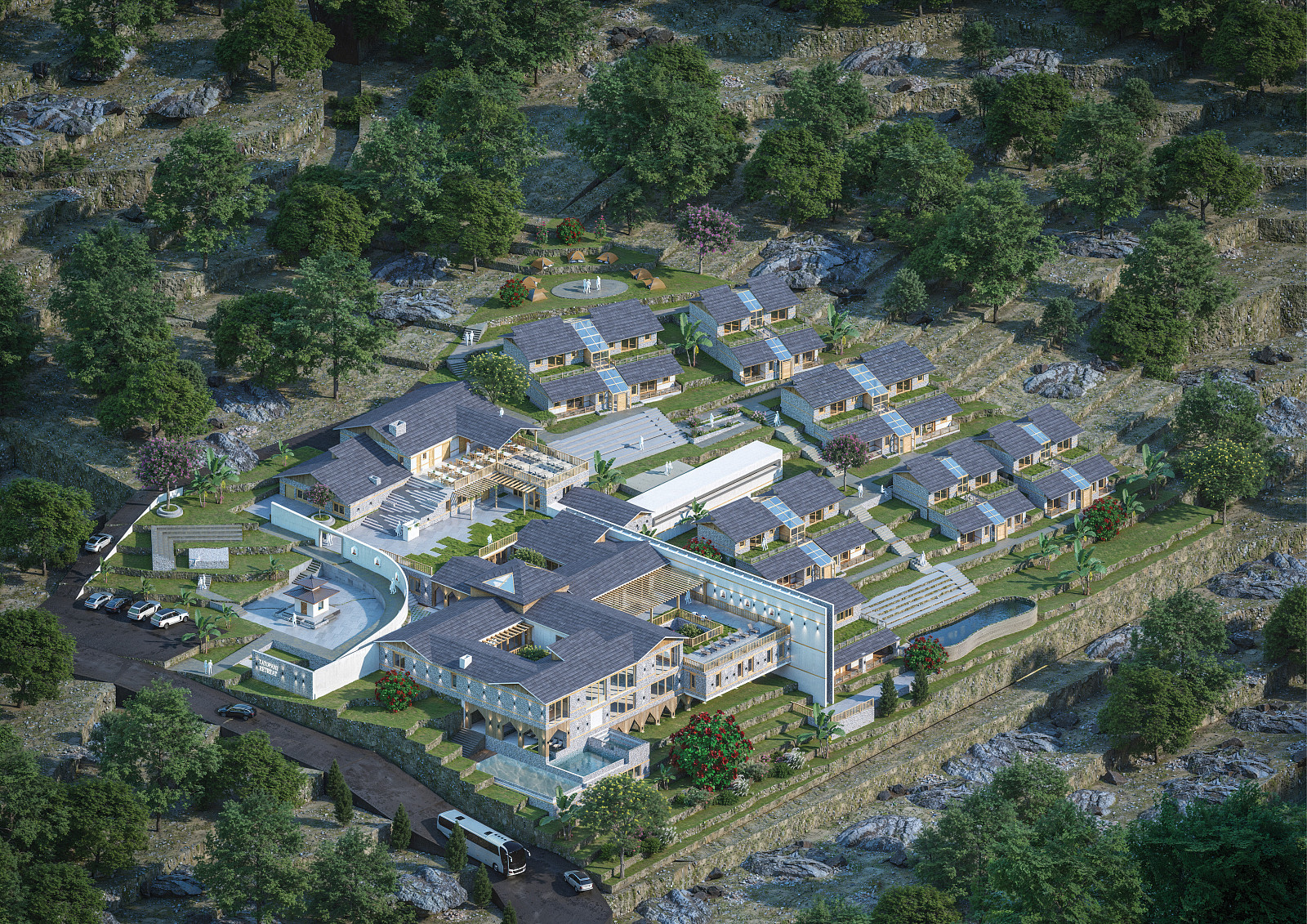
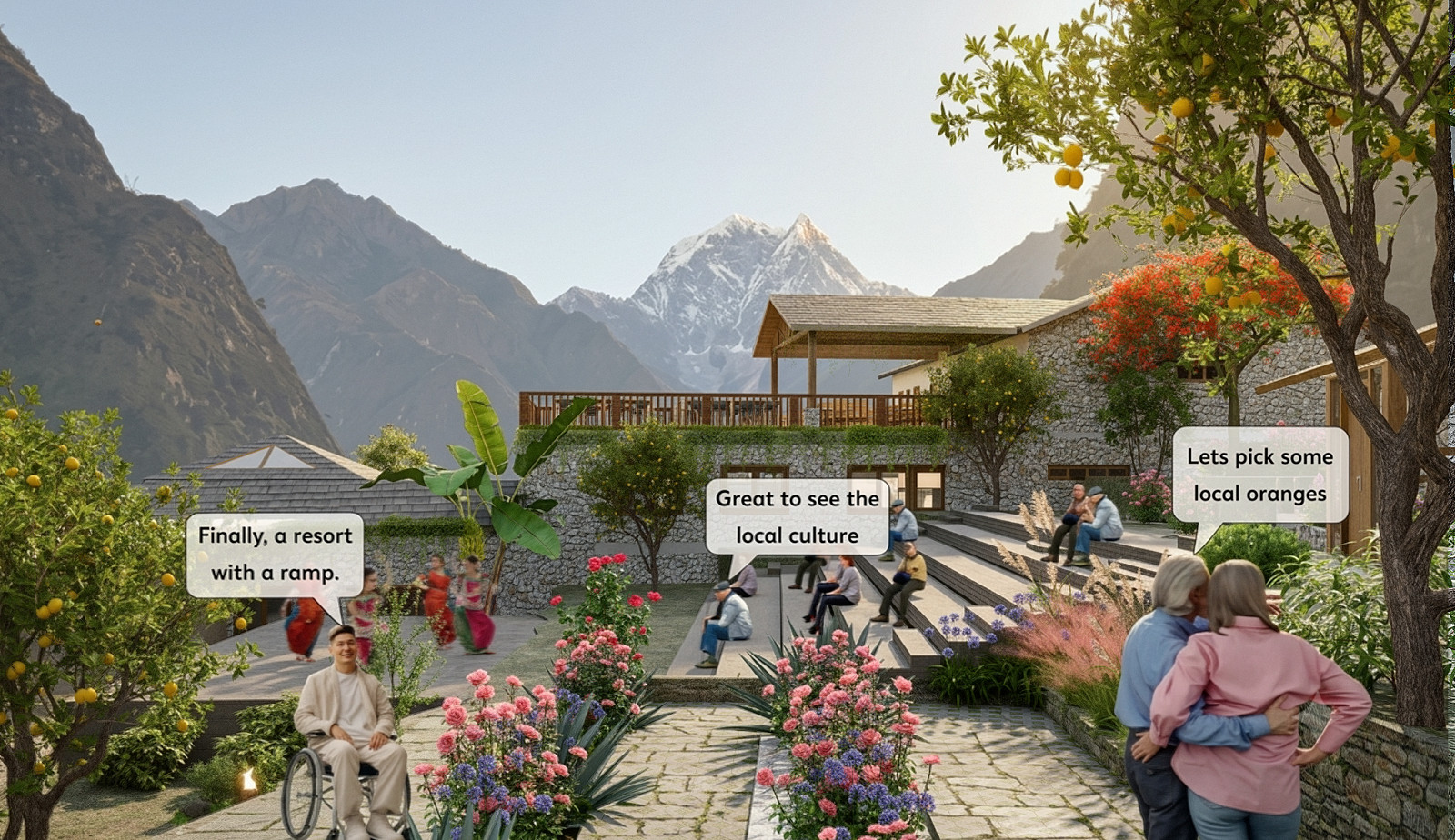
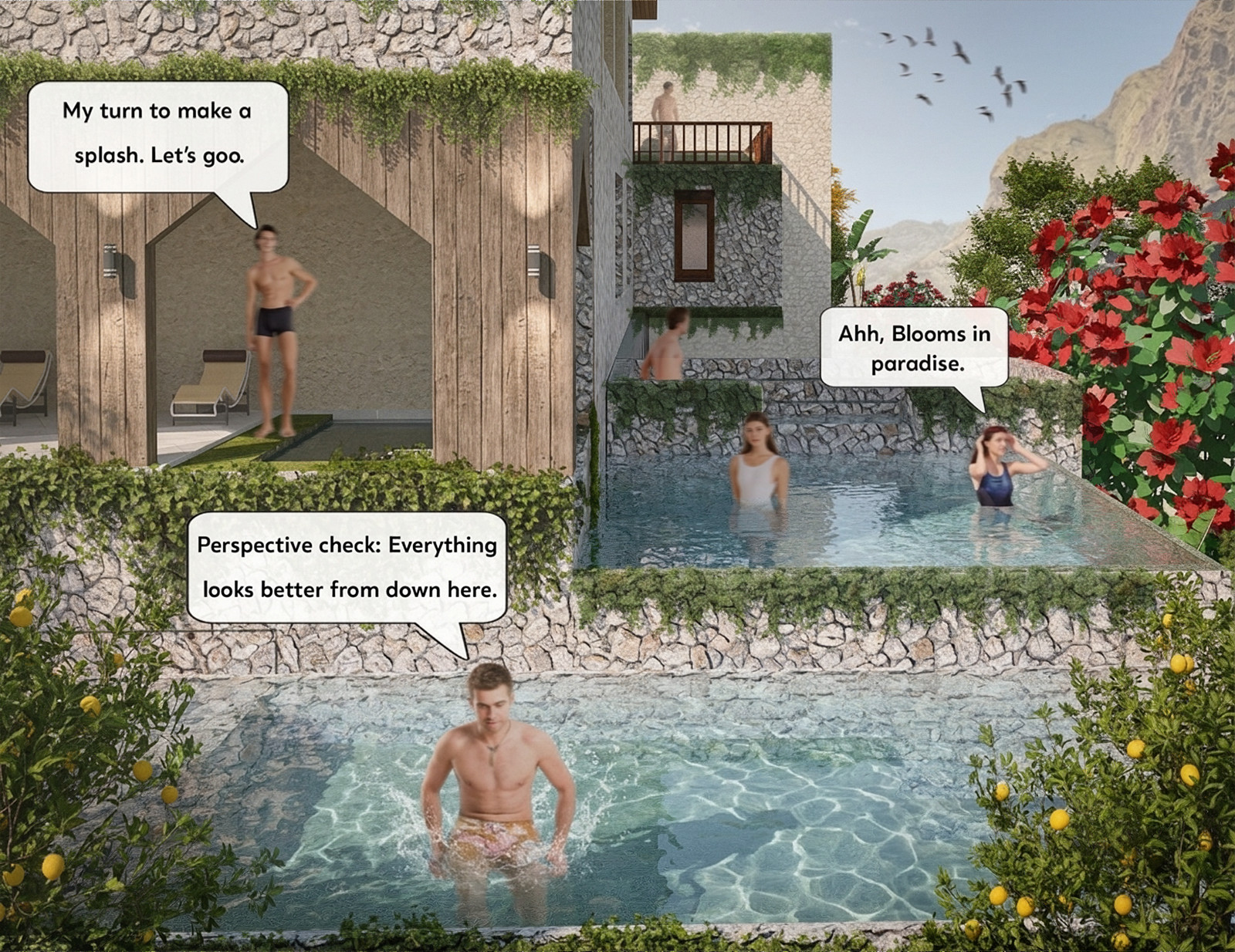
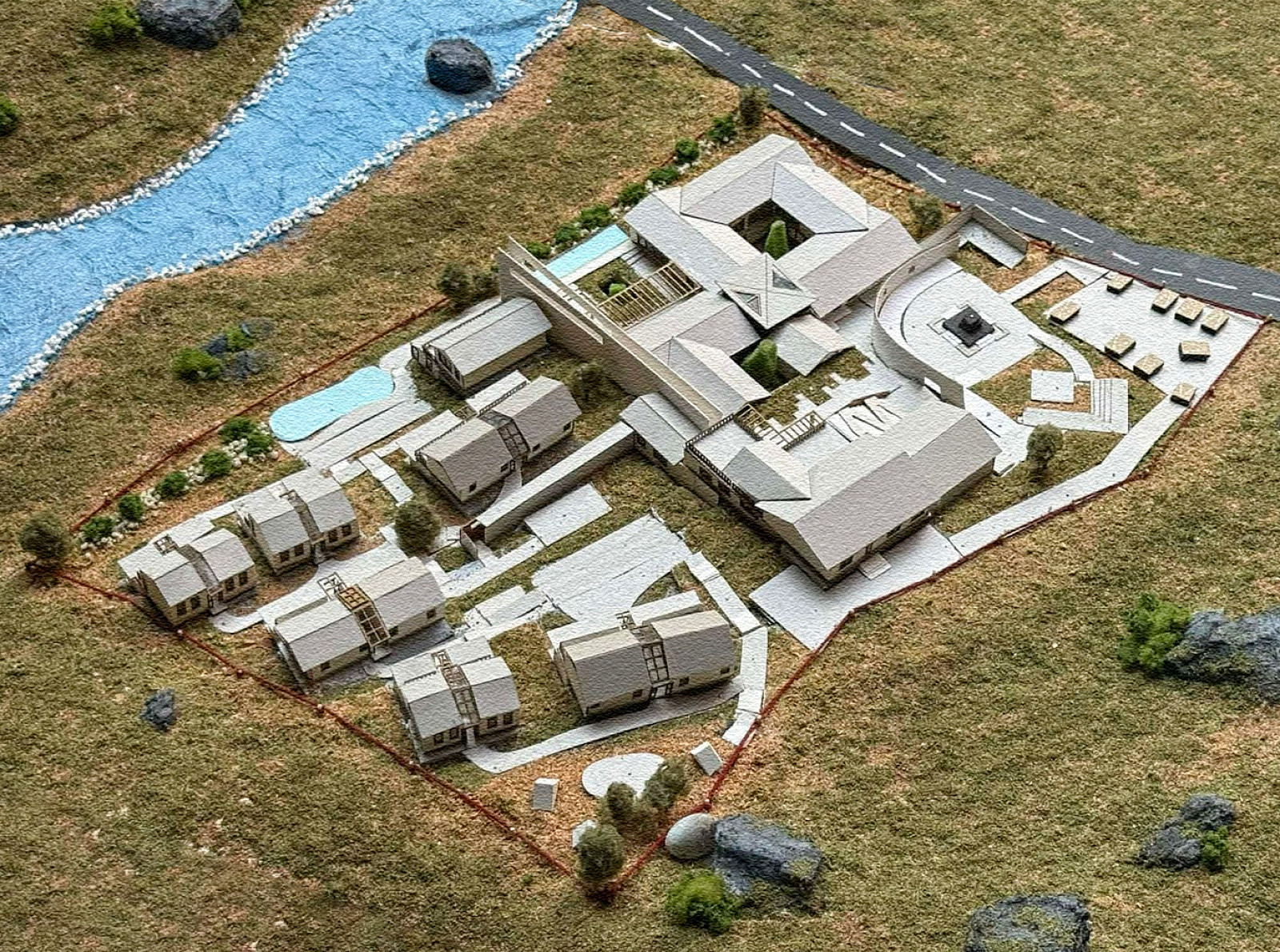
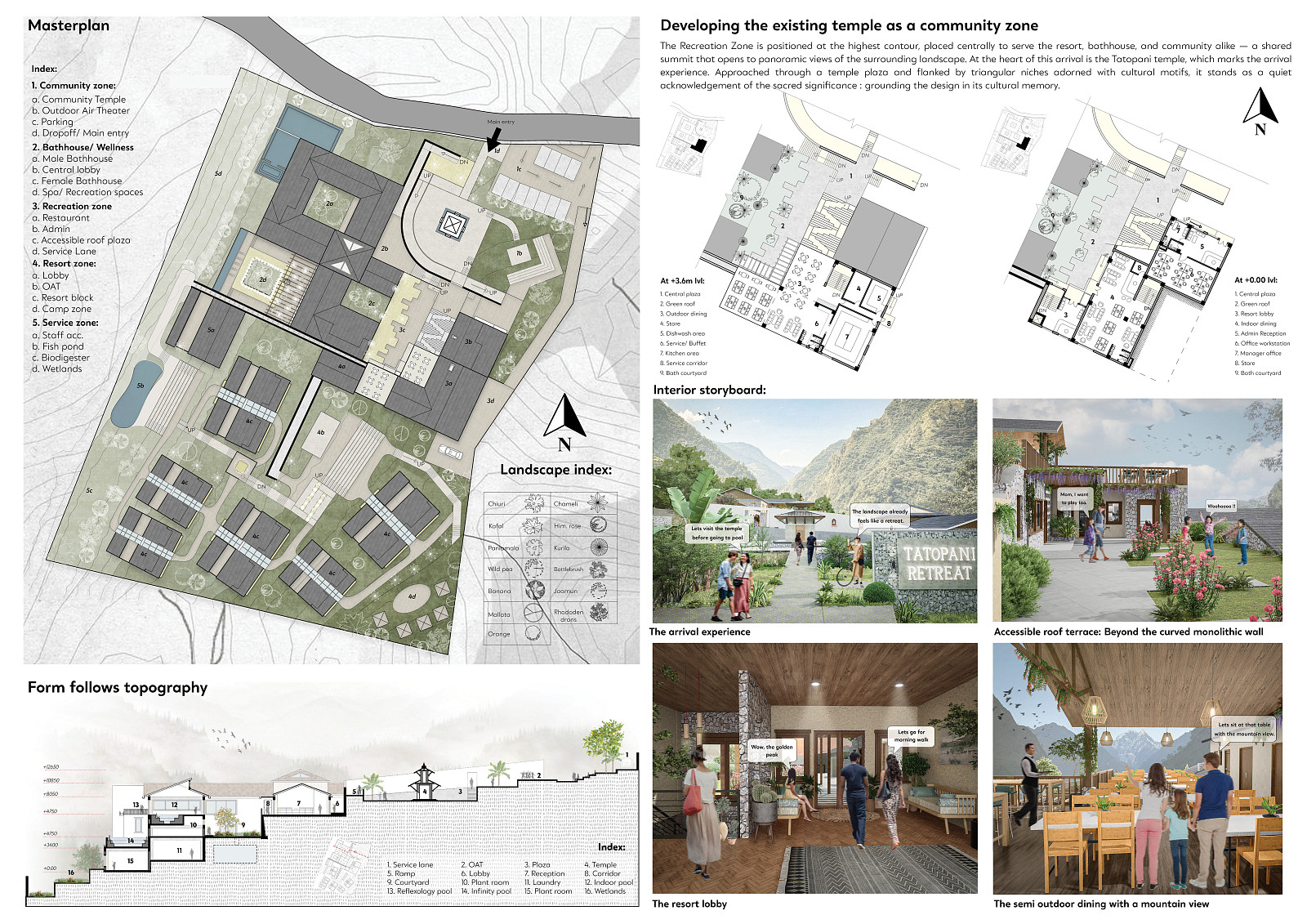
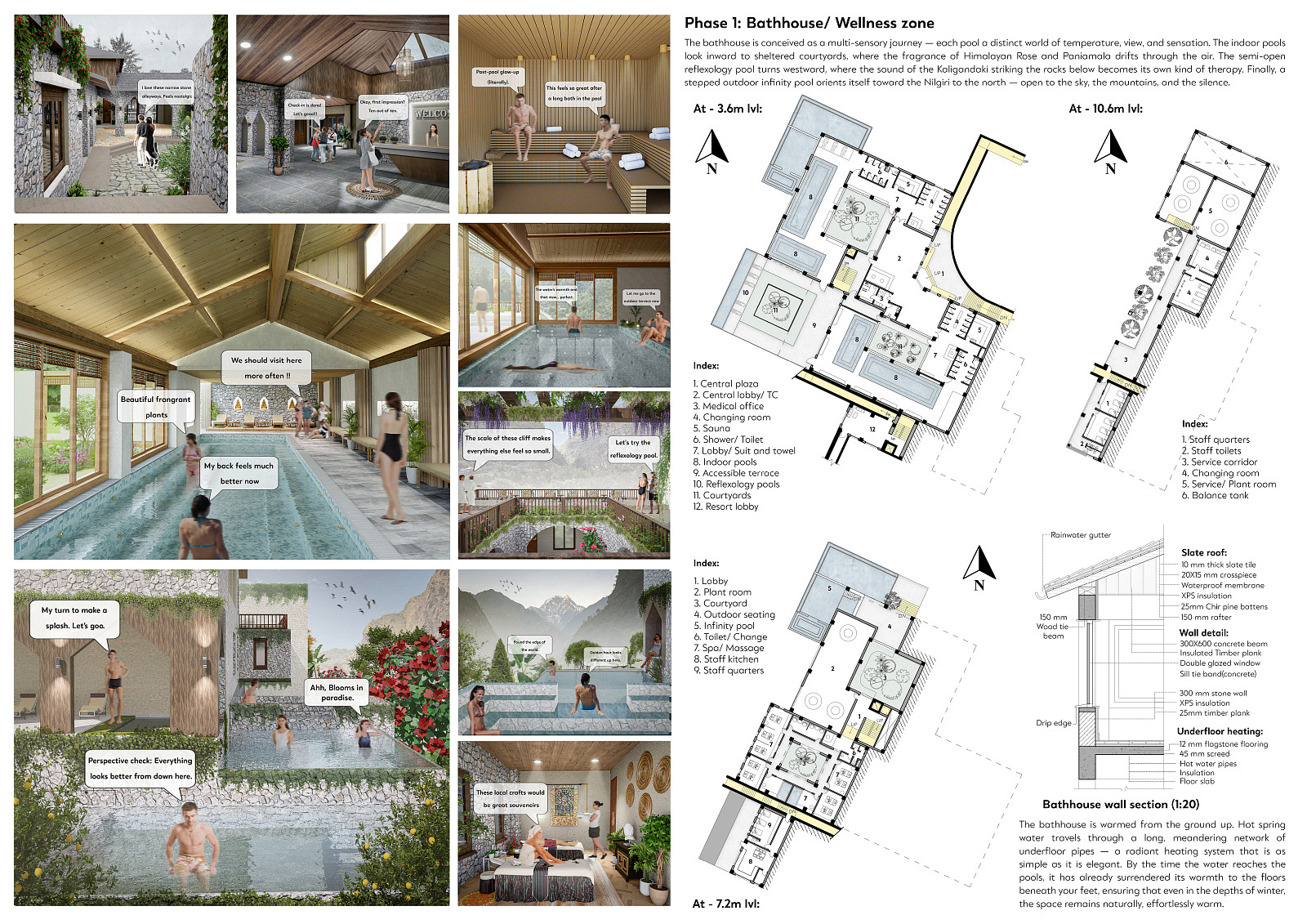
The program is shaped around all of them. The entry opens into a community zone - temple and plaza that settles the arrival before anything else happens. Then the bathhouse and wellness zone unfolds: pools of different temperatures and moods, each one framing the world outside differently. One looks out toward Mount Nilgiri to the north. Another faces the Kaligandaki river to the west. A third turns inward to a quiet courtyard of fragrant local plants. And beyond all of it, the resort sits in the landscape as if it simply grew there - unhurried, grounded, a little like the village it draws from.
Rooted in Place
The approaches developed here are intended as a replicable framework for all hot springs across the country.
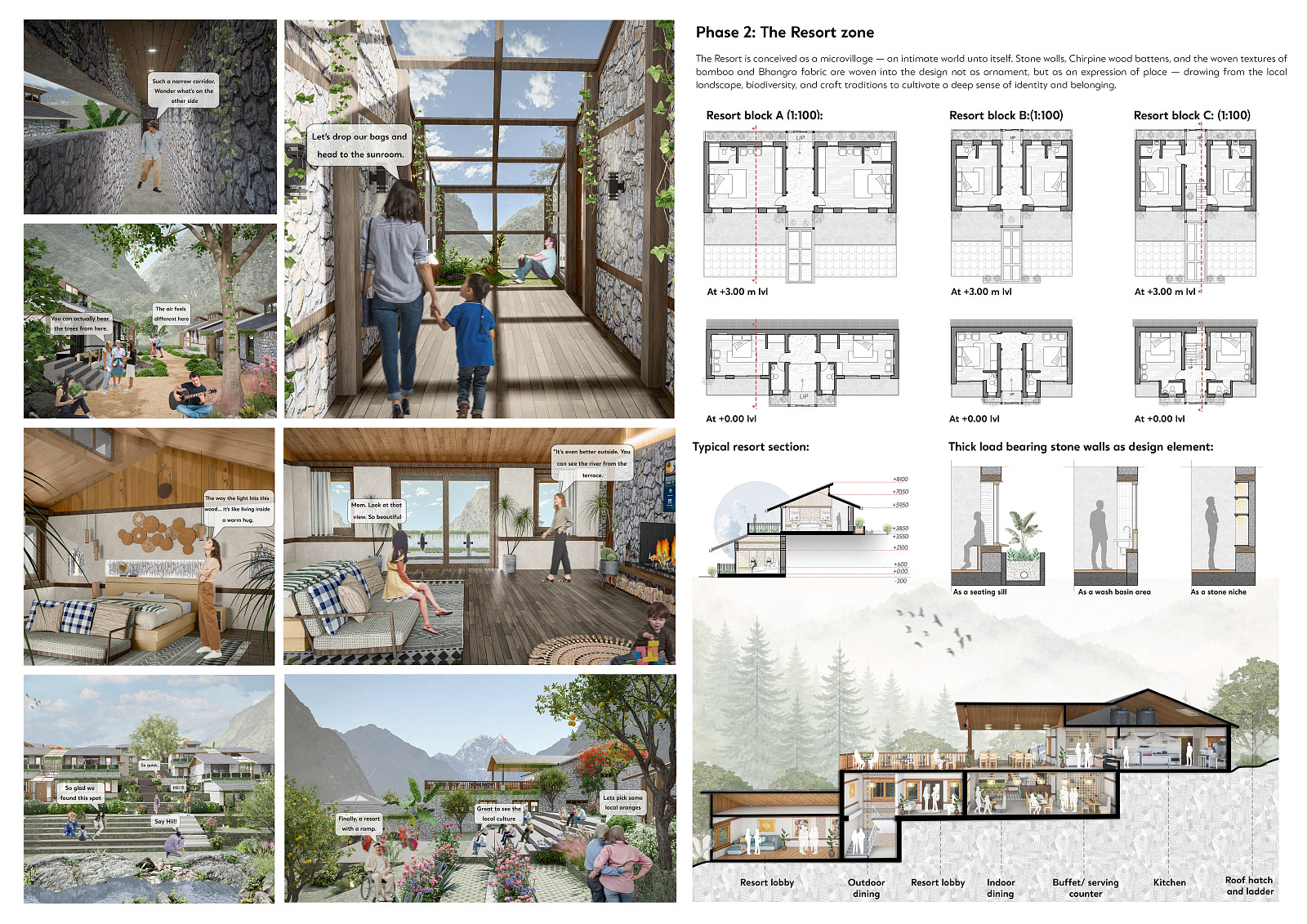
The first principle is material honesty - stone from the hill, timber from the forest, river stones from below - each improved for resilience against a climate that is harsh and a geology that is seismically active.
The second is identity. What makes the experience of one Tatopani different from another? Context. The bamboo weaving traditions, the Bhangra fabric-making, the sloped roofs, the narrow stone gallis of Narchyang village that inspired the site's circulation - these are not decorations. They are the building itself.
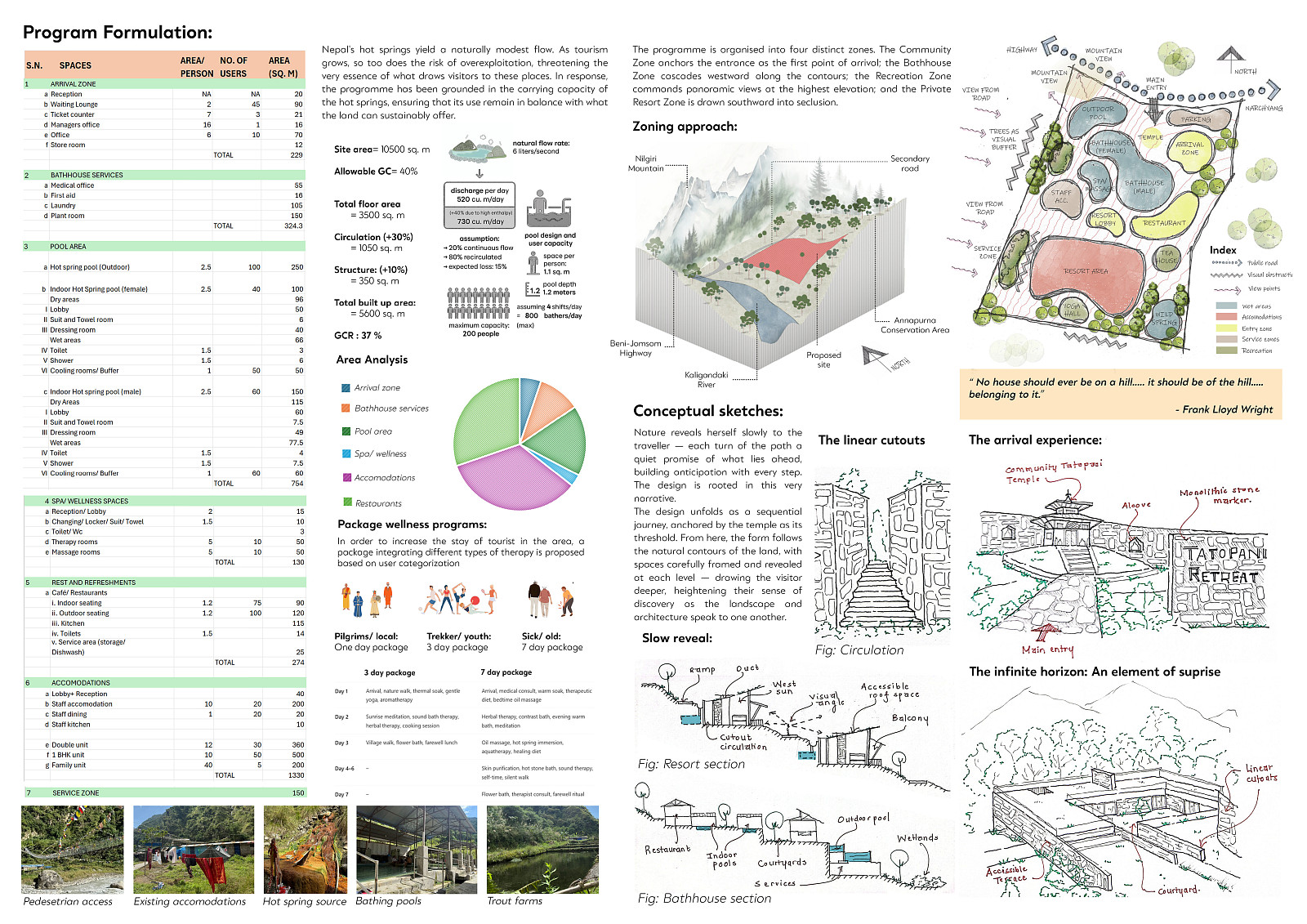
The third is restraint. Pool sizes, numbers, and visitor capacity are all calibrated against the natural discharge rate of the source to prevent overexploitation. Greywater and blackwater are treated on-site through wetlands and biodigester systems. Discharge is filtered before entering the river. These are not extraordinary measures - they are simply careful ones, and entirely replicable.
The Community at the Centre
The communities surrounding these springs have built their lives around hospitality. Local food, traditional healing knowledge, cultural practice - these are not amenities to layer onto the experience. They are the experience. This project is designed to bring them to the centre of it: so that the community is not simply hosting visitors, but genuinely sharing something of their own lives, and being sustained by the sharing.
If one Tatopani can be developed with this kind of care, it becomes more than a building. It becomes a demonstration - that this is how these places deserve to be treated, and what becomes possible when they are. Not just a destination, but an argument for what Tatopani could be, and for what Nepal's relationship with its own extraordinary landscape might yet become.
Technical information
Building with the Land and Against Its Forces:
The architecture is rooted in the vernacular traditions of the Himalayas - stone masonry, slate roofing, timber interiors - but it does not stop at appearance. It learns from those traditions structurally, and then quietly strengthens them.
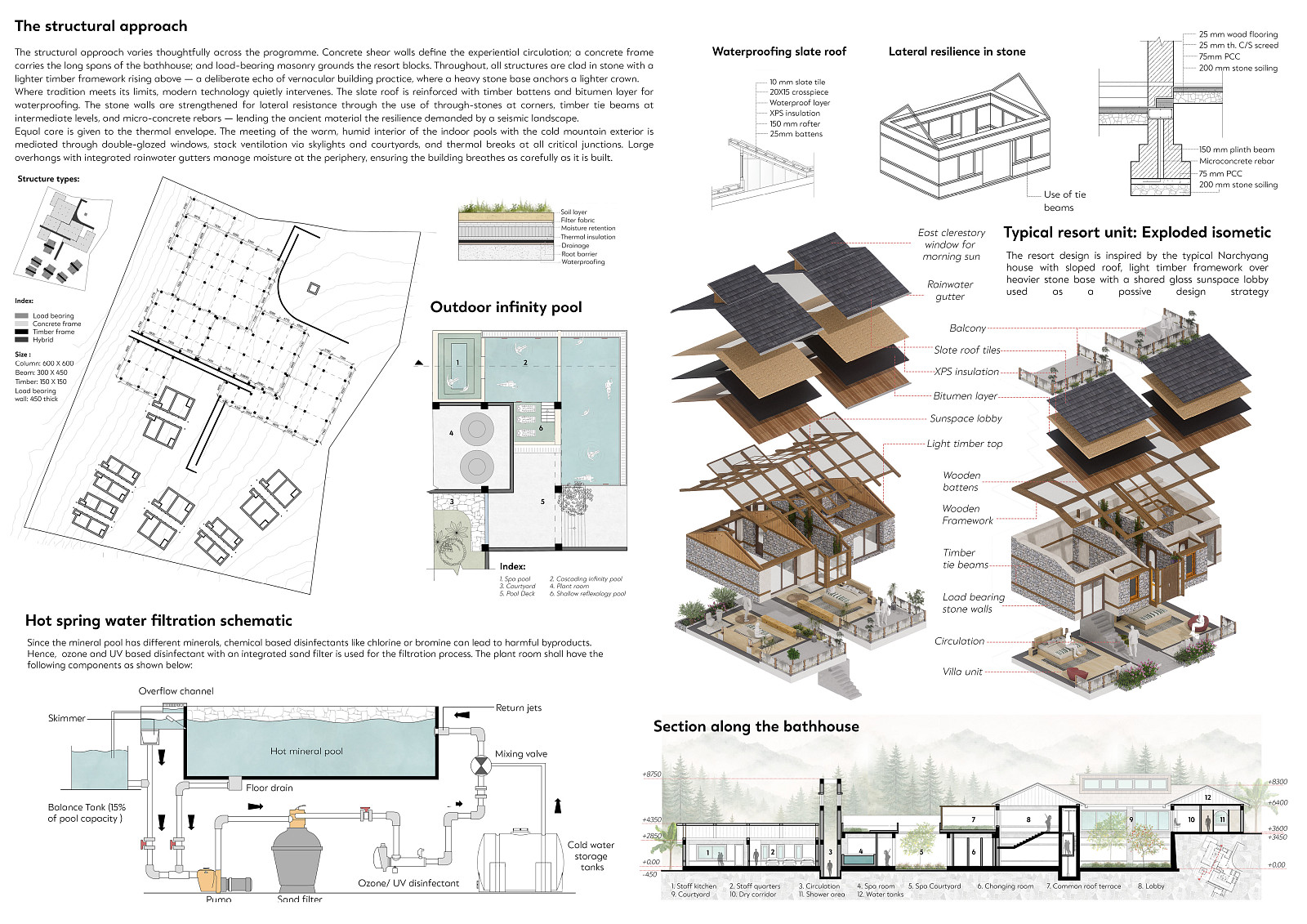
Three systems run through the site, each suited to what it carries. Shear walls define the circulation spaces. Load-bearing stone masonry - the same logic as the houses of Narchyang Valley - structures the resort. Concrete frames take over where the bathhouse and wellness zones need longer spans. What holds all of this together is a consistent surface: stone, timber, and local finishes clad every system, so the building reads as one continuous thing regardless of what lies beneath.
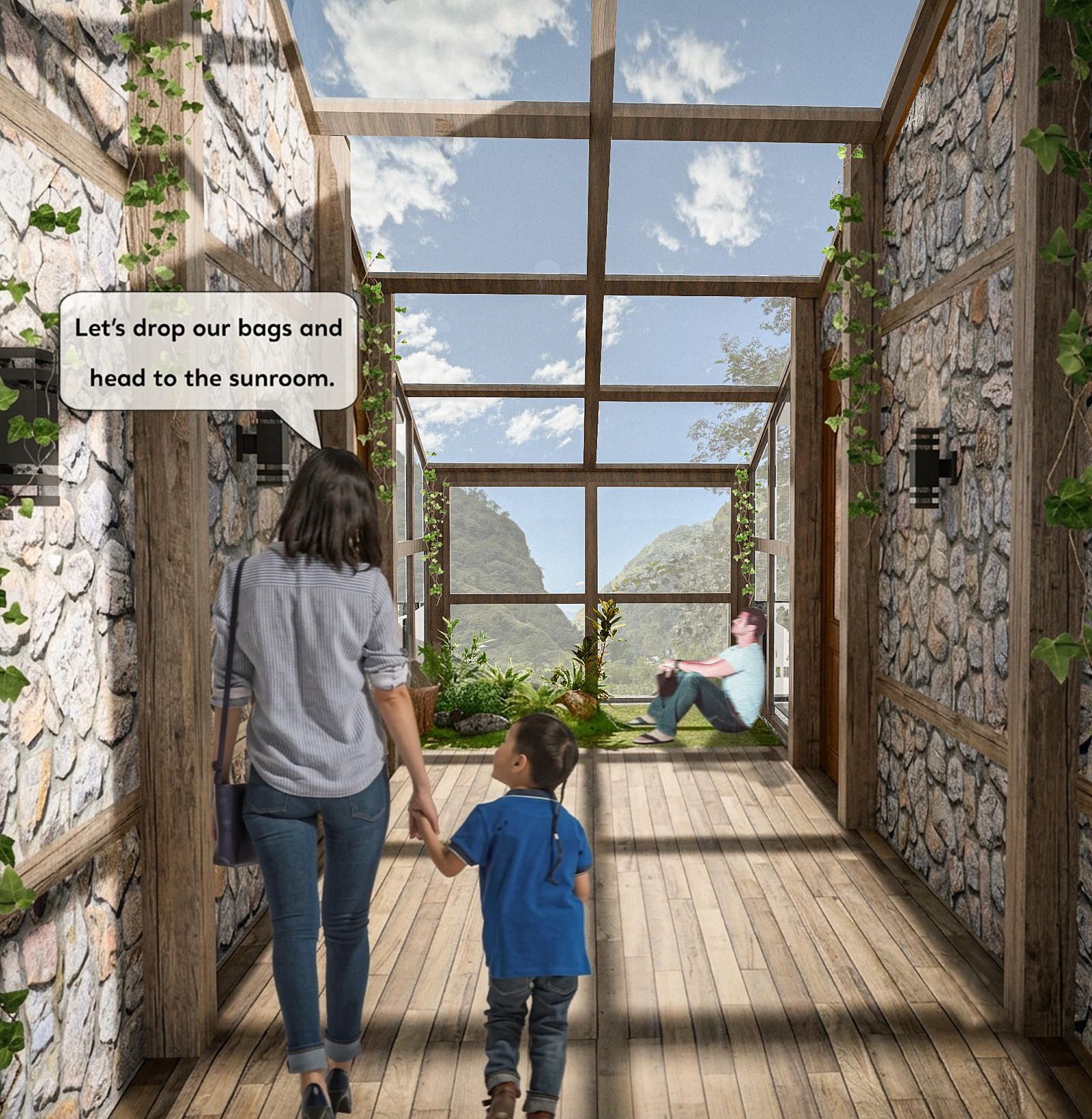
The Himalayan vernacular turns out to be good seismic thinking - heavy base, light frame above, slate roof at the top. The design follows that logic and reinforces it: horizontal timber tie beams at multiple levels, through-stones at corners, micro-concrete rebars rising from the foundations through the masonry. In the humid environment of the hot springs, timber is treated with linseed oil and detailed with tongue-and-groove joinery. Slate roofs sit over insulated, waterproofed Chir pine battens. A glazed sunspace lobby buffers the resort against the cold. Thick stone walls, double-glazed windows, and thermal breaks at critical joints do the rest.
Water management
Every drop that enters this site is treated as a resource.
Rainwater is harvested from sloped roofs into three underground tanks - one per bathhouse courtyard, each holding 100,000 litres - for irrigation and groundwater recharge. Greywater, around twenty-two cubic metres a day, is treated through a constructed wetland of water hyacinth, duckweed, and cattail, then returned for toilet flushing and irrigation, with surplus feeding an on-site fishpond. All toilet waste goes through a biodigester, producing methane for the kitchen and fertiliser for the gardens. A retention pond absorbs monsoon runoff and keeps it out of the Kaligandaki River. In the dry season, it becomes the same fishpond from surplus treated greywater.
Nothing leaves the site untreated. Nothing is wasted.
Knowing When Enough is Enough
The quietest and perhaps most important design decision here is simply: how many people can this place actually hold?
At comparable Tatopani sites, peak season brings fifteen hundred to twenty-four hundred visitors a day. The results are predictable -degraded water, eroded landscapes, an experience that serves nobody. This project sets a maximum of two hundred simultaneous bathers, calculated against pool surface areas and standard occupancy ratios. A three-tiered program — day visits, three-day stays, seven-day retreats - spreads visitor flow across the day and across seasons.
The spring has been here for centuries. The design is built around the intention that it stays that way.

Copyright © 2026 INSPIRELI | All rights reserved. Use of this website signifies your agreement to the Terms of Use, Privacy Policy, and use of cookies.