Secondary School in jaipur (ANTRA)


Project idea
Project Declaration – ANTRA Secondary School
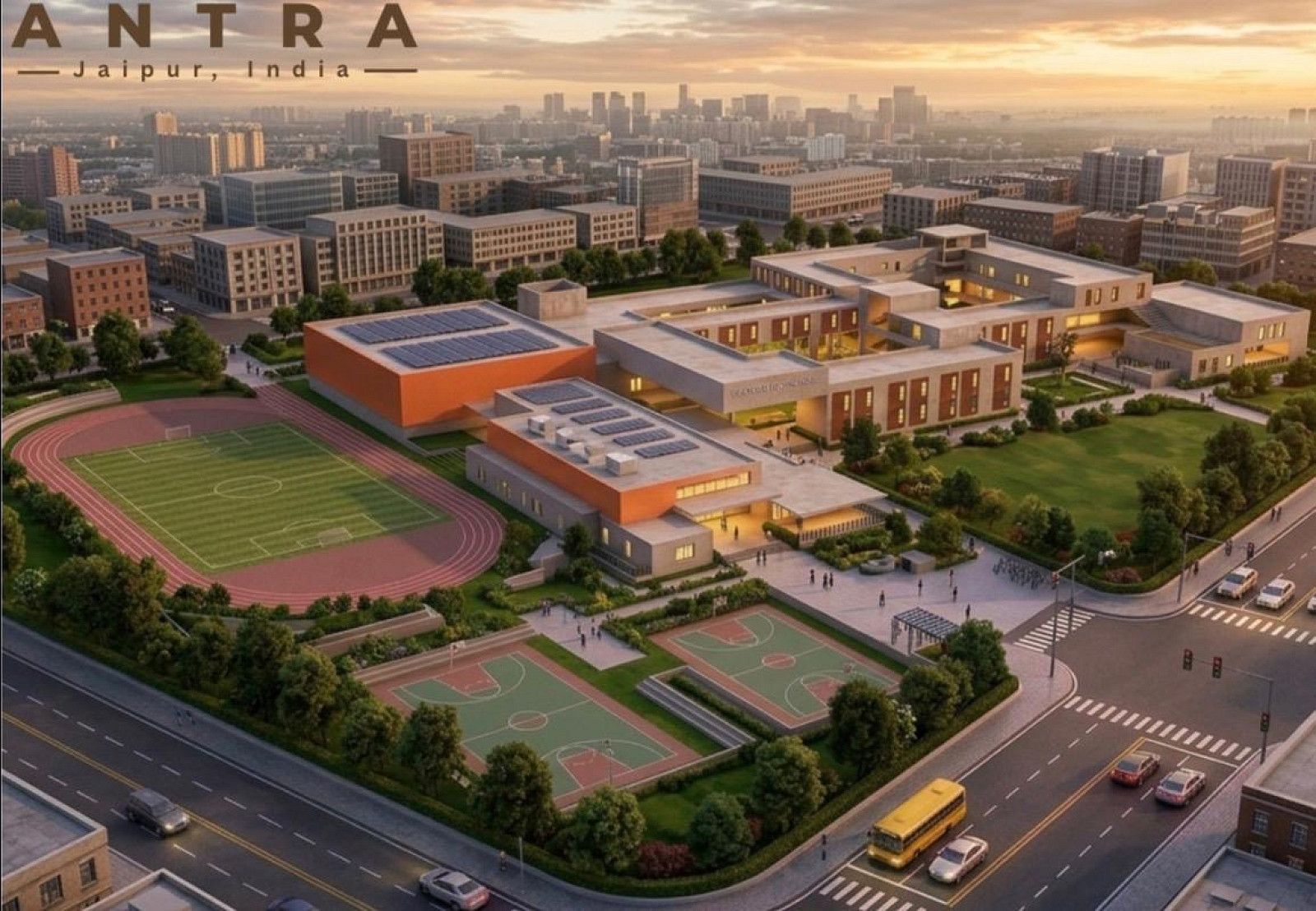
ANTRA Secondary School is a climate-responsive educational campus proposed in the urban context of Jaipur, Rajasthan. The project is developed on a 20,000 m² site with a design approach rooted in solar-passive principles and sustainable planning strategies suitable for Jaipur’s hot-dry climate.
The core idea of the project is to create a courtyard-friendly and view-friendly learning environment where students remain visually connected to nature, activities, and surrounding spaces throughout the campus. The design aims to move beyond conventional school planning by encouraging interaction, openness, and a strong relationship between built and open spaces.
A network of courtyards forms the organizational spine of the campus, providing natural light, ventilation, thermal comfort, and social gathering spaces. Academic blocks, administration, library, and recreational facilities are arranged around these courtyards to ensure easy orientation and visual connectivity. The administration block is positioned on the eastern side to establish a clear entrance sequence and efficient campus management.
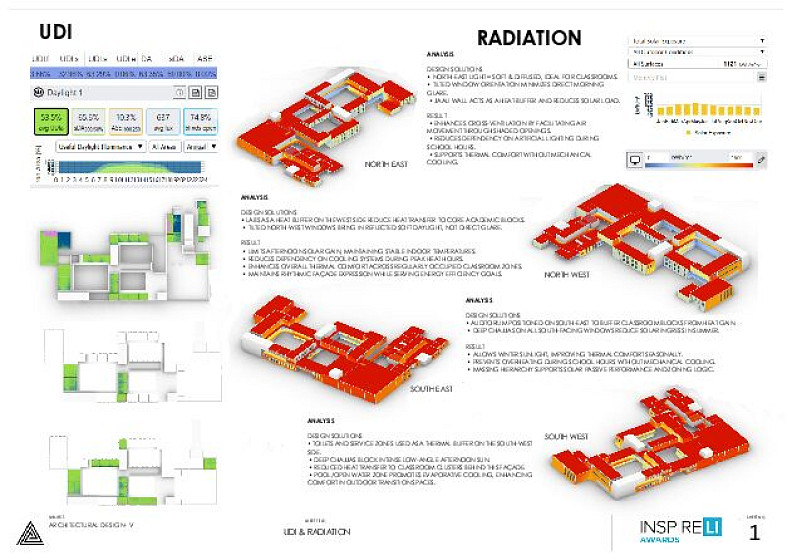
The project incorporates solar-passive design strategies such as north-oriented tilted windows, optimized building orientation, daylight utilization, and natural ventilation to reduce heat gain and improve energy efficiency. Through these measures, ANTRA seeks to create a comfortable, sustainable, and engaging educational environment for approximately 300–400 students.
The objective of the project is to demonstrate how architecture can enhance learning experiences by integrating climate-responsive design, visual connectivity, social interaction, and environmental sustainability into a cohesive educational campus.
Project description
The scope of ANTRA Secondary School is to develop a climate-responsive educational campus that caters to the academic, recreational, administrative, and social needs of approximately 300–400 students. The project explores how architecture can create a comfortable and engaging learning environment through the integration of solar-passive design principles, sustainable planning, and user-centered spaces.
The project includes the planning and design of academic facilities such as classrooms, laboratories, library, staff areas, and administration spaces, along with supporting facilities including playgrounds, open activity areas, courtyards, and gathering spaces. Special emphasis is placed on creating visual connectivity across the campus, ensuring that students remain connected to outdoor spaces and campus activities from various locations.
The design addresses Jaipur’s hot-dry climate through passive strategies such as optimized building orientation, north-facing tilted windows, natural daylighting, cross ventilation, shaded courtyards, and thermal comfort measures. The project also aims to reduce dependence on artificial lighting and mechanical cooling systems, thereby improving environmental sustainability and energy efficiency.
The scope further extends to creating a safe, accessible, and inclusive campus environment that promotes interaction, collaboration, and holistic learning. Through the integration of built and open spaces, the project demonstrates how educational architecture can contribute to the physical, social, and environmental well-being of its users.
Technical information
Project Name: ANTRA Secondary School
Project Type: Educational Institution (Secondary School)
Location: Jaipur, Rajasthan, India
Site Area: 20,000 m²
FAR (Floor Area Ratio): 1.0
Permissible Built-up Area: 20,000 m²
Student Capacity: Approximately 300–400 Students
Site and Planning
* Campus planned around multiple interconnected courtyards.
* Administrative block located on the eastern side of the site.
* Academic, recreational, and support facilities organized around open spaces.
* Separate circulation for students, staff, and visitors where required.
* Integration of landscape and built form to improve environmental comfort.
Academic Facilities
* Classrooms
* Science Laboratories
* Computer Laboratory
* Library and Reading Area
* Staff Rooms
* Administrative Offices
* Multipurpose Spaces
* Student Activity Areas
Recreational Facilities
* Outdoor Playground
* Sports Areas
* Open Activity Spaces
* Courtyard Gathering Spaces
* Landscaped Open Areas
Climate Responsive Features
* Solar-passive design approach.
* North-oriented windows for glare-free daylight.
* Tilted window design for improved daylight penetration and reduced heat gain.
* Multiple courtyards for natural ventilation and cooling.
* Building orientation optimized according to Jaipur’s hot-dry climate.
* Shaded circulation spaces.
* Maximum utilization of natural lighting and ventilation.
Building Construction
* Reinforced Cement Concrete (RCC) structural framework.
* Brick masonry walls.
* Cement plaster finish.
* Energy-efficient glazing in window systems.
* Combination of hardscape and softscape landscape elements.
Environmental Considerations
* Reduction of solar heat gain.
* Increased daylight utilization.
* Enhanced cross ventilation.
* Reduced dependency on artificial lighting during daytime.
* Improved thermal comfort through passive design strategies.
Design Objectives
* Create a courtyard-friendly educational environment.
* Ensure visual connectivity throughout the campus.
* Promote interaction and social learning.
* Achieve environmental sustainability.
* Provide a comfortable and healthy learning atmosphere.
Documentation
Created in:


Copyright © 2026 INSPIRELI | All rights reserved. Use of this website signifies your agreement to the Terms of Use, Privacy Policy, and use of cookies.