Coconuttales


 Assoc. Prof. Sapinah Danial
Project idea
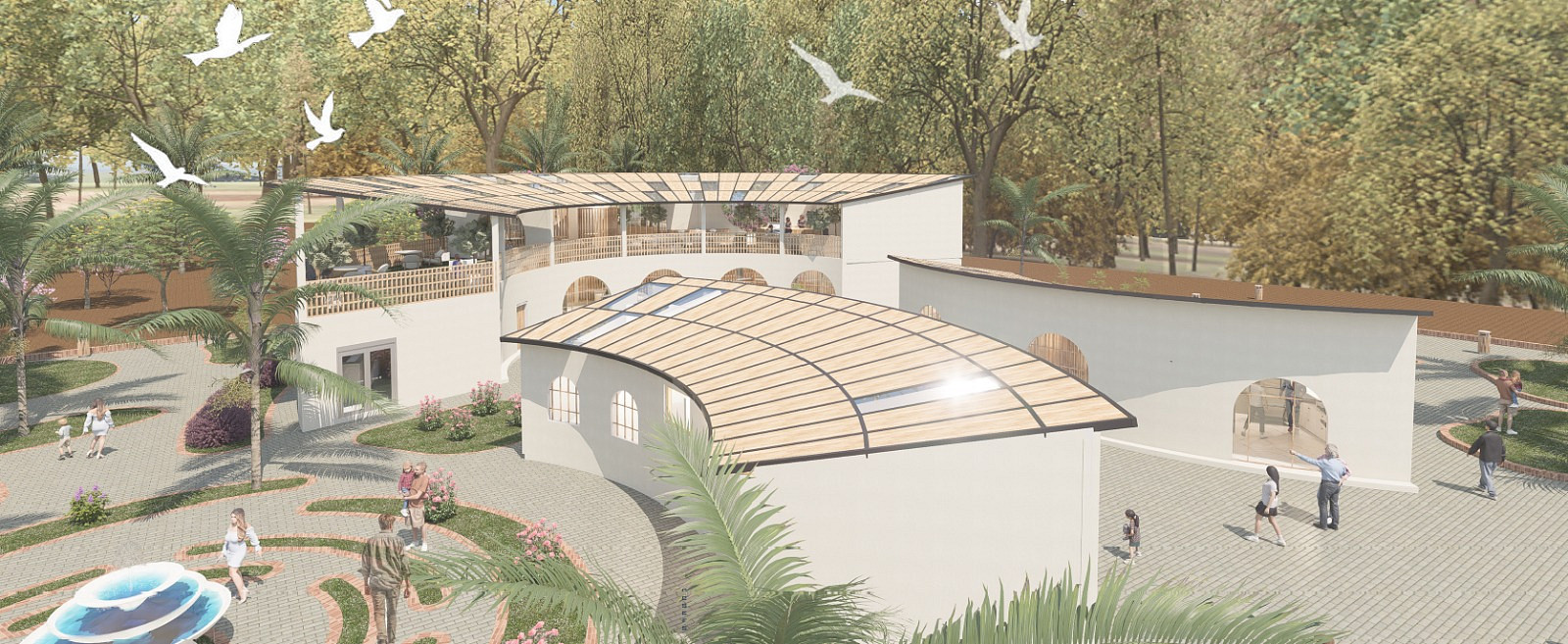
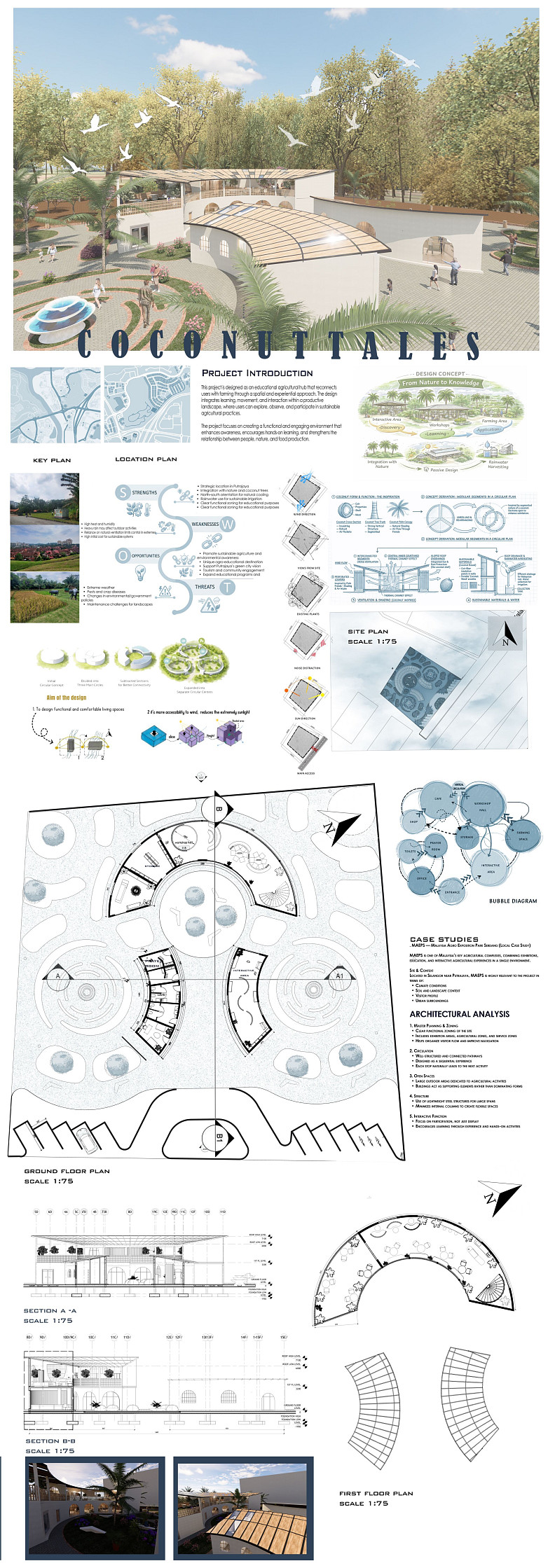
Cocconuttales is an agro-educational farming centre dedicated to the cultivation, study, and celebration of the coconut — one of Southeast Asia's most culturally significant, ecologically versatile, and economically vital plants. Situated within Putrajaya, Malaysia, the project reimagines the coconut not merely as a crop but as a living archive of Malay heritage, traditional knowledge, and sustainable land practice, bringing its story into the heart of the city through architecture, education, and active farming.
The coconut palm occupies a singular place in Malaysian cultural and agricultural life. Every part of the plant — from the husk and shell to the flesh, water, and frond — carries utility, meaning, and memory. Cocconuttales honours this totality by designing a facility where the full lifecycle and material richness of the coconut is explored, demonstrated, and taught across a series of interconnected farming and educational spaces.
The project's dual programme places farming and education in constant dialogue. Coconut groves, nursery propagation beds, and processing demonstration areas form the productive agricultural landscape, while open-air classrooms, interpretive pavilions, and hands-on workshop studios constitute the educational infrastructure. Visitors engage with the coconut at every scale — observing young seedlings in the nursery, learning traditional harvesting techniques along grove pathways, and participating in product demonstration workshops that reveal the extraordinary range of uses the plant sustains.
Within a 300 m² built-up footprint, the architecture is compact and purposeful, with built forms stepping back to allow the coconut landscape to command the spatial experience. Covered transition spaces, shaded learning nodes, and open farming ground are woven together into a coherent civic facility.
Cocconuttales aspires to restore the coconut to its rightful place at the centre of Malaysian cultural consciousness — growing it, teaching it, and sharing it with the communities of Putrajaya and beyond.
Project description
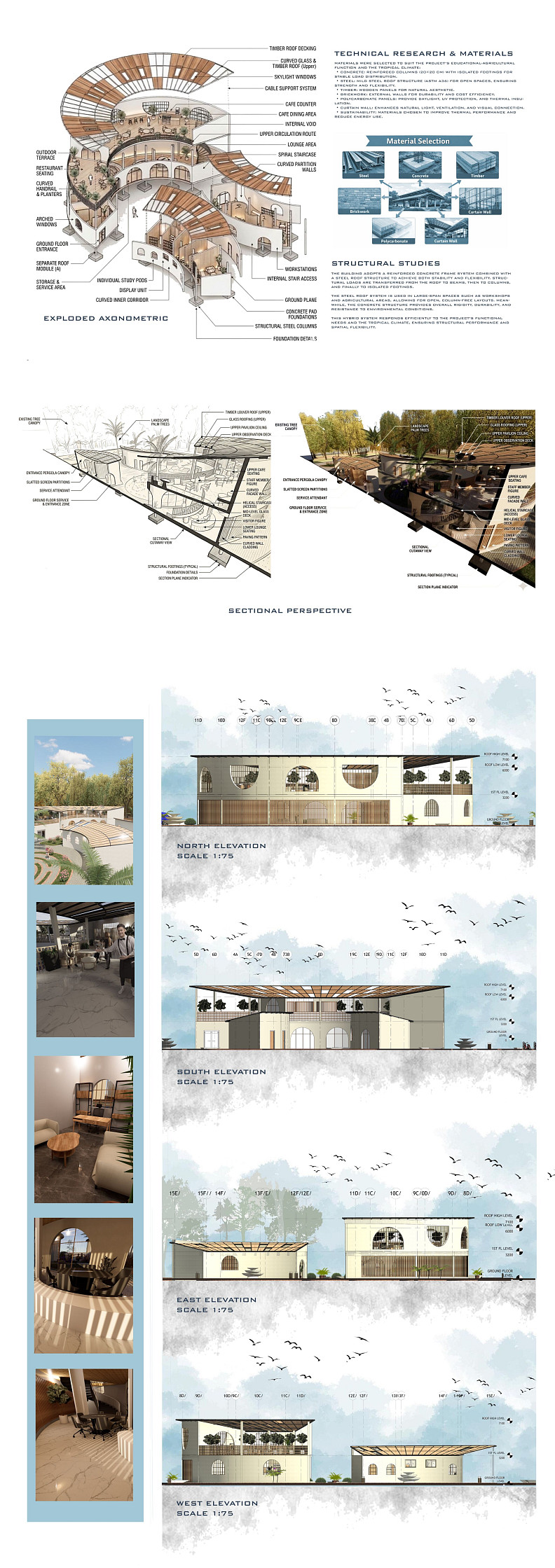
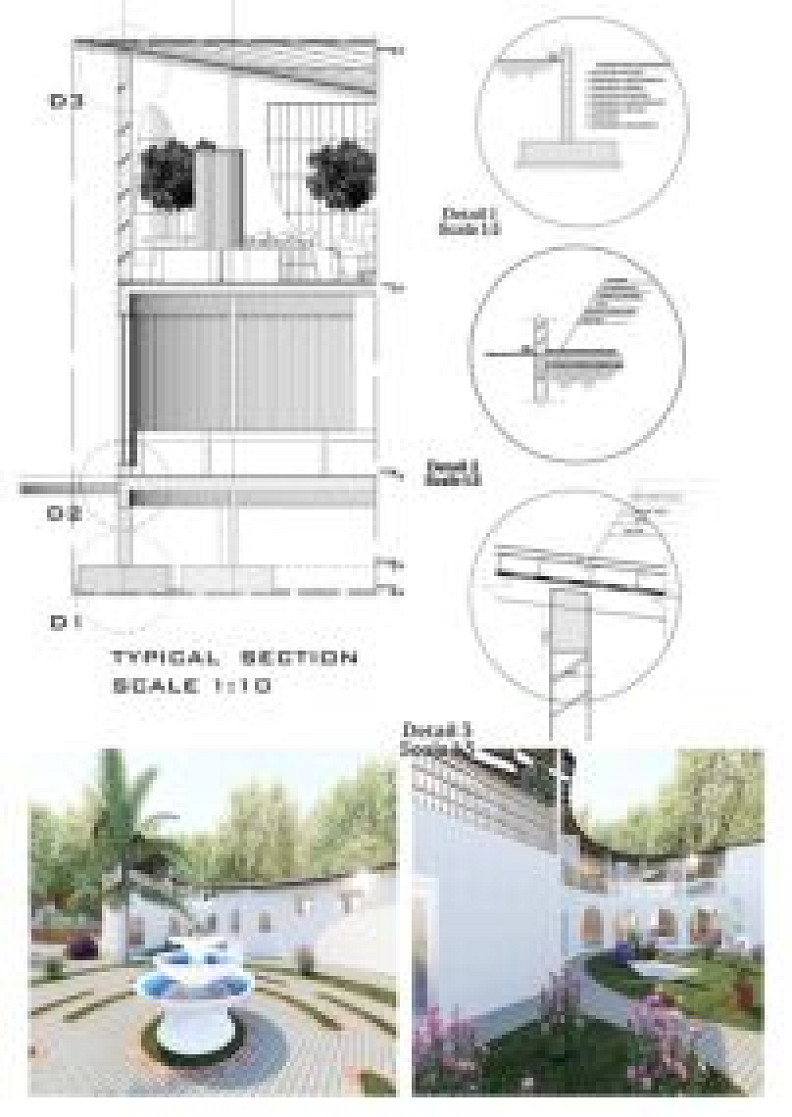
Cocconuttales draws its architectural language directly from the material world of the coconut palm — a building vocabulary rooted in the very crop it cultivates, celebrates, and teaches. The architecture is conceived as a living demonstration of the coconut's extraordinary material versatility, where the built environment itself becomes an exhibit of what this singular plant can offer as a construction resource, a spatial mediator, and a cultural artefact.
The primary structural and finish material of Cocconuttales is coconut timber — the dense, fibrous hardwood harvested from mature coconut palm trunks that have completed their productive lifespan. Coconut timber columns, beams, and screen elements define the architectural character of the facility with a richly grained, dark-toned material presence that is simultaneously local, sustainable, and deeply expressive. Its natural variation in grain pattern and tone gives each built element a distinct handcrafted quality, reinforcing the project's commitment to artisanal agricultural knowledge over industrial uniformity.
Coconut frond weaving informs the design of shading screens, ceiling liners, and partition infill panels across the semi-open learning pavilions and transition spaces. These woven elements filter tropical sunlight into dappled, animated patterns across floors and working surfaces, creating an interior atmosphere that is inseparable from the agricultural landscape surrounding it. As the woven panels weather and silver over time, they deepen in character, ageing gracefully alongside the growing coconut grove they face.
Rammed earth plinths and low boundary walls ground the lighter timber and woven elements above, anchoring the facility to its site with a material solidity and thermal mass appropriate to Putrajaya's tropical climate. The earth tones of these walls echo the cultivated soil of the farming beds, blurring the boundary between constructed ground and agricultural ground.
Floors transition deliberately across the site — from polished compressed earth within enclosed teaching spaces, to rough-sawn coconut timber decking beneath shaded pavilions, to bare compacted laterite across the open farming and grove areas. This material graduation from refined to raw mirrors the experiential journey of Cocconuttales itself — moving visitors from the architectural interior outward into the productive landscape, and back again, in a continuous cycle that reflects the very nature of the crop at the project's heart.
Technical information
Cocconuttales is designed as a fully integrated environmental system, where every passive and active strategy is derived from and calibrated to the ecological logic of the coconut palm itself. The facility operates as a closed-loop agricultural environment — one where the growing, harvesting, processing, and decomposing of coconut plants generates the resources that sustain the building's own environmental performance, minimising external energy and water dependency across all operational phases.
Natural ventilation is the primary environmental comfort strategy. The spatial organisation of Cocconuttales is oriented along a northwest to southeast axis, aligning the principal farming and educational spaces to capture Putrajaya's prevailing monsoon breezes throughout both the southwest and northeast monsoon seasons. Coconut timber louvre screens along east and west elevations are designed with adjustable blade angles, allowing occupants to modulate airflow and solar penetration in response to daily and seasonal climatic variation. Cross-ventilation is maintained across all semi-open pavilion spaces through the deliberate separation of parallel building edges, drawing air continuously through teaching and farming zones without mechanical assistance.
The coconut grove itself performs a critical passive cooling function. The dense canopy of mature coconut palms across the farming landscape shades the ground plane and surrounding built elements from direct solar radiation, reducing surface temperatures and creating a localised microclimate that is measurably cooler than the surrounding urban context. Evapotranspiration from the grove further humidifies and cools incoming breezes before they enter occupied spaces, functioning as a living air-conditioning system of considerable effectiveness.
Rainwater harvesting is integrated into every roof surface across the facility. Sloped coconut timber and corrugated metal roof planes channel rainfall into a network of subsurface storage cisterns with a combined holding capacity sufficient to sustain full irrigation of the coconut nursery and farming plots through Putrajaya's intermittent dry periods. Overflow from the cistern network feeds constructed bioswales that traverse the farming landscape, slowing stormwater runoff, recharging the local water table, and supporting the moisture requirements of young coconut seedlings along their edges.
Waste generated by the facility is managed through a comprehensive on-site circular economy system. Coconut husks and shells from the processing demonstration area are carbonised in a small-scale biochar kiln, with the resulting biochar incorporated into farming bed soil mixtures to improve water retention, aeration, and nutrient availability. Coconut frond offcuts and organic agricultural waste are processed through a dedicated composting bay, returning nutrients directly to the growing beds and closing the organic waste cycle entirely within the site boundary.
Photovoltaic panels are mounted on the south-facing roof planes of the enclosed programme volumes — the seed library, workshop studio, and demonstration processing kitchen — generating sufficient renewable electricity to power lighting, ventilation fans, water pumps, and refrigeration systems across the full facility. A real-time energy monitoring display is integrated into the educational interpretive circuit, allowing visitors to observe live energy generation and consumption data as a tangible demonstration of the facility's environmental performance and self-sufficiency ambitions.
Documentation
Show PDF 1Show PDF 2Show PDF 3


Copyright © 2026 INSPIRELI | All rights reserved. Use of this website signifies your agreement to the Terms of Use, Privacy Policy, and use of cookies.