THEATRE OF PERFORMING ARTS IN THE CITY OF BAMENDA, CAMEROON


Project idea
Bamenda, the regional capital of North-West Cameroon and the main cultural hub for the English-speaking communities, suffers from a structural lack of cultural infrastructure. Despite an exceptional artistic wealth — community theatre, traditional dance, urban music — cultural actors have no professional space dedicated to the creation, training and dissemination of the performing arts. The only existing performance venue, the Alliance Française in Bamenda, offers a mere 72 m², a derisory area given the needs of a city with over 573,000 inhabitants.
In a region deeply scarred by several years of socio-political crisis, this project offers much more than a cultural facility: it envisions a space for social reconstruction, dialogue and reconciliation through the arts. Here, the theatre becomes an architectural tool serving community cohesion, the promotion of local identity and the development of the creative industries.
The aim is to design a contemporary, inclusive and sustainable theatre, rooted in its context, capable of hosting theatre, dance and music performances as well as community activities, whilst offering young local talent a professional setting in which to train and flourish.
Project description
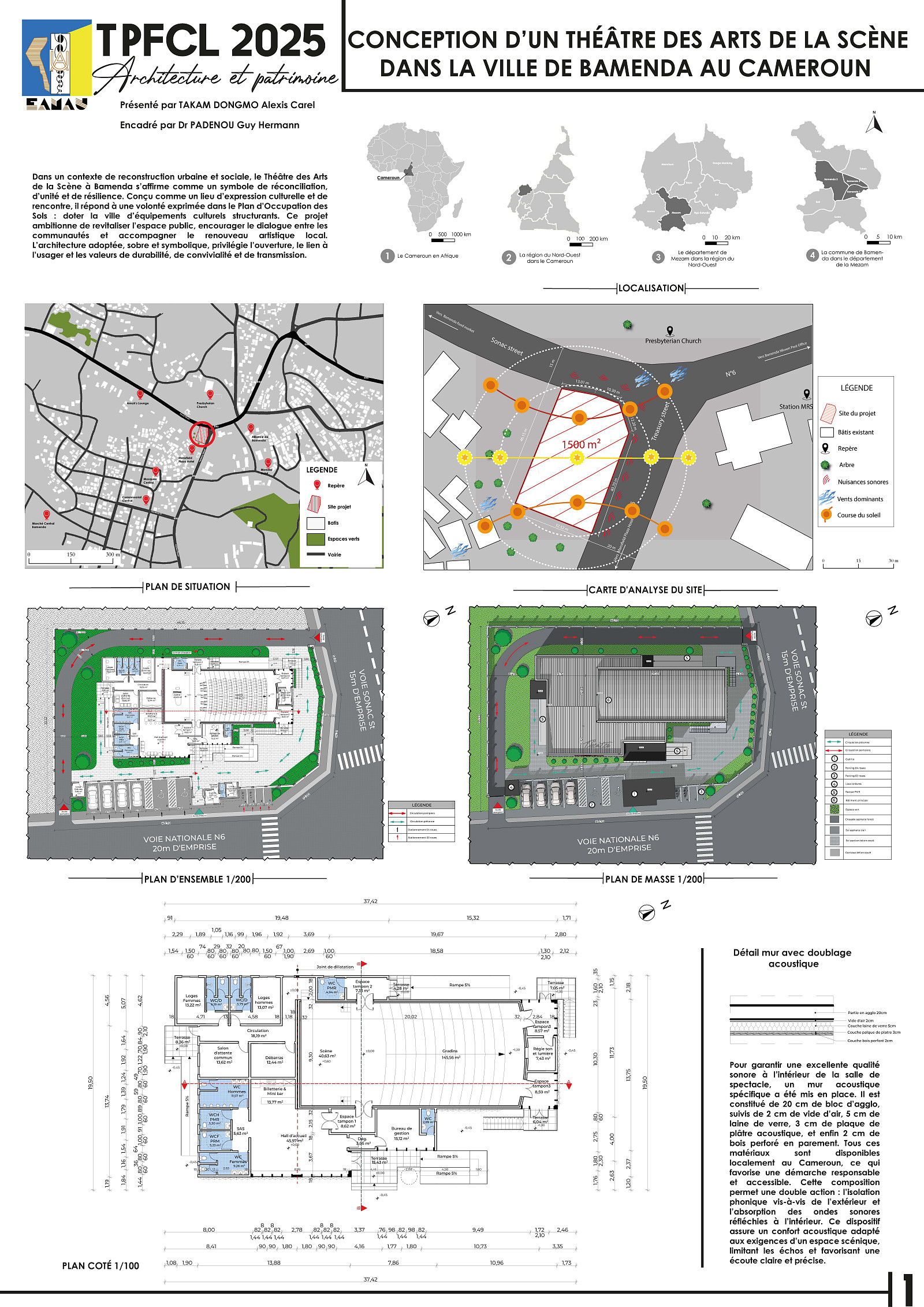
The project involves the design of a performing arts theatre situated on a 1,500 m² site in the heart of Bamenda, at the junction of the N6 national road and Sonac Street. Its strategic location ensures maximum visibility and optimal accessibility for the entire population.
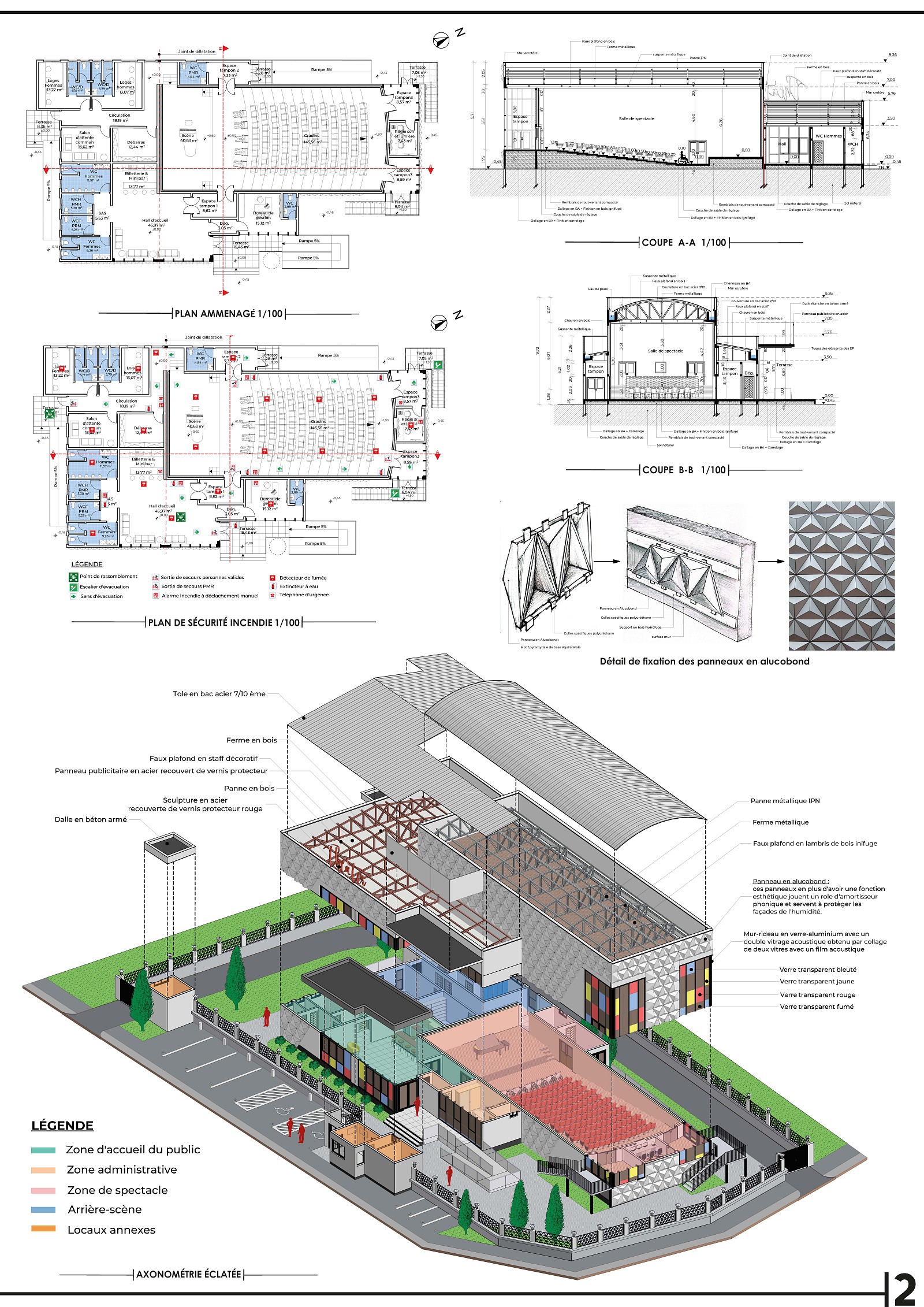
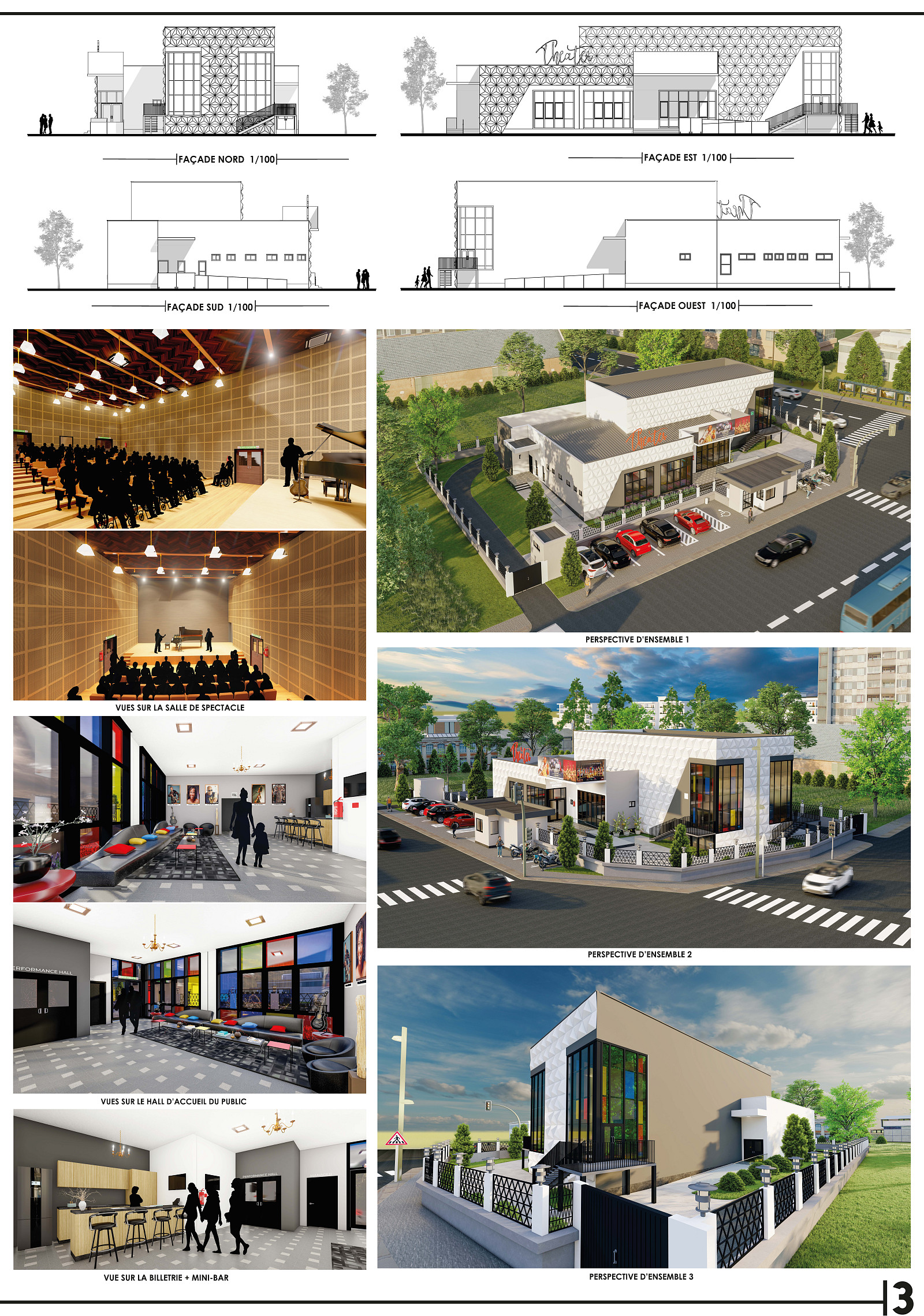
The single-storey building, with a floor area of 459.21 m², is organised around four clearly defined functional zones: a public reception area, a performance hall, a backstage area and an administrative area. This layout ensures distinct and smooth flow between the public, the performers and the technical staff.
The auditorium, the heart of the project, features a modular stage of 40.63 m² and tiered seating for approximately 150 people, designed to offer optimal visibility and acoustic comfort to every audience member. The backstage area includes men’s and women’s dressing rooms with showers, an artists’ lounge and a storage area. The open and bright reception hall is combined with a ticket office and a mini-bar, creating a welcoming space before and after performances.
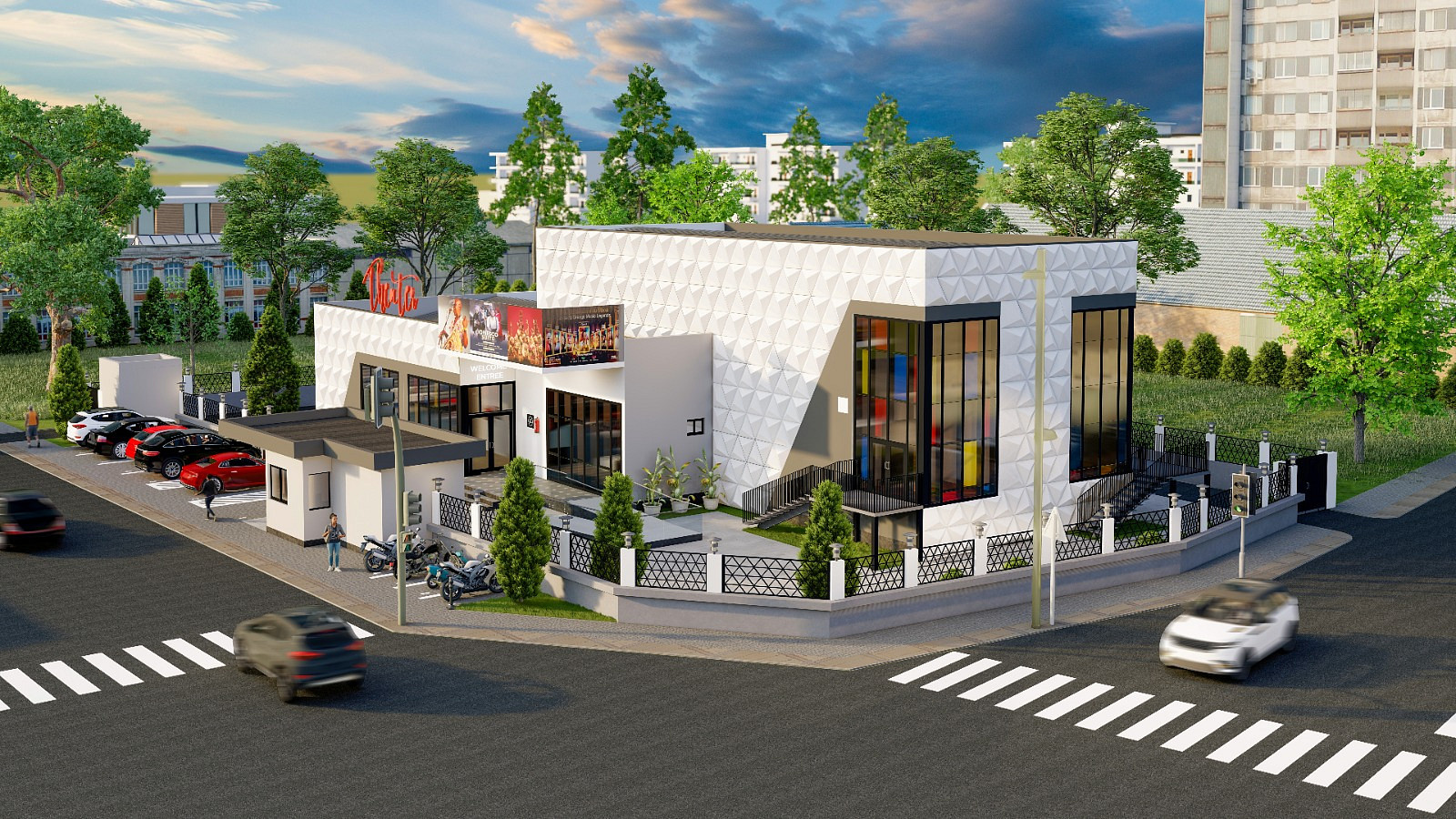
The architectural approach is based on three fundamental pillars. Firstly, acoustic performance, ensured by a 32 cm multi-layered wall, a curved roof that aids sound propagation, and the complete absence of any direct opening between the auditorium and the outside, thanks to buffer zones. Secondly, universal accessibility, integrated from the very outset of the design with 5% gradients, accessible circulation routes and facilities for people with reduced mobility throughout the building. Finally, the architectural identity is expressed through a façade of white Alucobond panels — a symbol of peace in a region undergoing reconstruction — enlivened by touches of red, yellow and blue on the glazing, evoking the vitality and cultural diversity of Bamenda.
The project also incorporates bioclimatic strategies adapted to Bamenda’s tropical mountain climate, 278 m² of green spaces, car parks and a dedicated lane for emergency vehicles.
Technical information
The project is a cultural facility dedicated to the performing arts, located in Bamenda, in the North-West Region of Cameroon. It is situated on a 1,500 m² site with a main floor area of 459.21 m² and an auditorium seating approximately 150 people in tiered seating.
The technical approach is based on creating a building that performs well in structural, acoustic, climatic and functional terms, whilst remaining adapted to local construction realities.
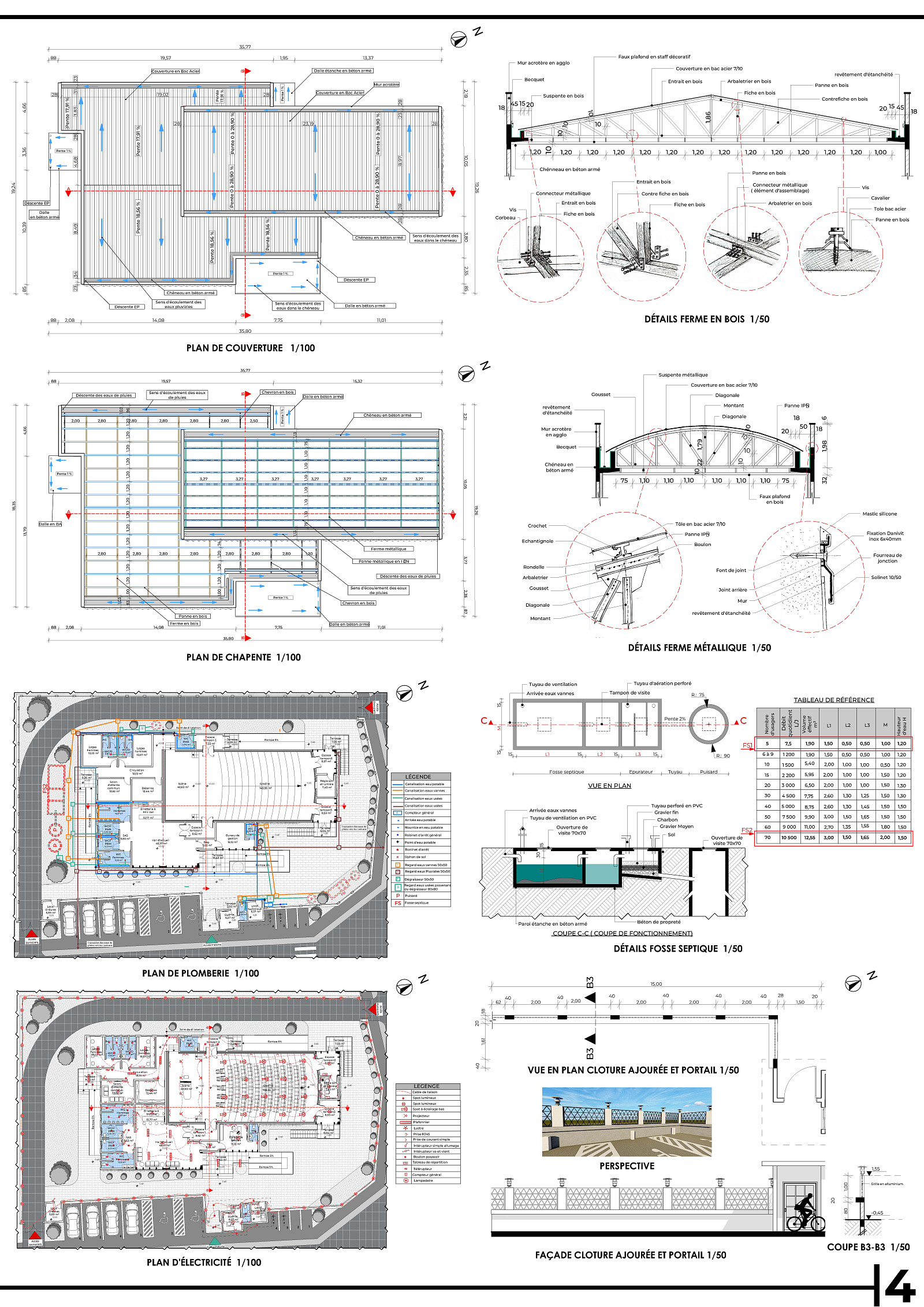
The main load-bearing structure is constructed from reinforced concrete (column-beam system) resting on isolated, continuous footings with a density of 350 kg/m³. This choice ensures excellent structural stability, good resistance to climatic stresses and controlled implementation thanks to the availability of materials and local expertise in the construction sector in Cameroon.
Two structural systems have been combined to optimise the project’s technical performance:
A galvanised steel framework supports the curved roof of the auditorium. This choice allows for large spans to be spanned without intermediate columns, ensuring optimal visibility from every seat and total flexibility of the stage area. Steel also offers high geometric precision for the construction of the curved roof, which is the project’s key architectural feature.
A fire-retardant treated timber frame is used for the administrative and ancillary spaces. Wood was chosen for its regional availability, its low environmental impact, its natural thermal properties, and the warm atmosphere it brings to the spaces used daily by artists, staff and visitors. Its use also helps to strengthen the link between the building’s contemporary architecture and local building traditions.
The auditorium has been given specific acoustic treatment designed to meet the requirements of theatrical, musical and dance performances. The walls consist of a 32 cm multi-layer assembly comprising 20 cm hollow blocks, a 2 cm air gap, 5 cm of glass wool insulation, 3 cm of acoustic plasterboard and a final 2 cm perforated timber cladding. This composition provides both insulation from external noise and improved interior sound quality by limiting echo and reverberation.
The hall’s ceiling consists of perforated acoustic timber panels suspended from a metal framework fitted with anti-vibration hangers. This solution improves speech intelligibility and ensures even sound distribution throughout the auditorium.
The flooring consists of fire-retardant solid wood parquet laid over an acoustic underlay. This material offers excellent comfort for performers, enhances the hall’s acoustic performance and creates a warm atmosphere in keeping with the building’s cultural purpose.
The colour scheme of the façades reflects the project’s philosophy: simplicity, peace and reconciliation. The white Alucobond panels, symbols of neutrality and purity, convey a message of calm in a regional context marked by tensions. Shades of grey add texture and depth, whilst the anthracite of the west façade visually anchors the building to its site. Touches of red, yellow and blue in the glazed curtain walls breathe life and expressiveness into the design, symbolising energy, diversity and vitality — thereby establishing the building as a major cultural landmark in Bamenda’s urban landscape.
The project also incorporates bioclimatic strategies adapted to the local tropical mountain climate. Roof overhangs, green spaces and ventilation systems help to improve thermal comfort whilst reducing energy requirements. The green spaces cover 278.15 m² and contribute to the site’s microclimatic regulation.
Universal accessibility is a fundamental principle of the project, featuring 5% gradients, circulation routes of at least 1.50 m, adapted toilets, reserved parking spaces and routes accessible to all categories of users.
Safety is ensured by four emergency exits, one of which is adapted for people with reduced mobility, smoke detectors, regulation fire extinguishers and evacuation signage compliant with public building standards.
Created in:


Copyright © 2026 INSPIRELI | All rights reserved. Use of this website signifies your agreement to the Terms of Use, Privacy Policy, and use of cookies.