Finding Peace

Project idea
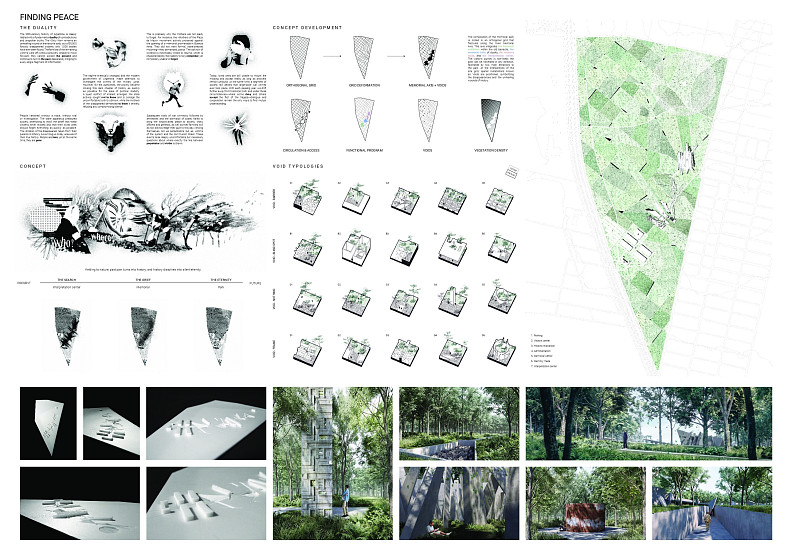
Argentina continues to live with the unresolved legacy of the Dirty War - a history marked by contradictions, absences, and unanswered questions. Decades later, thousands of families still search for truth, while society remains divided between remembering and forgetting, accepting and denying, knowing and not knowing. This duality lies at the core of the project. Our proposal creates a space for dialogue, discussion, and collective reflection - an interpretation center where people can come together in the ongoing search for truth and understanding. At the same time, the project acknowledges that not all answers can be physically recovered; some may only be found within ourselves, through personal reflection in the memorial spaces and the landscape of the park. At its heart is an expression of hope: the belief that answers may still be found, whether through dialogue, research, or remembrance. The project is conceived as a living and evolving structure. Today it functions as an interpretation center dedicated to the search for answers; in the future, as collective understanding grows, it transforms into a memorial, and ultimately, as nature gradually reclaims the site, it becomes part of a landscape of acceptance, where grief slowly dissolves into memory and memory into eternity.
Project description
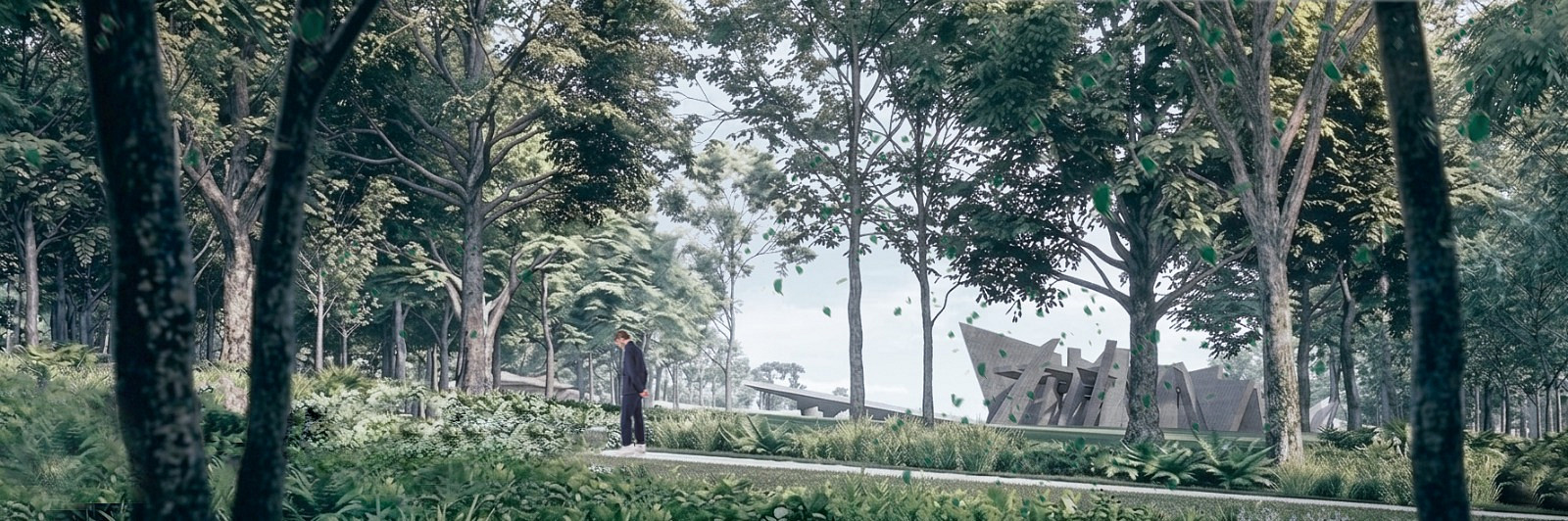
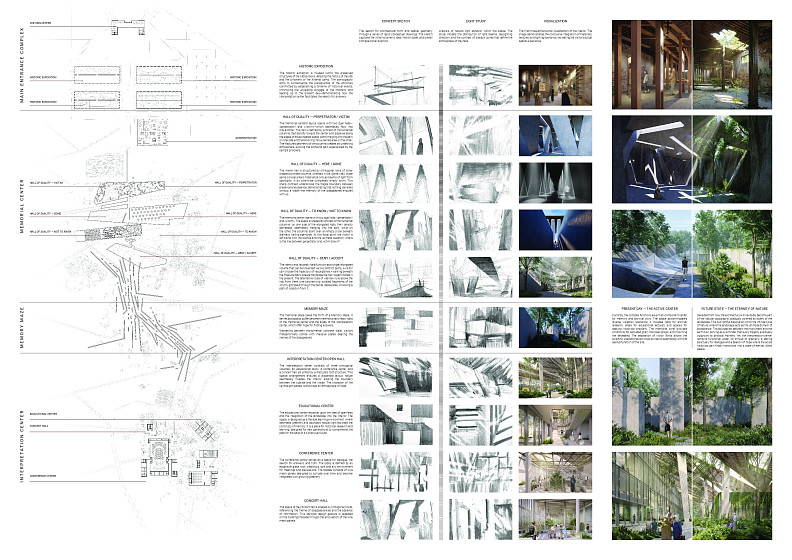
The memorial park is structured around a central Memory Axis that connects a sequence of spaces dedicated to remembrance, reflection, and the ongoing search for truth. Embedded within an orthogonal grid that fractures along this axis, the park is punctuated by a network of spatial installations known as Voids. Located at the intersections of the grid, these interventions represent absence, disappearance, and the unhealed wounds left by history. Experienced as barriers, blind spots, frames, or empty spaces, they emerge unexpectedly within the landscape, creating moments of discomfort and confrontation with loss.
The journey begins in the preserved barracks, which house the Historic Exposition. Here, visitors are introduced to the history of the Arsenal camp, the stories of the disappeared, and the continuing struggle for truth and justice. The Memory Axis then leads to the Memorial Center, composed of a series of Halls of Duality exploring the fundamental contradictions that continue to shape Argentina’s collective memory: perpetrator and victim, here and gone, deny and accept, to know and not to know. Through architecture, light, and space, these halls invite visitors to engage with the complexity of the past rather than offering simple answers.
Beyond the memorial lies the Memory Maze - a transitional landscape between grief and hope. From there, the journey culminates at the Interpretation Center, conceived as a place for dialogue, education, and collective reflection. Bringing together learning spaces, a conference center, and a concert hall beneath a fractured roof open to nature, the center provides an environment where discussion and research may contribute to the search for answers. Over time, the complex evolves: what begins as an active place of inquiry gradually transforms into a memorial, before eventually becoming absorbed into the landscape itself, where memory endures as architecture slowly yields to nature.
Technical information
The material palette of the project is intentionally restrained, emphasizing the contrast between permanence and transformation. The memorial structures and the network of Voids are primarily constructed from exposed concrete, whose mass and durability reflect the enduring presence of memory and the weight of historical trauma. Embedded within the landscape, these interventions act as physical scars that remain visible even as the surrounding environment evolves over time.
In contrast, the Interpretation Center adopts a lighter architectural expression. The building is conceived using prefabricated structural elements and mineral-based facade panels, reducing material consumption and environmental impact while creating bright and open spaces for dialogue, education, and collective reflection. A lightweight roof structure composed of wooden slats filters natural light and establishes a changing play of shadow throughout the day.
The architecture is designed to transform with time rather than resist it. Metal mesh screens elements are intended to weather naturally through corrosion and interaction with vegetation, while the roof gradually acquires the marks of climate and age. As materials weather and become increasingly integrated with the landscape, the project reinforces its central idea: memory is not static but continuously reshaped by time, nature, and collective experience. Ultimately, the architecture slowly yields to the landscape, allowing remembrance to persist even as the physical structures become part of the natural environment.
Documentation
Show PDF 1Show PDF 2Show PDF 3


Copyright © 2026 INSPIRELI | All rights reserved. Use of this website signifies your agreement to the Terms of Use, Privacy Policy, and use of cookies.