
The Ocean Climber


Project idea
Reframing the relationship between the city and the sea.
Project description
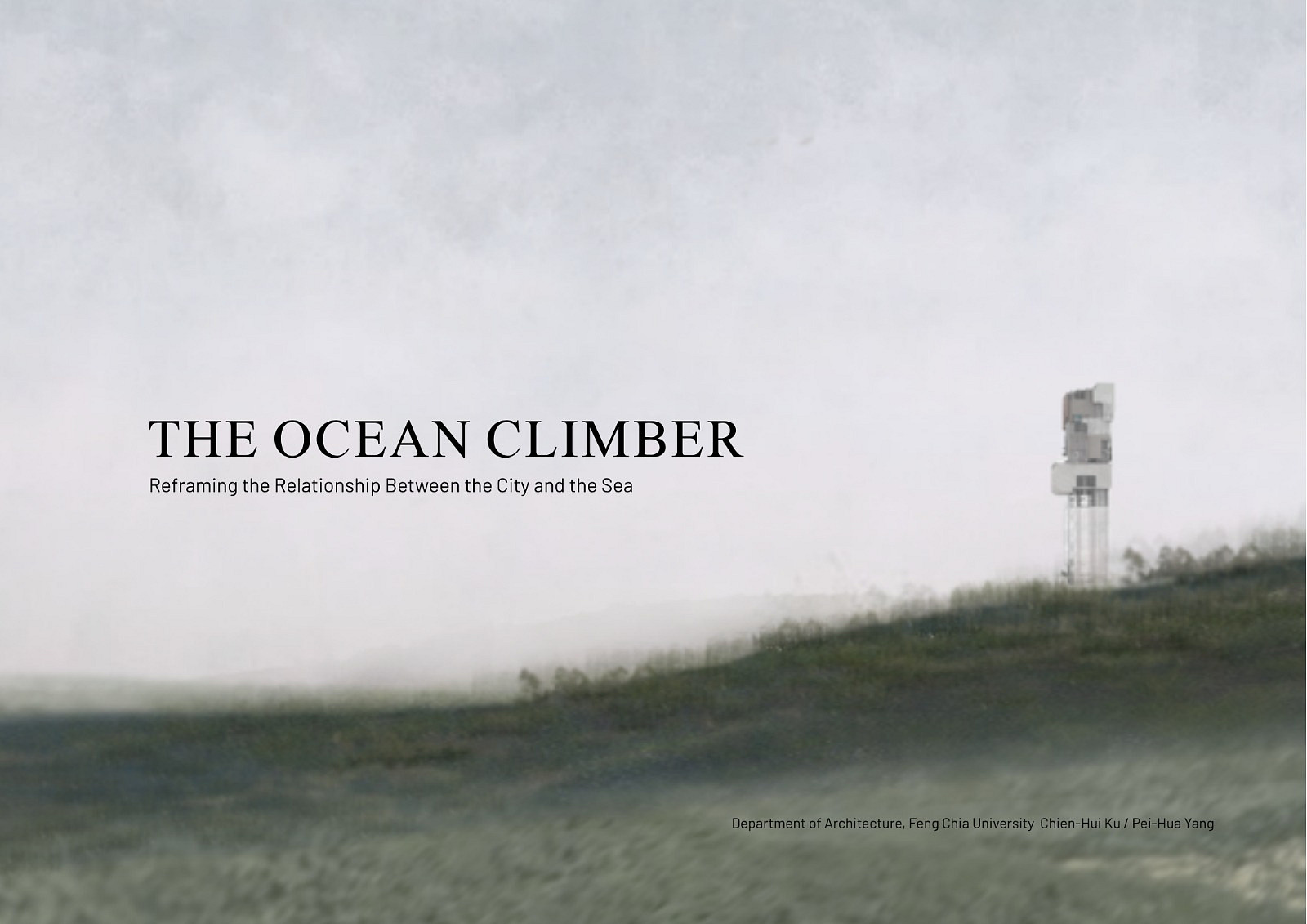
As the Port of Taichung continued to expand and urban development gradually spread inland, the sea has slowly disappeared from the everyday perception of the city’s residents. At the same time, Dadu Mountain has long been regarded as a geographical boundary separating the urban area from the coastline. This project takes the Taichung Metro Blue Line crossing Dadu Mountain as an opportunity to rethink the relationship between the mountain, the sea, and the city. The proposed B8 Station is envisioned as a new urban node, transforming an overlooked landscape into an interface that reconnects the mountain corridor with the coastal region.
The design establishes a continuous sequence composed of the metro station, landscape trails, a cable car system, and an observation tower. Together, these elements guide visitors from the urban environment into the mountain terrain, allowing them to gradually experience changes in topography, light, and perspective. Rather than functioning solely as transportation infrastructure, B8 Station becomes the gateway to a public recreational network on Dadu Mountain. The landscape trails connect natural and urban environments, while the cable car offers a slow and immersive journey that reestablishes the relationship between people and the surrounding landscape.
At the end of this journey stands a vertical museum that combines exhibition spaces with panoramic observation. More than a viewing platform, the tower functions as a device for reading the city. Visitors enter the tower at its middle level, ascend directly to the top floor, and then descend through a spiraling sequence of exhibition spaces. Different floors respond to various layers of Taichung’s identity—including Qingshui, the harbor, industrial districts, the airport, and the urban core—through curated exhibitions, material transformations, and strategically framed views. In this way, the historical development of Taichung is translated into a spatial narrative that can be both observed and experienced.
Rather than presenting the sea directly, the project seeks to reveal it through a process of concealment, fragmentation, and rediscovery. The presence of the sea is gradually perceived through specific viewpoints, distances, and moments of movement. Visitors must actively search for and recognize the connections between the city and the coastline. Upon reaching the lower levels of the tower and looking back across the city, they realize that the entire journey has been an act of rereading Taichung from the vantage point of Dadu Mountain.
The Ocean Climber is therefore more than a path leading to a higher elevation. It is a journey of rediscovering Taichung and reexamining the relationship between the mountain, the sea, and the city. Through movement, observation, and interpretation, architecture becomes a medium that reconnects landscape, memory, and urban identity, allowing the sea to once again emerge within the collective perception of the city.
Technical information
This section outlines the technical framework of the project, including site conditions, spatial organization, circulation systems, structural strategies, and transportation infrastructure. By integrating the metro station, landscape trail, cable car system, and observation tower, the project establishes a continuous spatial network that reconnects the city, Dadu Mountain, and the coastline of Taichung.
Documentation

Copyright © 2026 INSPIRELI | All rights reserved. Use of this website signifies your agreement to the Terms of Use, Privacy Policy, and use of cookies.