Factory[n]Certainty


 Mujtaba Ahsan
 A K M Saleh Ahmed Anik
Project idea
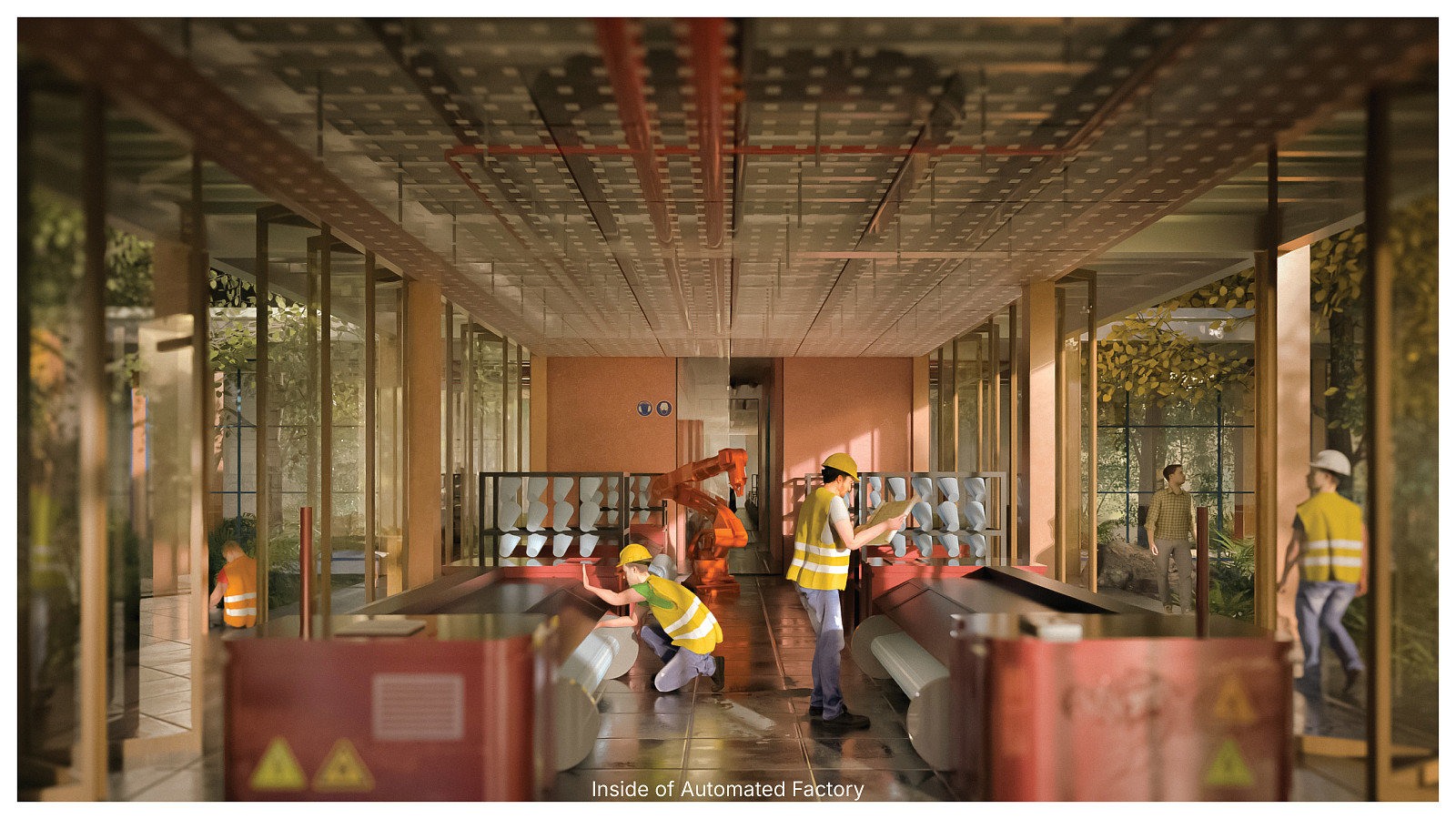
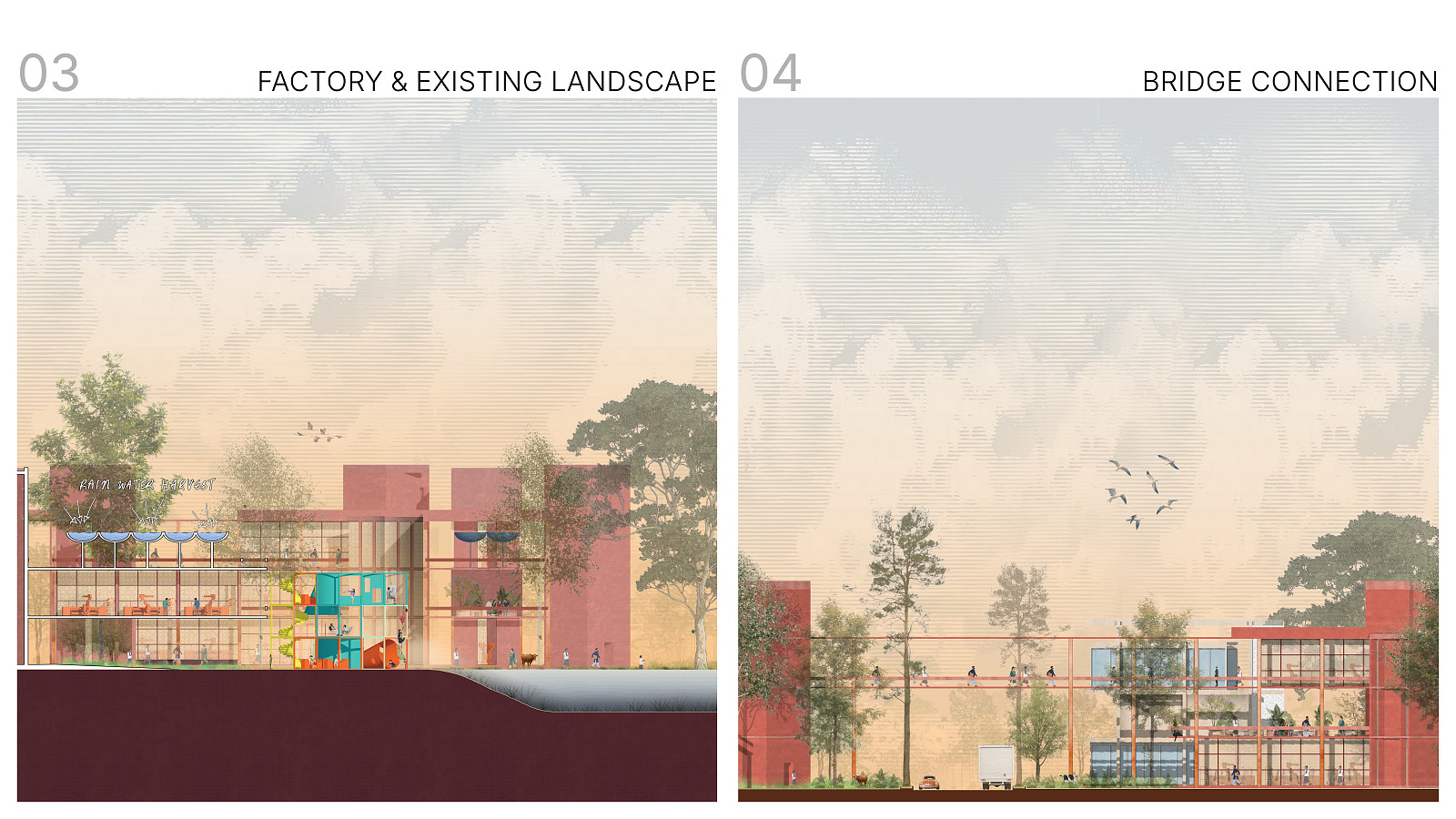
This project reimagines the textile factory as a human-centered cultural landscape, moving beyond the traditional notion of industry as a purely mechanical operation. The design challenges the alienating conditions of industrial modernity, proposing instead an environment where work, leisure, and housing coexist within a shared architectural framework.
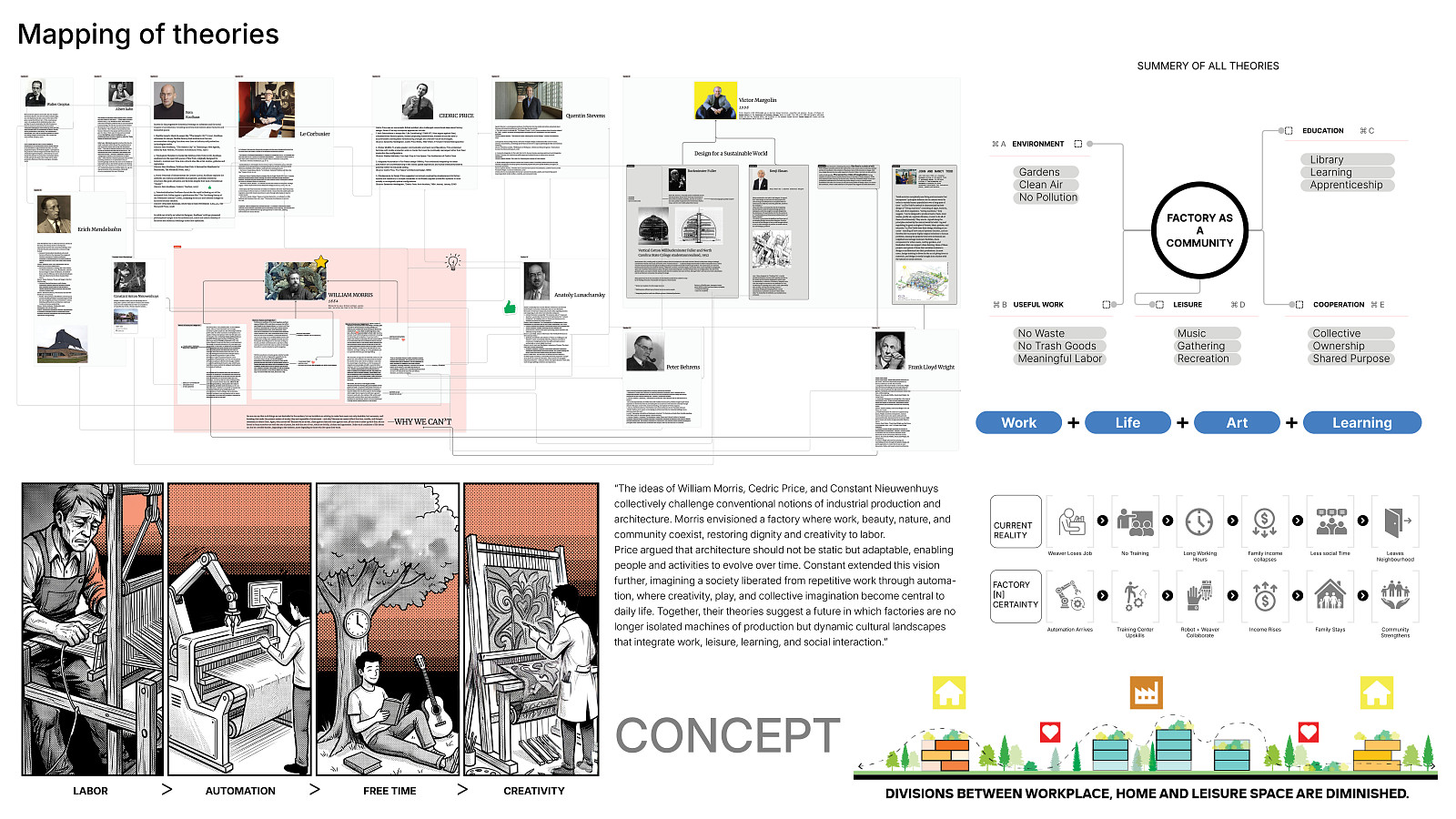
The starting point draws from the ideas of William Morris, who argued for the integration of art, labor, and daily life. Morris envisioned a world in which the act of making was not divorced from beauty or social well-being. Taking this as an initial provocation, the project asks: What if a factory could become a site of dignity, creativity, and community rather than exploitation?
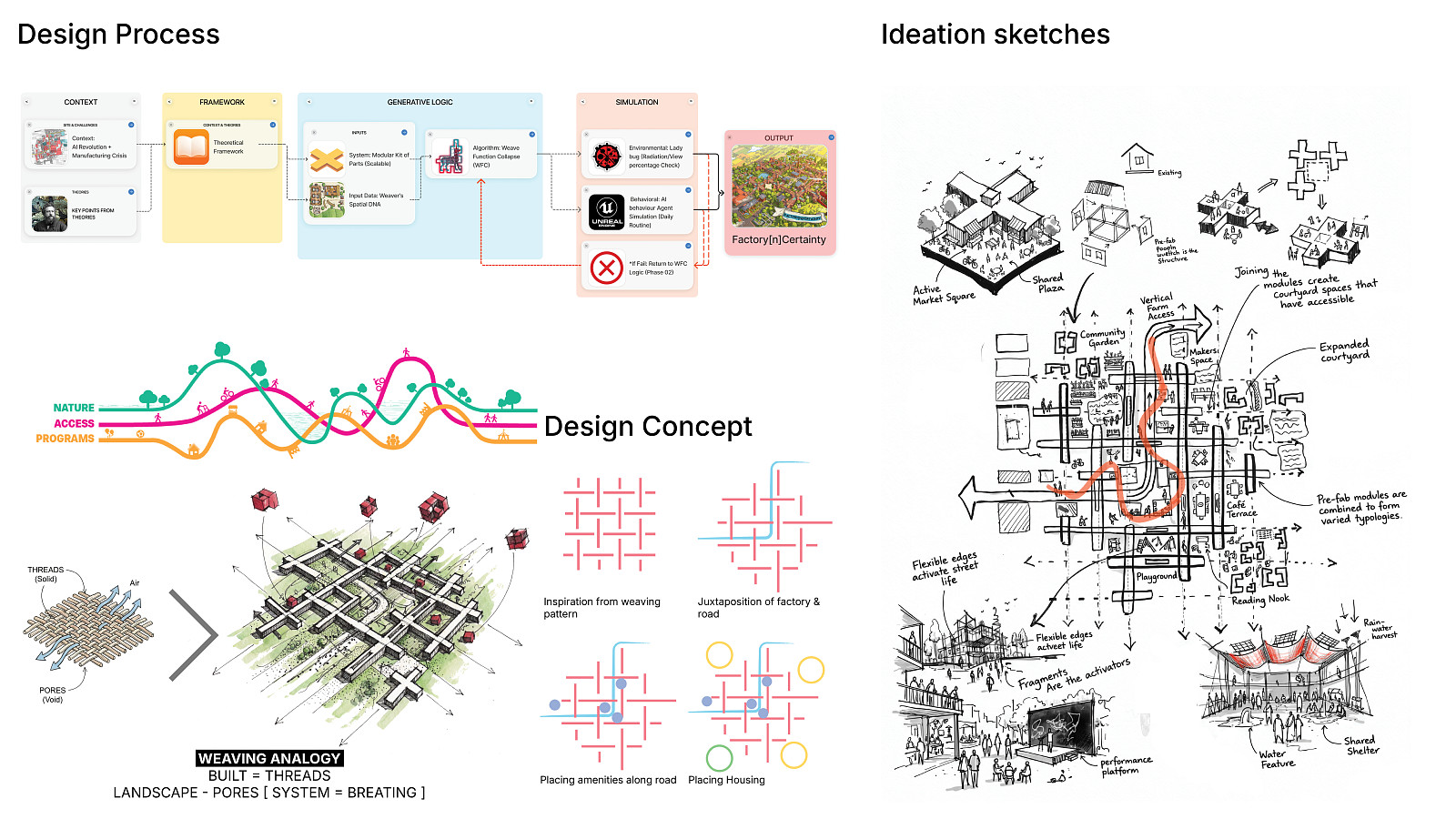
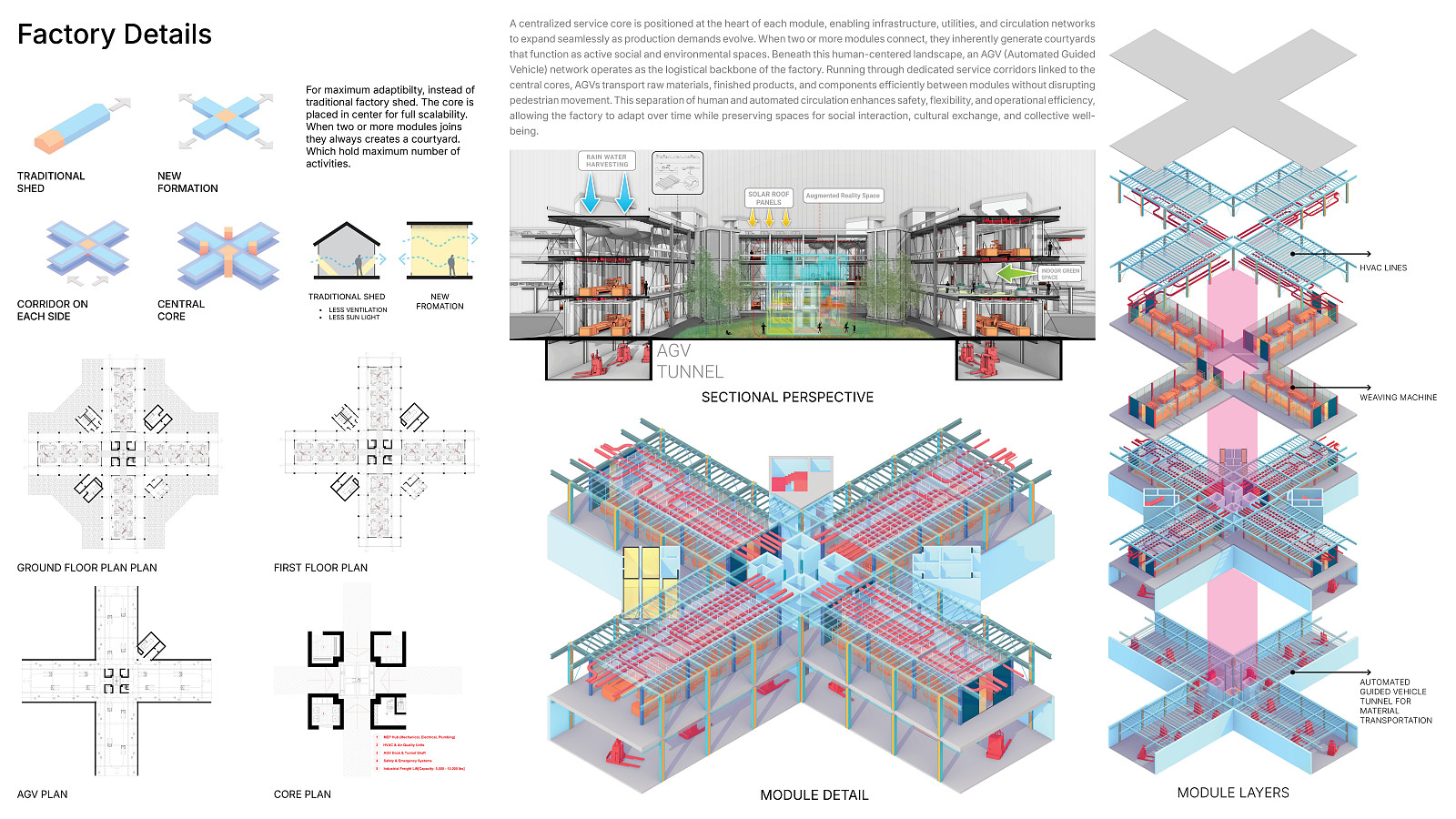
The design embraces scalability and adaptability as its central principle. Rather than functioning as a fixed structure, the factory is conceived as a modular system that can expand or contract, with services plugged in from the outside and programs shifting fluidly over time. This dynamic structure acknowledges that industrial and cultural needs are never static but constantly evolving.
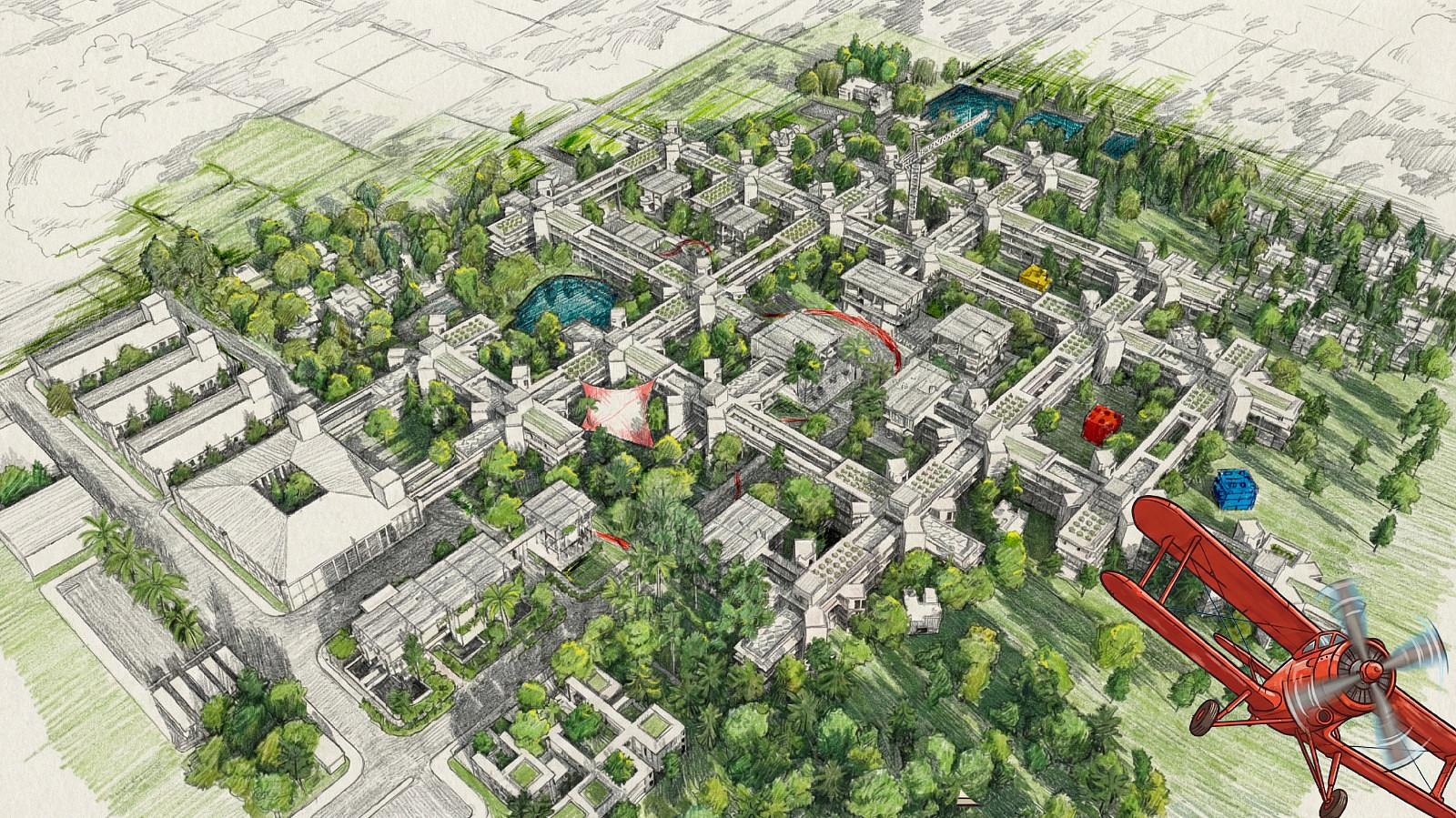
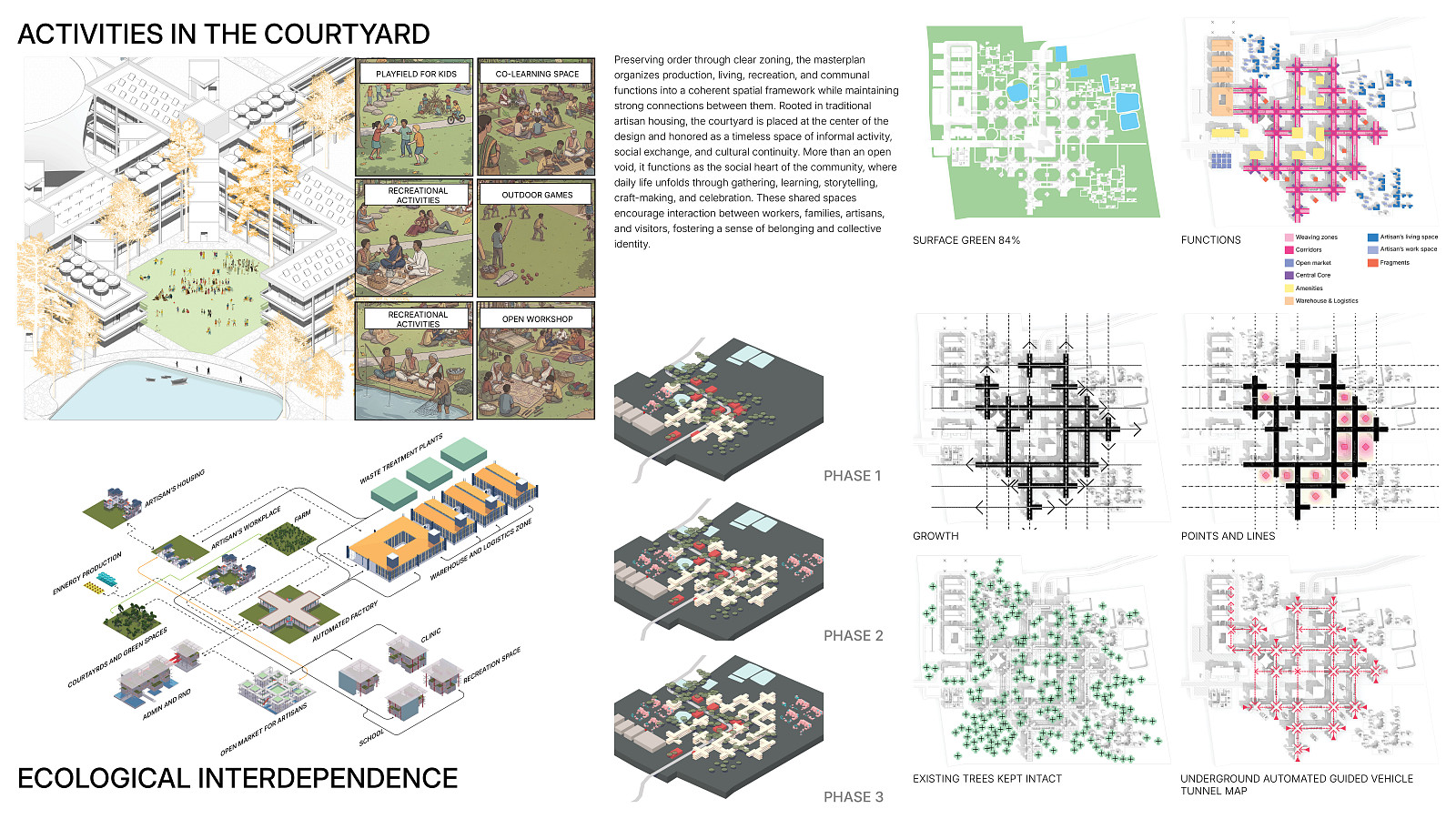
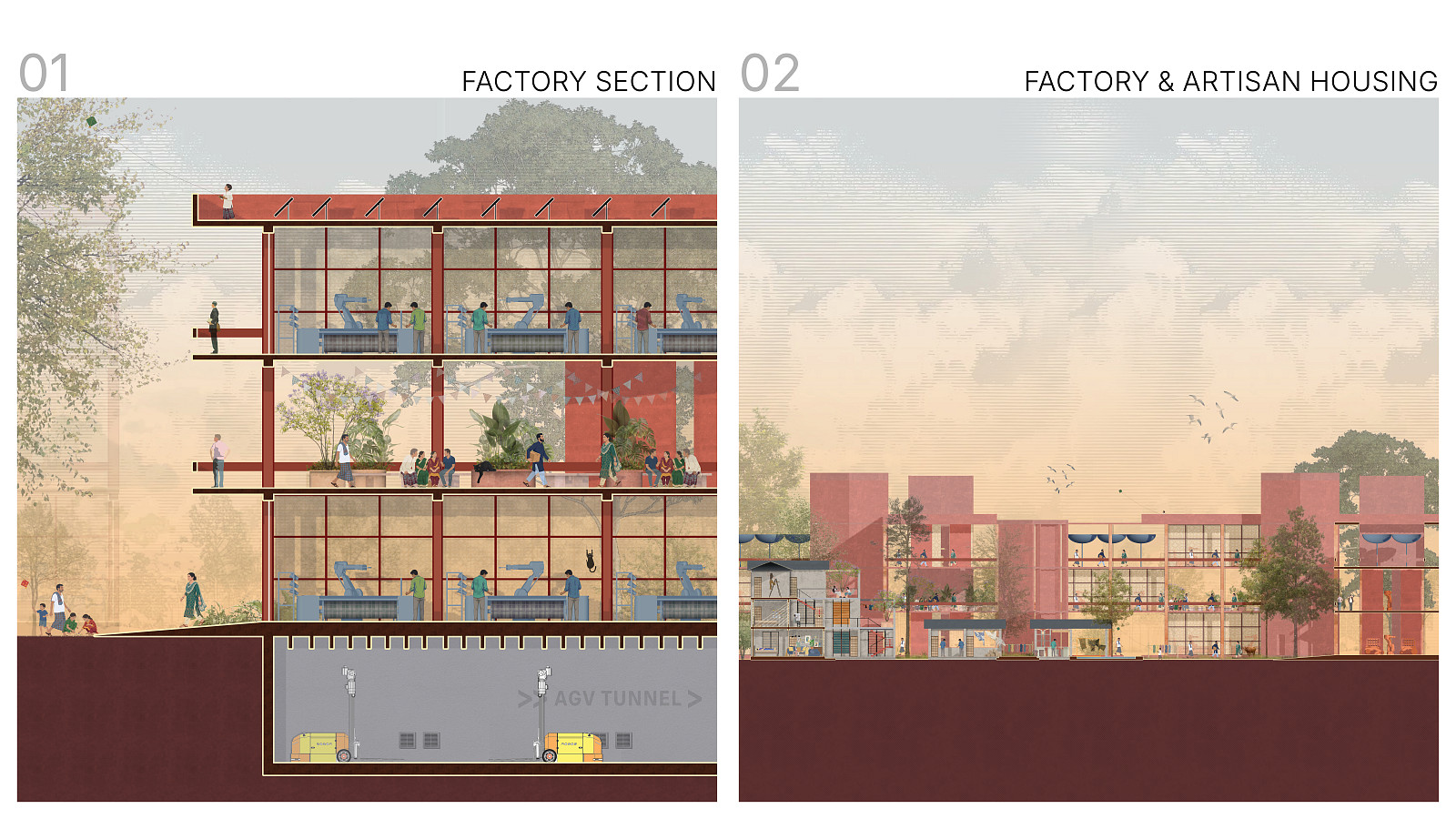
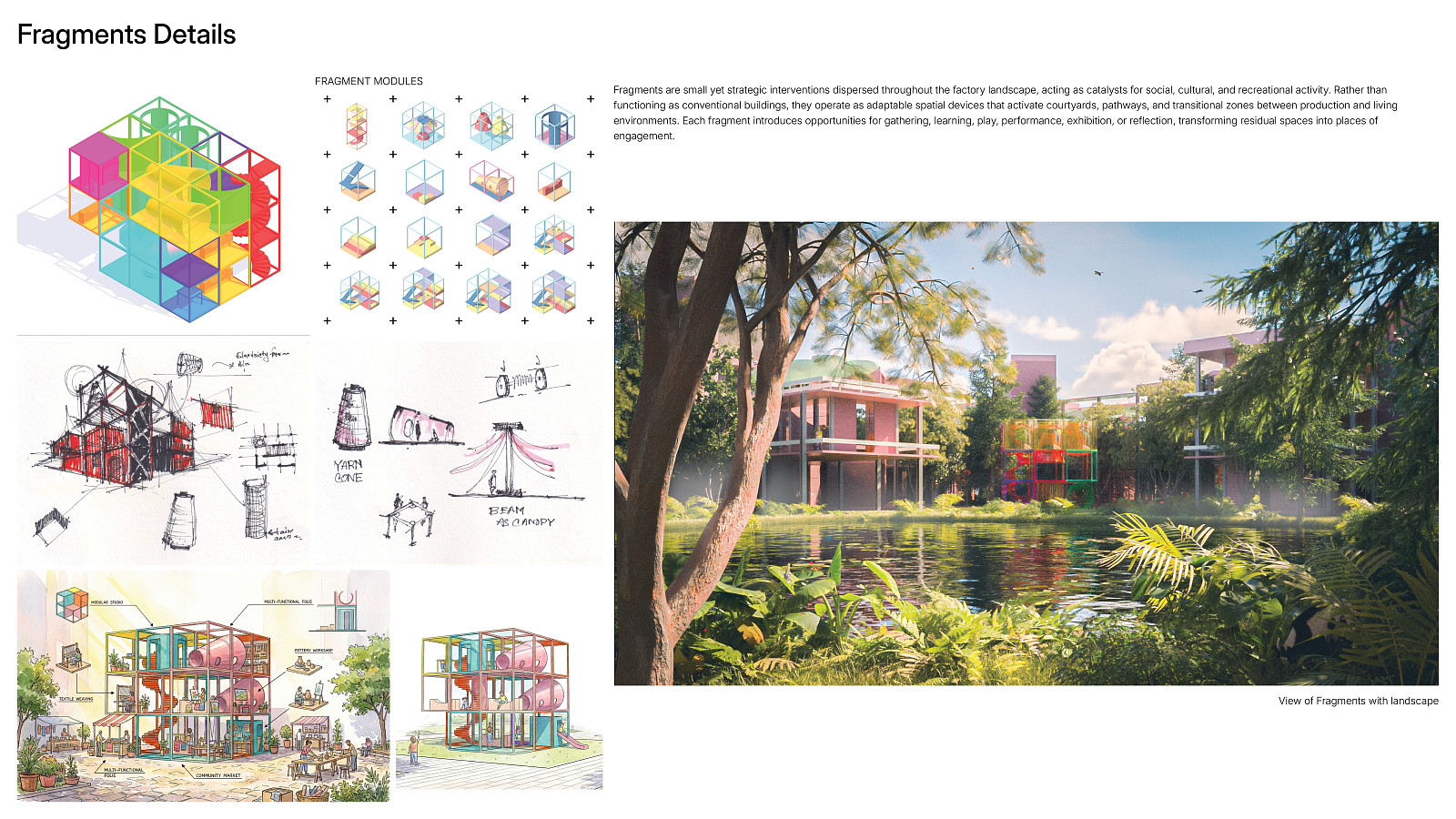
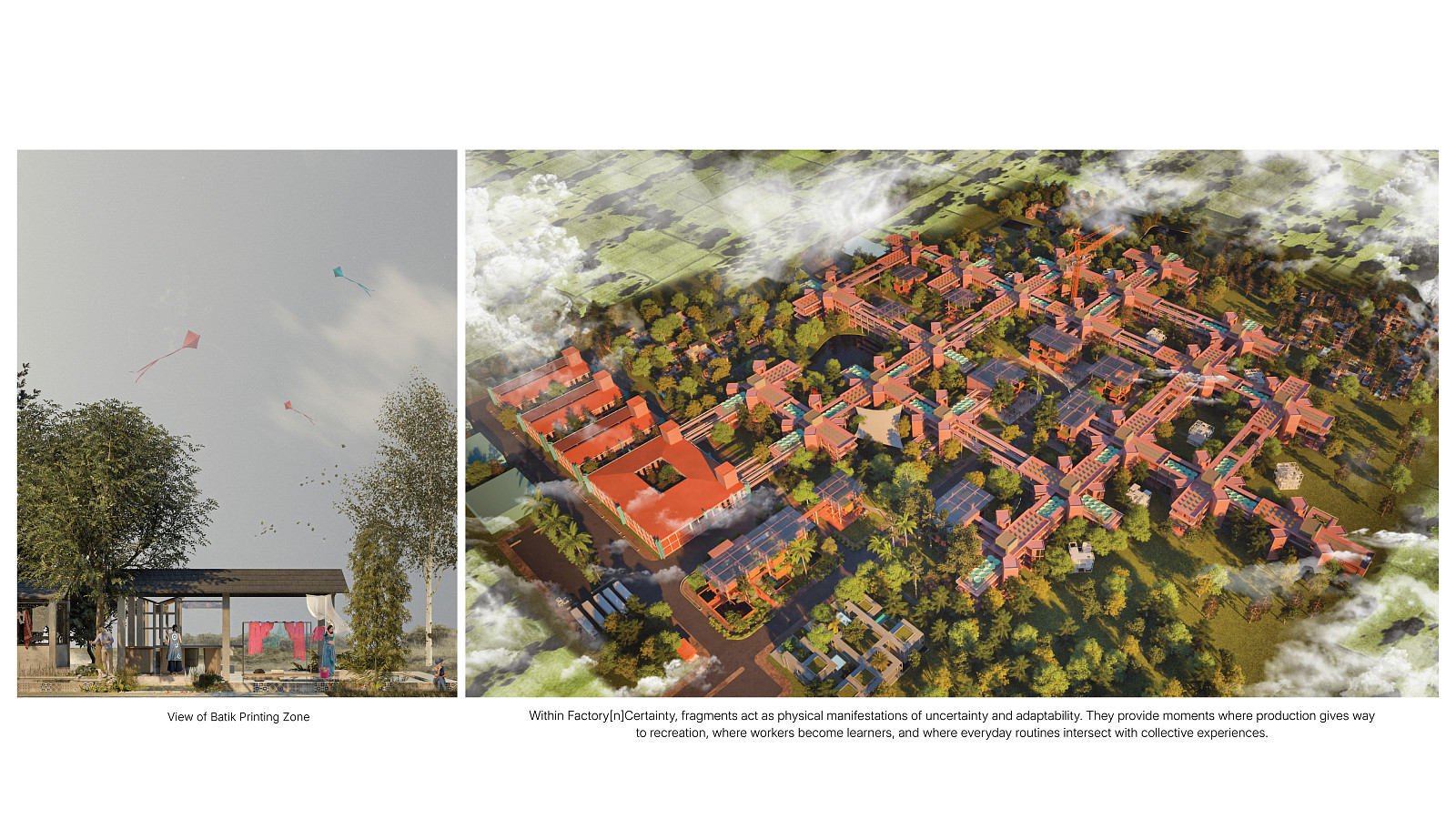
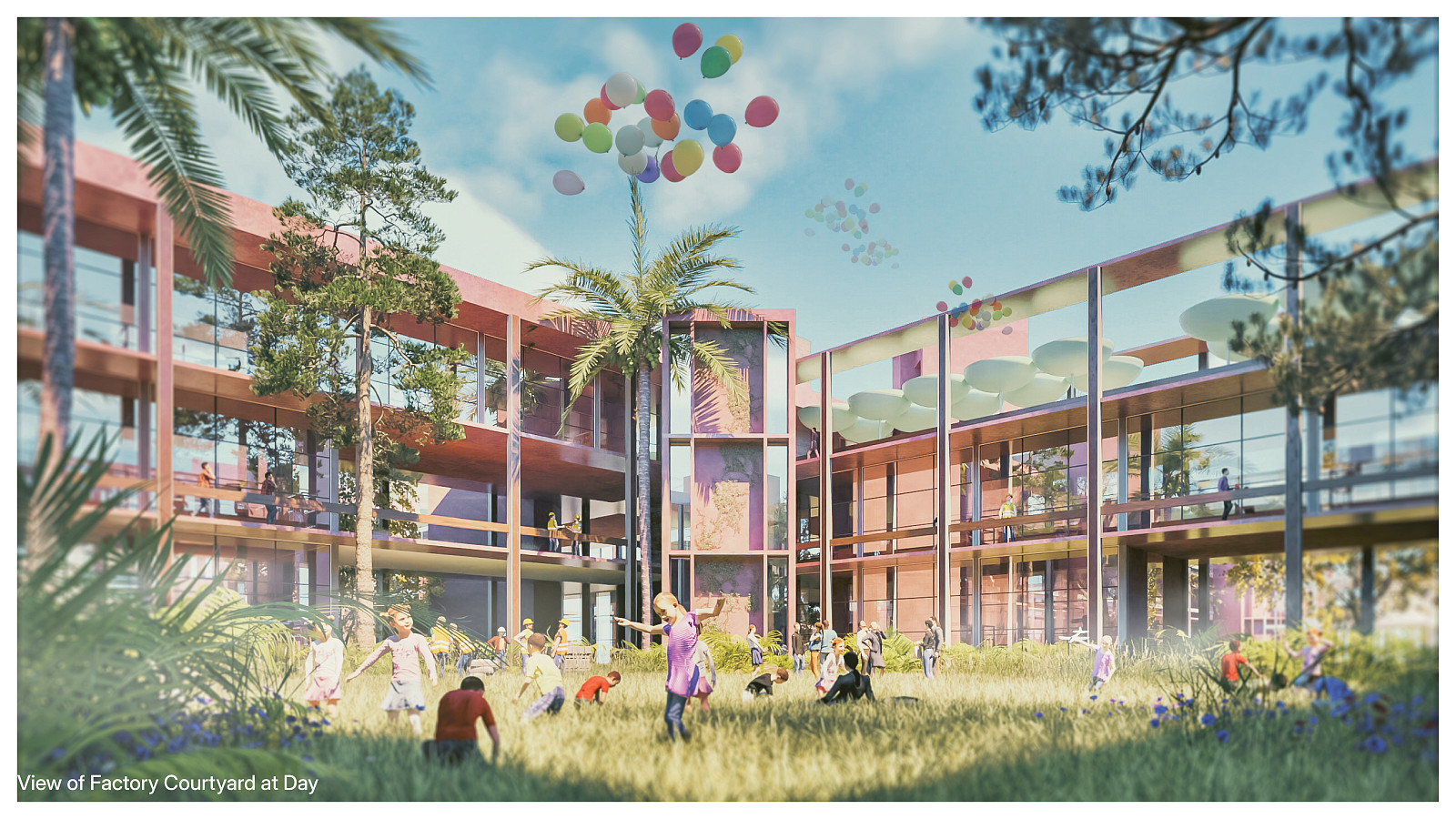
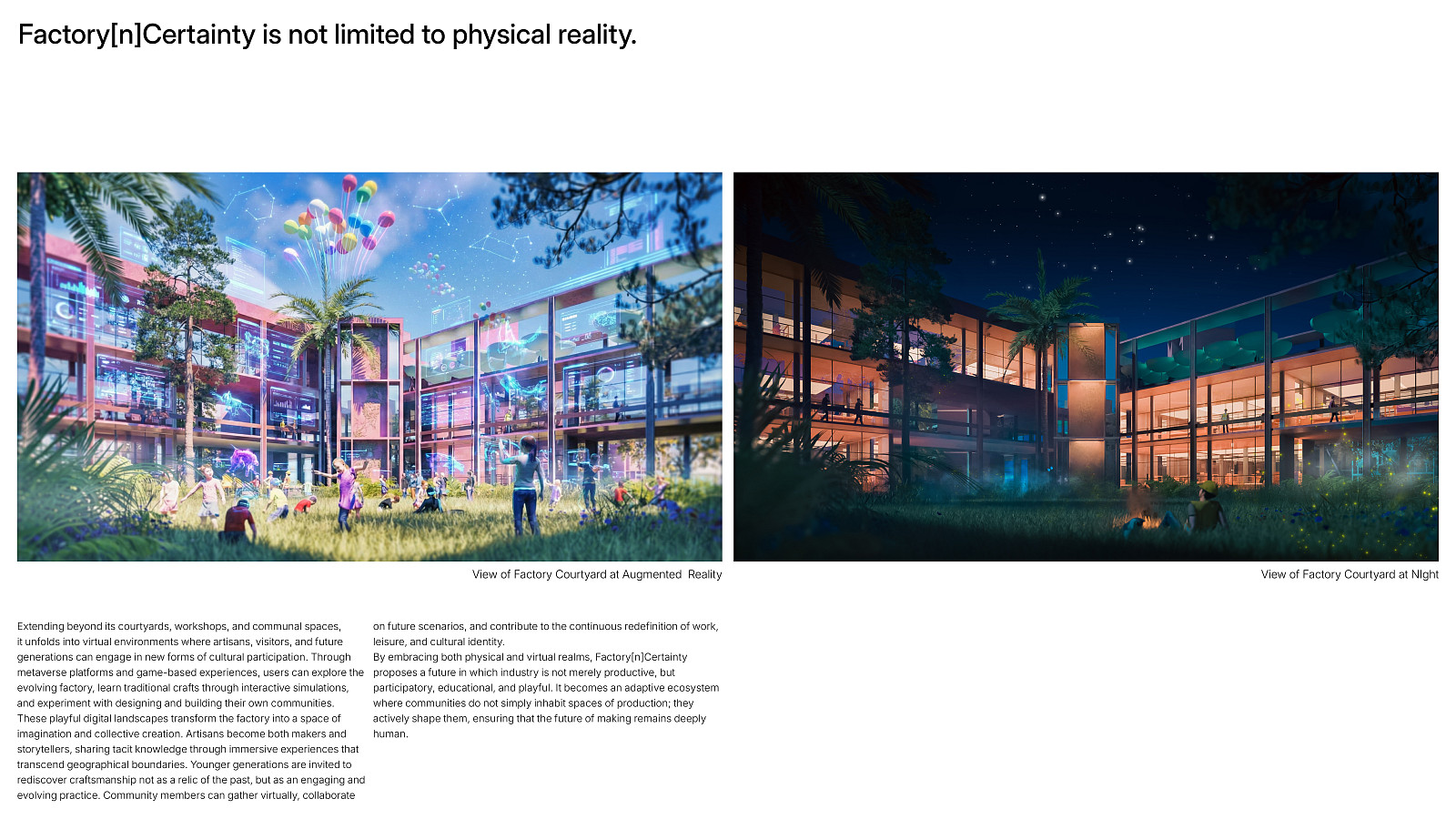
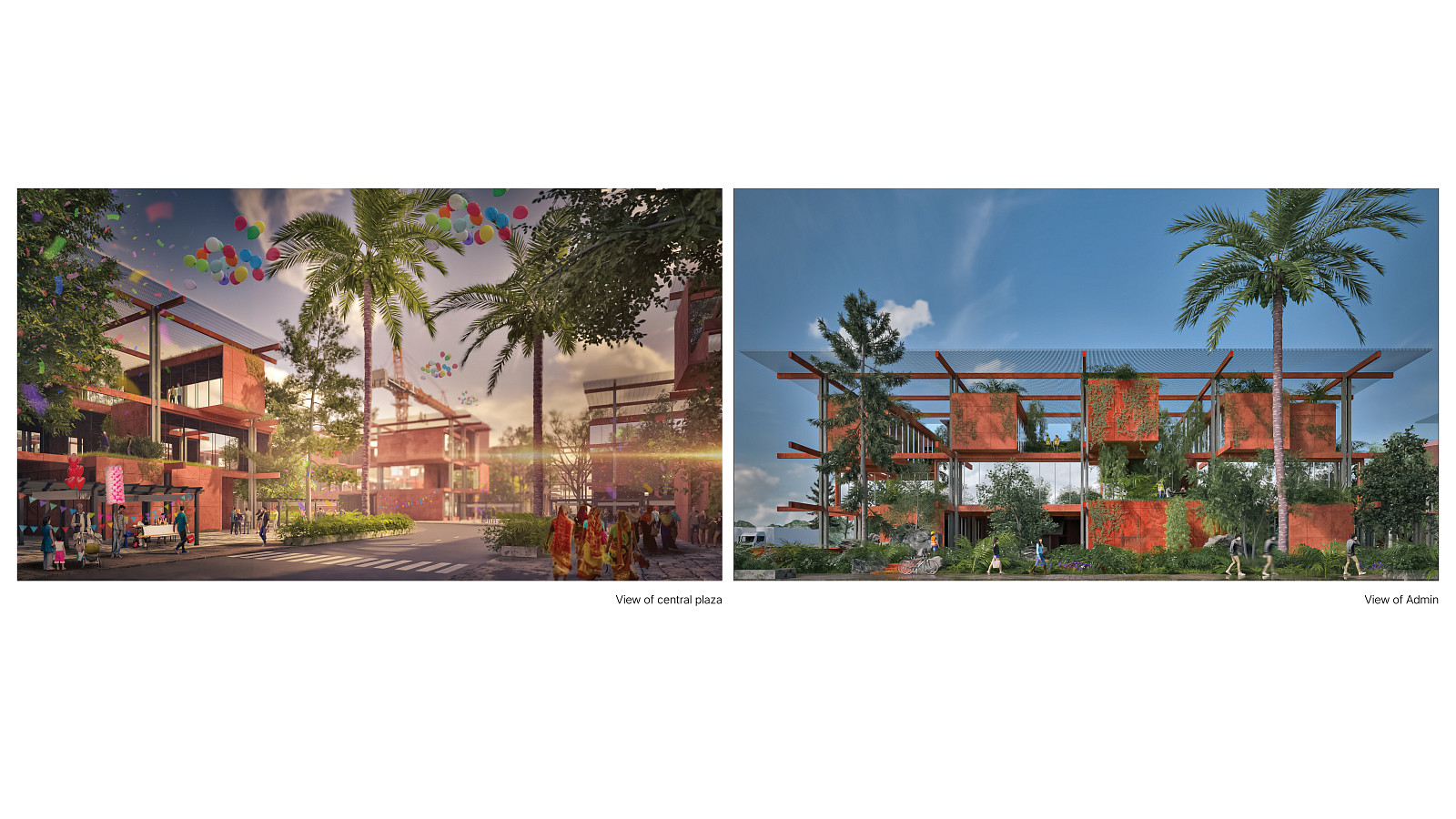
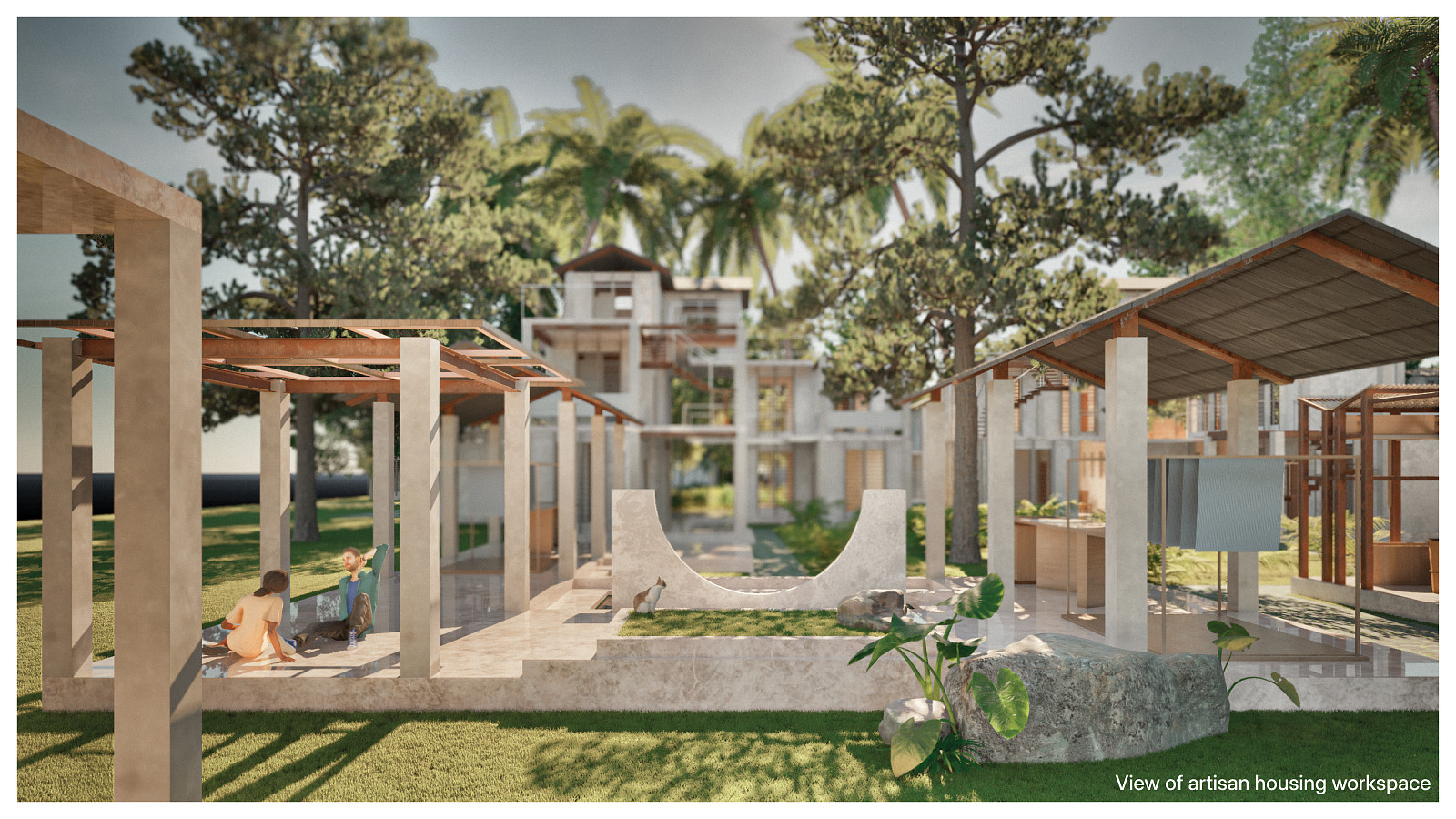
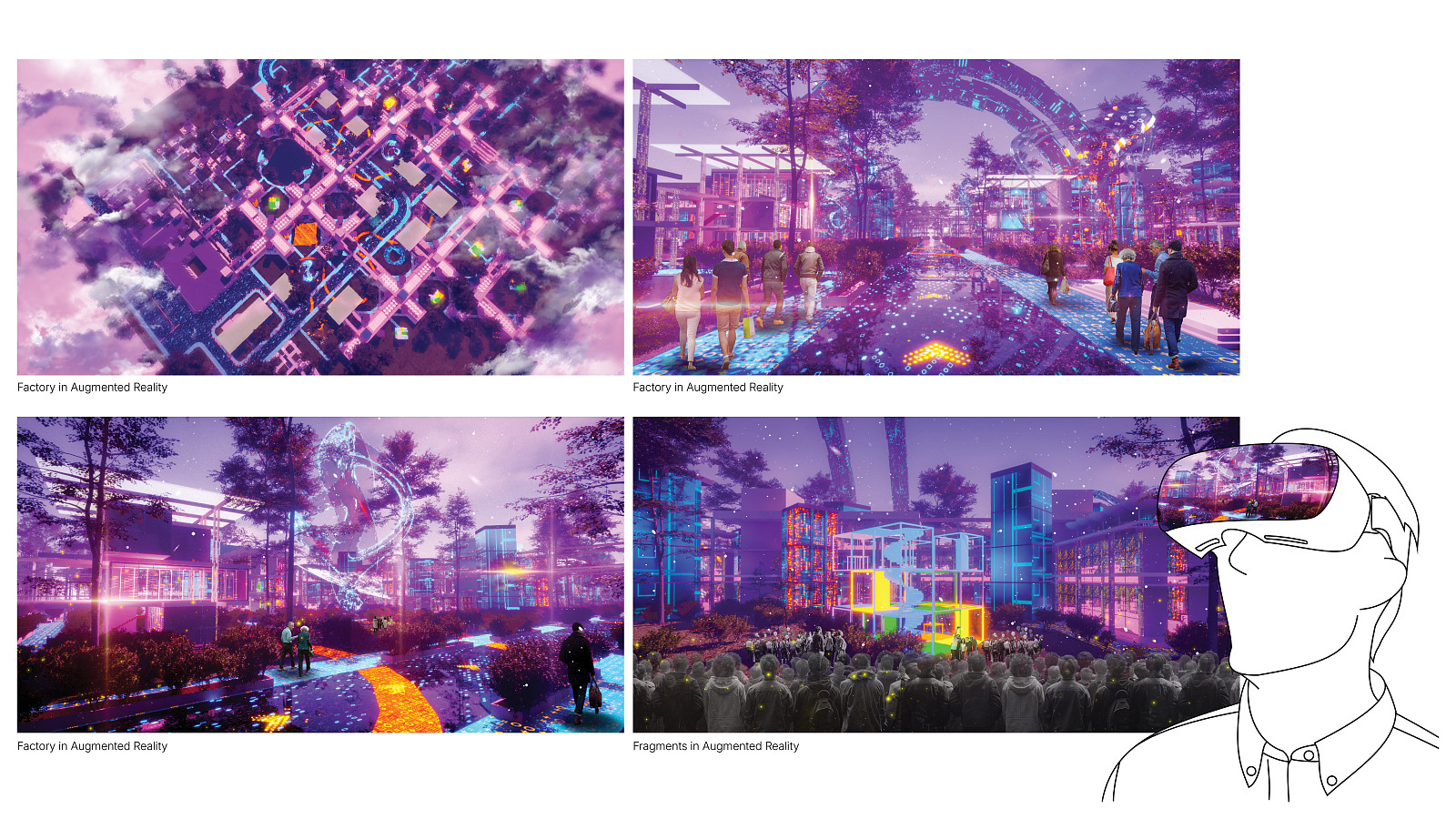
Spatially, the organization balances production and habitation. Between them, courtyards emerge as central spaces of interaction. Far from being passive voids, these courtyards are activated through fragments—architectural interventions and augmented reality elements that invite play, dialogue, and cultural expression. These fragments transform empty space into social condensers, encouraging workers and residents to rest, eat, relax, and participate in collective life.
Philosophically, the design aligns with traditions of experimental architecture that reject rigidity in favor of flexibility and collective engagement. The result is not just a factory but a living, adaptable organism, where human activity defines form and meaning. It proposes an architecture of coexistence—one that bridges production and culture, industry and life.
Project description
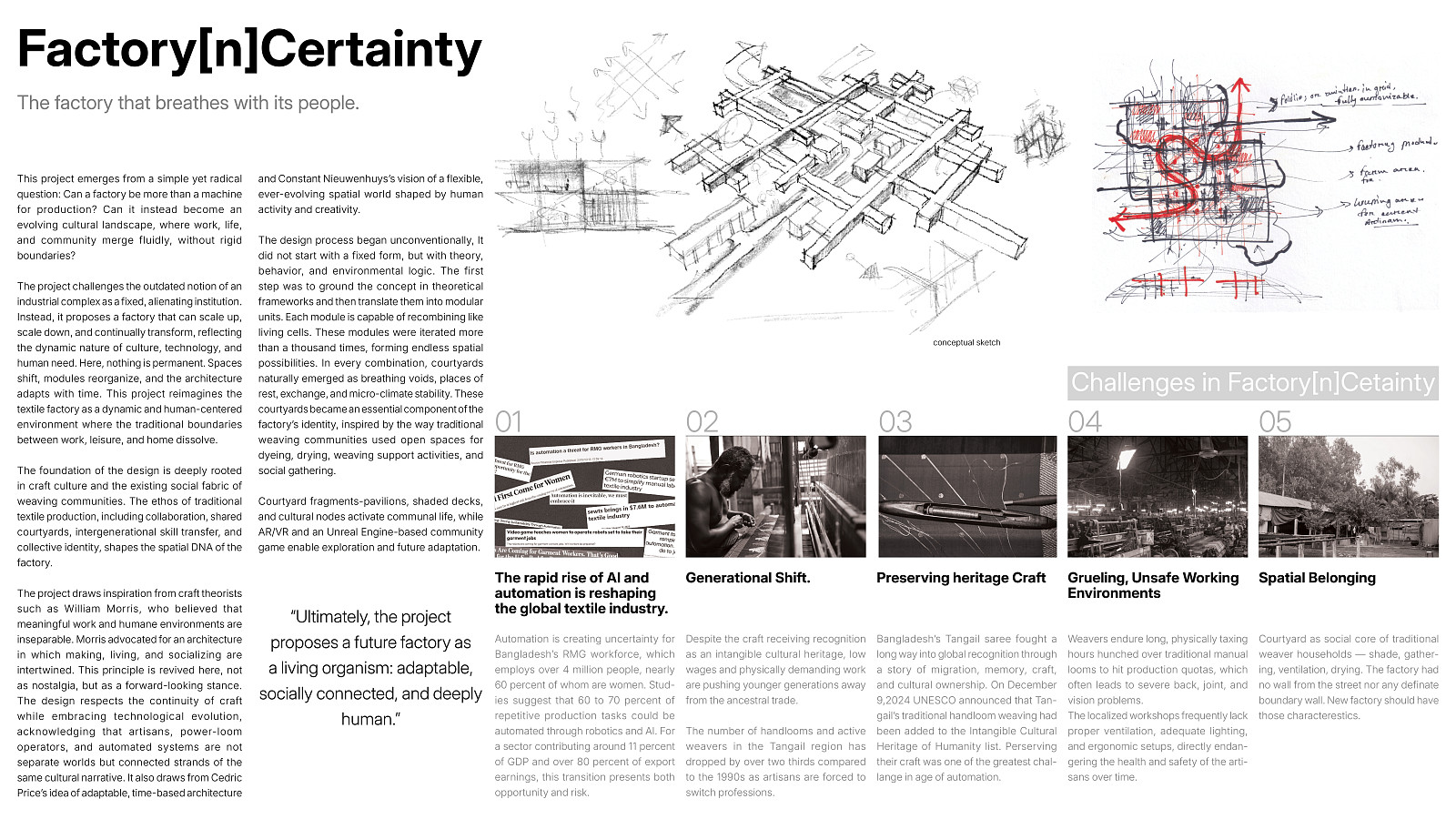
This project emerges from a simple yet radical question: Can a factory be more than a machine for production? Can it instead become an evolving cultural landscape—one where work, life, and community merge fluidly, without rigid boundaries? The project challenges the outdated notion of an industrial complex as a fixed, alienating institution. Instead, it proposes a factory that can scale up, scale down, and continually transform, reflecting the dynamic nature of culture, technology, and human need. Here, nothing is permanent—spaces shift, modules reorganize, and the architecture adapts with time.
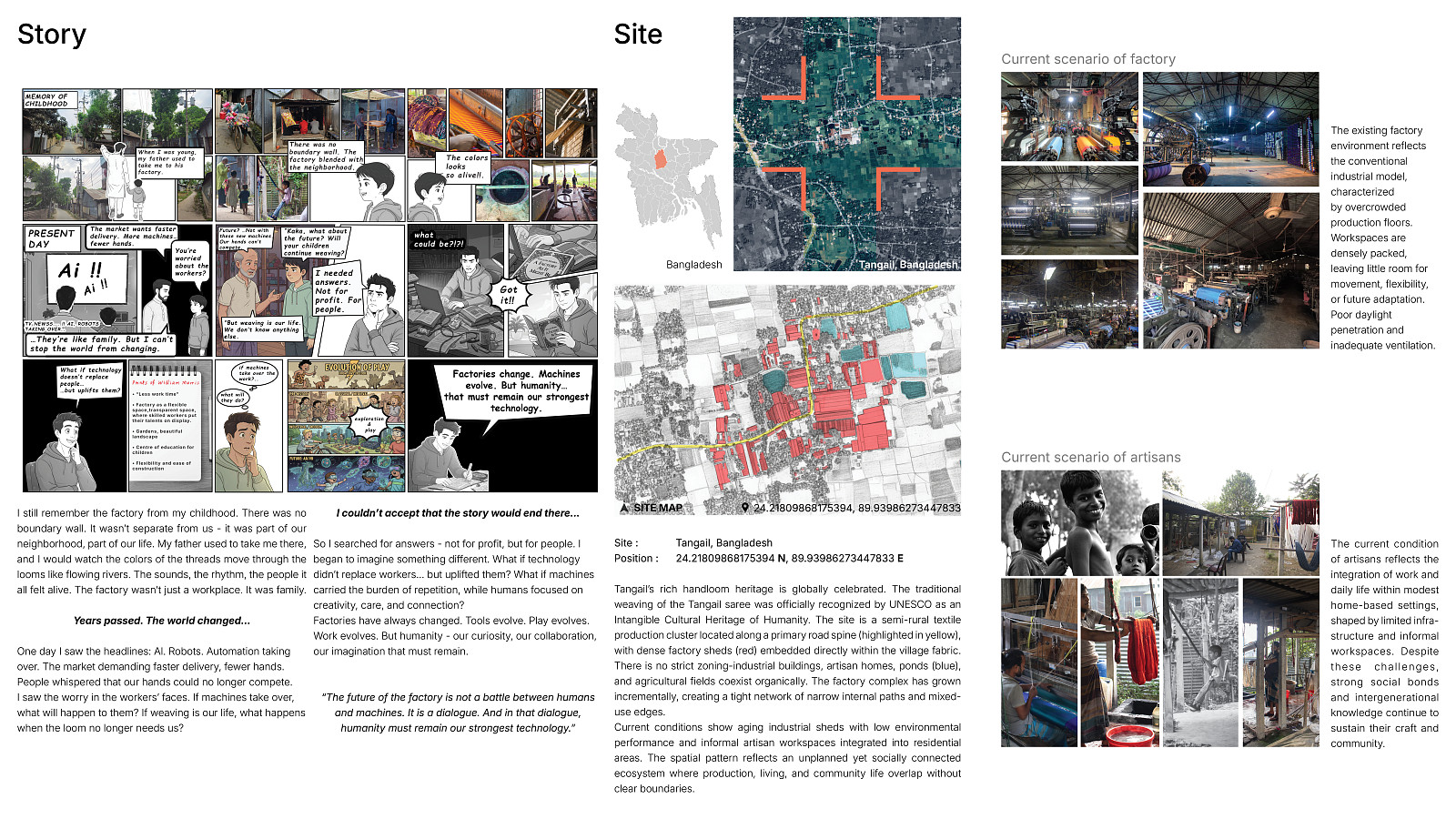
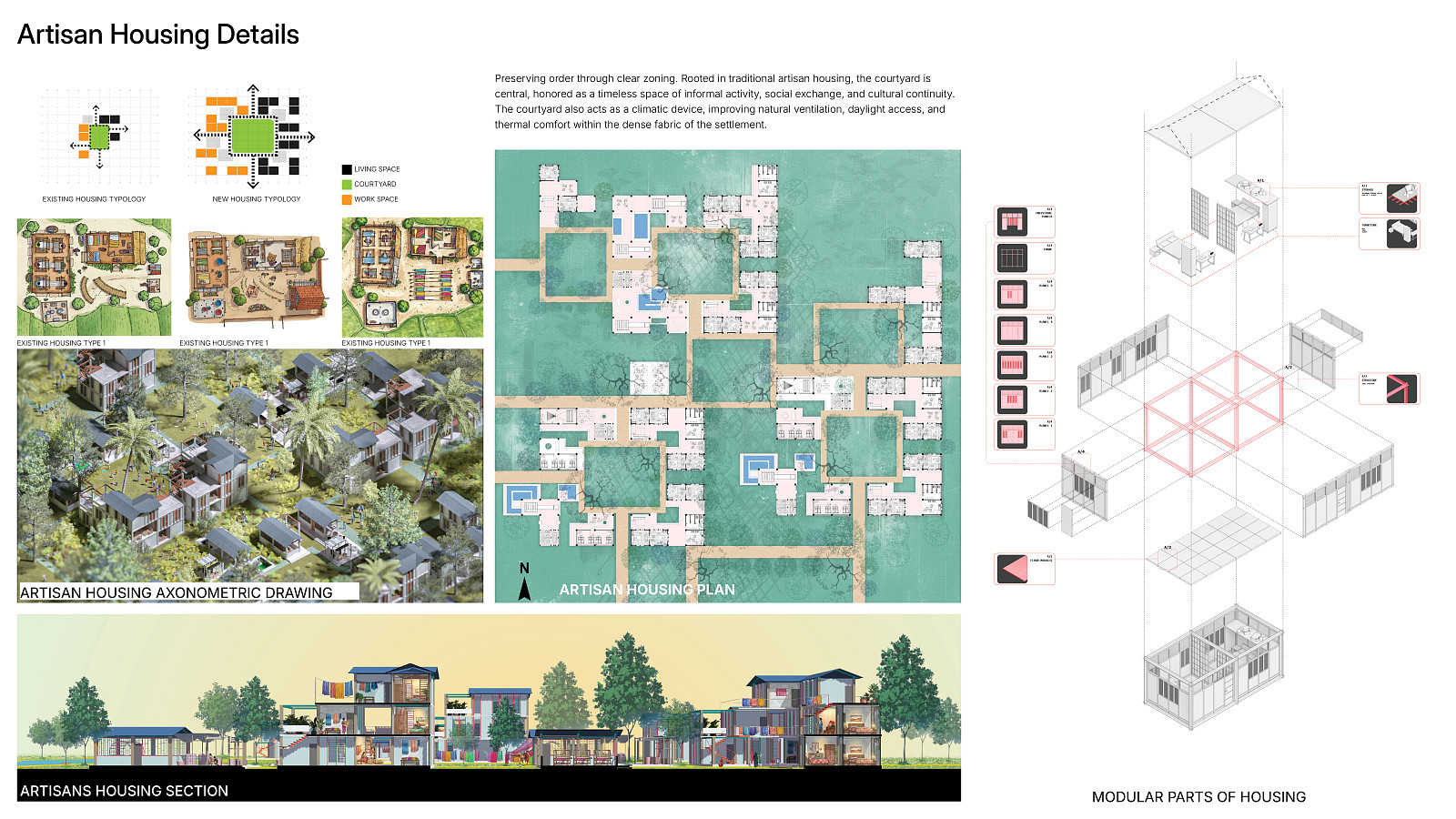
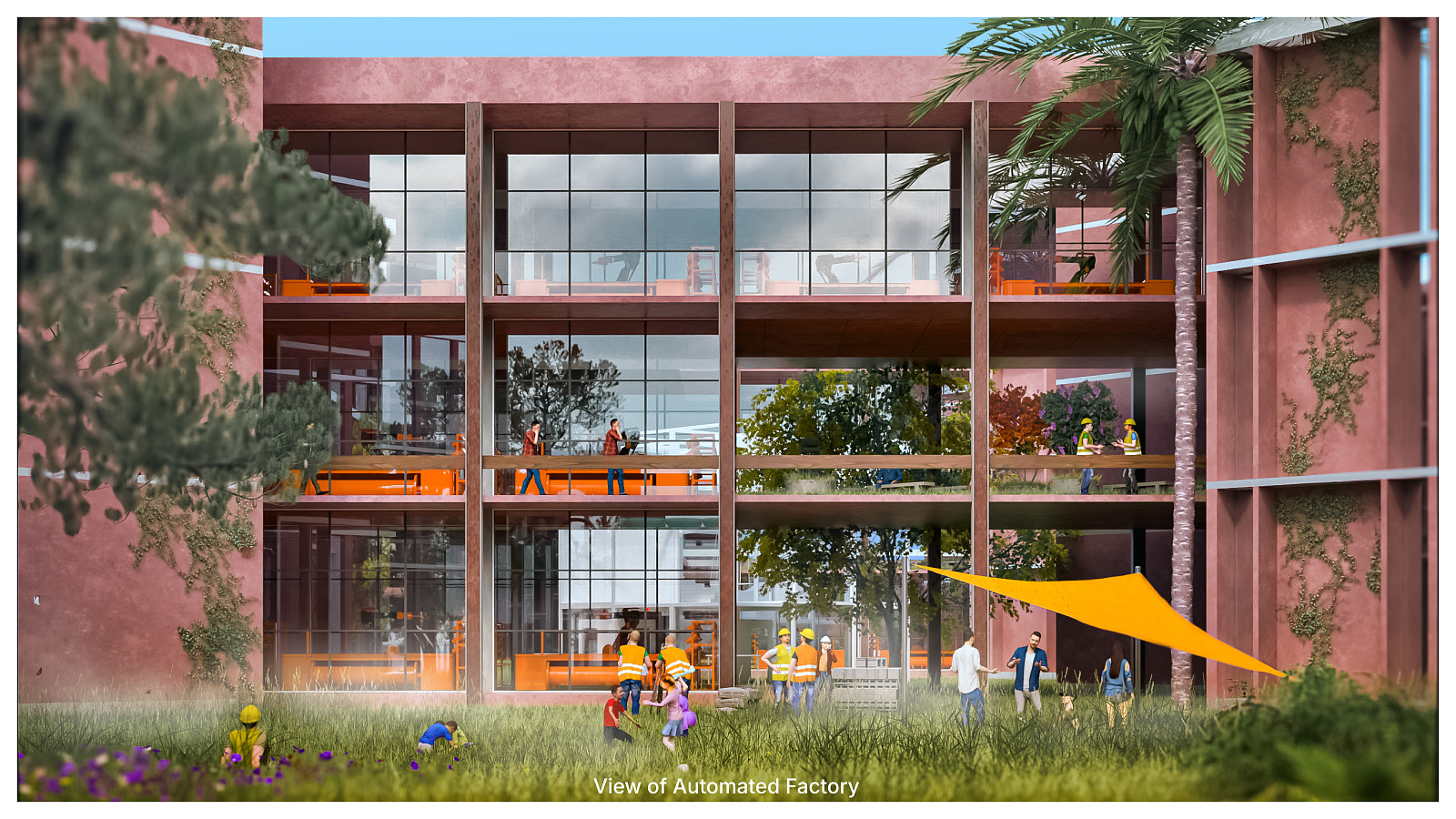
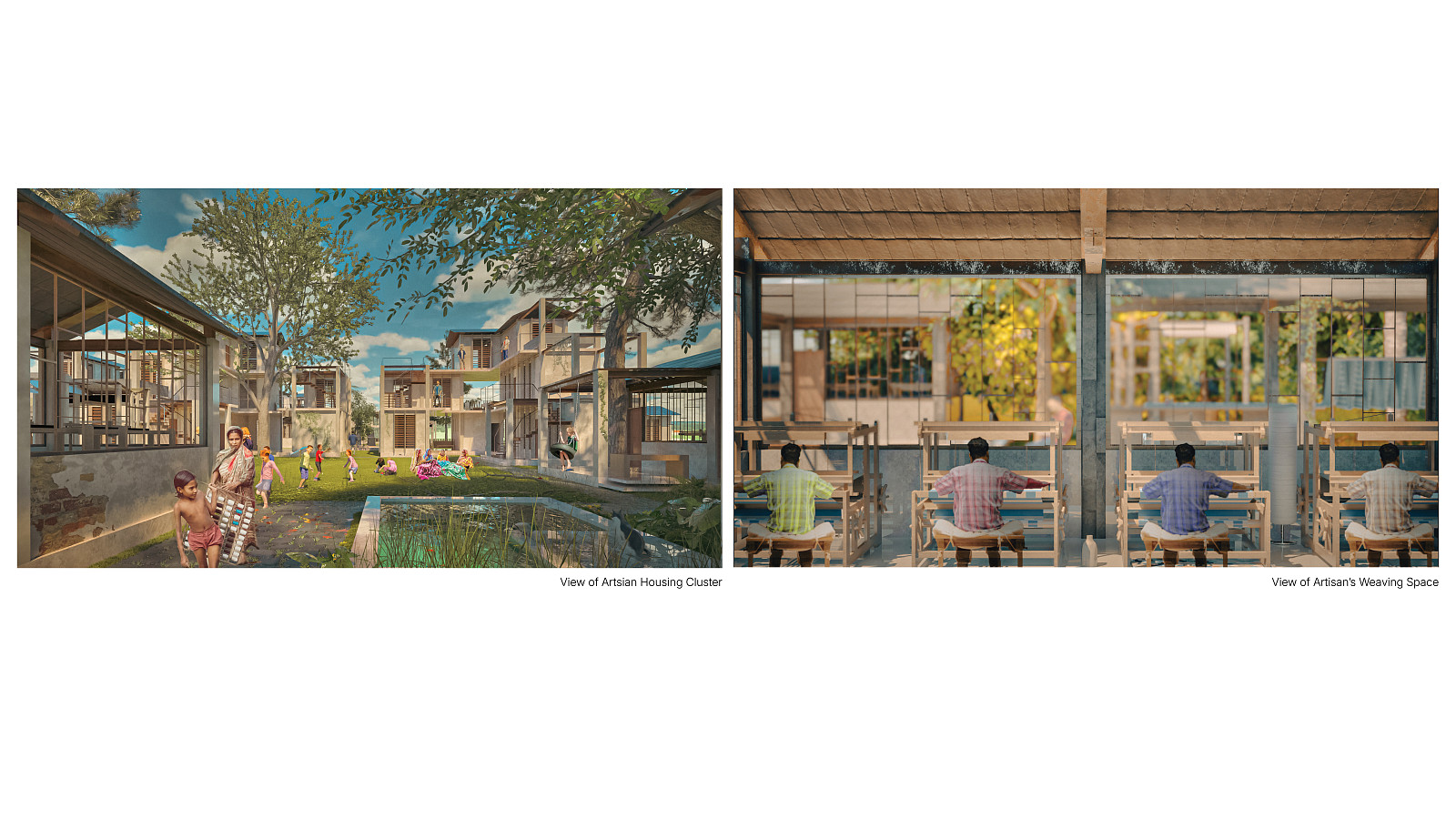
The foundation of the design is deeply rooted in craft culture and the existing social fabric of weaving communities. The ethos of traditional textile production—collaboration, shared courtyards, intergenerational skill transfer, and collective identity—shapes the spatial DNA of the factory. The project draws inspiration from craft theorists such as William Morris, who believed that meaningful work and humane environments are inseparable. Morris advocated for an architecture in which making, living, and socializing are intertwined—a principle revived here, not as nostalgia, but as a forward-looking stance. The design respects the continuity of craft while embracing technological evolution, acknowledging that artisans, power-loom operators, and automated systems are not separate worlds but connected strands of the same cultural narrative.
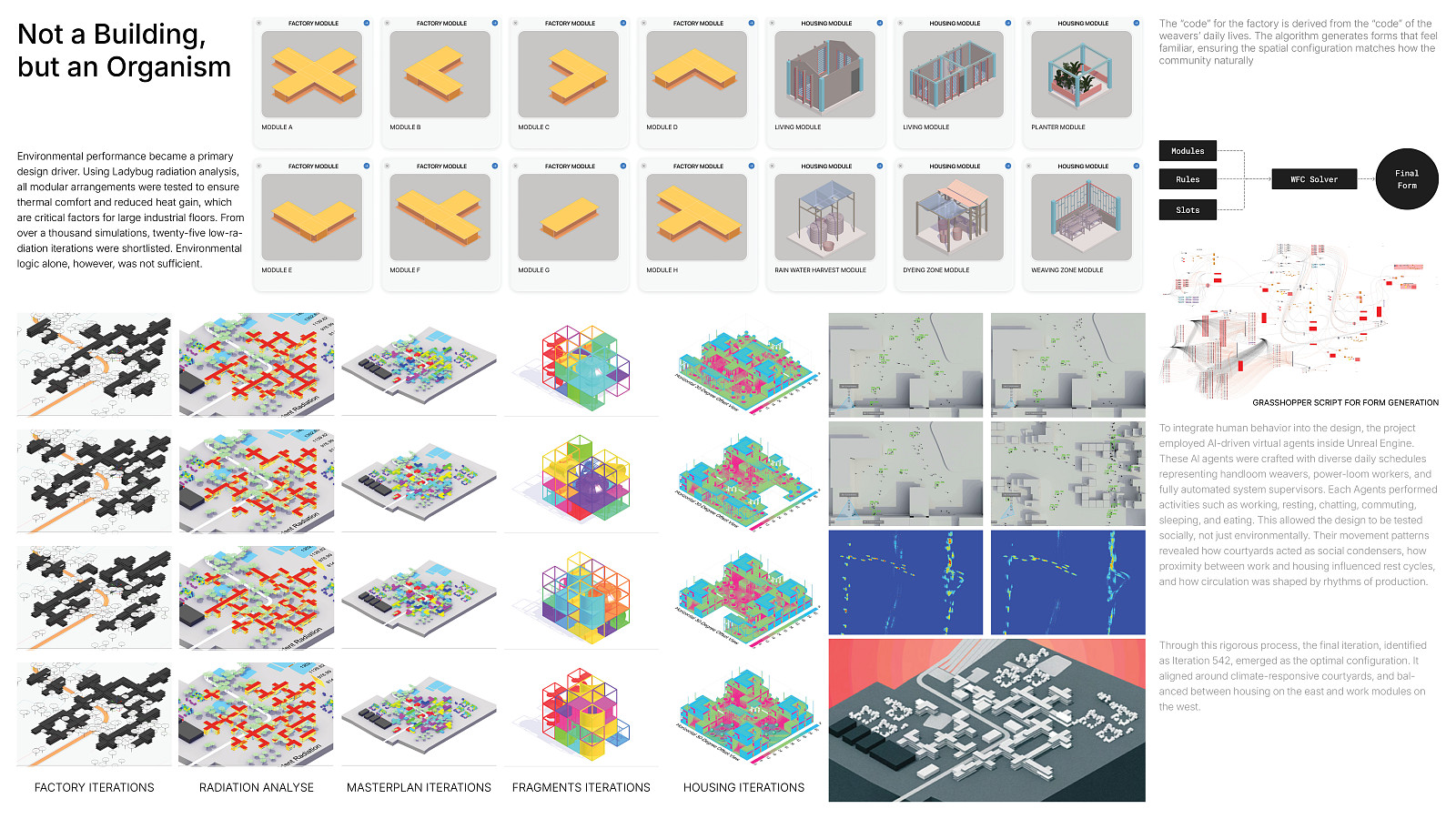
The design process combined theoretical inquiry with computational analysis and simulation. Using Ladybug radiation analysis, thousands of modular arrangements were tested for environmental efficiency. From these, twenty-five low-radiation iterations were selected for detailed study.
To measure social as well as spatial performance, the project employed AI-driven agents within Unreal Engine. These NPCs were programmed with distinct life cycles—working, eating, relaxing, and sleeping—reflecting the diverse rhythms of factory life. Some agents represented traditional handloom weavers, others power loom operators, and some fully automated systems. Their interactions revealed how courtyards, housing, and workstations functioned under different cultural and behavioral conditions.
Performance was assessed through three parameters: maximum social interactions, maximum program use, and average mesh face occupancy. This provided insights into how spaces might encourage or limit human engagement.
The outcome of this iterative process led to the selection of Iteration 542, capable of accommodating 1,464 machines while balancing efficiency with human comfort. More importantly, the simulation confirmed that courtyards, when activated by fragments, became genuine spaces of collective life rather than leftover voids. Through this process, the project demonstrates how theory, computation, and human-centered design can converge to produce an architecture that is both adaptive and deeply social.
The evaluation used three key parameters: 1. Maximum percentage of social interactions – How often and where do people meet? 2. Maximum percentage of program use – Which spaces are most active, and which remain underutilized? 3. Average mesh face occupancy – How densely and efficiently do people occupy the architectural surfaces and paths?
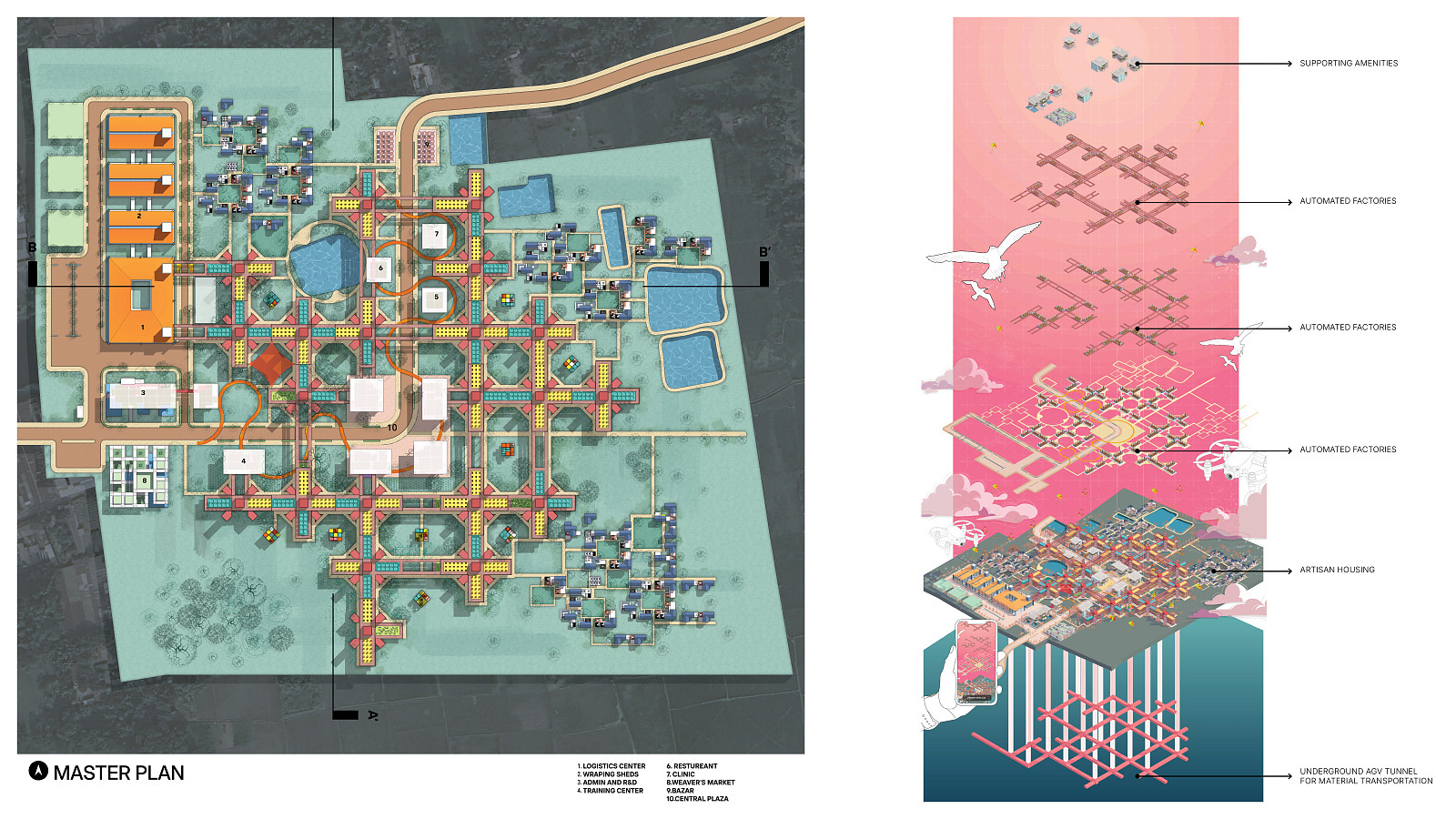
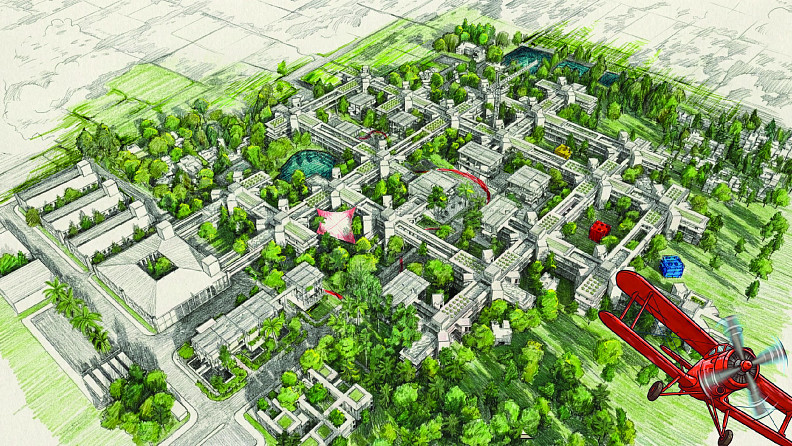
Through this rigorous process, the final iteration (Iteration 542) emerged as the optimal configuration. It supports 1,464 machines, aligned around climate-responsive courtyards, and balanced between housing on the east and work modules on the west. This spatial system produces a gradient—from intense production zones to quieter living clusters—mirroring the rhythm of human life.
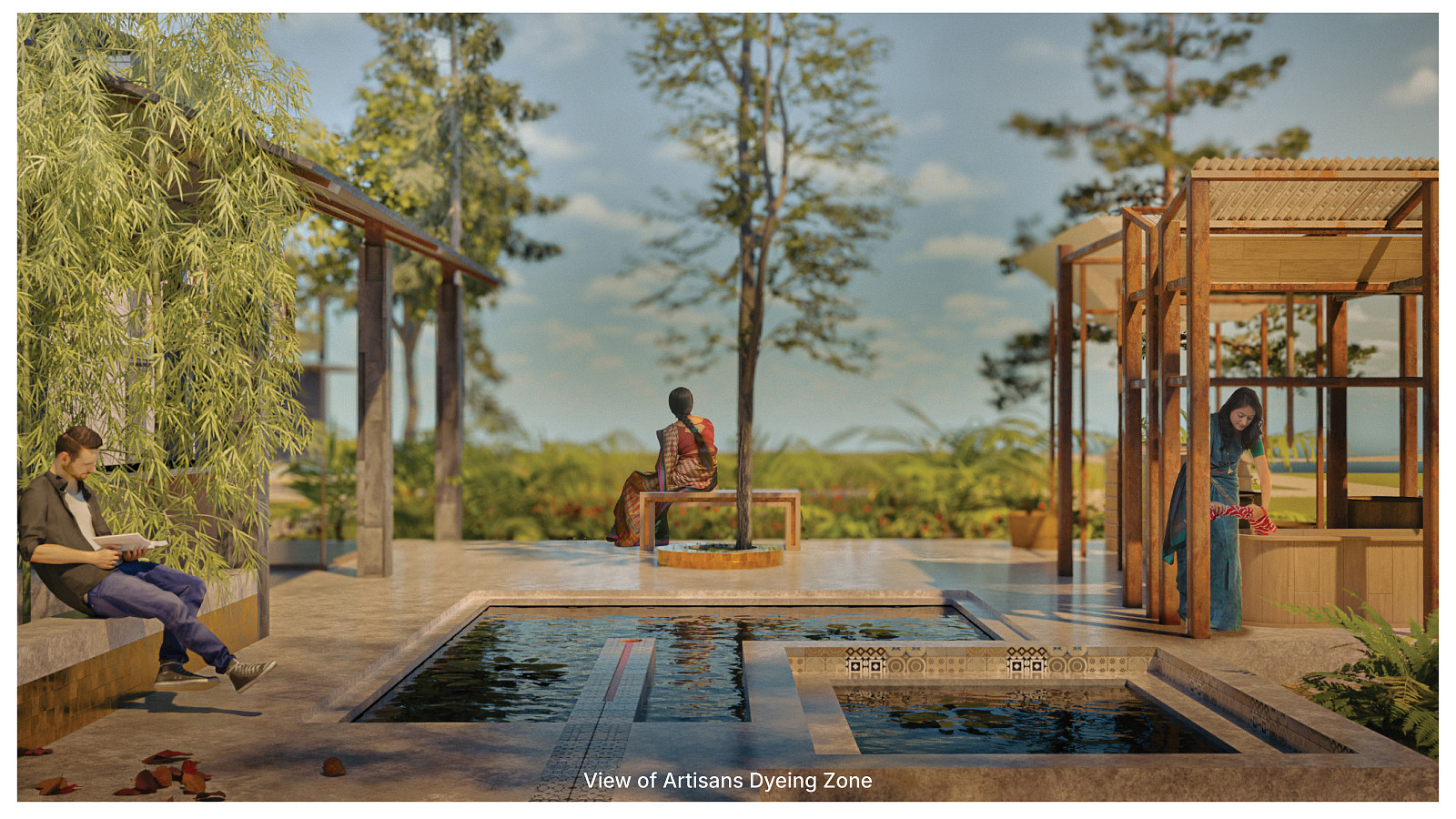
To enhance the human experience further, the project integrates “fragments”—architectural insertions placed within courtyards. These fragments act as experiential anchors: small pavilions, shaded resting decks, elevated walkways, and cultural nodes. They echo the conceptual lineage of architectural follies but reinterpret them as functional and sensory devices. These fragments activate space, encourage community use, and enrich daily rituals. They become atmospheres rather than objects—giving workers spaces to pause, interact, and reconnect with their environment.
Cultural continuity is essential to the project. The design respects the lived reality of weaving communities, where work is more than economic activity; it is heritage, memory, and identity. By weaving housing, workspaces, and communal life into one adaptable platform, the project maintains this continuity in a future where automation and industrial intensification are inevitable. Rather than erasing the cultural landscape, the architecture elevates it, using new tools—AI simulation, environmental computation, modular construction—to strengthen the social and spatial structures that have always defined artisan communities.
At its core, the project proposes a new model of the future factory: not a monolithic institution, but a living organism. A place where work does not alienate, where technology does not isolate, and where architecture becomes a framework for coexistence. It is an optimistic vision—one that learns from the past, responds to the present, and prepares for a flexible, human-centered industrial future.
Technical information
The project occupies a site area of 23,08,305 square feet (approximately 52.99 acres) and is conceived as a modular textile ecosystem that integrates production, housing, recreation, and community spaces within a flexible framework. The primary factory structures utilize a prefabricated steel structural system, selected for its adaptability, ease of expansion, and reduced construction time. Organized on a 24 ft × 24 ft modular grid, the steel framework allows factory units to be plugged in or removed according to changing production demands, ensuring long-term resilience and scalability. Large-span structural members create open floor plates that can accommodate varying machine layouts and future technological transitions.
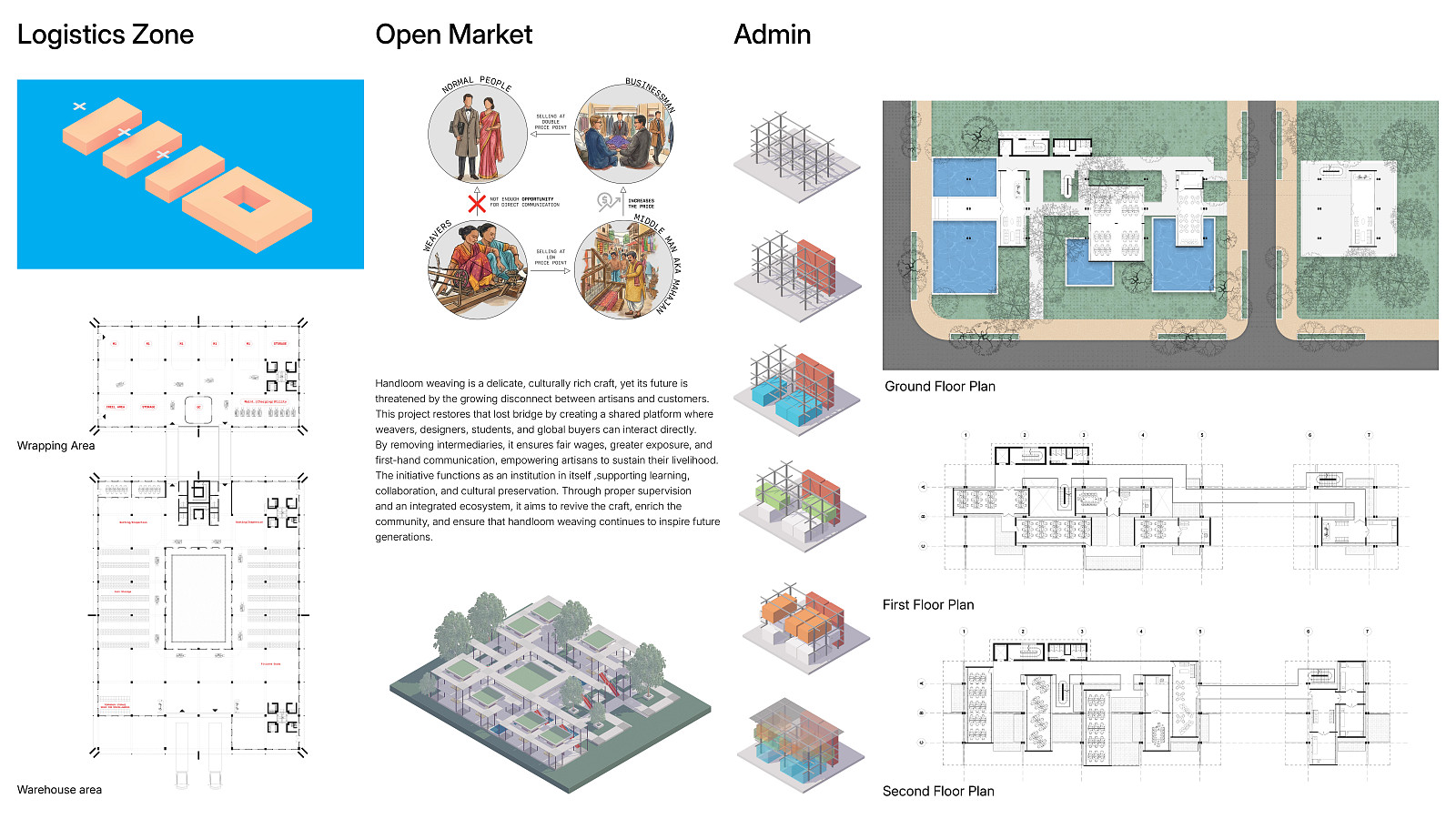
A key technical feature of the proposal is the incorporation of an underground AGV (Automated Guided Vehicle) tunnel network, which connects production floors, storage facilities, and service zones. By relocating logistics infrastructure below ground, the design separates industrial movement from pedestrian activity, enhancing operational efficiency, safety, and the quality of shared public spaces. The underground corridor also accommodates utility lines, including electrical systems, water supply, data infrastructure, and waste management networks.
The material strategy prioritizes durability, environmental performance, and contextual relevance through the use of recyclable steel, locally sourced brick, concrete, permeable paving systems, and native landscape elements. Sustainability is embedded throughout the design process. Approximately 84 percent of the total site area is preserved as open and green space, incorporating courtyards, ecological buffers, community gardens, and permeable landscapes that support biodiversity, groundwater recharge, and microclimatic comfort. Environmental optimization through radiation analysis informed the overall massing strategy, minimizing heat gain and improving thermal performance. Together, these technical interventions establish a future-ready industrial model that balances productivity with environmental responsibility and human well-being.
Documentation


Copyright © 2026 INSPIRELI | All rights reserved. Use of this website signifies your agreement to the Terms of Use, Privacy Policy, and use of cookies.