SARO - Living. Working. Showing


Project idea
The idea of the SARO project arises from the need of artists for a place that combines retreat, focused work, and communal exchange. Located at Lake Scharmützel, the project creates a small artistic campus that brings together living, working, exhibiting, and meeting in one place. The design responds to its special setting between lake, forest, shore, and open landscape, developing an architecture that balances calmness, a strong connection to nature, and public accessibility.
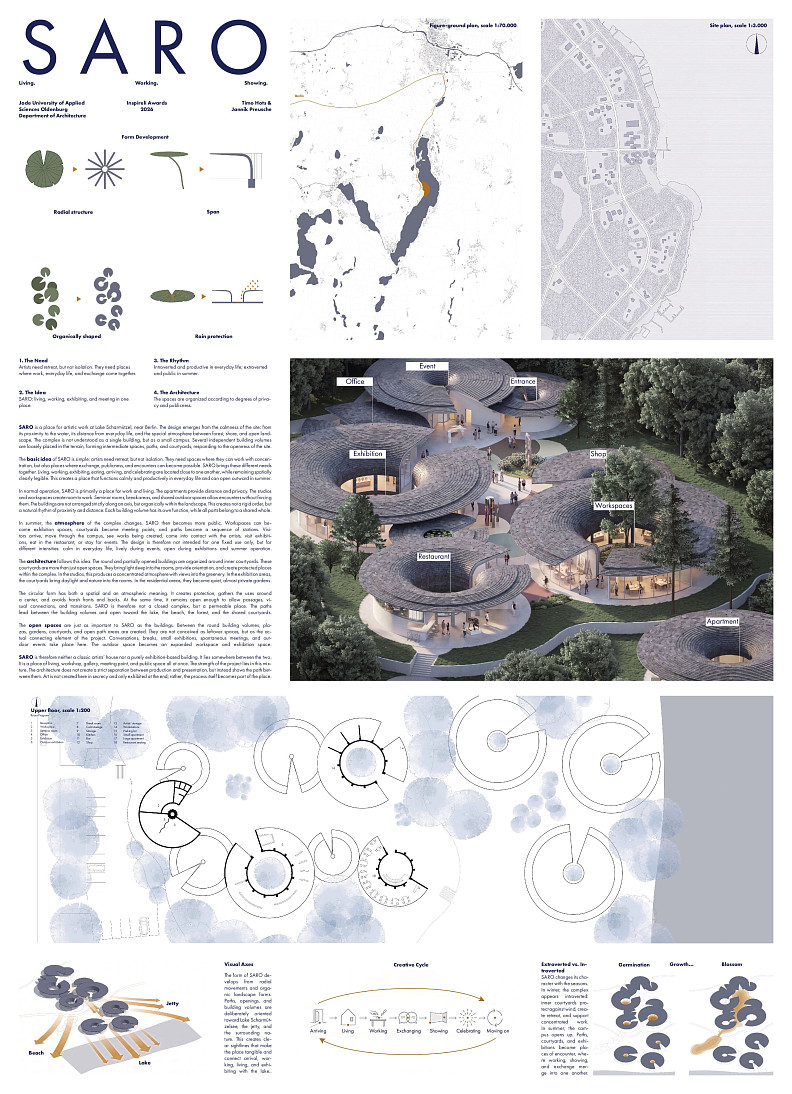
SARO understands artistic work not as an isolated process, but as an open cycle of arrival, living, working, exchanging, showing, and celebrating. In everyday use, the complex offers protected spaces for concentration and retreat. During exhibitions, events, and the summer season, the campus opens outward and becomes a public place of encounter between artists, visitors, and the landscape.
Project description
The project consists of several independent, organically shaped building volumes that are loosely embedded in the landscape and together form a campus. The form and spatial structure of the buildings are inspired by water lilies, whose rounded leaves float on the surface of the lake and create a natural pattern of proximity, distance, and openness. The buildings are not arranged along a strict axis, but follow radial movements, sightlines, and natural relationships to Lake Scharmützel, the jetty, the beach, and the surrounding landscape. Between the buildings, paths, courtyards, gardens, plazas, and open communal areas are created, acting as the connecting fabric of the project.
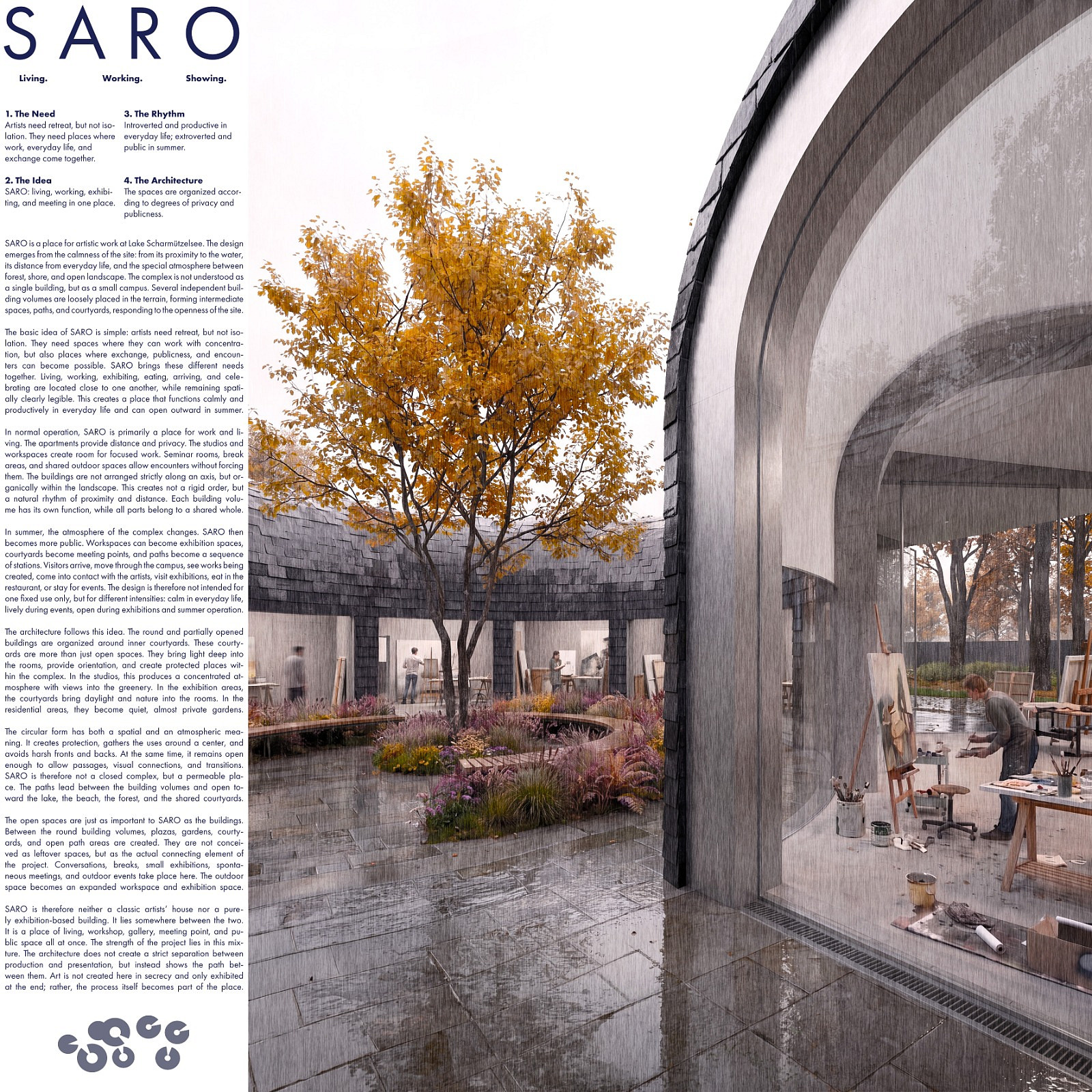
The program includes apartments for artists, studios and workspaces, seminar rooms, exhibition areas, a reception, administrative spaces, a shop, restaurant, kitchen, bar, storage areas, and outdoor spaces for encounters, events, and open-air exhibitions. The round and partially opened buildings are organized around protected inner courtyards. Similar to the structure of water lilies, each volume has its own center while remaining part of a larger organic composition. These courtyards bring daylight deep into the interiors, improve the microclimate, and create calm places for orientation and retreat.
The spatial structure is based on different degrees of privacy and publicness. The residential areas provide calmness and distance, the work areas enable focused artistic production, and the public areas create space for exhibitions, exchange, and shared use. As a result, SARO can operate in different ways depending on season and use: introverted and productive in everyday life, open and lively during exhibitions, events, and the summer season.
Technical information
SARO is conceived as a permanent, sustainable, and adaptable campus. The construction combines robust, repairable, and dismantlable materials with a spatial organization that allows long-term flexibility. The buildings make use of daylight, natural ventilation, protected inner courtyards, and constructive sun protection. Through the round building forms and courtyard-based organization, sheltered outdoor spaces are created that improve the microclimate while providing orientation, light, and spatial quality.
The material concept is defined by a slate roof, steel columns, floor-to-ceiling glass façades and bright solid wall surfaces made of monolithic aerated concrete. The slate roof protects the rooms from weather, connects the individual building volumes, and forms a long-lasting mineral envelope. Steel columns support the projecting roofs and allow flexible floor plans. The glass façades open the rooms toward the courtyards, lake, and landscape, creating a transparent connection between working, exhibiting, and the public realm.
An important technical and sustainable approach is the reuse of materials. Components such as slate, steel, and natural stone are intended to be planned as separable, processable, and reusable as possible. Ideally, the slate roofing can be sourced from existing material in the surrounding area. The floor plans are designed to adapt to changing uses over time. Sustainability is therefore understood not only as a technical feature, but also as spatial, constructive, and social durability.
Documentation

Copyright © 2026 INSPIRELI | All rights reserved. Use of this website signifies your agreement to the Terms of Use, Privacy Policy, and use of cookies.