Museum of Advanced Technologies "Volga Pearl"

Project idea
Description of the Overall Design Idea and Architectural Concept
The search for the ideal architectural form was inspired by the image of a seashell, a universal symbol of growth, protection, and organic development. The seashell became the conceptual foundation of the project, shaping both its architectural expression and its underlying philosophy.
Its smooth biomorphic geometry reflects the continuous evolution of technology and art, emphasizing their ability to adapt, transform, and progress over time. The protective nature of the shell serves as a metaphor for the museum itself, a place that preserves, safeguards, and communicates humanity's knowledge, achievements, and innovations. The spiral structure symbolizes the constant expansion of understanding, the pursuit of discovery, and the endless potential for future development.
The concept of “Volga Pearl” is envisioned as an architectural complex designed to become a catalyst for innovation, knowledge exchange, and creative collaboration. The project combines a Museum of Advanced Technologies with a co-working environment, creating a platform where science, art, education, and entrepreneurship converge to shape future ideas and opportunities.
The building is designed as a dynamic and forward-looking landmark that embodies the spirit of technological progress and innovation. Through its organic architectural form, the project expresses movement, transformation, and continuous development, inspiring visitors to explore, learn, and create.
More than a cultural institution, the complex functions as a living ecosystem for knowledge and creativity, fostering interaction between researchers, innovators, entrepreneurs, students, and the wider public. By integrating exhibition spaces, collaborative work environments, and public gathering areas, the project encourages interdisciplinary dialogue and supports the development of new ideas capable of shaping the future.
Project description
Architectural Design
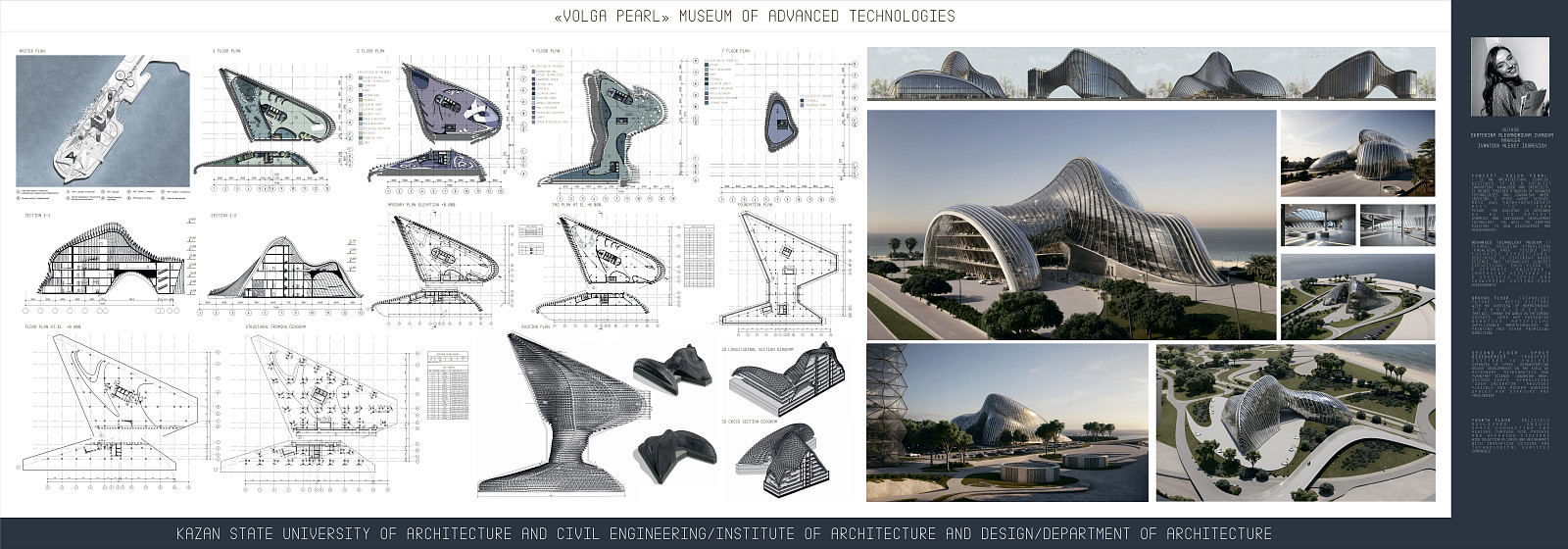
The complex consists of two interconnected buildings.
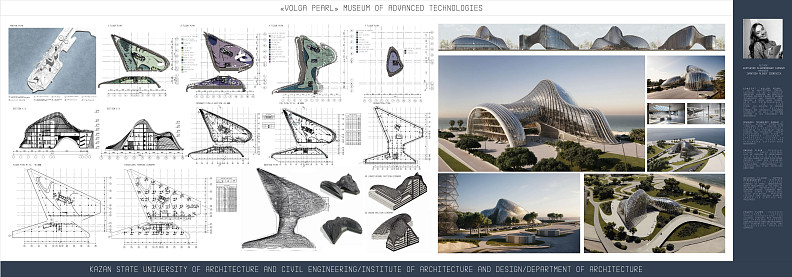
The first building, the Museum of Advanced Technologies, is a seven-story structure that symbolizes a "Knowledge Base." The museum is organized into thematic exhibition zones dedicated to various fields of science and technology. Each floor is conceived as a separate universe, immersing visitors in a specific topic while showcasing cutting-edge developments and achievements.
The first floor, "Technologies of the Future," introduces visitors to breakthrough innovations that are expected to transform the world in the coming decades. The exhibition features robotics, artificial intelligence, nanotechnology, 3D printing, and other emerging technologies. A multi-level floor system is incorporated into the design to create a more immersive visitor experience.
The second floor, "Space Discoveries," transports visitors into the vastness of space and presents the latest achievements in astronomy, astronautics, and planetary science.
The third floor, "Medicine of the Future," showcases the latest advancements in healthcare, biotechnology, and genetic engineering. The exhibition demonstrates innovative methods of diagnosis and treatment, robotic surgery, artificial organs, regenerative medicine technologies, and personalized healthcare solutions.
A continuous ramp extending from the first to the third floor is located within the glazed central atrium, creating an uninterrupted visitor route and a dynamic spatial experience.
The fourth floor, "The Culinary Boulevard," is a unique destination that connects the two buildings through an elevated skybridge and offers a variety of cafés and restaurants featuring innovative cuisine and technology-driven services.
The skybridge functions not only as a physical connection but also as an independent public space that unites the museum and the co-working center, fostering an atmosphere of collaboration and innovation. Its transparent structure provides panoramic views of the city and the interior spaces of the complex.
The upper floors, from Levels 5 to 7, accommodate museum administration, research staff, and technical facilities, ensuring the efficient operation and future development of the institution.
The second building serves as a co-working center and symbolizes an "Idea Incubator." It provides flexible and contemporary workspaces for start-ups, freelancers, researchers, and innovative companies.
The project represents the intersection of technological progress and human potential through contemporary architecture and carefully organized functional zoning. The complex is designed not only as a destination for showcasing scientific and technological achievements but also as a platform for knowledge exchange, collaboration, and the creation of future innovations.
Facade Concept
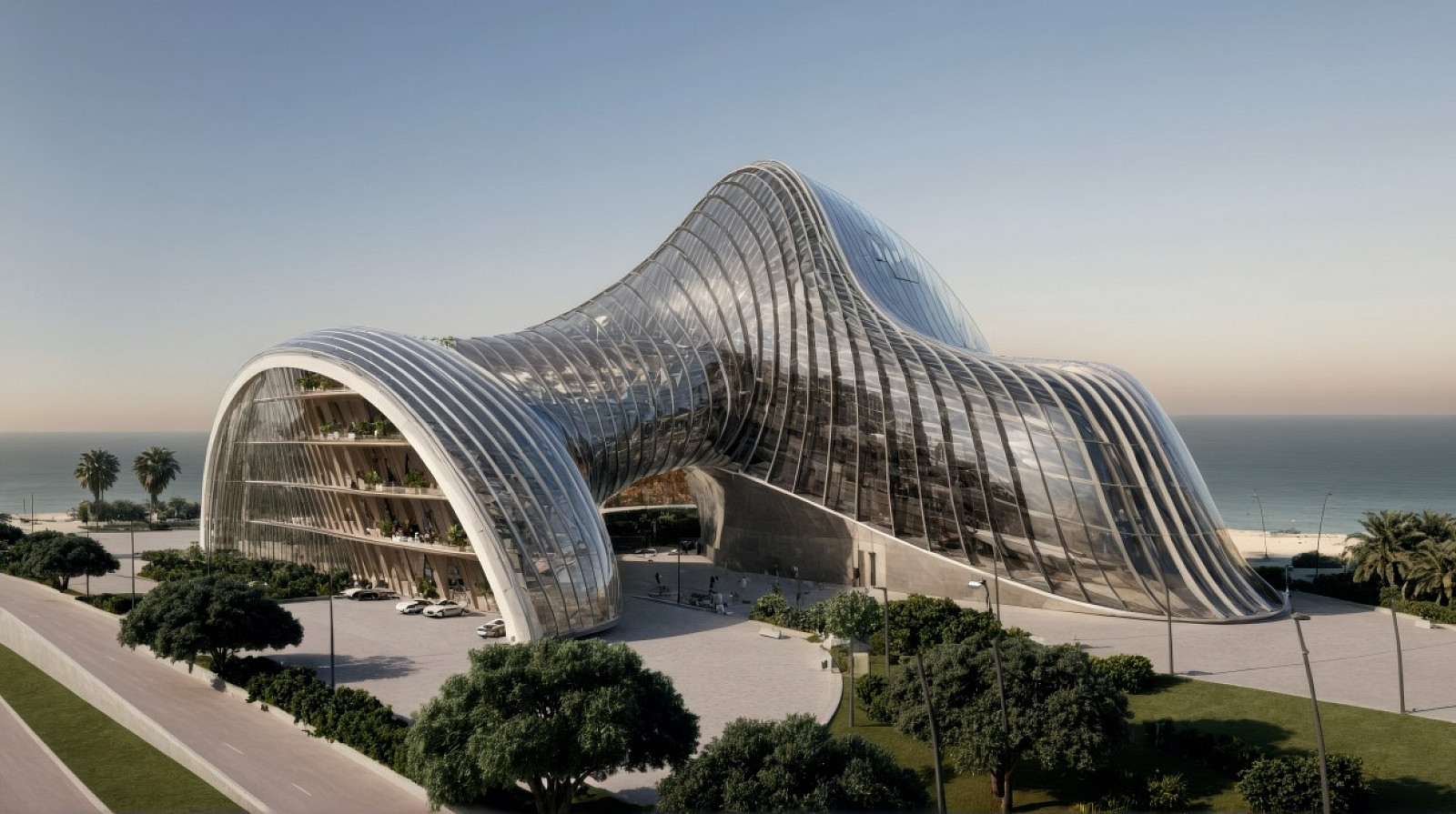
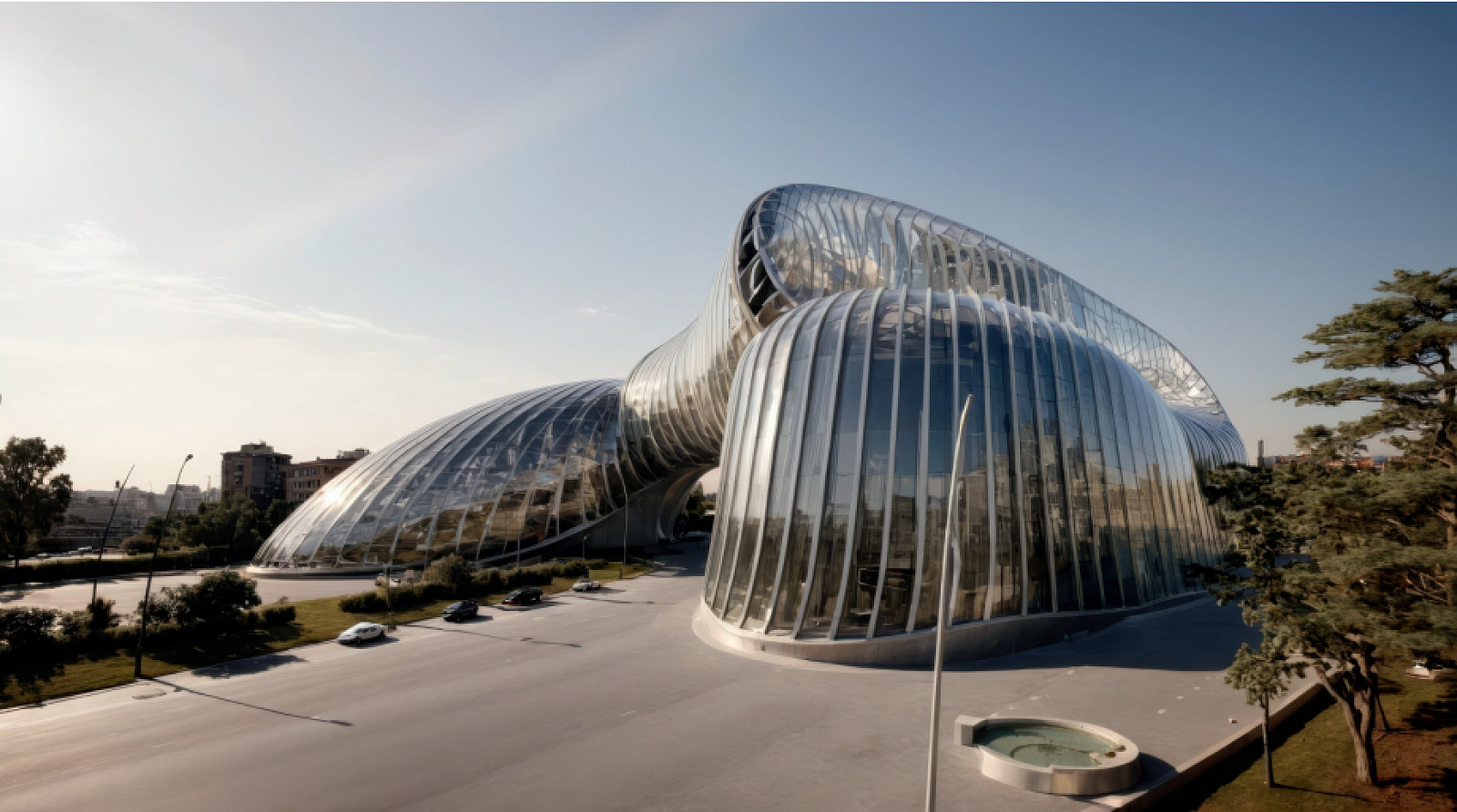
The facade design is based on the principles of biomorphic architecture and is inspired by natural forms resembling a seashell and ocean waves. The sculptural geometry creates a continuous architectural volume without a distinct separation between walls and roof, allowing the building to appear as an organic extension of the surrounding landscape.
The primary element of the façade composition is a transparent envelope incorporating panoramic glazing and a system of curved structural ribs. Extensive glazed surfaces maximize natural daylight penetration, create visual openness, and establish a constant connection between the interior spaces and the surrounding environment.
Vertical fins forming the external structural framework emphasize the fluidity of the volume and reinforce the perception of movement. The varying spacing of structural elements creates diverse lighting conditions and façade depth while simultaneously providing solar shading and reducing excessive heat gain.
A key architectural feature is the central full-height atrium, which visually divides the building volume and forms a distinctive entrance space. This design strategy allows the building to maintain its monumental scale while preserving visual lightness and permeability.
The combination of flowing forms, panoramic glazing, and a parametric façade system creates a recognizable architectural identity that symbolizes innovation, technological advancement, and continuous progress.
Master Plan
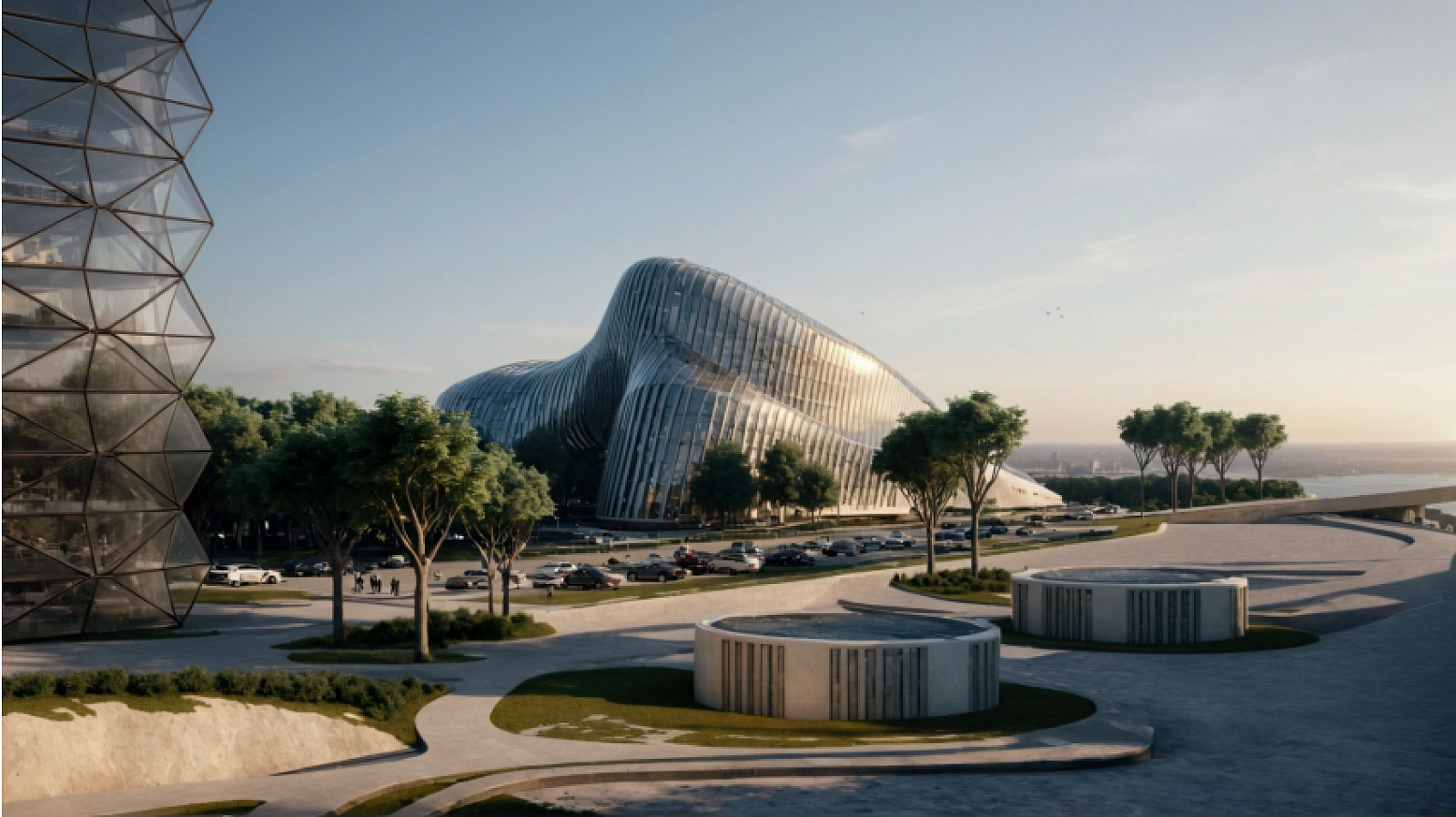
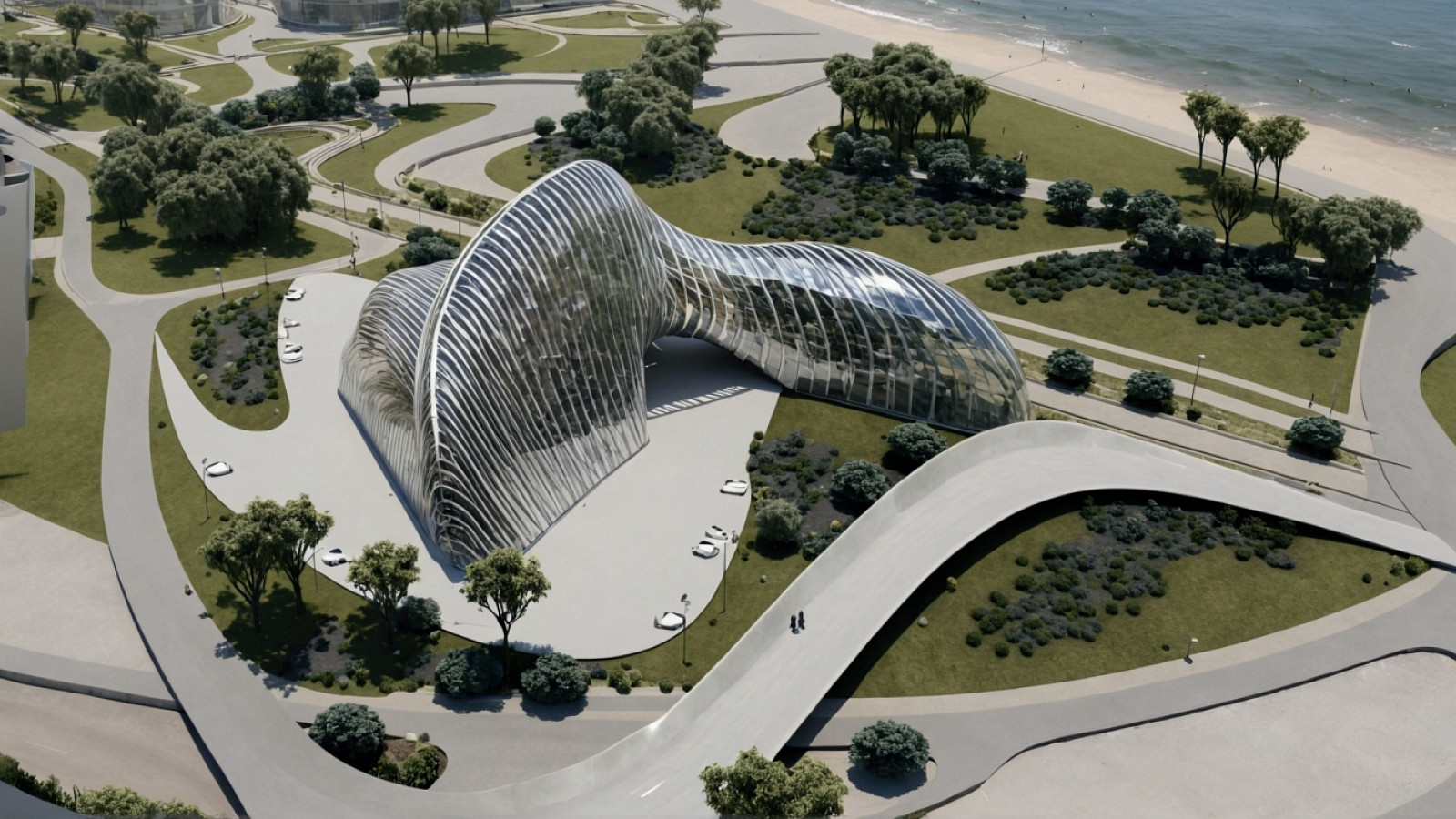
The master plan is organized around a continuous pedestrian axis extending across the entire peninsula and connecting public spaces, residential developments, business facilities, waterfront promenades, and recreational areas. This axis forms the primary urban route of the district and ensures uninterrupted movement between its key destinations.
The Museum of Advanced Technologies "Volga Pearl" serves as the culminating element of this urban structure. Strategically positioned at a key location within the site, the museum acts as the final focal point of the public realm. All major pedestrian flows gradually converge toward the museum, transforming it into both an architectural landmark and the principal public destination of the new urban district.
A distinctive feature of the planning concept is the creation of a continuous pedestrian loop. After visiting the museum, visitors continue their journey through the waterfront promenades, public spaces, and recreational landscapes before reconnecting with the central pedestrian axis. This circulation strategy creates an uninterrupted spatial experience and ensures balanced activity throughout the entire district.
The location on the banks of the Volga River further enhances the urban significance of the project, transforming the museum into a key landmark and a symbolic destination that marks the culmination of the public realm within the new waterfront development.
Technical information
Structural Design
The museum features a complex biomorphic steel envelope that defines its architectural identity and creates its distinctive sculptural form.
The primary load-bearing structure of the reinforced concrete building consists of monolithic reinforced concrete columns with cross-sections of 600 × 600 mm. Additional structural stability is provided by reinforced concrete shear walls with a thickness of 200 mm.
The floor system is designed as a monolithic reinforced concrete slab with a thickness of 200 mm. The ground floor incorporates a multi-level floor configuration, creating a dynamic interior spatial experience.
The structural framework includes steel primary beams of section 40B1 and secondary steel beams of section 20B1, arranged at a spacing of 1.5 m.
The building is founded on a piled raft foundation system, ensuring efficient load transfer and structural stability.
All structural shear walls, columns, floor slabs, and staircase elements are constructed from cast-in-place reinforced concrete with concrete strength class C30/37 (equivalent to B30).
Documentation

Copyright © 2026 INSPIRELI | All rights reserved. Use of this website signifies your agreement to the Terms of Use, Privacy Policy, and use of cookies.