The Luminal Veil


Project idea
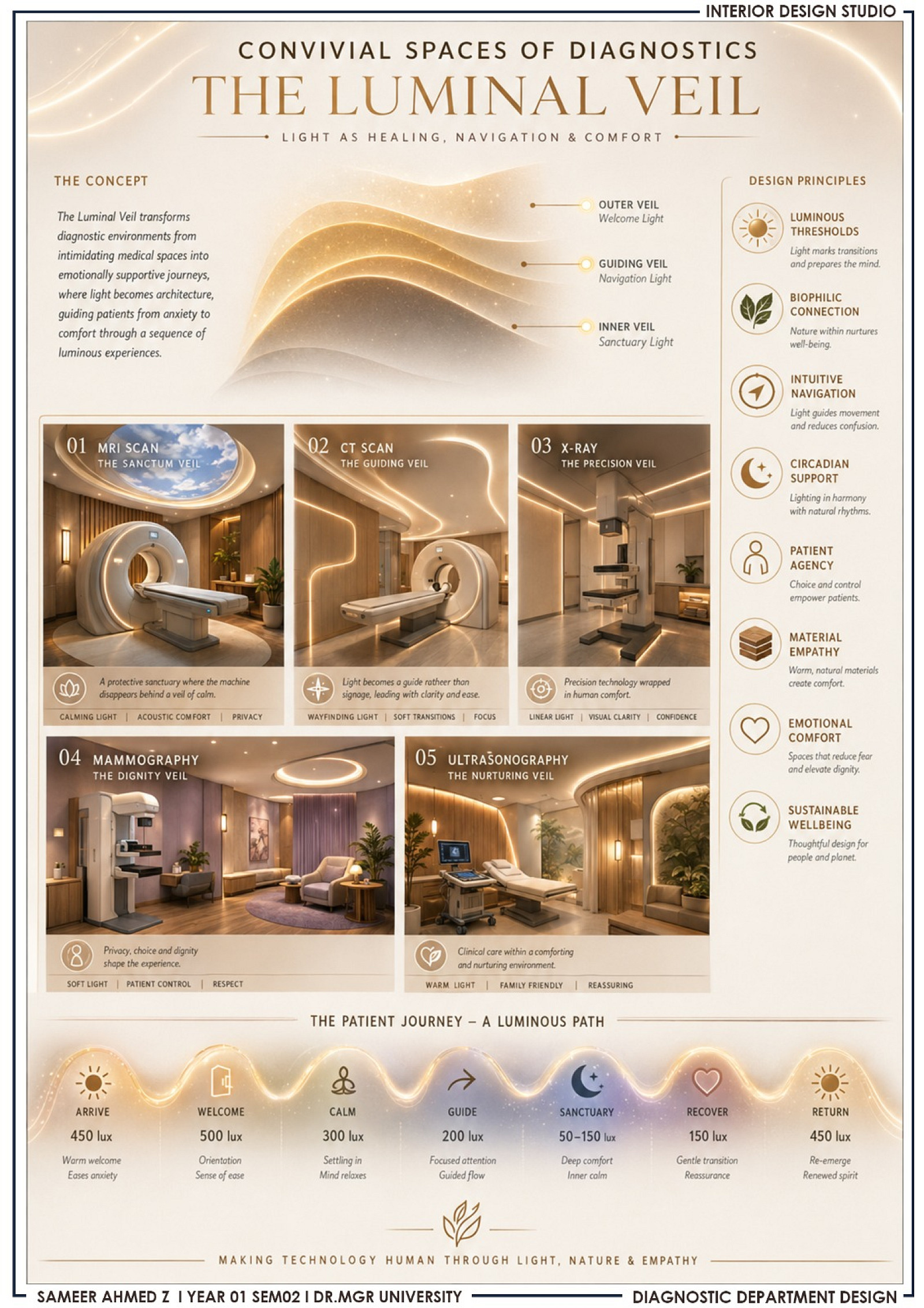
THE LUMINAL VEIL
Subtitle: Transformative Interior Design for a Diagnostic Department
1. PROJECT TITLE & ABSTRACT
Title: Convivial Spaces of Diagnostics – The Luminal Veil
Abstract: This project declares the design intent for a new Diagnostic Department within a hospital facility. The initiative seeks to move beyond sterile, purely functional medical interiors. Instead, it proposes "The Luminal Veil"—a design concept that utilizes light, biophilic elements, and human-centric materiality to transform intimidating medical diagnostic environments into compassionate, calming, and emotionally supportive spaces that prioritize patient dignity and well-being.
2. CONTEXT & BACKGROUND
Diagnostic departments (including imaging suites like MRI, CT Scan, X-Ray, Mammography, and Ultrasonography) are historically among the most anxiety-inducing areas in a hospital. Patients often walk into these environments already stressed and fearful of their health.
Most existing diagnostic environments prioritize equipment logistics and radiation shielding entirely over the patient's psychological state, resulting in cold, industrial, and claustrophobic rooms. The designated site for this project, located within Dr. MGR University in Chennai, India, requires a complete overhaul of this narrative to align with modern, holistic healthcare delivery.
3. CORE IDEA & DESIGN PHILOSOPHY
The foundational concept is "The Luminal Veil."
Here, "Light" is not just a utility; it is the primary tool of architecture. This idea manifests through a "Luminous Path" that guides the patient through the department:
Outer Veil: A welcoming, warm threshold to ease arrival anxiety (Lobby & Reception).
Guiding Veil: Navigation lighting that intuitively leads patients through corridors.
Inner Veil / Sanctuary: A protective, comforting envelope surrounding the machinery itself, reducing physical and psychological stress during the scan.
The project integrates Biophilic Design (nature, natural textures, sky ceilings, wood) to reduce cortisol levels and Patient Agency (choice, privacy, dignity) to restore a sense of control.
4. PRIMARY GOALS
The overarching goals of this design intervention are:
To Humanize Technology: To wrap invasive, anxiety-inducing medical machinery in a comforting architectural "embrace" using wood, warm lighting, and natural imagery.
To Alleviate Patient Anxiety: To measurably lower stress levels through strategic lighting, color psychology, and spatial zoning (e.g., using sky ceilings in MRI scans to mitigate claustrophobia).
To Achieve Technical & Functional Excellence: To create a layout that adheres to strict medical protocols, optimal circulation, and specific technical requirements (RF shielding for MRI, Lead shielding for CT/X-Ray) without compromising aesthetic quality.
5. SPECIFIC OBJECTIVES
The project aims to achieve the following measurable outcomes:
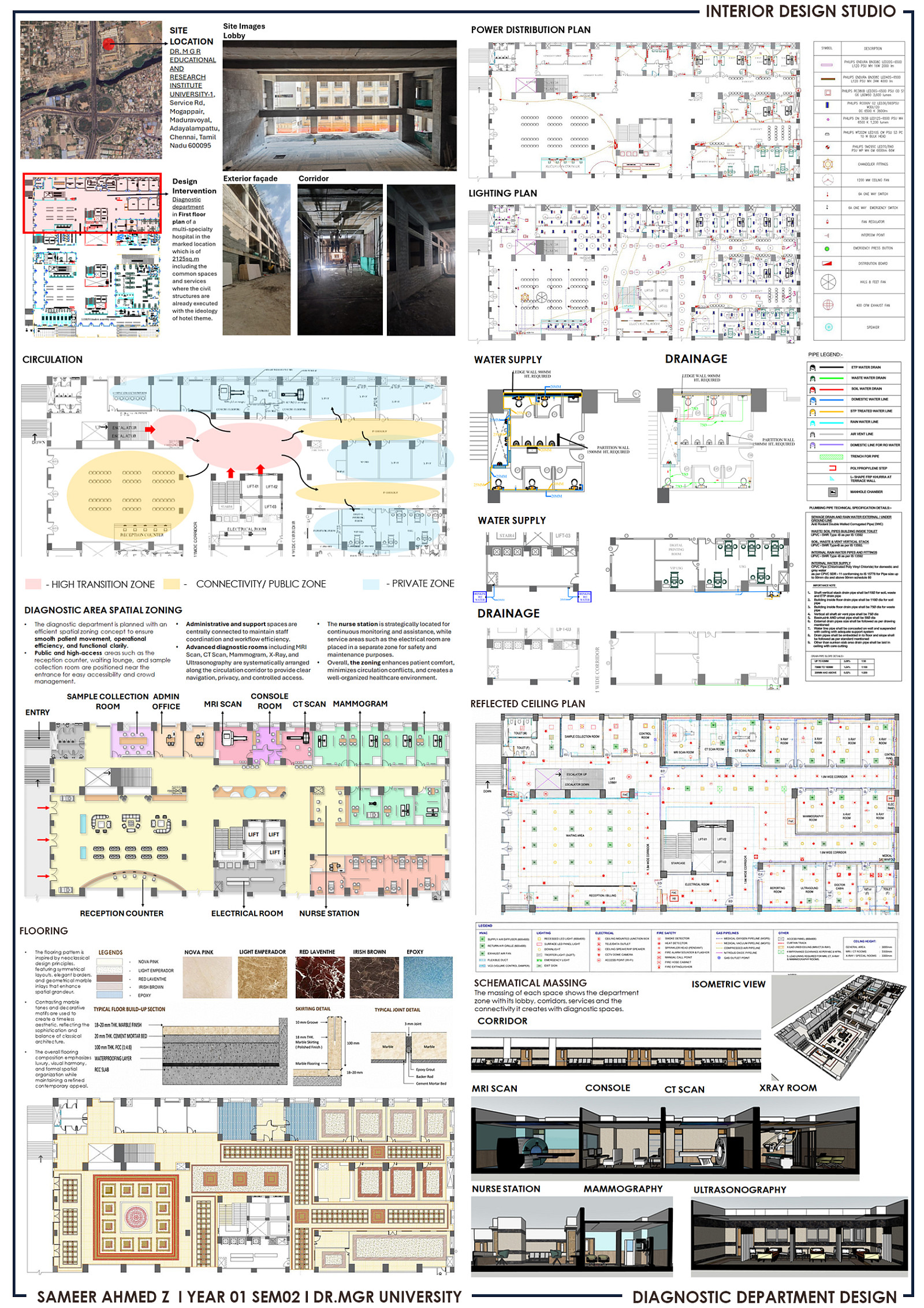
Circulation & Zoning: Create a clear, seamless patient flow from the "High Transition Zone" (Entrance/Reception) to "Private Zones" (Scanning Rooms) to minimize waiting times and confusion.
Room-Specific Innovations:
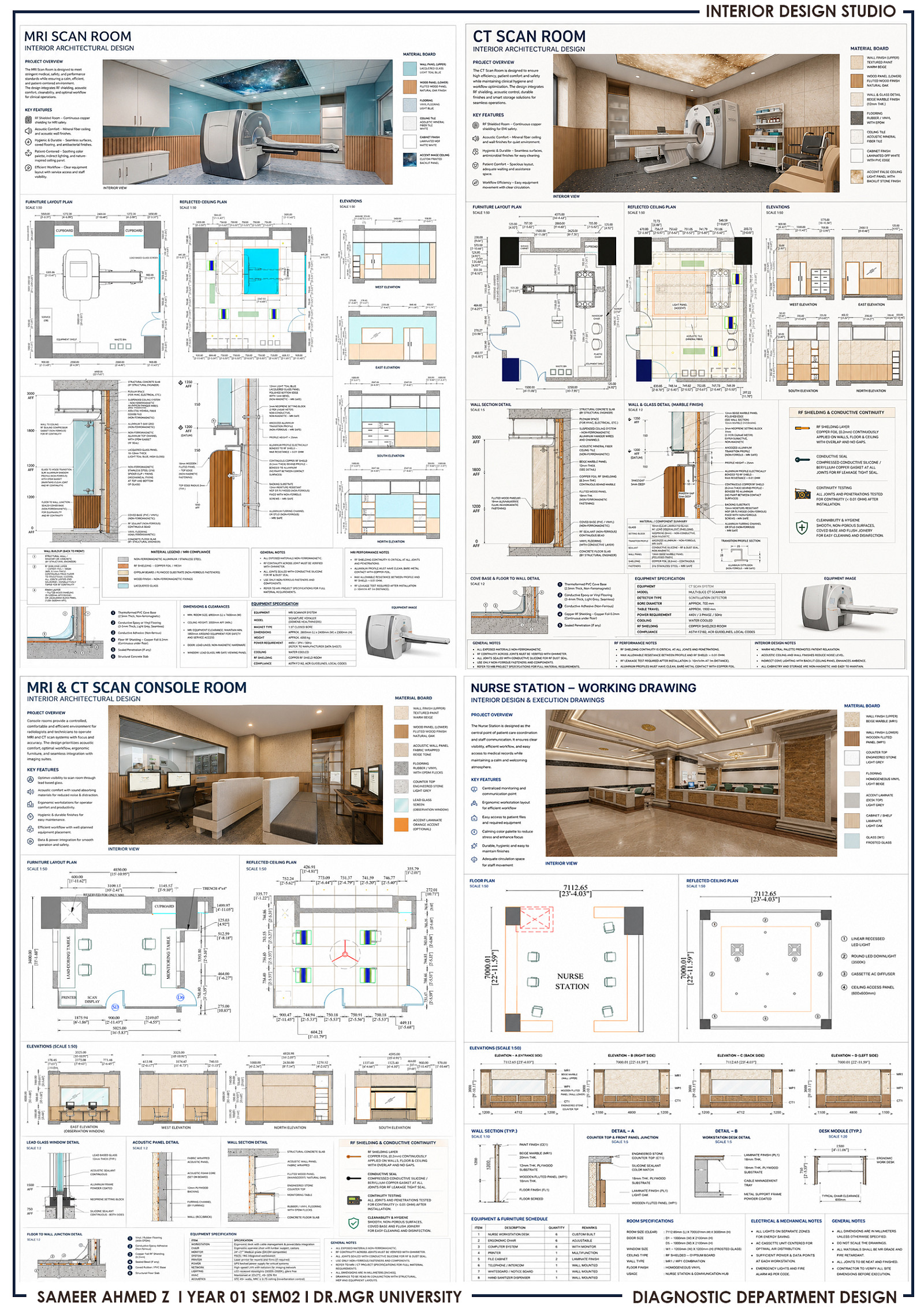
MRI Scan Room: Incorporate a multi-layered "Sky Ceiling" to combat claustrophobia alongside heavy-duty RF shielding.
X-Ray & CT Scan Rooms: Integrate "Tactile Warmth" and warm ambient lighting to offset the cold aesthetic of the machinery.
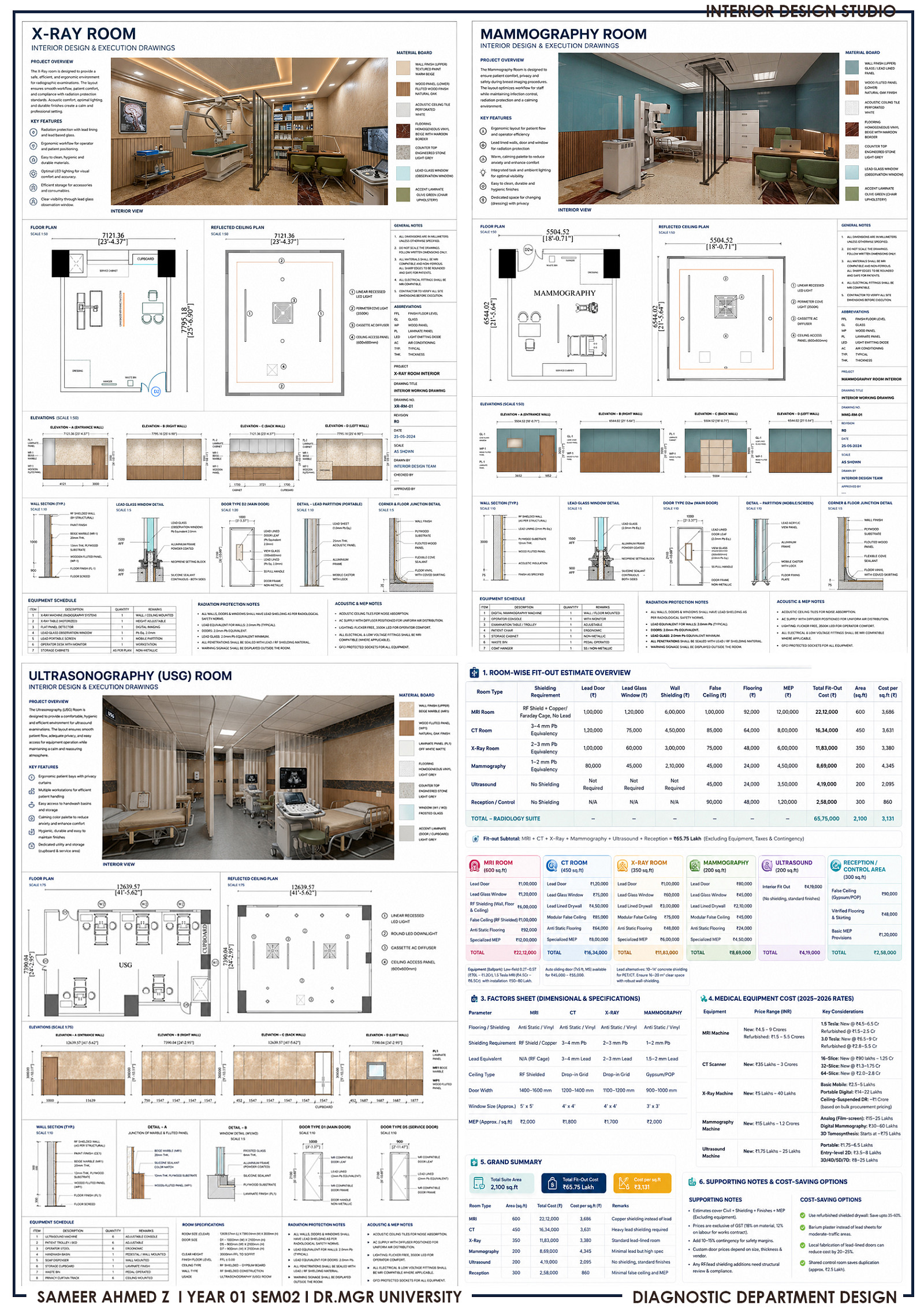
Mammography Room: Prioritize "Dignity Veil" (Privacy, Warmth, & Soft Lighting) to ensure the patient feels respected and safe.
Lighting Strategy: Implement a specific color temperature journey (from 2000K/2700K warm to 5000K cool, and back) to match the physiological needs of the patient at different stages (Arrival -> Scan -> Recovery).
Material & Cost Planning: Provide a fully detailed "Room-wise Fit-Out Estimate" and material palette (wood, stone, acoustic panels) ensuring the project is sustainable, cleanable, and financially viable for a hospital setting.
6. SCOPE & METHODOLOGY
This declaration covers the entire interior architectural design of the diagnostic wing, including:
Development of design concepts and mood boards.
Spatial planning, zoning, and circulation diagrams.
Detailed Floor Plans, Elevations, and Sections.
Technical working drawings for specialized rooms (MRI, CT, X-Ray, Mammography, USG).
Electrical, Lighting, and Reflected Ceiling Plans.
HVAC and Water Supply/Drainage schematics.
Execution details, construction notes, and a complete budgetary cost analysis.
7. CONCLUSION
Through this project, the Diagnostic Department will no longer be a place of fear, but a "Luminous Path" guiding patients from anxiety to comfort. It seeks to prove that in healthcare design, empathy and technical precision are not opposing forces but necessary partners in creating spaces that genuinely heal.
Project description
PROJECT DESCRIPTION & SCOPE OF SOLUTION
1. Project Title
Convivial Spaces of Diagnostics: The Luminal Veil
2. General Project Description
This interior architecture design project addresses the specific needs of a Diagnostic Department within a medical facility (Dr. MGR University, Chennai). The core solution transforms a clinical, anxiety-inducing environment into a human-centric, comforting, and technically precise space. The design reimagines how light, materiality, and spatial flow interact with heavy medical machinery to create a therapeutic patient journey.
3. Scope of the Project Solution
The design solution covers the complete interior architectural realization of the diagnostic wing. The specific deliverables and spatial boundaries are outlined below:
A. Spatial Boundaries & Rooms (Interior Design)
The scope includes the detailed design and working drawings for the following specific rooms and zones:
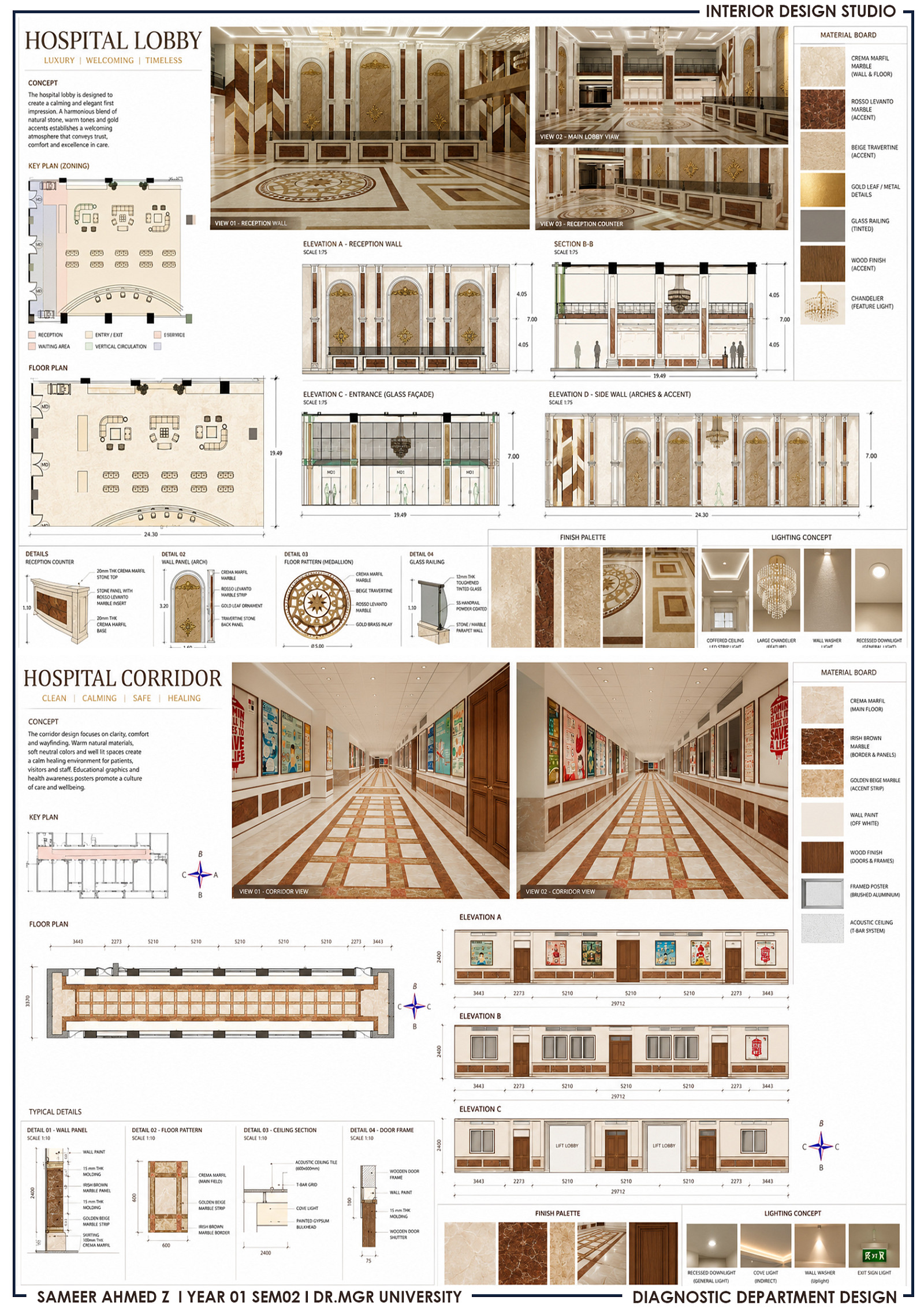
Public & Transition Zones: Main Entrance Lobby, Reception Area, Seating Lounge, Main Corridors (Circulation Zones).
Imaging Suites:
MRI Scan Room (with Console)
CT Scan Room (with Console)
X-Ray Room
Mammography Room
Ultrasonography (USG) Room
Operational Areas: Nurse Station, Sample Collection Area, Admin Office, Electrical Room.
B. Technical & Functional Scope (The "Hard" Requirements)
The solution addresses strict technical medical requirements that dictate the layout and construction materials:
Medical Shielding: Implementation of specific RF (Radio Frequency) shielding for the MRI room and Lead shielding for CT and X-Ray rooms.
Medical Gases & Plumbing: Integration of water supply, drainage, and medical gas lines into the floor plans and reflected ceiling plans.
Equipment Integration: Designing spatial allowances for large equipment (e.g., MRI bores, CT gantries) including clearances for patient transport and staff workflow.
Acoustics: Designing for acoustic comfort and noise reduction between imaging suites, particularly for the loud CT/MRI scanning processes.
C. Aesthetic & Human-Centric Scope (The "Soft" Requirements)
The core innovation of this solution is the "Luminal Veil" lighting concept. The scope includes:
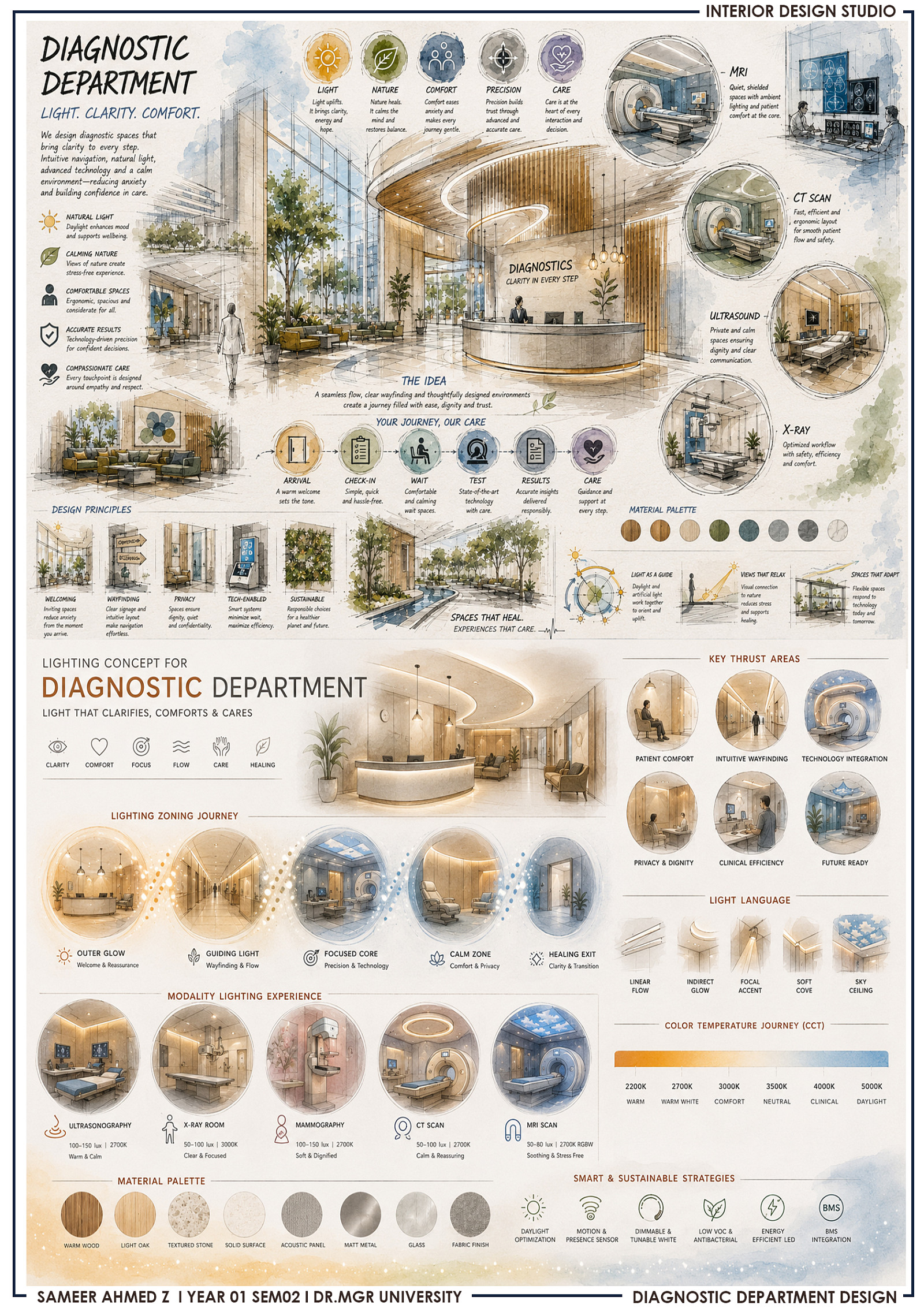
Lighting Journey Design: A specific lighting strategy where the Color Temperature (CCT) shifts to guide the patient's emotional state (e.g., 5000K for focus/technical clarity; 2700K for calm/dignity).
Biophilic Integration: Applying natural materials (wood, stone), natural daylight simulation, and a "Sky Ceiling" specifically for the MRI room to combat claustrophobia.
Material Specification: Fully detailed material boards specifying flooring (Marmoleum, Vinyl, Tiles), wall finishes (Anti-bacterial paint, Gypsum board), and furniture.
D. Design Deliverables & Documentation
The scope concludes with a full suite of technical drawings and construction documents required for execution:
Conceptual Boards: Mood boards, Concept development (Luminal Veil), Design Principles.
Layouts & Zoning: Floor plans, circulation diagrams, Spatial Zoning diagrams.
Technical Working Drawings: Detailed floor plans, Furniture layouts, Reflected Ceiling Plans (RCP), Electrical layouts, Water Supply & Drainage schematics.
Construction Details: Elevations, Sections, Wall and Flooring detail sections (e.g., Joinery, Skirting), and Door schedules.
Cost & Specifications: Full "Room-wise Fit-Out Estimate Overview" with material quantities and costs, including a Grand Summary ROI Analysis (budgetary breakdown for equipment vs. interior finishing).
4. Exclusions (Out of Scope)
While this is a comprehensive interior design solution, the scope specifically excludes:
Structural engineering modifications (load-bearing walls, major floor re-engineering).
Exterior landscape design or building envelope architecture.
Mechanical ventilation system design (though space for ducts is allocated within the RCP).
Procurement of actual medical imaging equipment (e.g., purchasing the MRI machine itself).
5. Conclusion
The "Luminal Veil" solution covers the full interior architectural scope, providing a "ready-to-build" package for a modern, empathetic, and highly technical diagnostic facility. It prioritizes patient psychology while rigorously adhering to medical standards, ensuring that the final space is both comforting and clinically superior.
Technical information
TECHNICAL SPECIFICATION: DIAGNOSTIC DEPARTMENT – THE LUMINAL VEIL
1. GENERAL PROJECT DATA
Project Type: Hospital Diagnostic Department (Interior Architecture)
Location: Dr. MGR University, Chennai (Site Coordinates: 13.030687°N, 80.234544°E)
Total Area: Approx. 310 sq.m (Estimated from Ground Floor layout footprint)
Design Software: AutoCAD (Drafting), SketchUp (Modeling), V-Ray (Rendering)
2. SPATIAL PLANNING & ZONING
Zone Classifications:
High Transition Zone (Red): Entrance, Reception, Main Lobby.
Connectivity/Public Zone (Yellow): Corridors, Waiting, Sample Collection.
Private Zone (Blue): Imaging Suites (MRI, CT, X-Ray, Mammography, USG), Nurse Station, Admin.
Corridor Dimensions: Min width 2400mm (Main access); 1800mm (Secondary).
Clearances: Imaging rooms designed to accommodate patient trolley turning radii (Min 1500mm) and equipment gantries.
3. CONSTRUCTION & MATERIALS SPECIFICATION
Flooring (Zone-wise):
Lobby & Reception: Polished Cream Marble / Travertine (600x600mm).
Corridors: Vinyl plank flooring with integrated wooden accents for wayfinding.
Imaging Suites (MRI, CT, X-Ray, Mammography): Homogeneous Vinyl Flooring (Antistatic & Seamless) with coved skirting for infection control.
USG Room: Warm Wood Look Laminate / Vinyl with anti-slip properties.
Wall Finishes:
General Walls: Gypsum Board partition system (90mm-100mm thick) with anti-bacterial paint finish (White, Light Grey, Muted Greens).
Imaging Walls: Lead-lined gypsum boards (2mm Pb thickness for X-Ray/CT; custom RF shielding for MRI).
Feature Walls: Wooden panelling (Oak/Walnut finish) and Textured Stone cladding (Red Lavante, Beige Brown).
Ceiling System:
General: Suspended Grid Ceiling (600x600mm) with acoustic tiles.
MRI Room: "Sky Ceiling" – Image projection system/Backlit biophilic panel integrated into acoustic ceiling.
High-Tech Zones: Plasterboard ceiling with recessed lighting profiles.
Joinery & Doors:
Doors: Lead-lined flush doors (for imaging rooms) with stainless steel handles. Wooden finish doors for admin/offices.
Skirting: 100mm high coved base (for infection control) or wooden finish matching flooring.
4. LIGHTING SPECIFICATIONS (THE "LUMINAL VEIL")
Color Temperature Journey (CCT):
Outer Glow/Arrival (Lobby): 2700K - 3000K (Warm)
Guiding Light (Corridors): 3000K - 4000K (Neutral)
Focused Core (Scanning/Technical): 4000K - 5000K (Cool/Neutral)
Sanctuary/Recovery: 2000K - 2700K (Very Warm)
Illuminance Levels (LUX):
Arrival (Lobby): 450 Lux
Welcome/Reception: 500 Lux
Calm (Waiting): 300 Lux
Guide (Corridor): 200 Lux
Sanctuary (MRI/Scan): 50-150 Lux (Adjustable)
Recovery: 150 Lux
Return: 450 Lux
Luminaire Types:
Linear Warm Cove Lighting (Directional)
Indirect Glow Profiles (Ambient)
Focused Spotlights (Task/Reading)
Soft Corner Lighting (Diffused)
Dimmable Systems (Patient control in scanning rooms)
5. SHIELDING & MEDICAL COMPLIANCE
MRI Scan Room: RF Shielding (copper or aluminum lining) to prevent electromagnetic interference.
CT Scan & X-Ray Rooms: Lead Shielding (2mm to 3mm Pb thickness) for walls, doors, and viewing windows.
Radiation Warning Lights: Red and Green "In Use" and "Safe" indicator systems at room entrances.
6. MEP (MECHANICAL, ELECTRICAL, PLUMBING)
Electrical Layout: Detailed conduit plans with emergency power supply (UPS) for critical imaging equipment.
Water Supply/Drainage: Designed for hand-washing stations, utility rooms, and imaging rooms (e.g., for contrast media preparation). Piping concealed in raised floor or ceiling.
Medical Gases: Dedicated outlets for suction, oxygen, and medical air (if required) marked on floor plans.
Reflected Ceiling Plan (RCP): Coordinates HVAC diffusers, fire sprinklers, and light fixtures.
7. FURNITURE & EQUIPMENT (SPECIFICATIONS)
Reception Counters: Custom millwork with granite/quartz tops. Curved design for patient flow.
Nurse Station: Modular 1200mm high desks with monitors, storage, and patient-facing interaction space.
Patient Seating: Lounge seating (waiting area), upholstered in antimicrobial vinyl (Washable).
Equipment Platforms: Raised flooring (150-300mm) in MRI/CT rooms for heavy equipment and cabling.
8. ACOUSTICS & ENVIRONMENTAL CONTROL
Acoustic Rating: STC (Sound Transmission Class) 45+ between imaging suites to prevent noise cross-talk.
Vibration Control: Floating slab/isolation pads under heavy machinery to prevent structural vibration (Critical for MRI and CT).
HVAC: Calculated Air Changes per Hour (ACH) = 6-20 ACH depending on room classification (higher for procedure rooms).
9. COST & BUDGET SUMMARY (ESTIMATED)
Interior Fit-Out Cost: Approx. INR 8,000 - 15,000 per sq.ft (depending on medical vs. non-medical finishes).
Equipment Cost (CT, MRI, etc.): Approx. INR 2.5 - 6 Crores (Major cost driver).
Grand Total (Est.): As shown in your "ROI Analysis" (Approx. INR 3.5 Crores total including equipment).

Copyright © 2026 INSPIRELI | All rights reserved. Use of this website signifies your agreement to the Terms of Use, Privacy Policy, and use of cookies.
