Reclaiming Childhood: A School for Growth After Displacement


Project idea
The idea of the project is to use schools to build resilience among rapidly growing numbers of internally displaced children. It is a child-centered architectural approach to internal displacement in Bangladesh that addresses what happens to children after displacement and how educational spaces can support their recovery and long-term growth, thereby building resilience.
Project description
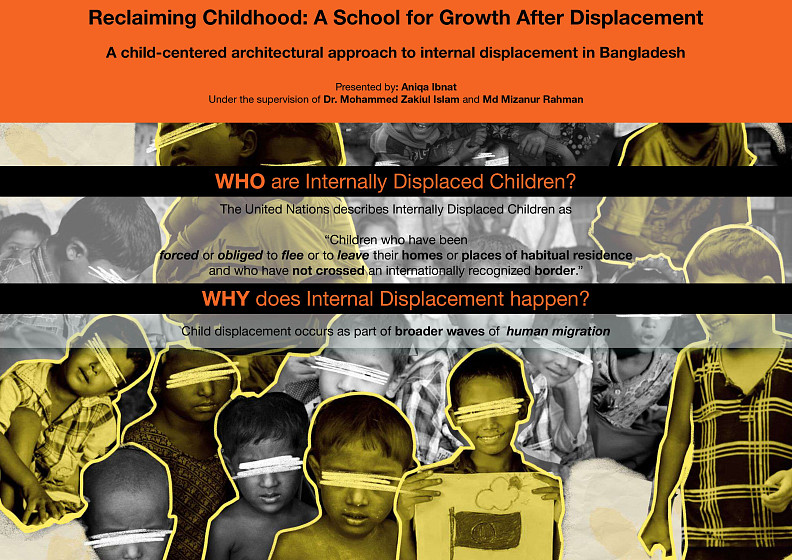
Around the world, there are millions of children whose lives are being dramatically shaped by migration and displacement. Many have been forced from their communities by urgent circumstances that threaten their well-being – such as conflict, violence, or disasters. Some will cross borders, continents, and oceans; some will move within their home country. This project examines what happens to children's lives of the children after displacement and how education can help them recover and achieve long-term growth.
The preliminary design strategy was created from a five-part framework. The first part reviews the existing literature on Internal Displacement to understand better understand internal child displacement, post-displacement migration patterns, and the practical design principles a designer needs to create an impactful educational institution. The second part analyzes the curriculum and routine guidelines of Bangladesh under NCTB 2025. The third part holds workshops with children who have faced internal displacement to understand their wants and needs. The workshops used open-ended questions and discussions with children from the target demographic, emphasizing making them feel heard and seen rather than targeted. It also provides guidance on implementing the conceptual framework in real schools. The fourth part considers all the given information to rationalize the conceptual framework. The fifth part creates a conceptual framework that creates the preliminary design decisions.
Many poor people, including IDPs, live in rapidly expanding but unplanned, unregulated, and underserved settlements in peri-urban areas. Urban IDPs tend to prioritize education over other services because it is transferrable human capital that may be key to rebuilding their lives. Ensuring education for displaced children as well as those from host communities should be a priority. In practice, this goal is undermined by the existence of special schools and special classes within mainstream schools, as well as by residential and other geographical disparities. While enrolment in separate schools is the most easily identified form of segregation, statistics on intermediate arrangements, such as mainstream classes with special support or special and mainstream schools on shared premises, are rarely available.
Schools give displaced children and young people access to vital services such as healthcare and psychosocial support. Schools are important places for them to receive help. Displaced people have to establish themselves in a new place without a network of family and friends, and need to deal with their trauma and stress. And they often struggle to find work and support their families. This makes school especially important.
Space can be a third teacher by making desired behaviors easy, accessible, and inclined to be repeated. It is also imperative that the behaviors be at the higher-order learning level (according to Bloom's Revised Taxonomy). In this scenario, the child's environment will act as the primary teacher, and the teacher will be the motivating force for the children to learn, rather than the children being dependent on the teacher for information.
Program Generation
By cross-referencing the routine and space limitations, we can derive a general formula for calculating the Space required to accommodate the hybrid teaching style. Based on the subject blocks, a minimum required Space exists. To test whether the amount of Space is sufficient, we can overlay the class routines to see whether the minimum spacing allows students ample room. From cross-referencing the given information, we can determine the necessary volume for the school.
Design Consideration
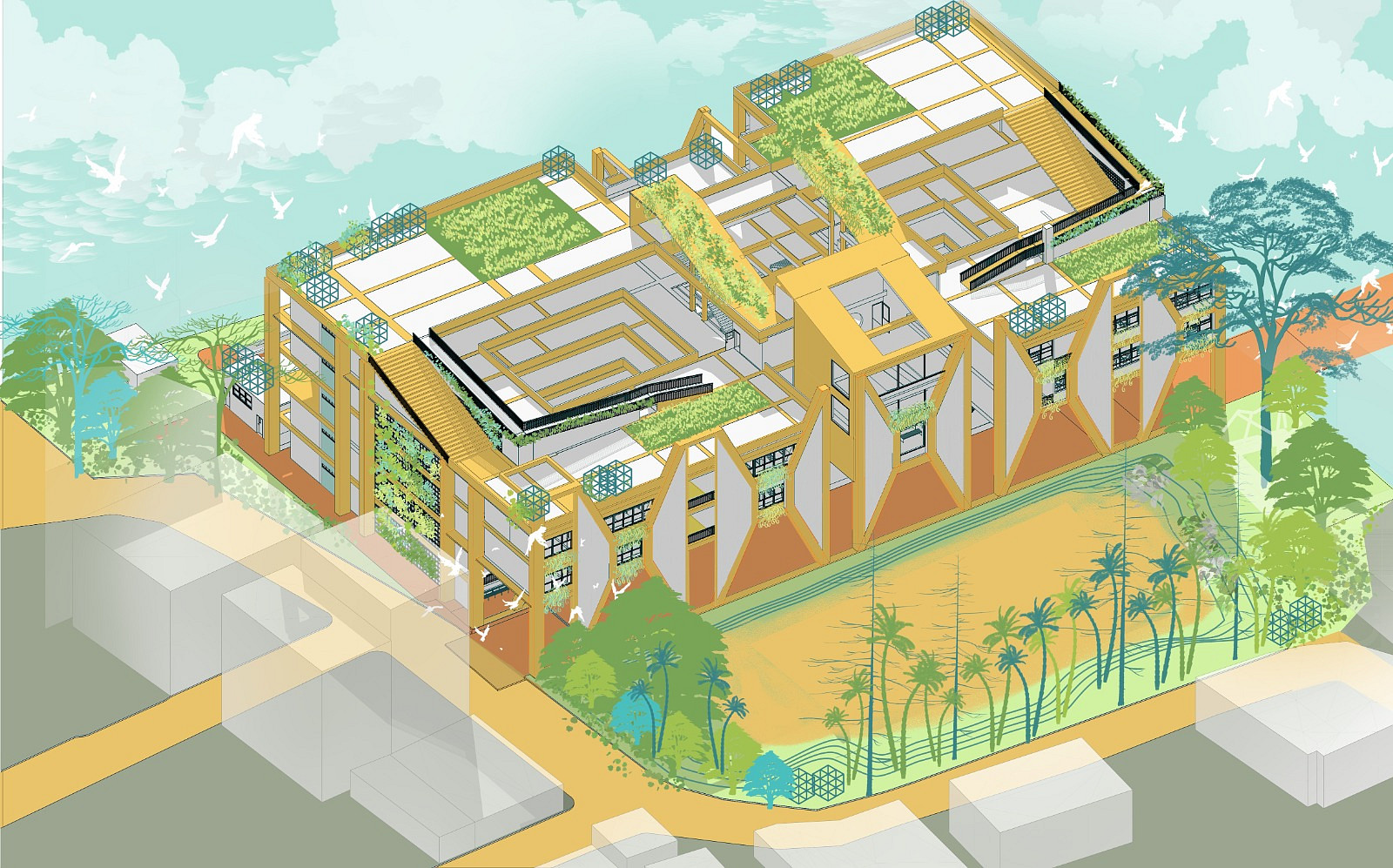
Fostering a strong sense of community was a key intention of the design. To do so, the pathways were connected via a public arcade that creates an urban corridor, strengthening the connection between the students, the community, and the school. Another design decision was to allocate at least half the land to open Space, given the significant lack and strong demand for it in the area, according to the master plan and workshop. Form generation came from organizing the accounted volume of necessary spaces deduced from the study and analysis part of the project, and stacking them. There were breaks in the mass created to make the scale more child-friendly. The remaining masses were placed strategically to maximize space efficiency within the given context while adhering to the design principles under study. Other than that, the landscape considerations are based on native plants and their blooming seasons to ensure that some fruit or flowering plants will be present throughout the year, as IDP children who migrate to urban areas often feel a lack of connection with nature after migration.
We can see two configurations for the ground-floor plinth space: either a combined or a separate lobby, depending on the need. The central Space is a shared common space that,t in non-schooling hours, can be used by the community. Two kinds of slopes surround the field/detention pond. The slope along the school is milder while the one across is steeper. The field will act as a sponge on rainy days because it is a detention pond.
The first floor gives access to subject-themed spaces. Each Space has a mezzanine floor, and the art-themed spaces have a sunken floor as well, to create diverse spaces. The first floor is also connected to the back of the school with a green walkway. The second floor primarily acts as a breakout space for the students. It consists of playful and green spaces. The third floor has access to the library and a visual connection to the student peer lounge, which has a direct view of the field. The Fourth Floor has greens starting in the northern part. The south and north parts are connected through a green walkway on the roof. It also has some adjustable small-scale installations.
Small-scale installations are present in the school and throughout the community to foster stronger community connection and involvement. These simple skeletal structures are intended to serve as the basis for adjustable designs created by the children and the community.
Each classroom has approximately. 30% of the Space is available in the current configuration. The facade walls can be adjusted for different kinds of screening. As part of the design-centric mindset, certain aspects of the design are left to the school's primary stakeholders to decide.
Technical information
The construction of the building is primarily in RCC, with small-scale adaptable installations in steel frames.
Documentation
Created in:


Copyright © 2026 INSPIRELI | All rights reserved. Use of this website signifies your agreement to the Terms of Use, Privacy Policy, and use of cookies.
