Community Center in Senegal


Project idea
1. Urban Concept
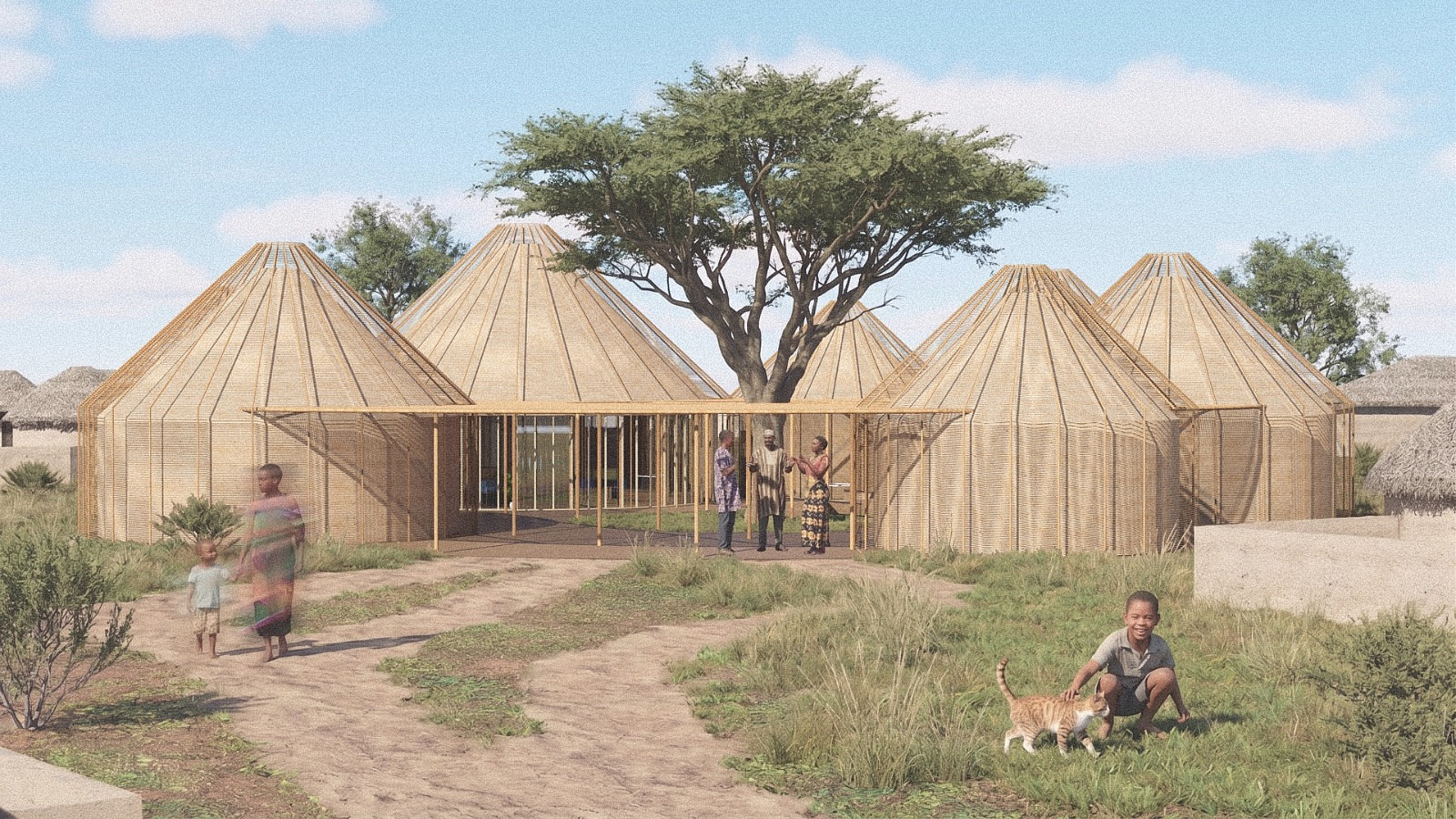
The urban design is based on a thorough analysis of the settlement structure in the Casamance region. This region, characterized by the presence of forests and fertile soil, is typified by a dense network of small villages and settlements interconnected by a network of winding, well-trodden paths. The built-up area of the villages itself is fragmented into courtyards bounded by earthen walls. Families live in these courtyards in multiple circular or orthogonal structures, with the centerpiece of each courtyard being a tree providing shade and a private dug well. The design of the community center transfers this proven principle from the micro-scale of the family courtyard to the macro-scale of the entire village. The building is situated directly in the center of gravity of the village, with the existing network of communication paths smoothly flowing into its spaces. The main urban and community focal point of the design is the integration of the existing tree directly into the structure of the center. The tree acts here as a natural shade generator and a traditional meeting place, thereby blurring the boundary between customary practices from family courtyards and the new public space.
2. Architectural Concept
The architectural expression of the building is a tribute to the local heritage, directly inspired by the traditional archetype of the Senegalese hut with a circular floor plan and a conical roof. However, the goal of the design was not just to mechanically copy this archetype, but to elevate and strengthen the architectural value that these communities have built over generations. The morphology and structure of the building respond to the harsh climatic conditions with an innovative approach in the form of using a double-skin construction. The outer, partially transparent skin made of woven bamboo fulfills not only a shading and windbreak function but also creates a strong visual effect. Thanks to the continuous play of light and shadow generated by the perforated facade, the building gives the impression of constant movement. This dynamic is the overarching metaphor of the entire concept, through which I wanted to point out that even third-world communities are – although perhaps on a smaller scale – in constant progress, movement, and development.
Project description
3. Spatial Layout
Due to the varying needs of individual villages and different spatial contexts, the layout is designed to be strictly modular and highly adaptable. The individual modules are interconnected by interior corridors and a central protected exterior space. The basic design of the community center consists of seven main rooms: a multifunctional community hall, a classroom, a library, public toilets, and a relaxation room. However, since village centers require flexibility, the design anticipates several floor plan alternatives.
The first is a transformation into an orphanage or social housing for the disadvantaged. This version includes accommodation units divided into two double or two single rooms, or specific accommodation units for children. The accommodation is complemented by shared sanitary facilities, a shared kitchen with a living room, a laundry room, a classroom, a common room, and a shared public space.
Another alternative is a marketplace, the central space of which is a large market hall with associated shaded outdoor areas, while the back-of-house facilities include a storage room, a cold room, public toilets, and a permanent shop.
The final considered option is a school, whose layout is rationally divided into a block of classrooms, sanitary facilities, a larger lecture room, and a central assembly hall.
Technical information
4. Construction and Material Solution
Local Materials & Innovation: The design strictly utilizes locally available materials (wooden logs, clay, bamboo, and thatch) modified with simple technologies for enhanced longevity and durability. The main load-bearing structure is a wooden skeleton anchored to the foundations, with infill structures composed of wattle plastered with clay.
Stabilized Clay Core: To increase load-bearing capacity and durability, the clay is stabilized with lime and cement. A major innovation is the surface treatment: the clay surfaces, including the roof planes, are impregnated with a hydrophobic silicate coating. This transforms the traditional clay into a final, rain-resistant surface, ensuring monsoon rains do not pose a threat to the structure.
Double-Skin Facade for Climate Control: The building features a double-skin wall system tailored to the extreme Casamance climate (intense dry heat and heavy monsoons). An outer mesh of flexible bamboo shoots is attached to the inner earthen core using steel anchors. The resulting gap creates a naturally ventilated facade that effectively dissipates accumulated heat, breaks hot winds, and protects the clay core from direct solar radiation.
Canopy & Interior Ventilation: Central public spaces and gathering areas are additionally protected by an overarching lightweight circular structure. This canopy not only provides shade but also physically and visually unifies all components of the community center into a cohesive whole. Inside the buildings, air entering through openings naturally ventilates the space via the stack effect through a roof opening.
Flood Protection: The entire center, including adjacent exterior areas, is strategically elevated 150 mm above the surrounding terrain to safely protect the buildings from water ingress during monsoon flooding.
5. Water Management and Sanitation
Rainwater Infiltration: A 300 mm deep gravel drainage layer is installed directly below ground level beneath the entire building footprint. This system acts as a large infiltration gallery. During torrential rains, water is captured, evenly distributed, and allowed to percolate naturally into the subsoil. This completely eliminates the need for complex external drainage to distant collection points and actively supports local groundwater retention.
Water Supply: The center is designed to connect to an excavated well—a standard practice in the region—serving as the primary source of potable water. The water is pumped, either manually or using a simple motor, into an elevated tank. From there, it is distributed to the sanitary facilities via a natural gravity-fed system.
Waste Water Recycling: The plumbing system separates wastewater for sustainable reuse. Greywater from washbasins is diverted into a dedicated retention tank and repurposed for landscape irrigation. Meanwhile, blackwater is stored in a separate holding tank to be utilized as fertilizer for the surrounding agricultural land.
Documentation

Copyright © 2026 INSPIRELI | All rights reserved. Use of this website signifies your agreement to the Terms of Use, Privacy Policy, and use of cookies.
