Belgrade Waterfront


Project idea
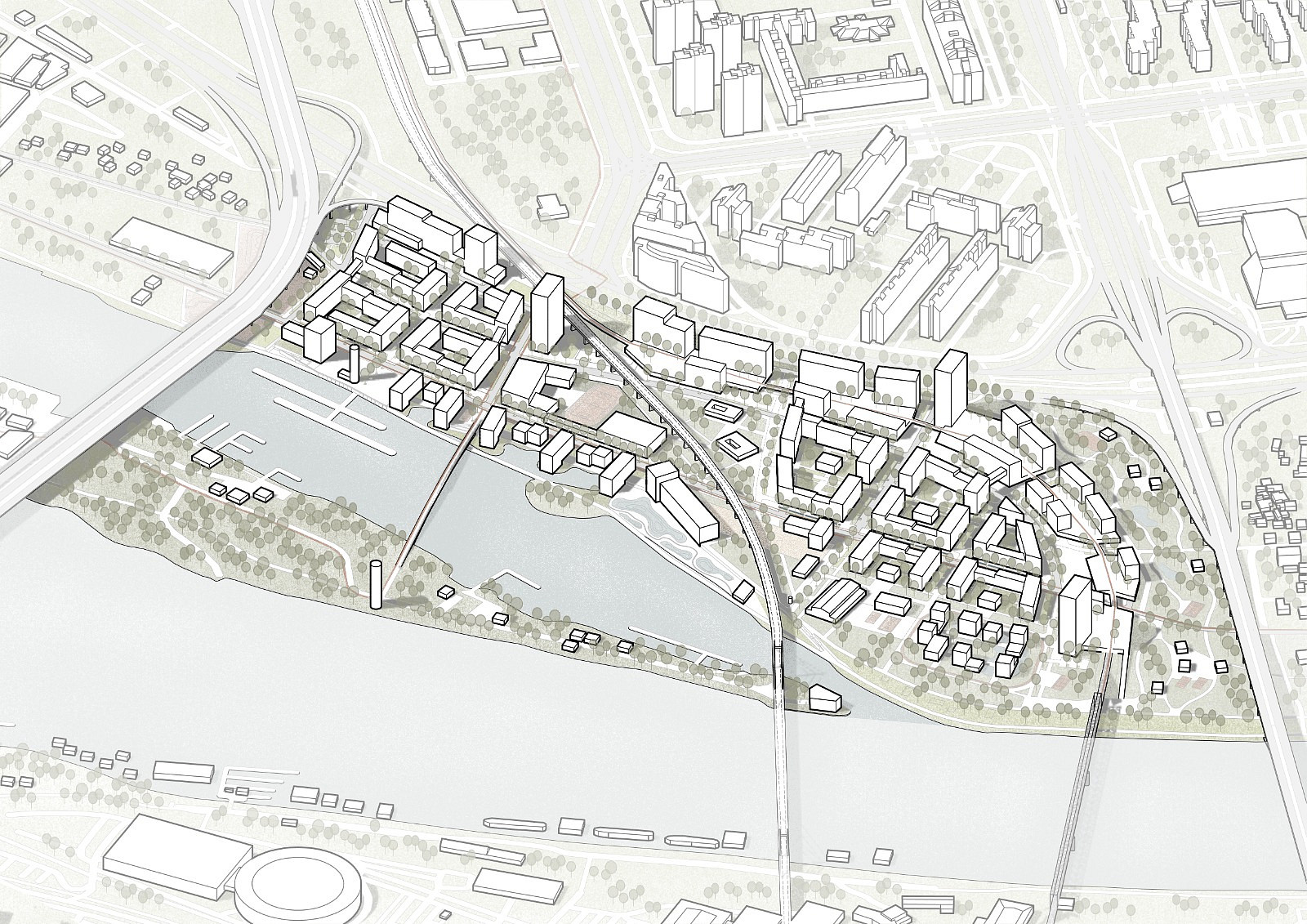
The project area is the site of a former cement plant, located in contact with four distinctly different spatial and functional contexts. These contexts differ not only in their use but also in scale, character of development, and social significance. The southern boundary is formed by the banks of the Sava River, the eastern side features low-rise family houses, the northern boundary is defined by an earthen mound with a former railway line separating it from brutalist high-rise blocks, and the western boundary is separated by a bridge from the rest of the industrial zone. In a broader context, the confluence of the Sava and Danube rivers and the historical center of Belgrade are in relative proximity, further increasing the strategic importance of the site. As stated in the social analysis of Serbia from the Project Portfolio, Balkan society has long faced internal contradictions, including tensions from ethnic and social diversity, a complex political situation, and historical traumas. The urban design does not aim to solve these problems directly, but to respond to them indirectly by creating an environment that supports a sense of security, stability, and opportunities for a free life within the community. The fundamental premise is the awareness of the diversity of people; a high-quality residential environment should enable the creation of a relationship with the place and motivate residents to actively participate in community life.
Project description
The design integrates all spatial, functional, and scale layers of the territory into a legible and cohesive urban whole. The social concept builds upon the mass-spatial concept by connecting zones with different scales and characters, while also striving to connect diverse groups of users. The response to this diversity is a wide range of functions, from basic civic amenities (schools, shops, administration, health centers) to facilities with a strong social dimension (social housing, a social center, or a mental health center). These functions are distributed in a hierarchy of spaces—private inner courtyards provide peace, semi-public spaces support smaller communities, and public spaces act as an open platform for urban life. The waterfront promenade is conceived as a continuous public space transforming from a park character to an active urban bathing area directly linked to a square. Supplementing the promenade with simple wooden platforms creates space for relaxation, and towards the west, it occasionally forms into a compact edge with a marina and supplementary functions. The system connects smaller squares supporting local community centers and culminates in sports and recreational areas under the bridge, integrating previously neglected areas into the new public space network.
Technical information
The mass-spatial concept is based on a balanced response to different conditions, taking relevant characteristics from each context. The earthen mound, previously a carrier for the elevated railway, is reinterpreted as a multifunctional space designed for large-capacity parking. This creates a prerequisite for limiting car traffic in the area and supporting pedestrian and cycling mobility, while functioning as a transition zone where development gradually decreases in height. The height regulation of the development is conceived as a continuous gradient from north to south, gradually approaching the water level of the river and the tree crowns. The preserved railway bridge in the center is surrounded by a protective buffer zone of greenery which is respected and further developed. The proportional and typological design responds to the block structure in the north and the scale of family houses in the east-west direction, where buildings take on a pavilion character often integrating temporary accommodation. Furthermore, the western industrial zone is projected into the area through transformed hall volumes, which find new technical applications mainly in the form of sports facilities and primary and secondary school buildings.
Documentation

Copyright © 2026 INSPIRELI | All rights reserved. Use of this website signifies your agreement to the Terms of Use, Privacy Policy, and use of cookies.