CRISIS ARCHITECTURE - PLANNING FOR THE UNEXPECTED


Project idea
The Architecture at Zero 2026 competition program - and university course - is to design a year-round educational and cultural venue (La Plaza) that will transform into a resiliency asset during regional emergencies (Emergency Operations Center), offering critical support for first responders and multi-agency emergency operations. The vision for the project is bold: it invites designers to envision more than just a single-use structure; it is an opportunity to design a space with dual purpose and profound impact.
In daily life and milestone events, the building will serve as a versatile community facility, adaptable to multiple social and educational uses. La Plaza, the subject of this competition, will be a two-story, 10,000 sq ft building that will host lectures, community events, performances, and exhibitions. With interactive programming, cultural events, and educational exhibits, La Plaza will integrate both cultural and resiliency goals to create a multifunctional space that is both forward-thinking and community-centered.
In times of crisis, the building will undergo a dramatic transformation, becoming a command post — a vital hub for emergency management and coordination. During an emergency, this building will be used by first responders. Adjacent to the building, first responders and/or evacuees will find respite from the intensity and stress of the emergency.
The challenge is to create a design that is both functional and inspiring, balancing utility with architectural vision, thereby creating a cultural landmark that serves the community at its best moments and sustains it in its most critical times.
Project description
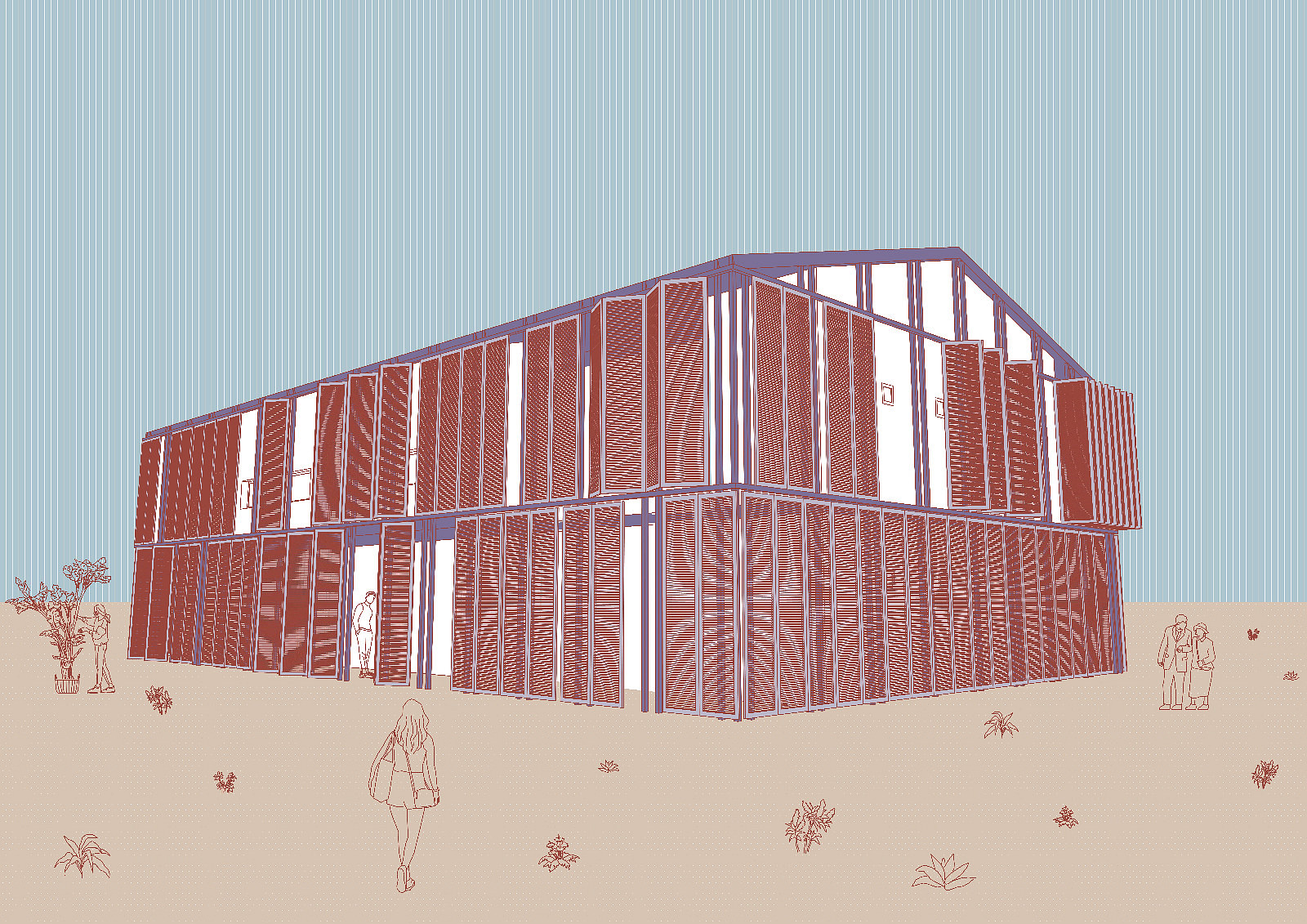
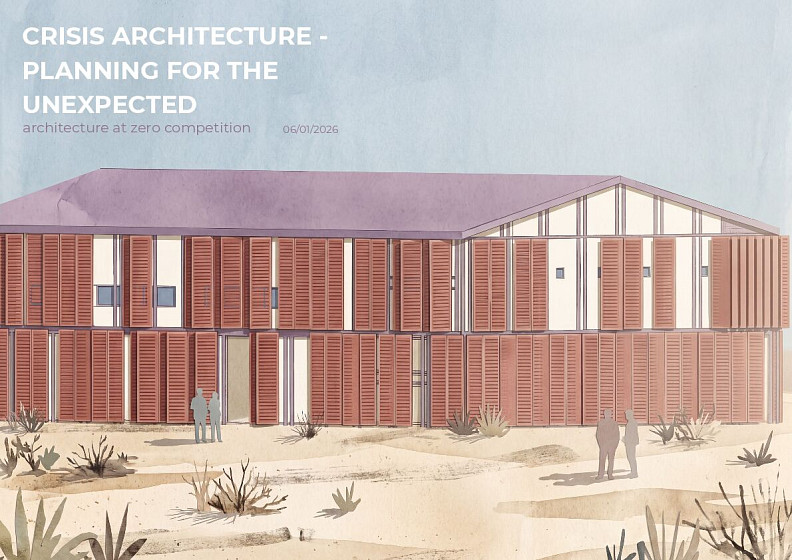
La Plaza is conceived as a culturally vibrant civic hub that transforms seamlessly into a community refuge during crises. At its heart lies a generous central space — a flexible public “living room” where daily cultural life unfolds and where, in emergencies, the community can gather, coordinate, and find safety.
The extreme desert climate of Antelope Valley shapes the architecture. A high‐performance envelope, exterior movable shading system, and thermal‐mass buffering minimize heat gain and stabilize indoor temperatures, reducing reliance on
mechanical cooling. Mixed‐mode ventilation supports natural airflow during mild seasons, while a filtered closed‐loop mode protects occupants during wildfire smoke events.
Fully electric VRF and DOAS systems, supported by on‐site solar generation and battery storage, ensure low‐carbon operation and maintain critical functions during outages. The building connects to a resilient microgrid capable of islanded operation,
enabling uninterrupted use of communication rooms, cooling‐refuge zones, and medical support spaces.
Landscape‐integrated solar canopies, drought‐tolerant planting, graywater reuse, and condensate recovery reduce water demand while creating shaded microclimates for outdoor gathering. These environmental systems work together to make La Plaza both energy‐efficient and climate‐adaptive, serving the community every day and sustaining it during regional disruptions.
Our design process approached equity not as a separate requirement, but as a fundamental architectural framework shaping how the building serves the community during both everyday use and emergency conditions.
Research into Antelope Valley revealed overlapping environmental and social vulnerabilities, including extreme heat, water scarcity, air quality concerns, and unequal access to cooling, shelter, transportation, and public resources. These challenges disproportionately affect vulnerable populations including children, older adults, outdoor workers, unhoused individuals, and historically marginalized communities.
In response, La Plaza was designed as an inclusive civic “living room” that supports cultural identity, environmental comfort, and community resilience simultaneously. Flexible public gathering spaces accommodate cultural events, educational programs, performances, and multigenerational activities throughout the year while remaining capable of rapid transformation into emergency coordination and refuge spaces during disasters.
The project prioritizes thermal comfort, shaded outdoor environments, universal accessibility, clean indoor air, and reliable access to energy and communication systems during outages. Landscape and water systems create cooler microclimates and welcoming public areas that remain usable despite extreme desert conditions.
Rather than designing a building that only performs during emergencies, the proposal creates a resilient public infrastructure that strengthens community life every day. Equity, in this project, means ensuring that safety, comfort, cultural representation, and environmental resilience are accessible to all members of the community regardless of age, income, or circumstance.
Technical information
The mechanical strategy for La Plaza is designed as a resilient all-electric environmental system capable of supporting both daily cultural programming and emergency operations during regional crises. The design responds directly to the extreme desert climate of Antelope Valley, where high daytime temperatures, cold winter nights, strong winds, and prolonged power disruptions create significant
operational challenges.
The project combines passive environmental control with high-efficiency active systems to reduce operational carbon while ensuring thermal survivability during emergencies. The building envelope minimizes heat gain through exterior shading, high-performance insulation, low solar heat gain glazing, and controlled daylight penetration. Thermal mass and night-flush ventilation strategies stabilize indoor
temperatures and reduce peak cooling loads.
Conditioning is provided through a variable refrigerant flow (VRF) heat pump system paired with dedicated outdoor air systems (DOAS) incorporating energy recovery ventilation. This approach allows individual zones to operate independently during fluctuating occupancy conditions while maintaining high indoor air quality during wildfire smoke events and emergency occupation periods.
The building operates as a mixed-mode system during shoulder seasons, enabling natural cross ventilation through operable openings. During emergencies or poor air quality conditions, the building transitions into a filtered closed-loop operating mode to maintain occupant safety and operational continuity.
Mechanical systems are fully electrified and supported by on-site renewable energy generation (solar panels) and battery storage. Critical systems, including communications rooms, emergency coordination spaces, medical support areas, and cooling refuge zones, are connected to a resilient microgrid capable of islanded operation during utility outages.
Water-efficient systems reduce dependence on municipal infrastructure through low-flow fixtures, drought-adapted landscaping, condensate recovery, and graywater reuse strategies. Together, these systems create a low-carbon, adaptable, and climate-responsive building capable of serving the community during both everyday use and emergency conditions.
The project responds to the primary climate risks facing Antelope Valley through a layered resilience framework integrating passive survivability, environmental buffering, operational redundancy, and community support infrastructure.
Extreme heat adaptation strategies include shaded outdoor circulation, high-performance envelope systems, thermal mass, passive cooling, cooling refuge zones, and drought-adapted landscape systems. Wildfire smoke resilience is supported through filtered ventilation modes and compartmentalized indoor air management systems.
Water scarcity adaptation includes graywater reuse, condensate recovery, drought-tolerant planting, and reduced potable water demand. Wind mitigation strategies shape landscape buffers and protected outdoor gathering spaces to improve comfort and safety during high desert wind events.
Emergency preparedness is reinforced through battery-backed microgrid infrastructure, resilient communication systems, flexible interior programming, and dual-use operational planning. The building is capable of transitioning rapidly from civic cultural use into emergency coordination mode while maintaining essential functions during infrastructure disruptions.
The resulting adaptation framework positions La Plaza as both a cultural destination and a long-term climate resilience asset for the Antelope Valley community.
Documentation
Created in:


Copyright © 2026 INSPIRELI | All rights reserved. Use of this website signifies your agreement to the Terms of Use, Privacy Policy, and use of cookies.