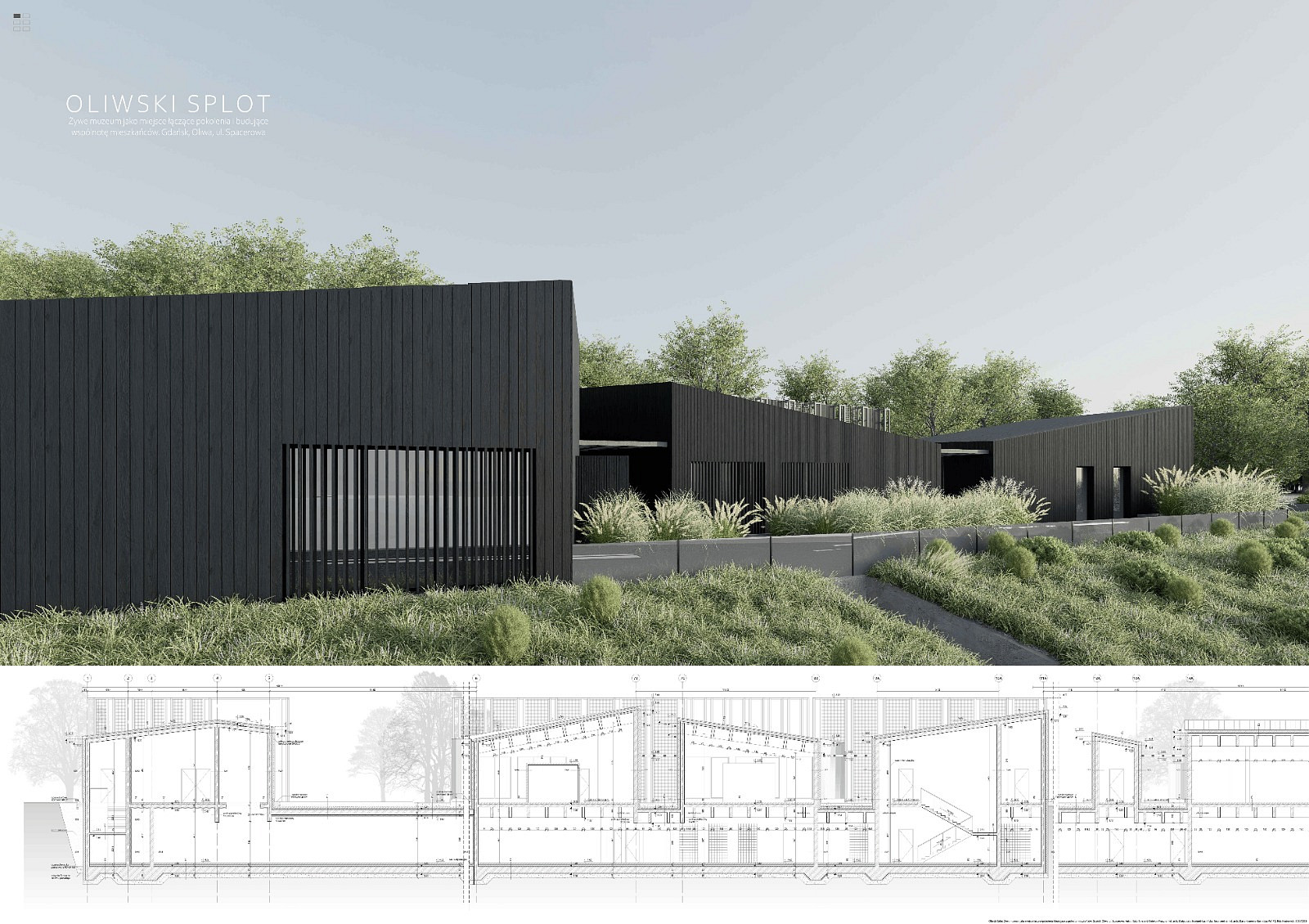
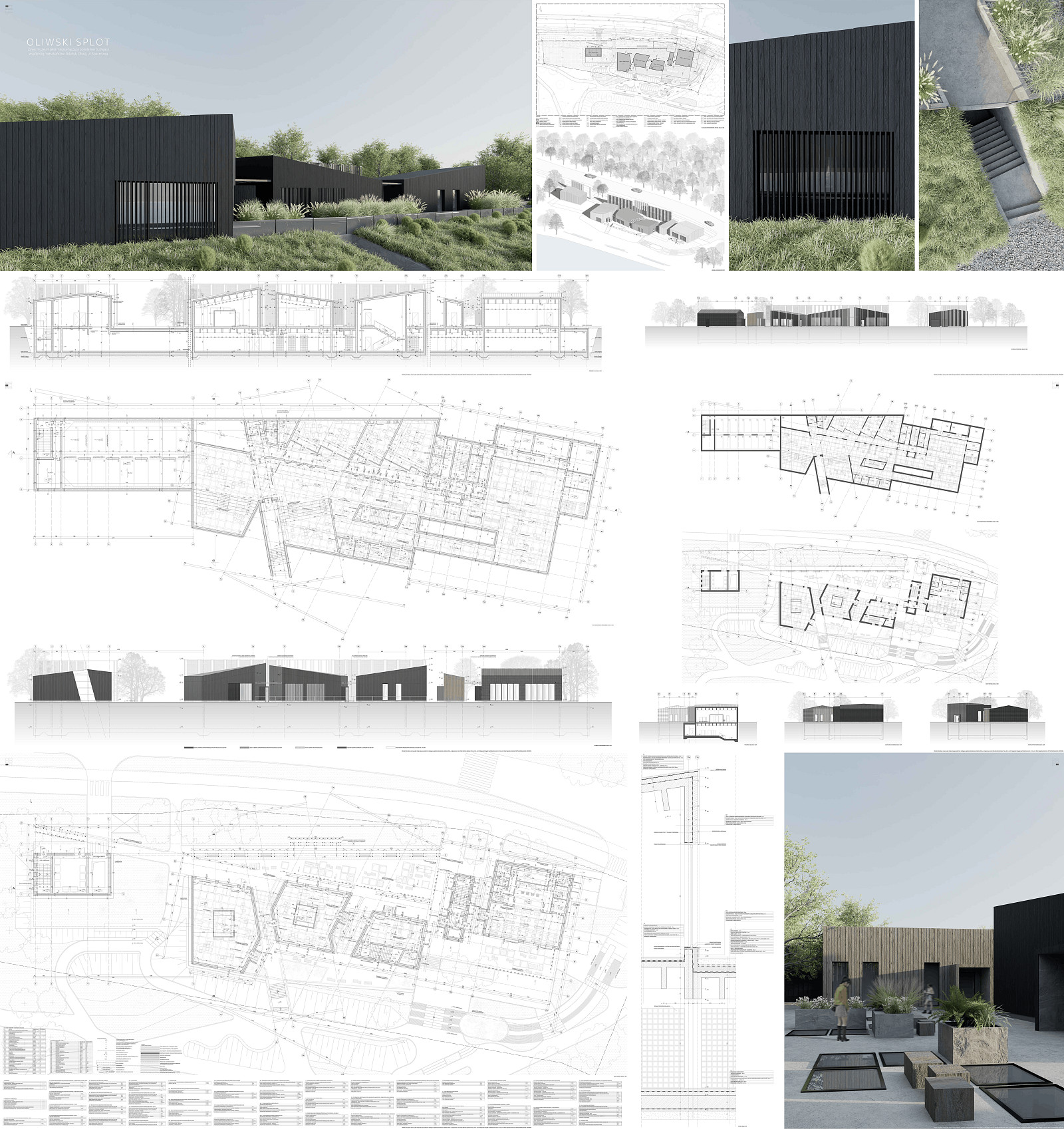
Oliwski Splot. A living museum as a place that connects generations and builds a community of residents. Gdansk, Oliwa, Spacerow


Project idea
The aim of the project is to create a space that responds to the needs of the residents of Gdańsk. It is dedicated to the issue of intergenerational relations, creating a place open to integration and social cooperation. It blurs ideological differences and allows for personal growth, establishing a point on the map where everyone has the opportunity to express themselves.
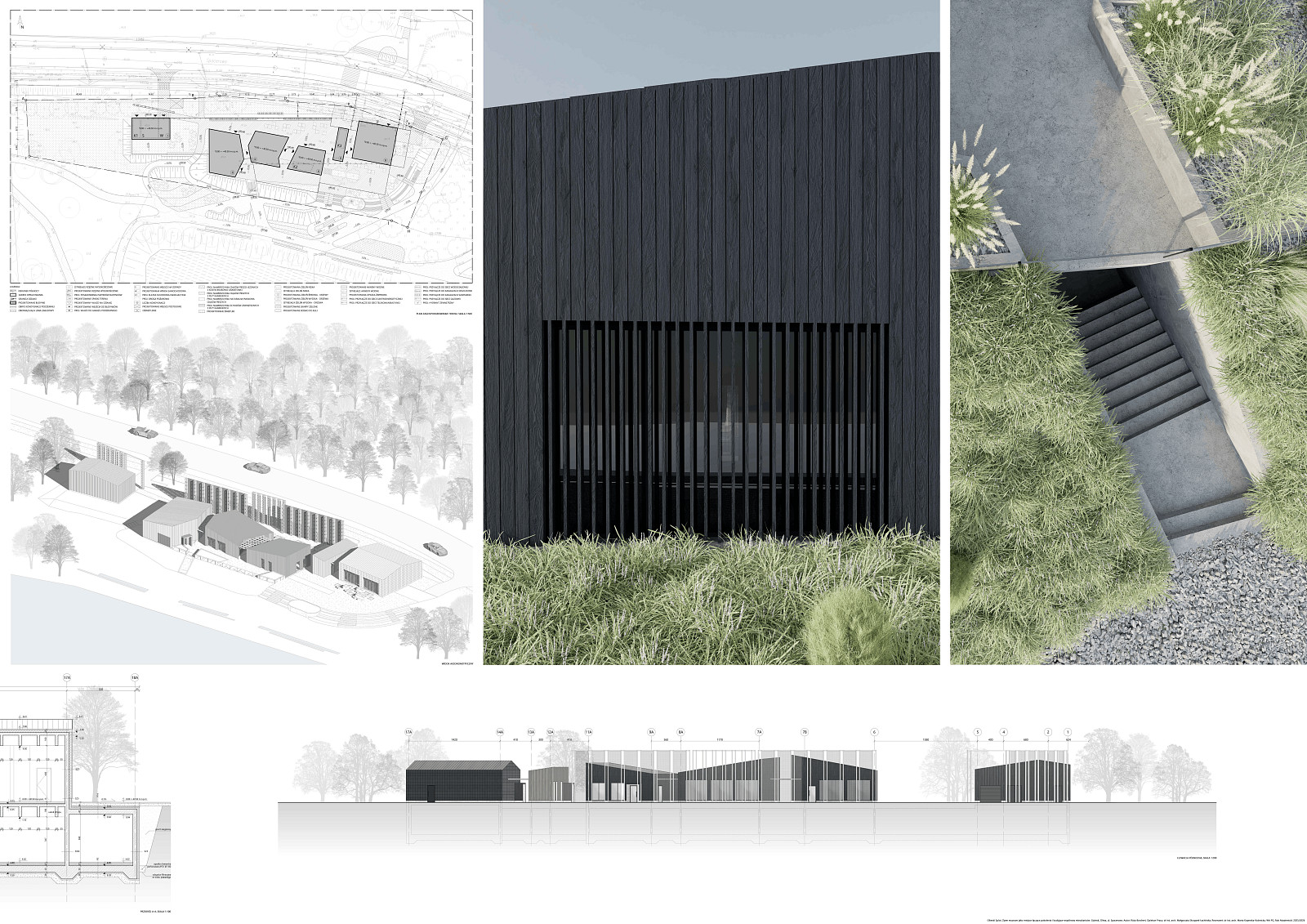
The design proposal is located in Gdańsk, in the historic district of Oliwa, on Spacerowa Street – an area surrounded by numerous green spaces and woodlands. This location has allowed the project to blend seamlessly into the surrounding nature and walking trails, utilizing them for recreational and scenic purposes. The natural slopes of the terrain enabled the development of cascading steps leading down to the Młyński Pond, creating effortless viewpoints overlooking the local landscape. This also served as the starting point for the form of the building, which is mostly situated underground, with its separate segments emerging at the surface to form irregular shapes that adapt to the ubiquitous greenery.
The district’s history has influenced the layout of the site, the built form, and the functional arrangement. The past of the site covered by the project inspired the creation of a symbolic curtain wall, which, through its positioning and scale, references a previously existing building. It acts as a partition that metaphorically separates the outside world from the world of the design, whilst simultaneously blending modern solutions with tradition. The incorporation of a gastronomic function along with terraced steps references a restaurant that used to exist here.
The entirety of the facility is intended for the residents of Oliwa, who can freely and fully utilise the offered museum spaces as spectators, as well as shape them independently. Open exhibition halls allow the interior of the building to be arranged in diverse ways, universally accessible workshop rooms provide a space for creative work, and access to multimedia equipment enables both educational classes and lectures.
Project description
The main objective of the urban planning concept is a symbiosis between the designed building and nature—ensuring minimal interference with the existing landscape. The leitmotif is to integrate the structure into the slope leading down to the water reservoir, maximizing the potential of the plot’s green areas. This is a key attempt to align with the most prominent features of the district, which is renowned for its approach to green spaces. Another theme is harmony and coherence, elements created by the uniform development of the immediate surroundings. In urban planning, these qualities can be achieved in many ways. Harmony is not defined by the architectural conformity of every object, but by their collective impact. When building coherent urban areas, it is crucial to focus on the perception of the whole, without neglecting distinctive elements that take on a representative form and become indispensable landmarks of the neighborhood. For this reason, in order to care for the image of the entire area, the scope of the project extends beyond the boundaries of the selected plot. Revitalizing a larger recreational area will strengthen the attractiveness of the Staw Młyński (Mill Pond) site, including the designed object itself. Given the plot's location at the entrance to the built-up area, the facility will serve as a focal point (landmark) that will refer to the key values of the district and invite visitors, not only to the building itself but primarily to explore the entire immediate surroundings. Due to its location along the street and its shape, the plot dictates an elongated structure aligned with the road, providing an extension of the existing compositional axis of buildings created along the course of existing streets.
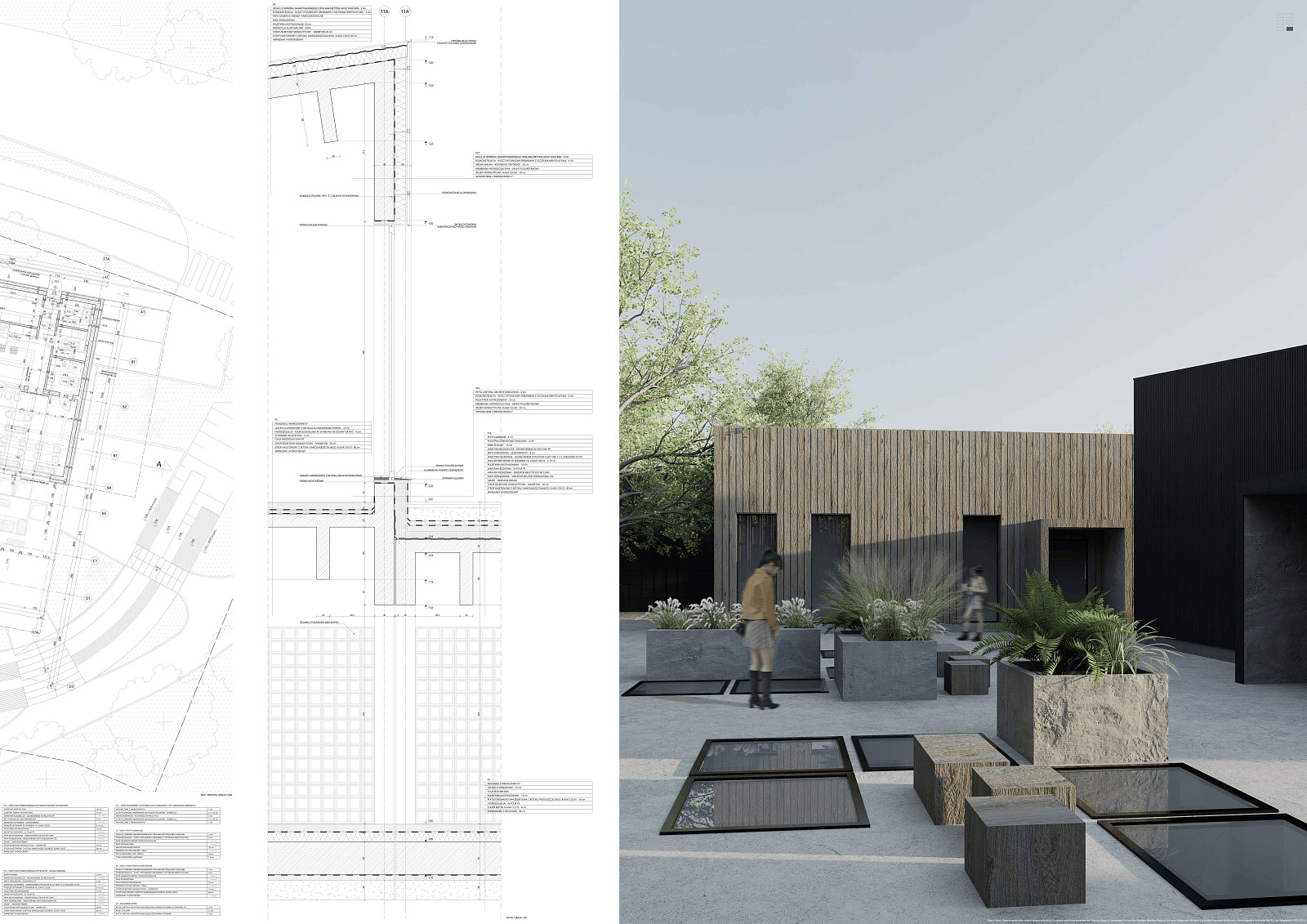
The design intention was to integrate as effectively as possible into the natural environment. Keeping the existing slopes in mind, the building has taken the form of a functional semi-subterranean structure, naturally fitting into the topography of the terrain and connected to ground-level facilities. The building’s walls are laid out in a dynamic manner, modulating the internal functional space and creating diverse public areas surrounding the object. The façade finish has become an attention-grabbing element due to its deep black charred wood. This deliberate treatment utilizes natural materials that blend into the forested areas while contrasting with the nearby buildings. Natural light within the space is provided by glazing in the façades and the flat roof, which open the facility to visitors. Following the district's hallmark—greenery—numerous new plantings have been introduced with attention to species diversity, while the valuable old-growth trees located on the plot have been preserved. The entire composition is enclosed by a cascade of stairs, which reference the historical layout of the Waldhäuschen hotel that previously occupied the site. Additionally, in correspondence with the former lodging site, a steel curtain wall covered with climbing vegetation has been installed on the grounds, serving a commemorative and educational function. This acts as a metaphorical detachment from the outside world, creating a peaceful enclave.
The functioning of the entire facility is tailored to the current needs of the residents. Providing a multifunctional space that changes its form in line with social concepts enables a wide range of activities and eliminates physical limitations to performing them. The rooms have been designed with the creativity of residents in mind; their sizes are diversified, and they are equipped with multimedia devices—the use of modern technology allows for rapid changes in scenery and constant variety within the space. The entire character of these places depends on the vision and usage style of the residents; therefore, by building a space adapted for easy modifications, each room can easily take on a new form appropriate to current needs. This was also taken into account in the permanent exhibitions, which can freely transform into places for meetings, debates, speeches, or educational activities.
The idea of public accessibility is demonstrated by the design of the ground floor and circulation spaces. Referring to the previously operating hotel and restaurant, a gastronomic space has been provided that opens up visually to the surrounding landscape and acts as a visual connection between visitors and nature. The communication system is routed through cores that sink into the ground and extends horizontally to the other side of the street, connecting with existing recreational paths of Pachołek. Equipped with elements facilitating relaxation, modern furniture, and architectural details referencing the surrounding areas, the facility allows visitors to treat this place as a zone for meetings and nature-art experiences.
Technical information
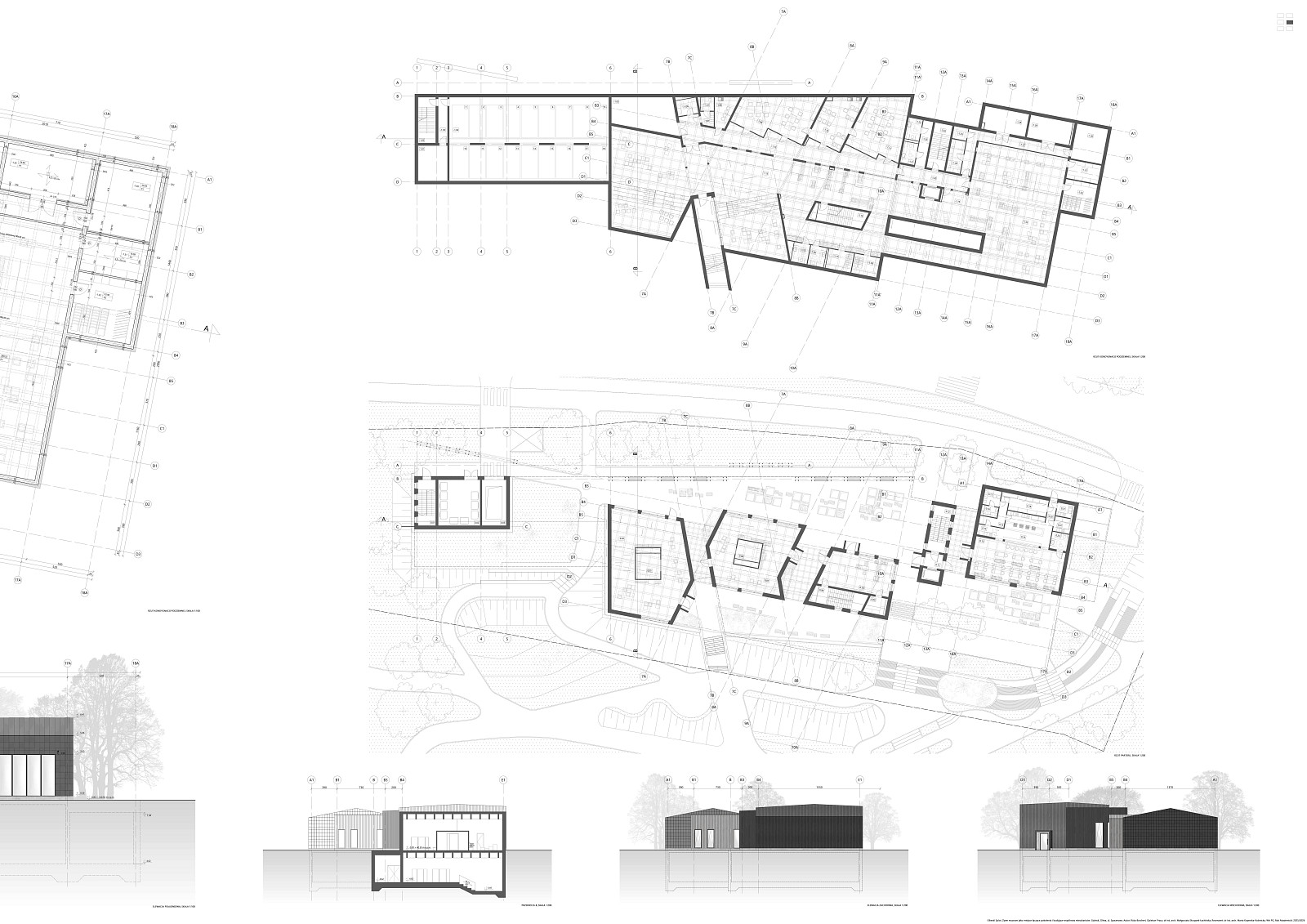
The main compositional premise of the designed museum and exhibition complex is to integrate the architectural structure with the historical and natural pedestrian-landscape trail running from Pachołek Hill towards the Mill Pond (Staw Młyński) in Gdańsk. The entire spatial layout has been designed so that the cultural facility does not act as an urban barrier, but rather becomes an active element and an extension of this topographical sequence. The building has been inscribed into the natural geometry of the slope, which allowed for the shaping of cascading descents.
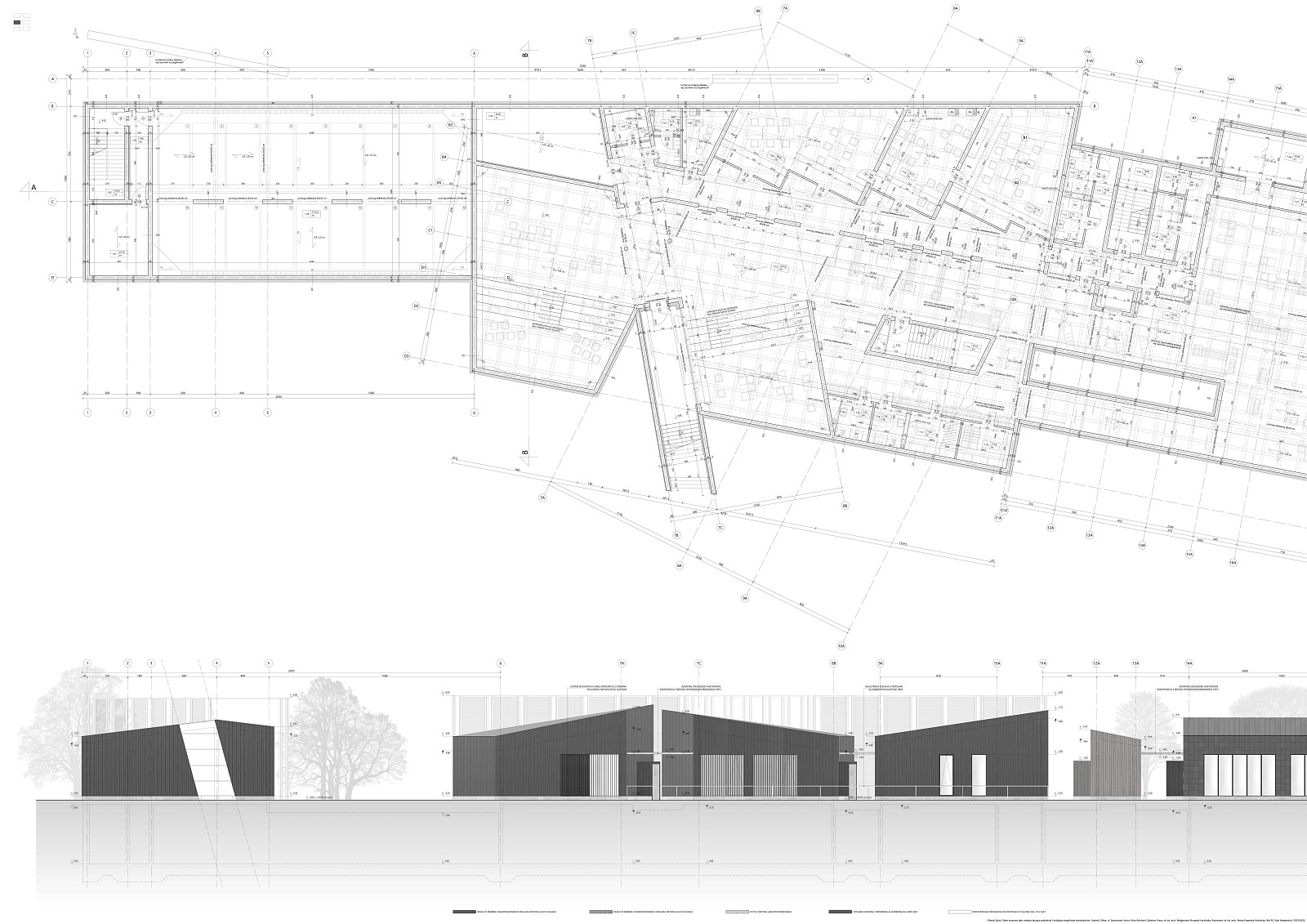
The main communication core of the entire facility, which aligns with the route of the pedestrian trail, has been inscribed directly into the key urban axis. This element serves as the functional backbone of the complex, connecting public space with the architectural interior. Part of this core is a freestanding staircase, integrated with a through-type elevator. It directs pedestrian traffic to the representative main lobby located entirely underground.
The main exhibition zone, laid out on the underground level, is based on the formula of an open and multifunctional space integrated with a complex of workshop rooms. The interior architecture enables the realization of diverse custom scenarios and allows for the fluid configuration of space to meet the specific requirements of individual exhibitions. The remainder of the underground level consists of technical rooms and an automated underground parking facility, equipped with a car lift, providing 18 parking spaces.
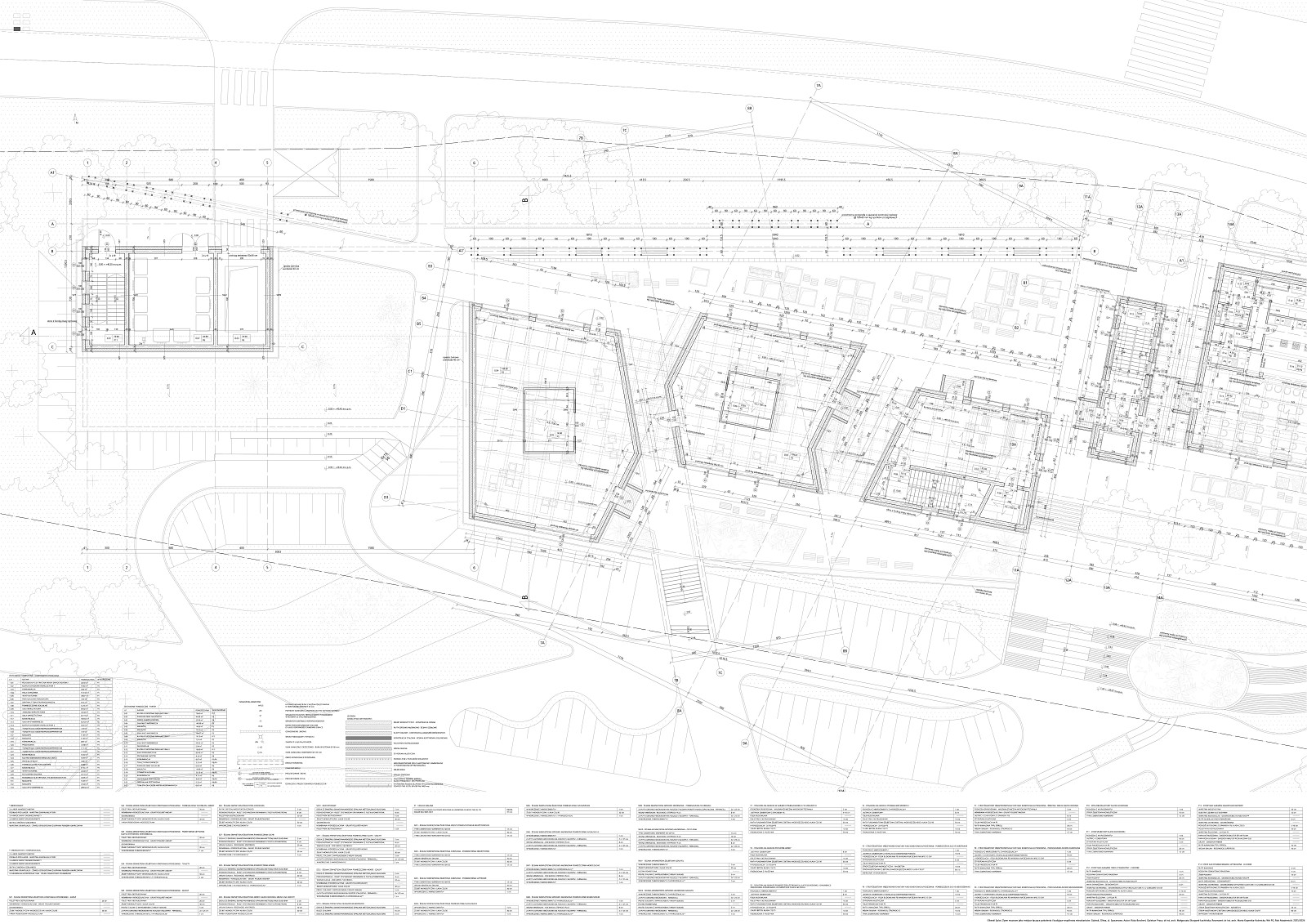
The above-ground part of the complex consists of six independent, single-story pavilions that act as an architectural continuation of the museum space and the surrounding pedestrian trail. The façades of the pavilions, finished in charred wood, contrast with the natural surroundings while simultaneously creating coherent landmarks along the pedestrian route. One of the structures serves a gastronomic function, housing a dining hall integrated with an independent kitchen facility that opens onto it. An integral element of the landscape development around the pavilions is the external glazing in the roof slab, made of high-strength tempered glass. These serve as skylights, providing views from the ground level into the depth of the underground floor and illuminating the exhibition and workshop halls with natural daylight.
The structural framework of the building has been designed in a uniform reinforced concrete system, utilizing advanced monolithic and prefabricated technologies. Both the entire underground level and the full above-ground structure of the facility are based on reinforced concrete, ensuring exceptional rigidity, durability, optimal load distribution, and compliance with all fire safety requirements as defined in the Technical Conditions.
In parts of the facility, in order to cover significant spans of halls and rooms, reinforced concrete waffle slabs (coffered slabs) have been employed. This system was chosen to optimize the structure—significantly reducing the dead weight of the horizontal partitions while maintaining high load-bearing capacity—and simultaneously serves as a key aesthetic element of the interiors, exposing the raw, structural nature of the ceilings. The load-bearing walls and structural columns were also executed using concrete technology, aligning them with the overall character of the complex.

Copyright © 2026 INSPIRELI | All rights reserved. Use of this website signifies your agreement to the Terms of Use, Privacy Policy, and use of cookies.