The Waking Sail


 Mohamed Noeman
Project idea
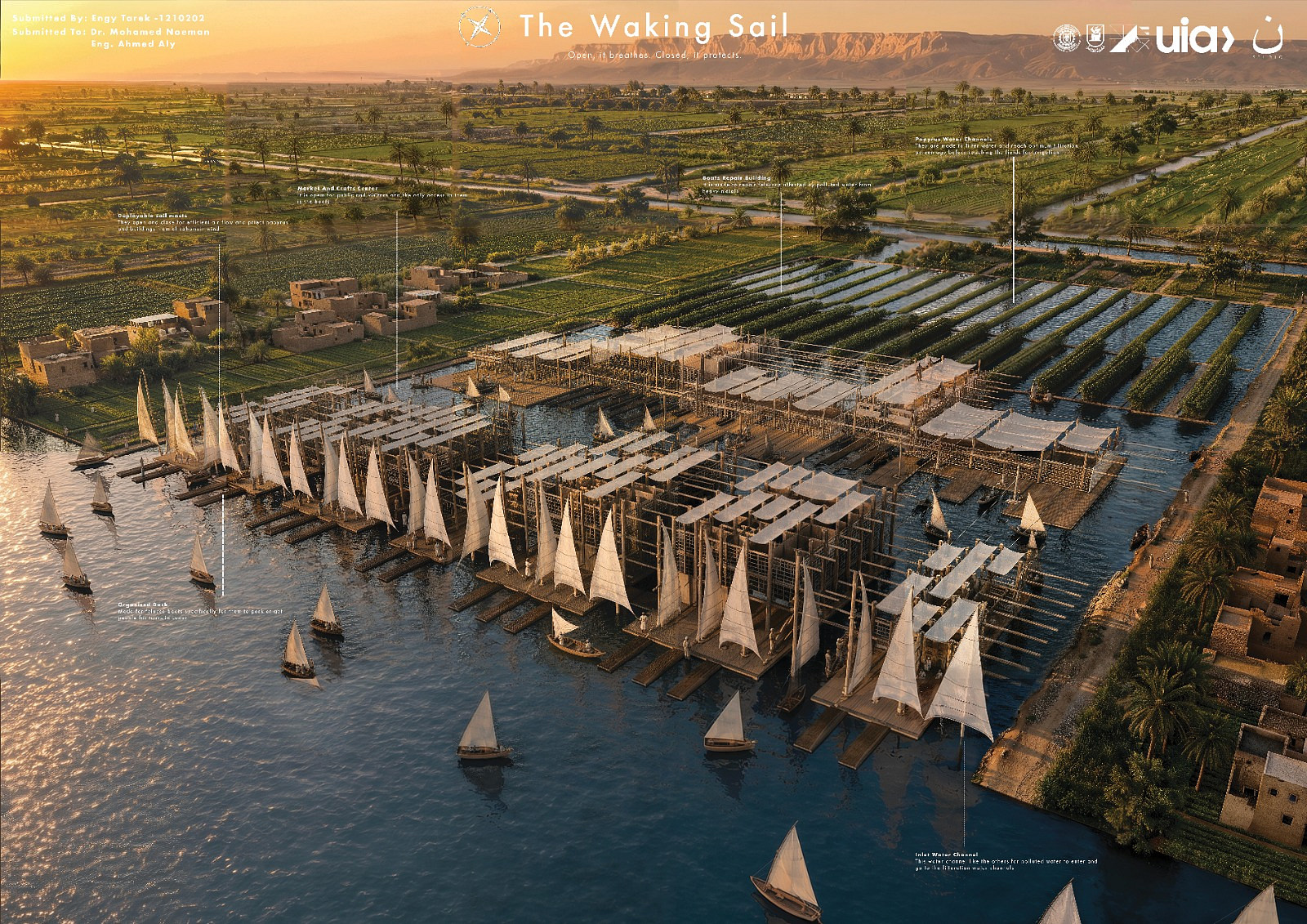
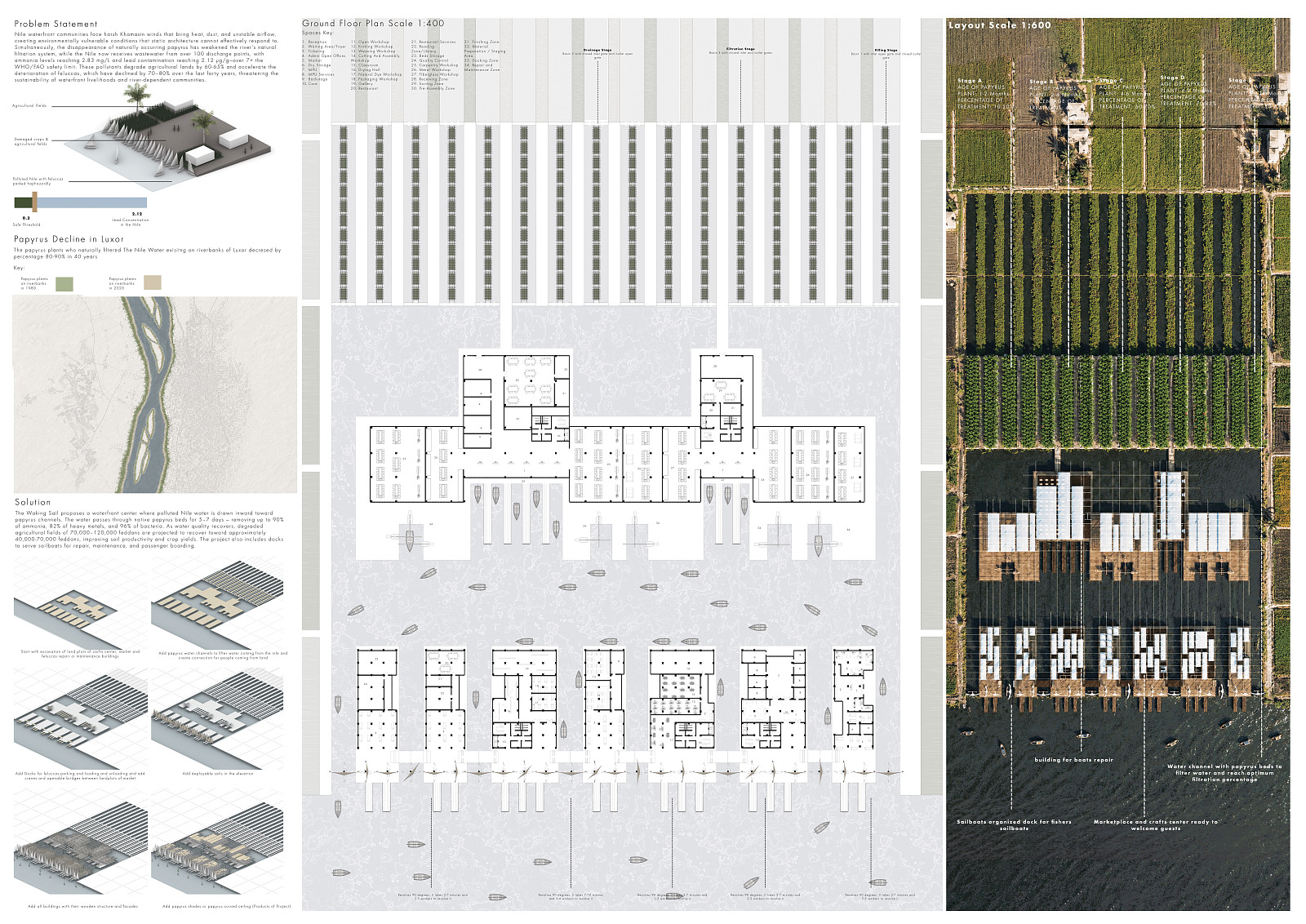
The project located in Luxor, Egypt responds to the ecological degradation of the Nile edge, the disappearance of papyrus wetlands, the increasing contamination of irrigation water, and the gradual decline of the traditional felucca craft industry.
Historically, papyrus grew extensively along the Nile banks, forming a natural filtration system that improved water quality, stabilized river edges, and supported local ecosystems. However, increasing environmental pressures, including climate change, rising temperatures, and recurrent khamsin winds, have contributed to the degradation and disappearance of large portions of these wetlands. As papyrus declined, the river lost an important ecological buffer capable of absorbing pollutants before they reached agricultural land.
In the existing condition, polluted Nile water carrying ammonia, heavy metals, and other contaminants is transferred directly into irrigation networks serving nearby agricultural fields. This has resulted in declining environmental quality and increasing ecological pressure on productive farmland. At the same time, the traditional wooden felucca industry has experienced a significant decline due to the lack of organized repair facilities, working docks, and spaces dedicated to preserving the craft and knowledge associated with Nile navigation.
The project proposes an integrated system that reconnects ecological restoration with local productive traditions. Instead of treating water pollution, agricultural decline, and the disappearance of felucca culture as separate problems, the project addresses them through a single architectural intervention.
The main idea is to reintroduce papyrus as a living water-treatment landscape while simultaneously reviving the felucca repair and sail-making industries that historically formed part of the Nile economy. Polluted water is directed through a controlled papyrus treatment system before entering the agricultural fields, reducing contaminants and restoring part of the river's natural filtration capacity.
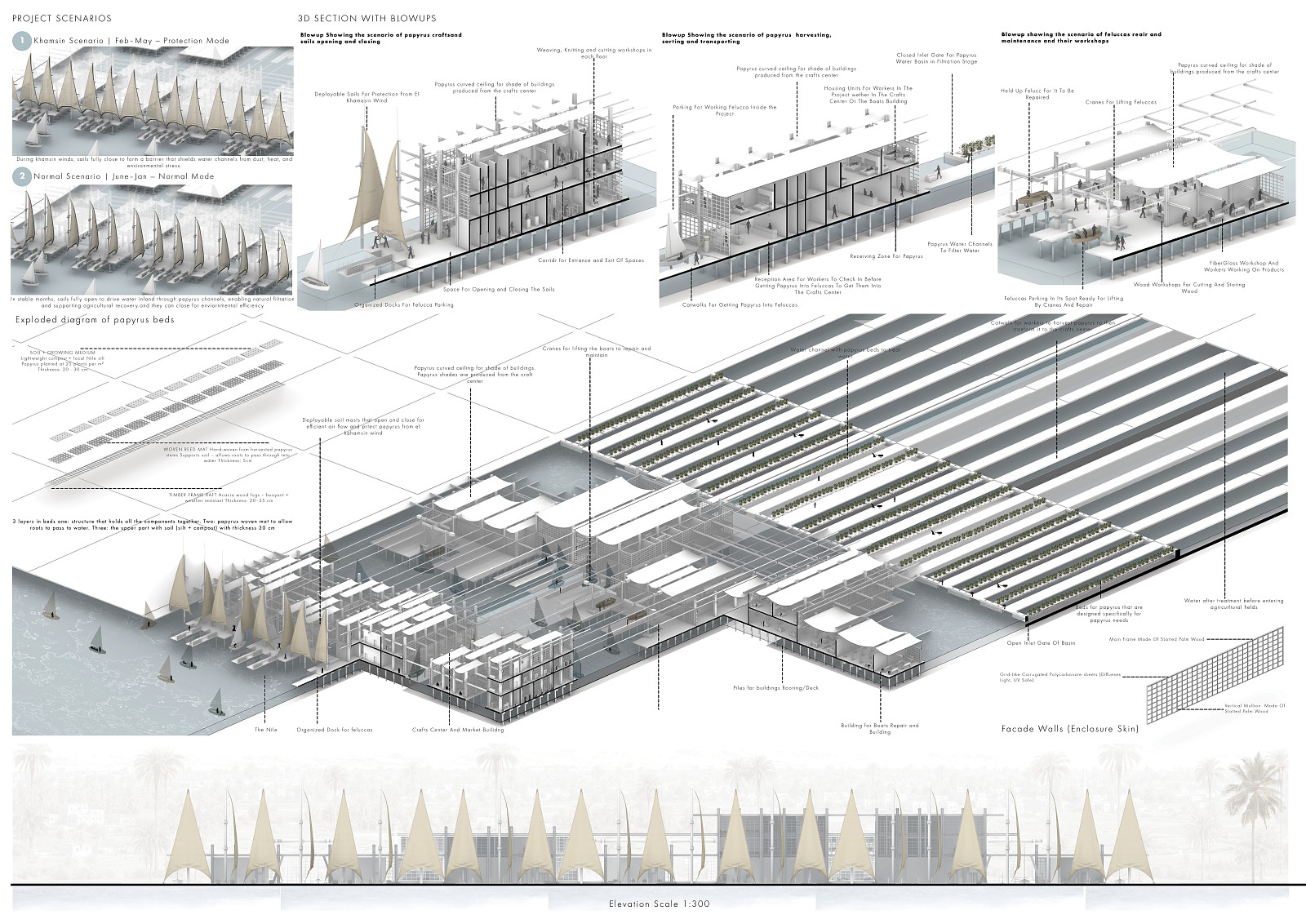
The architectural concept is derived from the felucca sail. The sail is transformed into an environmental device that regulates airflow, controls water movement, creates shaded working spaces, and protects the papyrus wetlands from khamsin winds and seasonal environmental stress. The same craft knowledge traditionally used to build and operate Nile sails becomes the mechanism through which the landscape is restored and protected.
The project is not only a water treatment facility and not only a boat repair center. It is a productive ecological infrastructure that combines environmental remediation, agricultural support, craft preservation, and community activity within a single integrated system.
By restoring papyrus wetlands, improving irrigation water quality, and providing the first organized repair and maintenance facility for feluccas in Luxor, the project establishes a new relationship between the river, the agricultural landscape, and the communities that depend upon both.
Project description
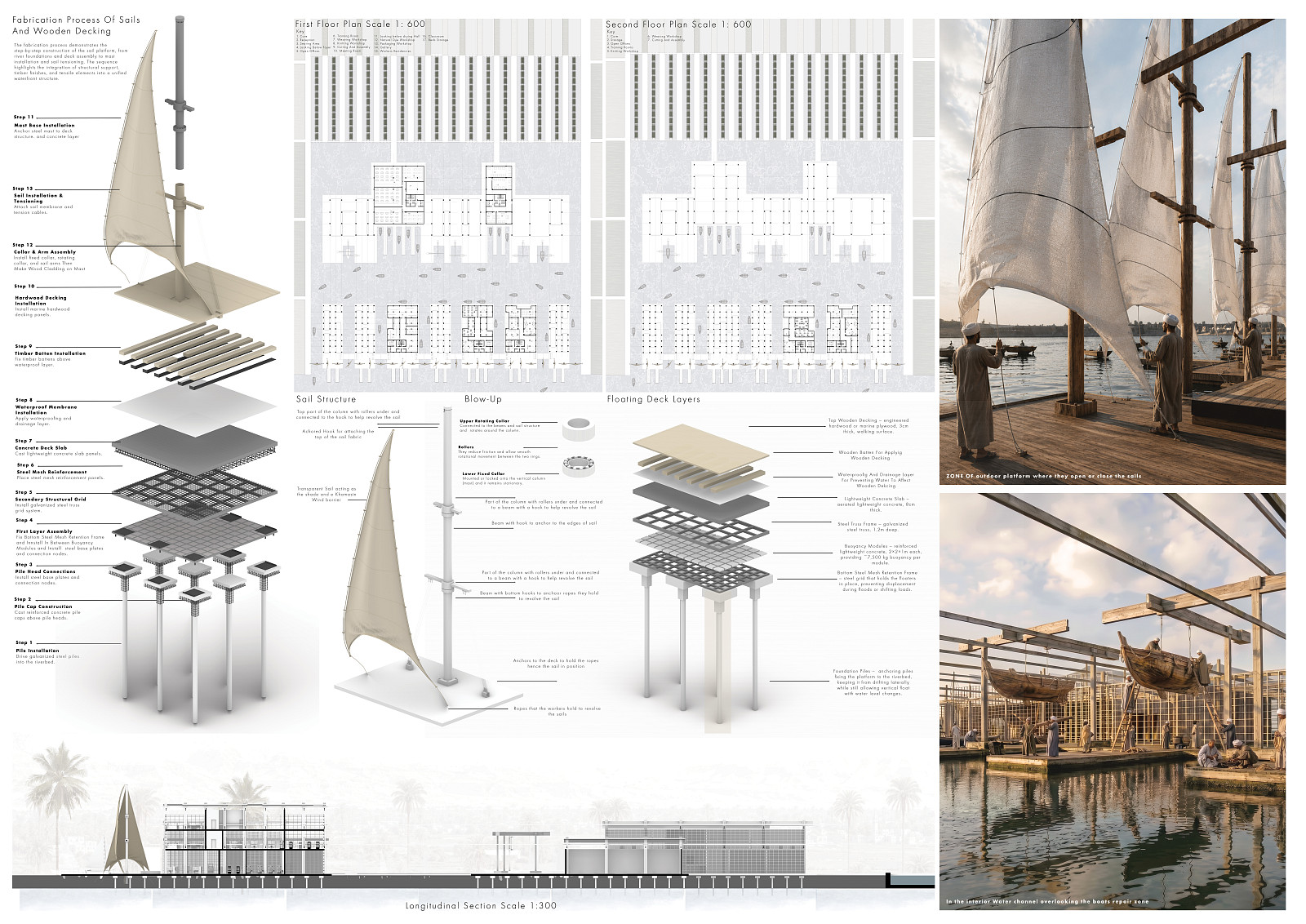
The Sail Mechanism — Each equilateral triangular sail panel with a concave curved foot hangs between a pair of A-frame acacia masts on a pivot bearing assembly allowing 180-degree rotation. When closed the sail forms a protective screen reducing khamsin wind speed from 11 m/s to under 3 m/s at the papyrus bed surface — below the threshold that damages papyrus stalks and disrupts filtration.
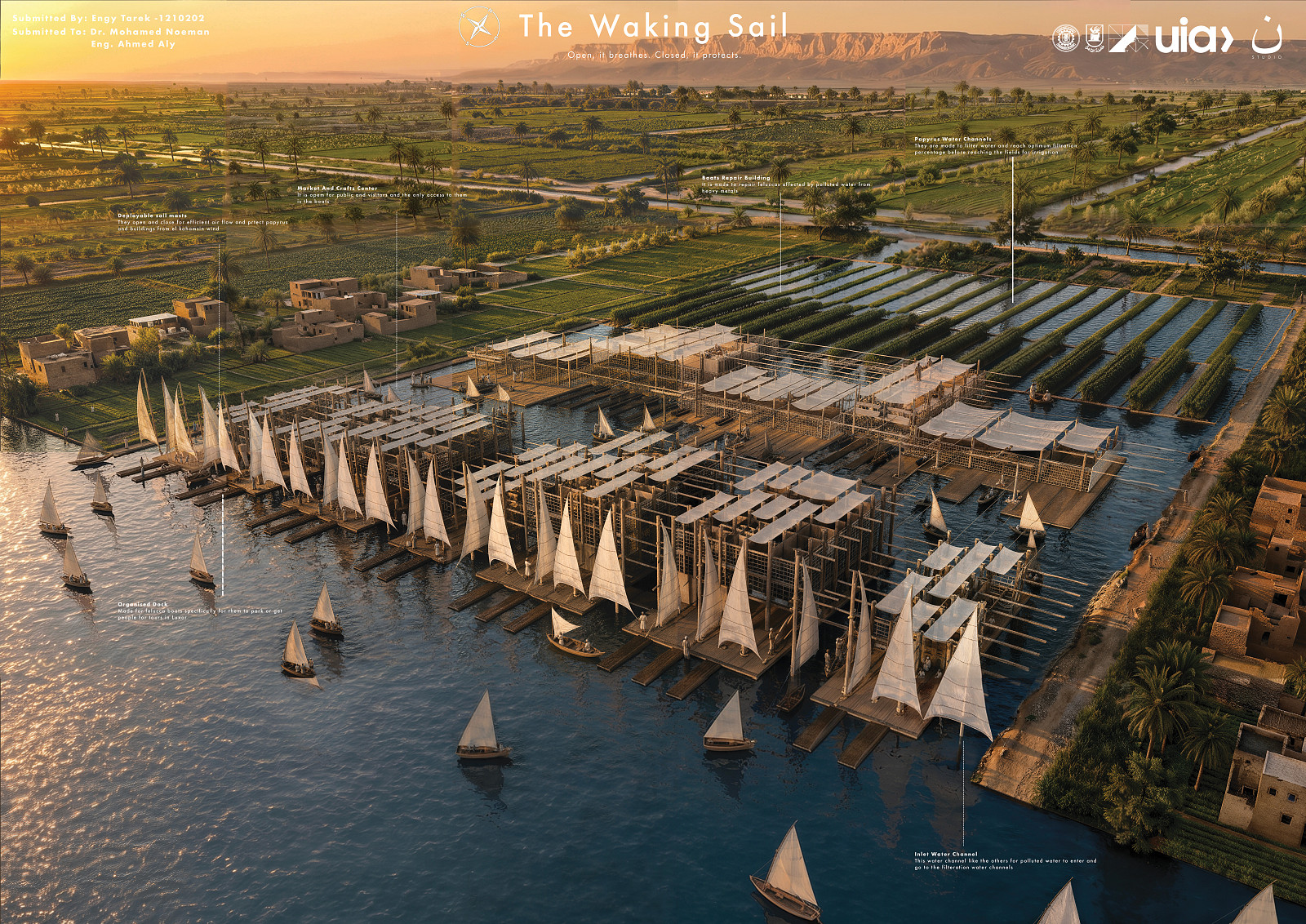
The Water Treatment System — Polluted Nile water enters through a monumental venturi sail gate — two tall acacia timber pylons with horizontal wire filaments catching the golden afternoon light — into a 4,500 m² channel of staggered floating papyrus beds. Inlet and outlet sluice gates with handwheel-operated Aswan granite-silled sliding steel panels control a seven-day retention cycle. After treatment, clean water exits through terracotta irrigation pipes directly into the agricultural fields: 92% of ammonia removed, 84% of heavy metals eliminated, 99% of bacteria treated, 482,000 litres processed daily, serving 241,000 people.
The Boat Repair Facility — The first organized felucca facility in Luxor provides dry dock slipways, hull carpentry bays with steam-bending stations, a sail making hall where new lateen sails are cut and stitched hanging from the building masts, mast and yard repair workshops, rope and rigging stations, and a crane zone. A continuous 144-metre timber working ledge on the Nile-facing edge provides the craftsman with direct access to every moored hull.
The Papyrus Crafts Center — A complete horizontal production sequence on the island building: harvesting from the floating treatment beds, soaking at stone steps descending into the channel, outdoor drying under the mast cluster, wire-filament cutting at seated acacia frame stations, pressing, and weaving at traditional loom stations. A marketplace, exhibition gallery, water quality research laboratory, community meeting hall, and training rooms occupy the upper floor.
Technical information
Primary Structure — Composite acacia timber columns formed by four bundled 100×100mm square posts clamped with iron bands at 600mm intervals, producing a composite section of approximately 250×250mm. Rectangular acacia beams 200×100mm span between column clusters on a 4×4m grid, connected with galvanized steel plate gussets and M16 stainless bolts. The entire frame is exposed — structure is architecture.
Mast System — Single tapered round acacia shaft, 180mm diameter at base tapering to 60mm at 16m height, seated in a steel socket bolted to the column cluster top. A 14m tapered acacia yard lashed at 30% from the lower end with six rope wraps. Wooden block sheave at mast cap, cleat at 1.2m height — one person, no machinery.
Pivot Bearing — Steel outer race, bronze inner race, eight ball bearings, grease nipples at 90-degree intervals. Allows full 180-degree rotation of mast and sail assembly on a handwheel-operated threaded rod for gate and windbreak positioning.
Gate System — Vertical sliding 12mm galvanized steel panels, 0.80m wide × 0.90m tall, in acacia timber groove frame channels. 25mm stainless threaded rod with 250mm cast iron handwheel, 4mm rise per revolution. Aswan granite sills, rubber perimeter seals. Zero electricity. Zero pump.
Floating Beds — Galvanized steel frame 4×2m, woven reed mat, 300mm soil and compost layer, papyrus at 25 plants per m² — 128 plants per bed. Roots penetrate through the mat into the water column achieving maximum root-to-water contact for phytoremediation.
Materials — Locally sourced Upper Egyptian acacia for all primary timber, chosen for its density, water resistance, and 5,000-year history in Nile boat construction. Iron hardware from Luxor blacksmith tradition. Galvanized steel at all structural connections. Natural fiber rope throughout. Aswan granite at all water contact surfaces. The material palette is entirely local, entirely honest, and carries the roughness of a working waterfront — not a monument.

Copyright © 2026 INSPIRELI | All rights reserved. Use of this website signifies your agreement to the Terms of Use, Privacy Policy, and use of cookies.