Ai Nuri Mosque

Project idea
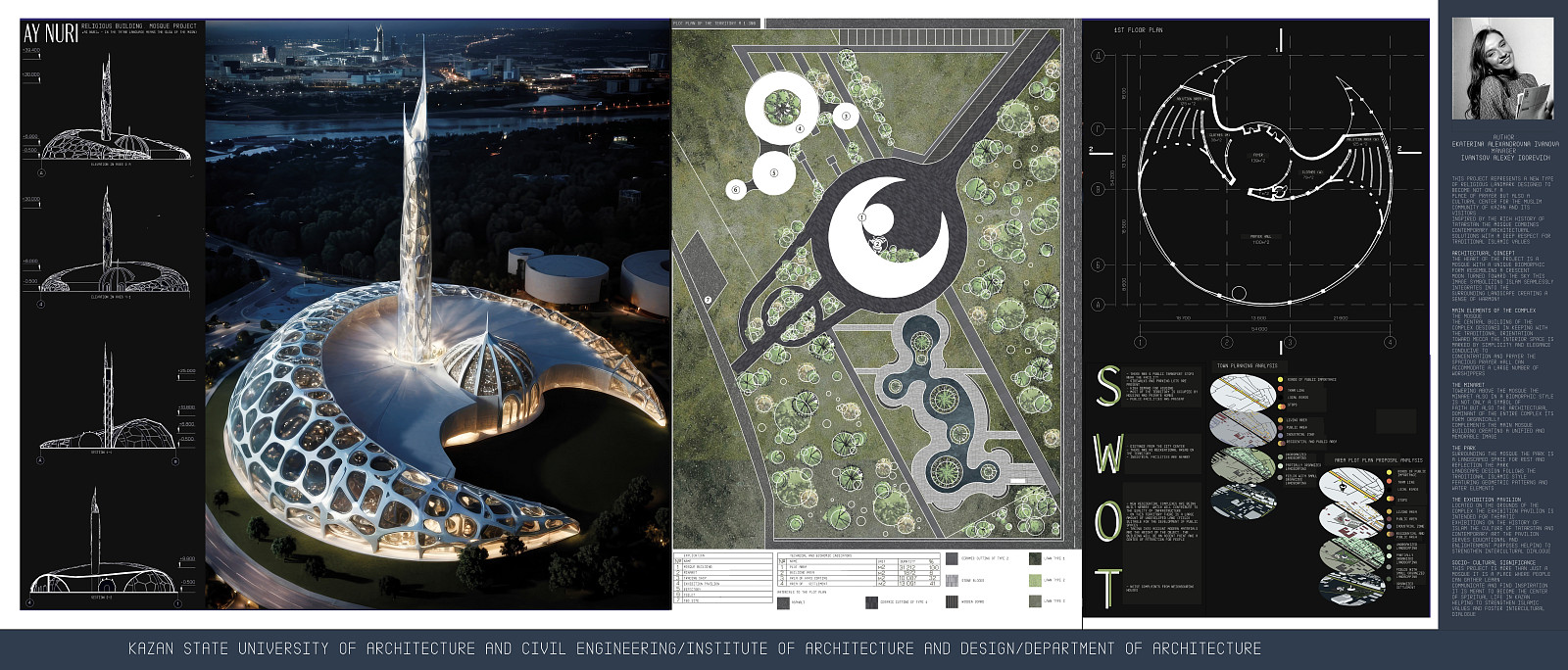
"AI NURI" (Ai Nury, translated from Tatar as "moonlight") is a new type of religious building, designed to become not only a place of prayer but also a cultural center for the Muslim community of Kazan and its visitors. Inspired by the rich history and spiritual heritage of Tatarstan, the mosque combines modern architectural solutions with a respectful attitude toward traditional Islamic values.
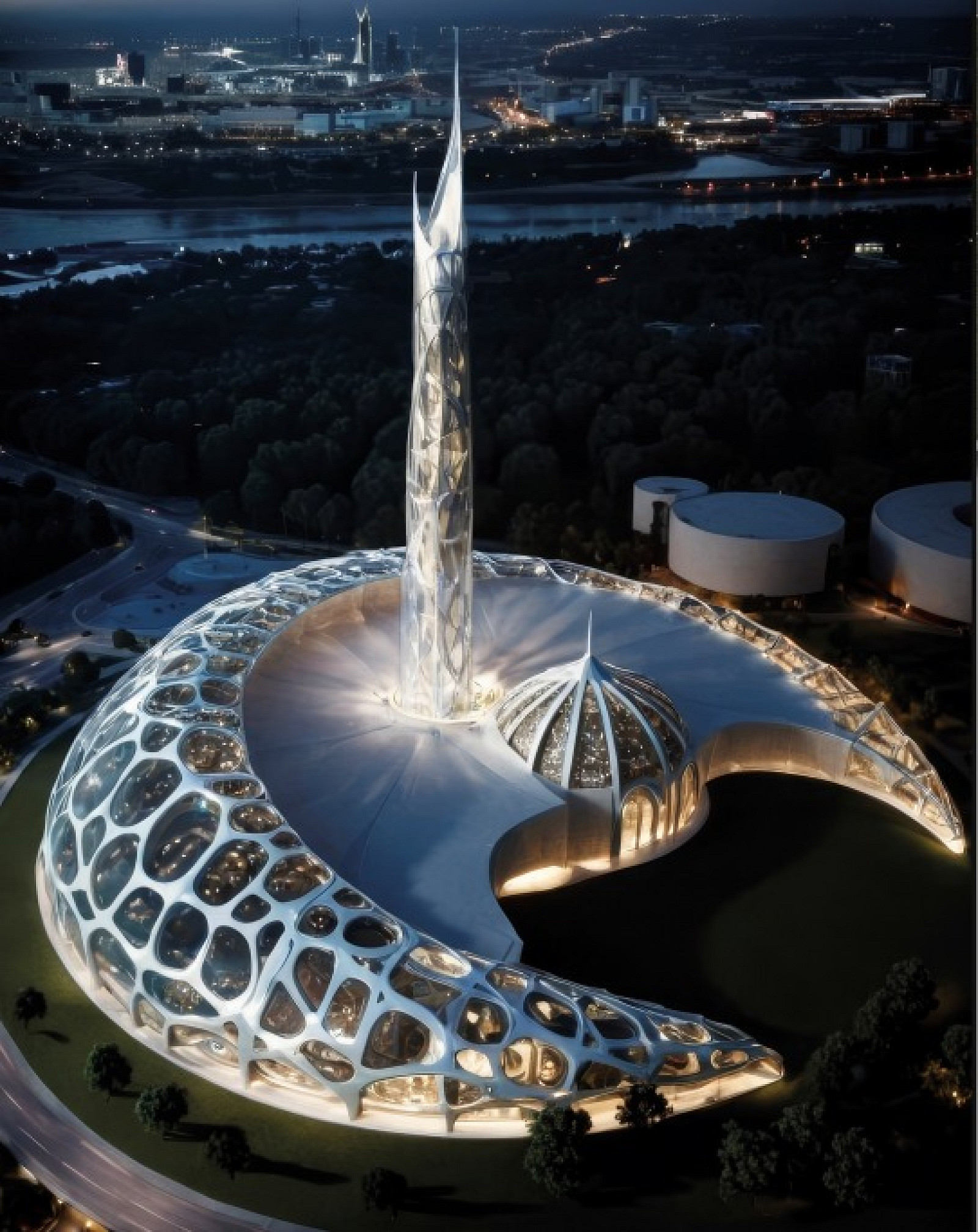
Architectural concept: The heart of the project is a mosque, designed in a unique bionic form reminiscent of a crescent moon facing the sky. This image, symbolizing Islam, seamlessly integrates into the surrounding landscape, creating a sense of harmony and spiritual upliftment.
Project description
The main elements of the complex:
• Mosque: The central building of the complex, designed with the traditional orientation toward Mecca in mind. The interior space is characterized by simplicity and elegance, conducive to concentration and prayer. The spacious prayer hall accommodates a large number of worshippers.
• Minaret: The minaret, also designed in a bionic style, towering above the mosque is not only a symbol of faith but also the architectural dominant feature of the entire complex. Its shape blends seamlessly with the main building of the mosque, creating a unified and memorable image.
• Park: The park surrounding the mosque is a landscaped space for relaxation and reflection. The park's landscape design is executed in a traditional Islamic style, using geometric patterns and water features.
• Exhibition Pavilion: Located within the complex, the exhibition pavilion is designed to host thematic exhibitions dedicated to the history of Islam, the culture of Tatarstan, and contemporary art. The pavilion serves educational and outreach purposes, promoting intercultural dialogue.
Sociocultural significance: This project is more than just a mosque; it is a place where people can gather, learn, communicate, and find inspiration. It is intended to become a center of spiritual life in Kazan, fostering Islamic values and promoting intercultural dialogue.
Facade Concept
The mosque's façade solutions are based on a reinterpretation of traditional Islamic architectural motifs through modern form-forming technologies. The building's architectural appearance is formed by a combination of flowing biomorphic lines, the parametric structure of the façade, and the expressive vertical dominant feature of the minaret, which becomes the main compositional accent of the complex.
The foundation of the façade composition is a continuous openwork shell that envelops the building along its perimeter. The changing geometry of the cells creates a light and dynamic impression, despite the building's considerable scale.
Panoramic glazing, integrated into the façade structure, plays a significant role. Translucent surfaces provide natural light to the interior spaces and a visual connection with the surrounding landscape. In the evening, illumination filtering through the openwork shell highlights the gracefulness of the architectural form and transforms the building into a striking landmark for the neighborhood.
The central element of the composition is the minaret, designed as an upward-striving sculptural structure. Its dynamic form symbolizes spiritual ascent and serves as the complex's visual dominant, clearly visible in the city panorama. The contrast between the minaret's vertical structure and the flowing form of the main volume creates a harmonious and recognizable architectural composition.
The façade solutions aim to create a contemporary image for the mosque, combining the cultural traditions of Islamic architecture, innovative construction technologies, and expressive artistic expression.
Master Plan
The master plan for the complex is based on the principle of creating a unified spiritual and educational space, with the mosque at its center, serving as the main compositional and semantic core of the area. The planning structure is organized around the mosque building and is guided by the symbolism of Islamic culture, where architecture, landscaping, and landscape create a holistic environment for prayer, communication, and contemplation.
The complex also includes an exhibition pavilion, a retail outlet, and a refectory designed for public events, meetings, and charitable programs. To ensure the comfortable operation of the facility, a sanitary block and a waste disposal area, located off the main public routes, are provided.
The project places particular emphasis on landscaping and creating a comfortable natural environment. A significant portion of the site is dedicated to landscaping, with trees, shrubs, and a park area for visitor relaxation. This solution improves the microclimate of the area, creates a favorable ecological environment, and creates spaces for peaceful outdoor recreation.
A system of walking paths connects all functional areas of the complex and runs through a landscaped park. Benches and rest areas are located along the main routes, allowing visitors to spend time in peace and contemplation of the surrounding landscape. Decorative fountains are an important feature of the landscaping. The flowing geometry of the water features echoes the mosque's architecture and creates an additional sense of harmony, peace, and coolness in the summer.
Transportation services are provided around the perimeter of the complex. Access roads, parking spaces, and convenient pedestrian approaches are provided. However, the majority of the area remains pedestrian-only, creating a safe and comfortable environment for parishioners and visitors.
Technical information
Structural solutions: The mosque has a complex bionic metal shell. The structural foundation of the reinforced concrete portion of the building, which bears the main loads, is monolithic reinforced concrete columns with a cross-section of 600 x 600 mm. There are also 200 mm thick reinforced concrete diaphragms. The floor structure is a monolithic reinforced concrete slab 250 mm thick. Arched metal trusses, echoing the shape of the shell, were incorporated into the spans.
The foundation is a slab. The load-bearing diaphragms, columns, and floor slab on all floors, as well as the stair structures, are made of monolithic reinforced concrete, concrete grade B30.
Documentation

Copyright © 2026 INSPIRELI | All rights reserved. Use of this website signifies your agreement to the Terms of Use, Privacy Policy, and use of cookies.