From Parking Space to Public Place


Project idea
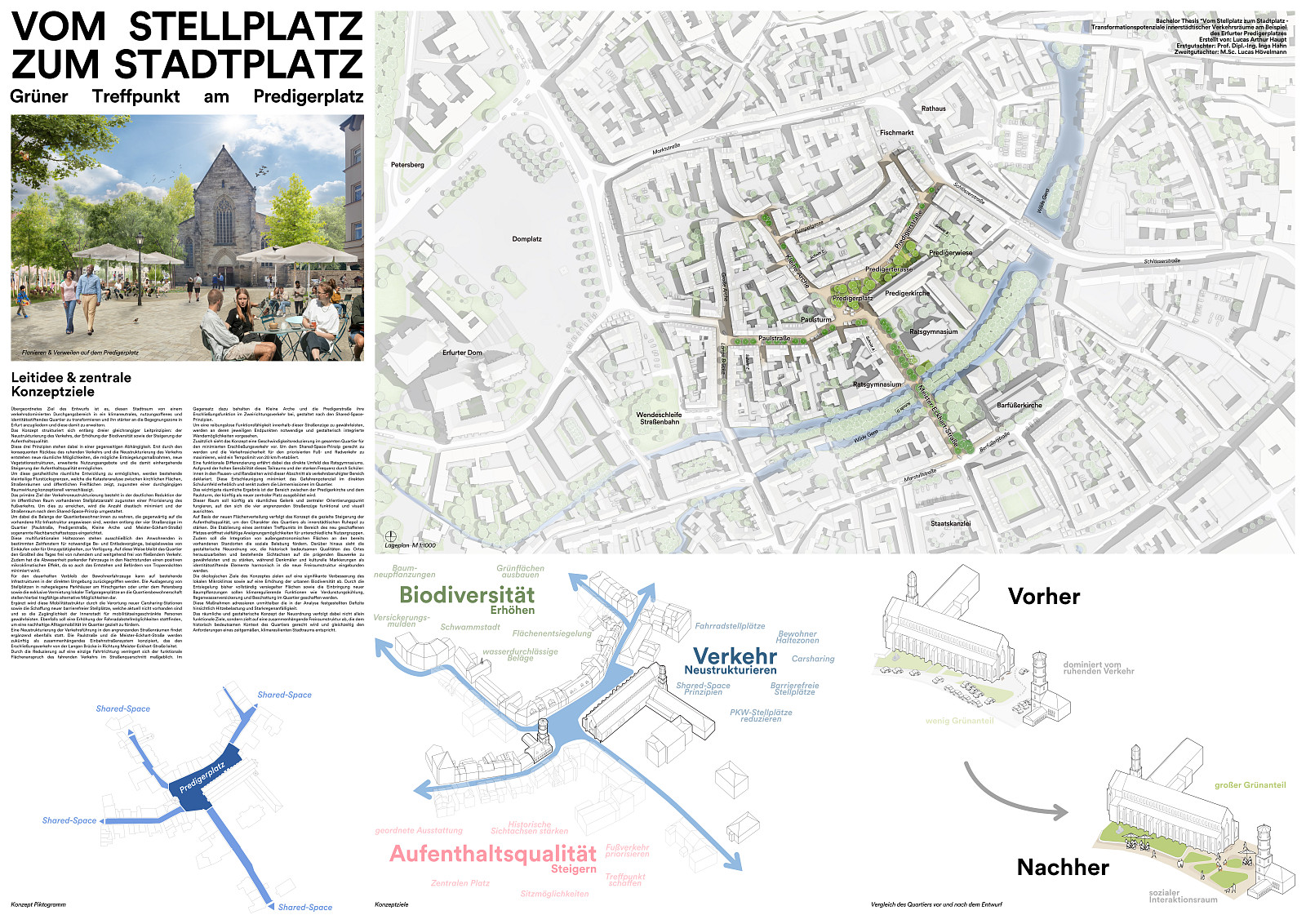
The resulting design, developed as part of a Bachelor's thesis, outlines the transformation of the Predigerquartier in Erfurt from a traffic-dominated transit area into a vibrant, urban meeting space. Embedded in the historic old town and inner city of Erfurt, the neighborhood is located in an urban environment that is already characterized by largely car-free areas and the established concept of the "Begegnungszone" (meeting zone). The design embraces this existing context, builds upon the established structures, and acts as a logical spatial extension of this urban planning approach.
While the theoretical foundations highlight the historical and ecological issues of the car-centric city, the clear focus lies on the spatial implementation of this concept. The central goal of the landscape architecture design is not to completely banish the car from the neighborhood, but to create an entirely new, sustainable form of coexistence. By consistently applying the Shared Space principle, the strict functional separation of road users is dissolved in favor of a considerate togetherness.
The achievement of this vision relies on the following core objectives:
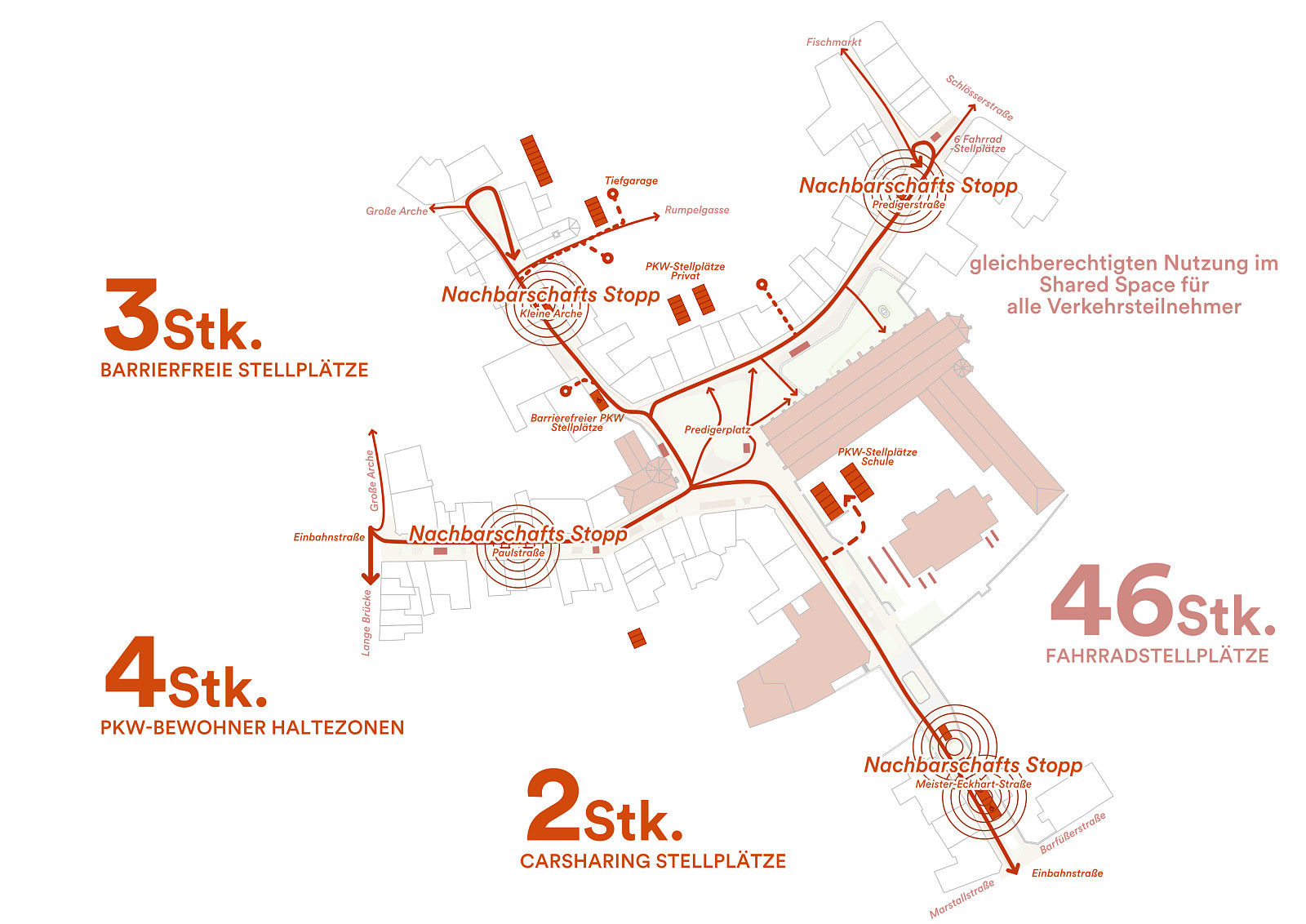
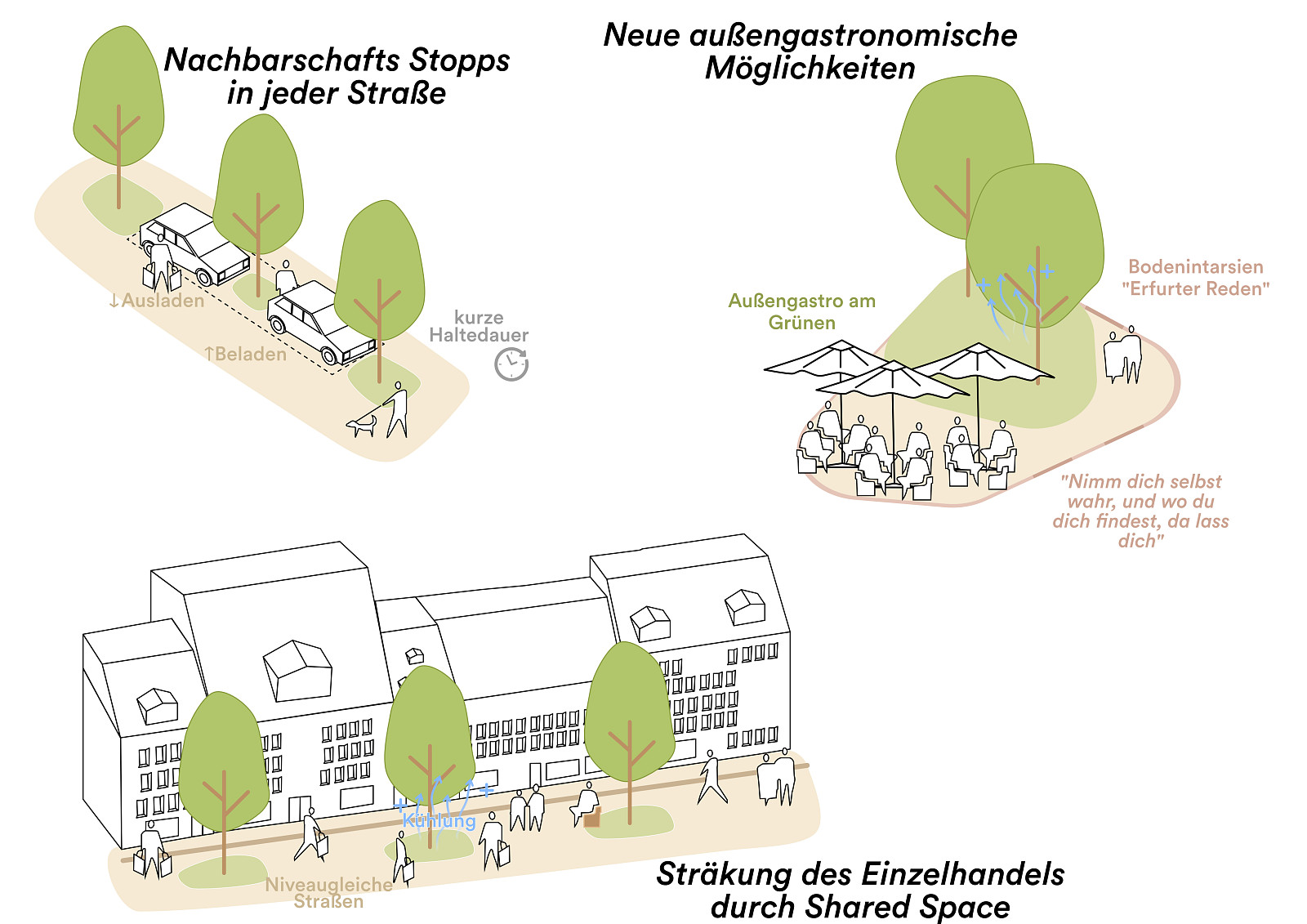
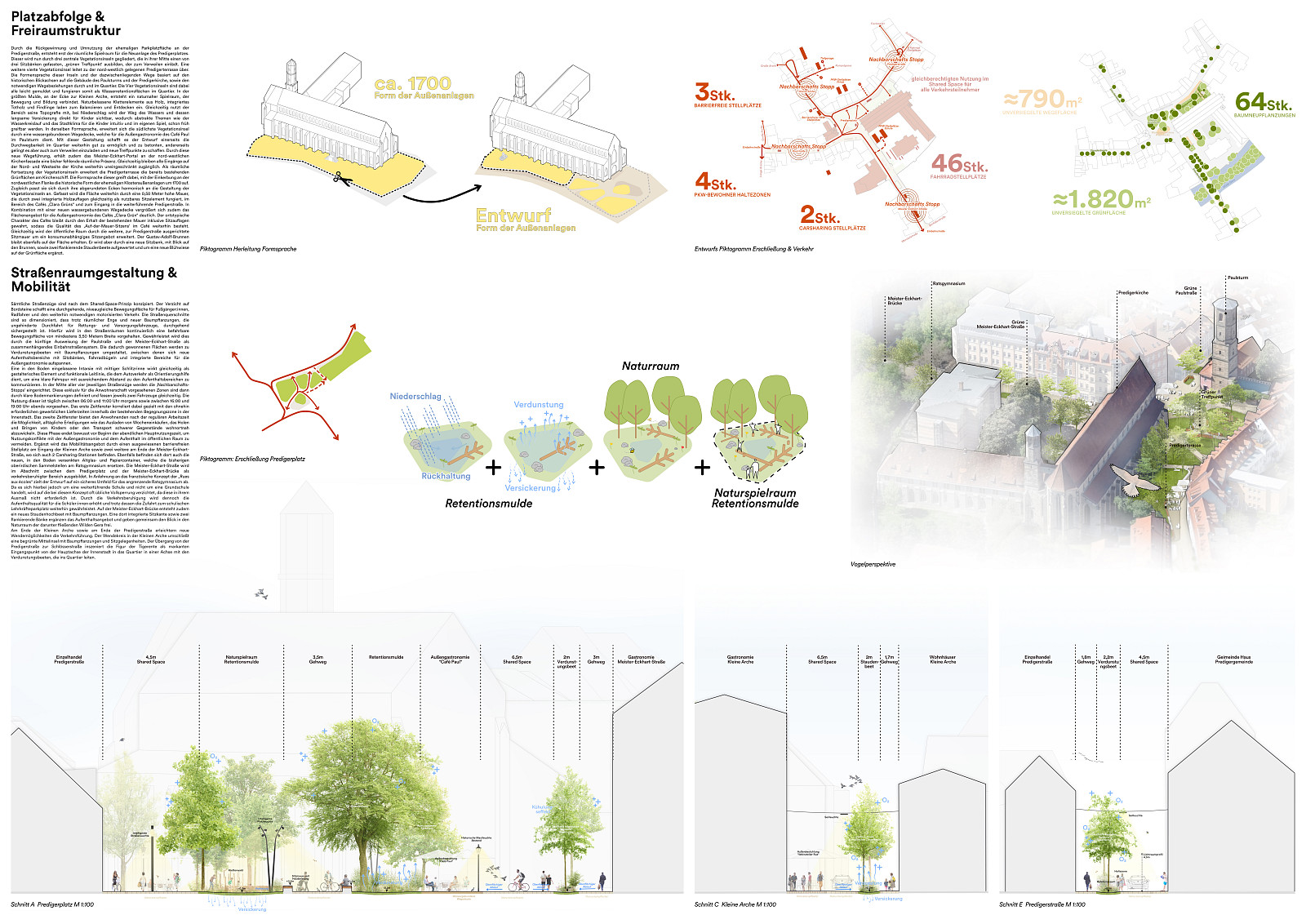
Restructuring of Traffic: Through a drastic reduction of parking spaces and the introduction of so-called "neighborhood stops" (Nachbarschafts-Stopps), the public space is freed from dominating stationary traffic. At the same time, necessary mobility needs for residents are maintained, allowing for a genuine, compatible coexistence.
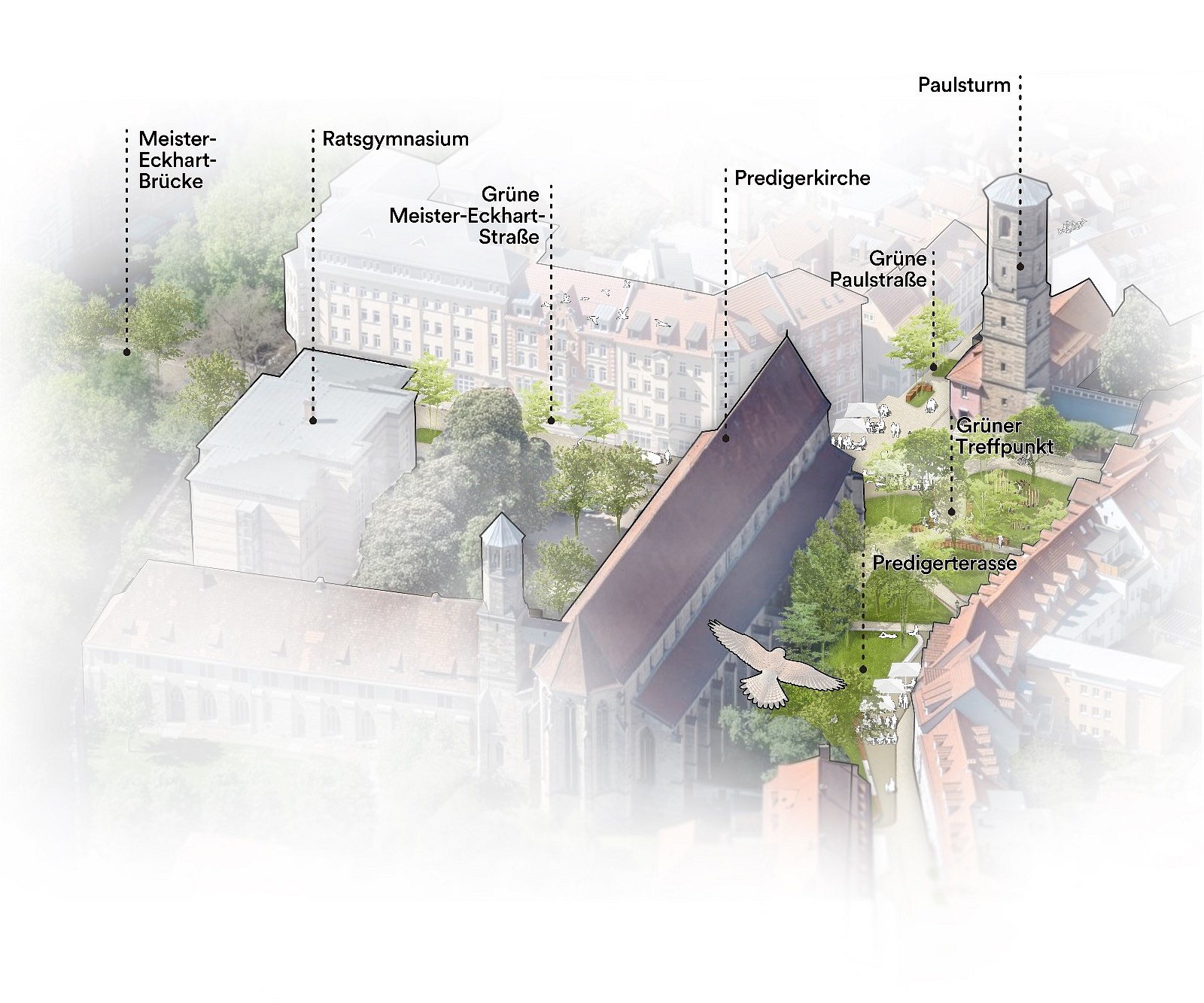
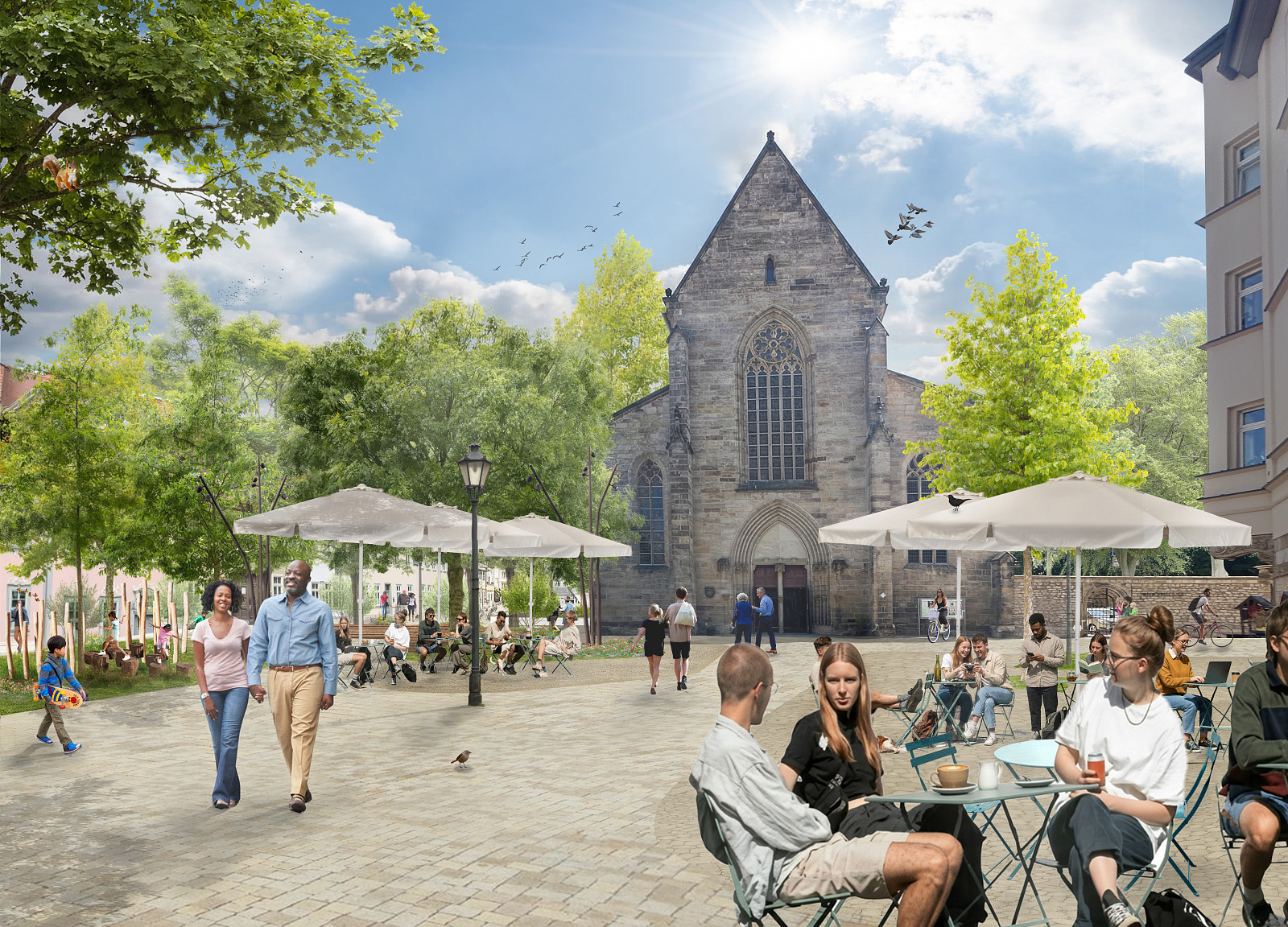
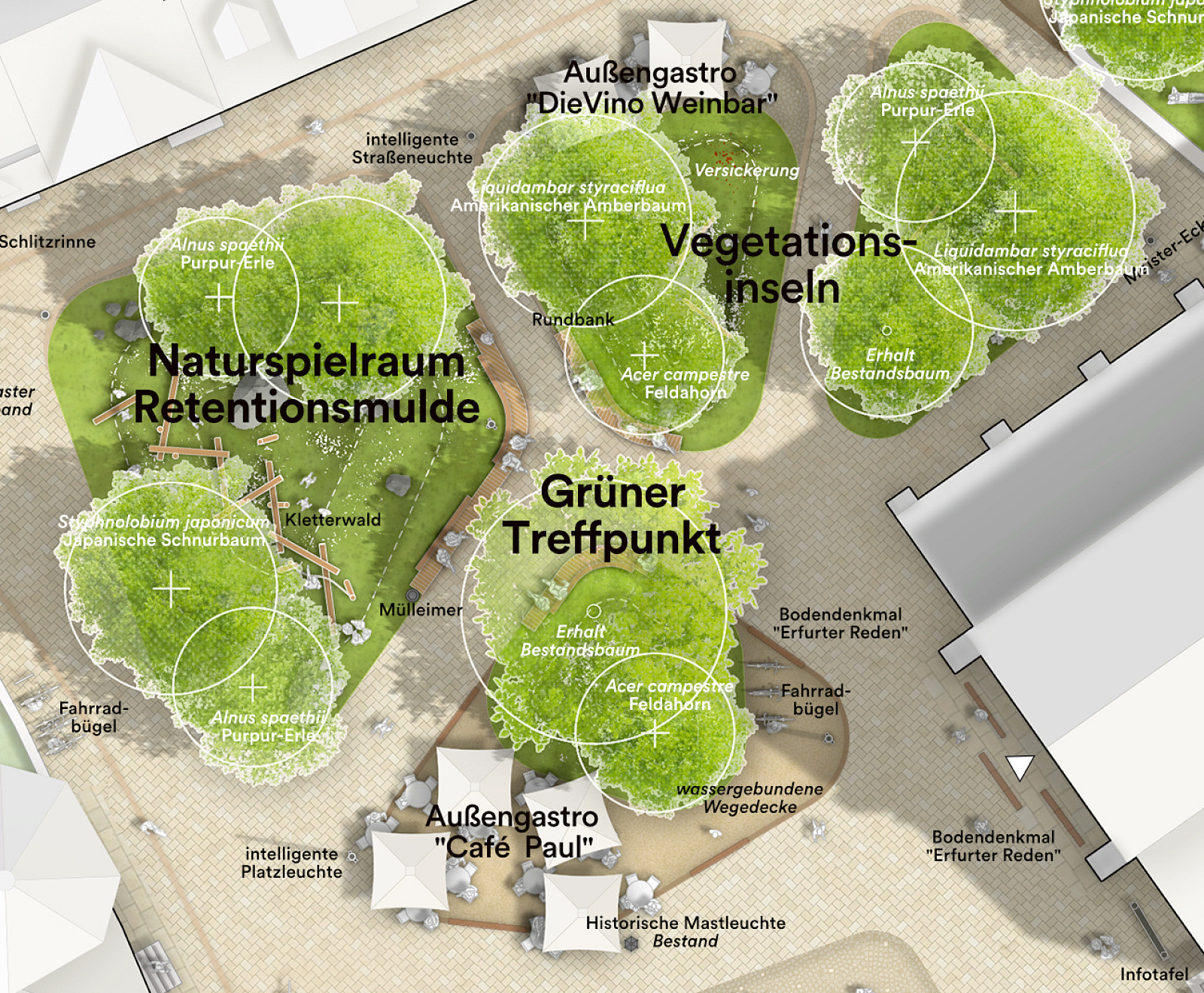
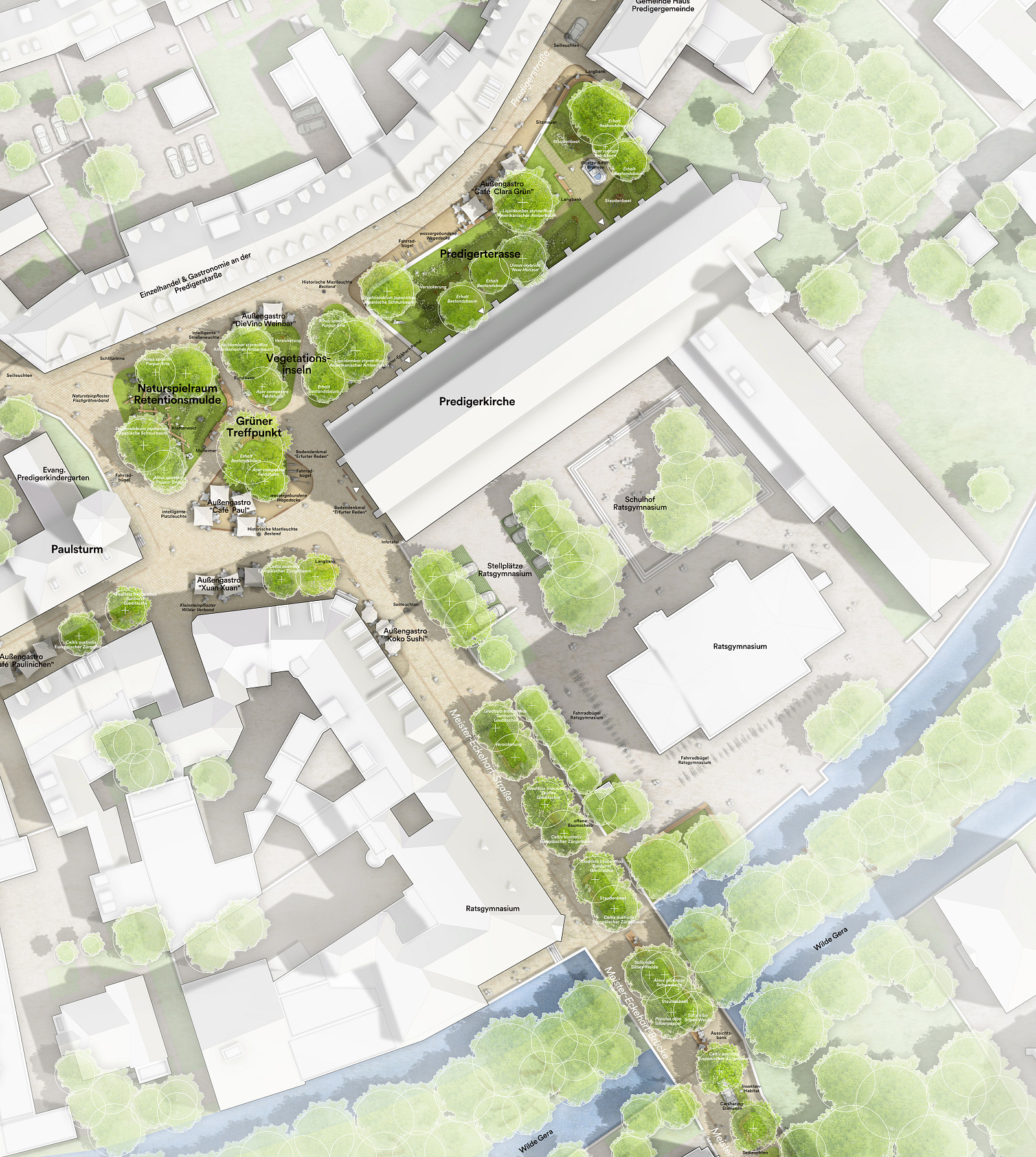
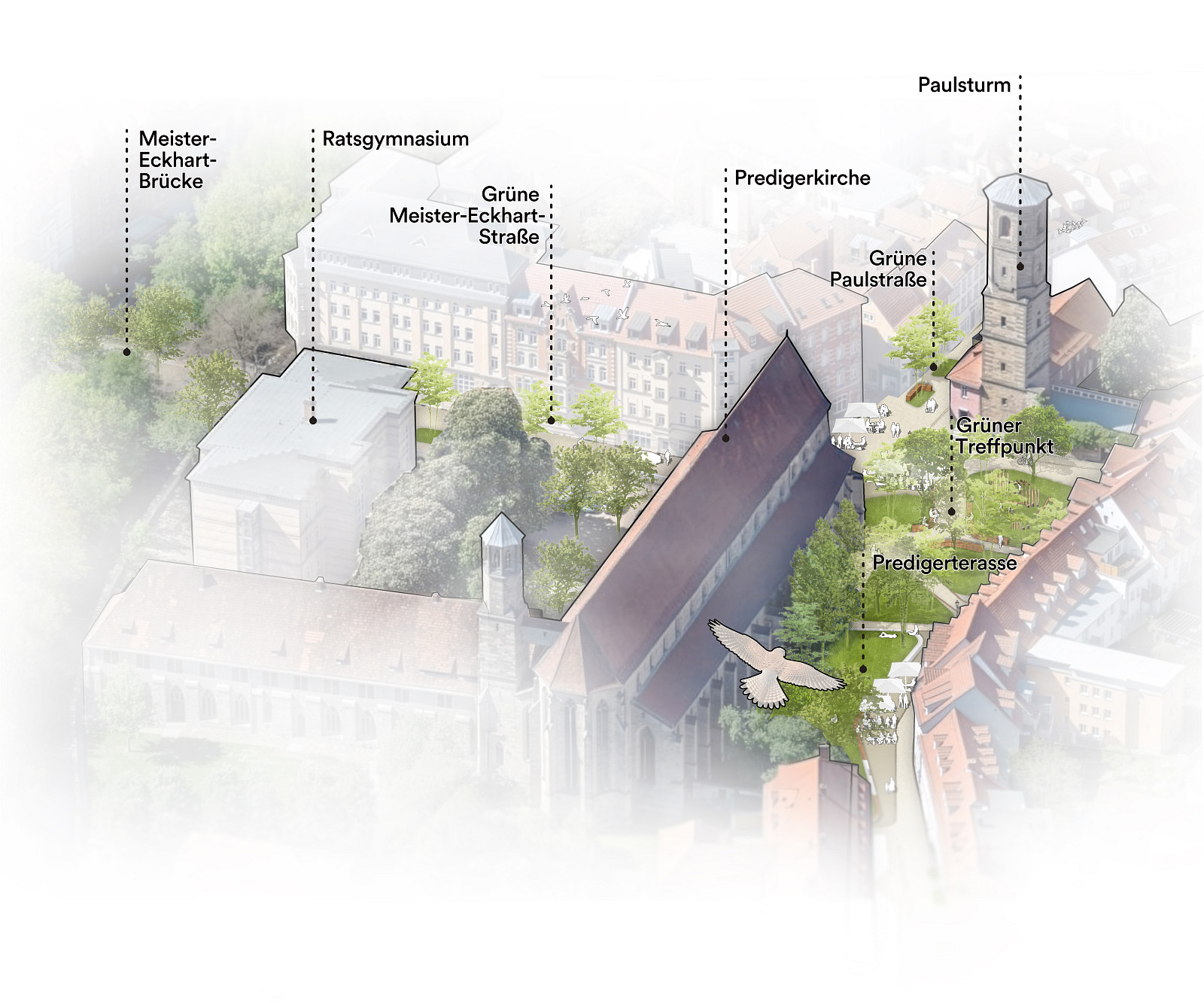
Creating a Place of Togetherness: The reclaimed area enables the creation of the new "Predigerplatz". This acts as a new spatial link and a central, green meeting point between the Predigerkirche and the Paulsturm, inviting people to linger without the need to consume.
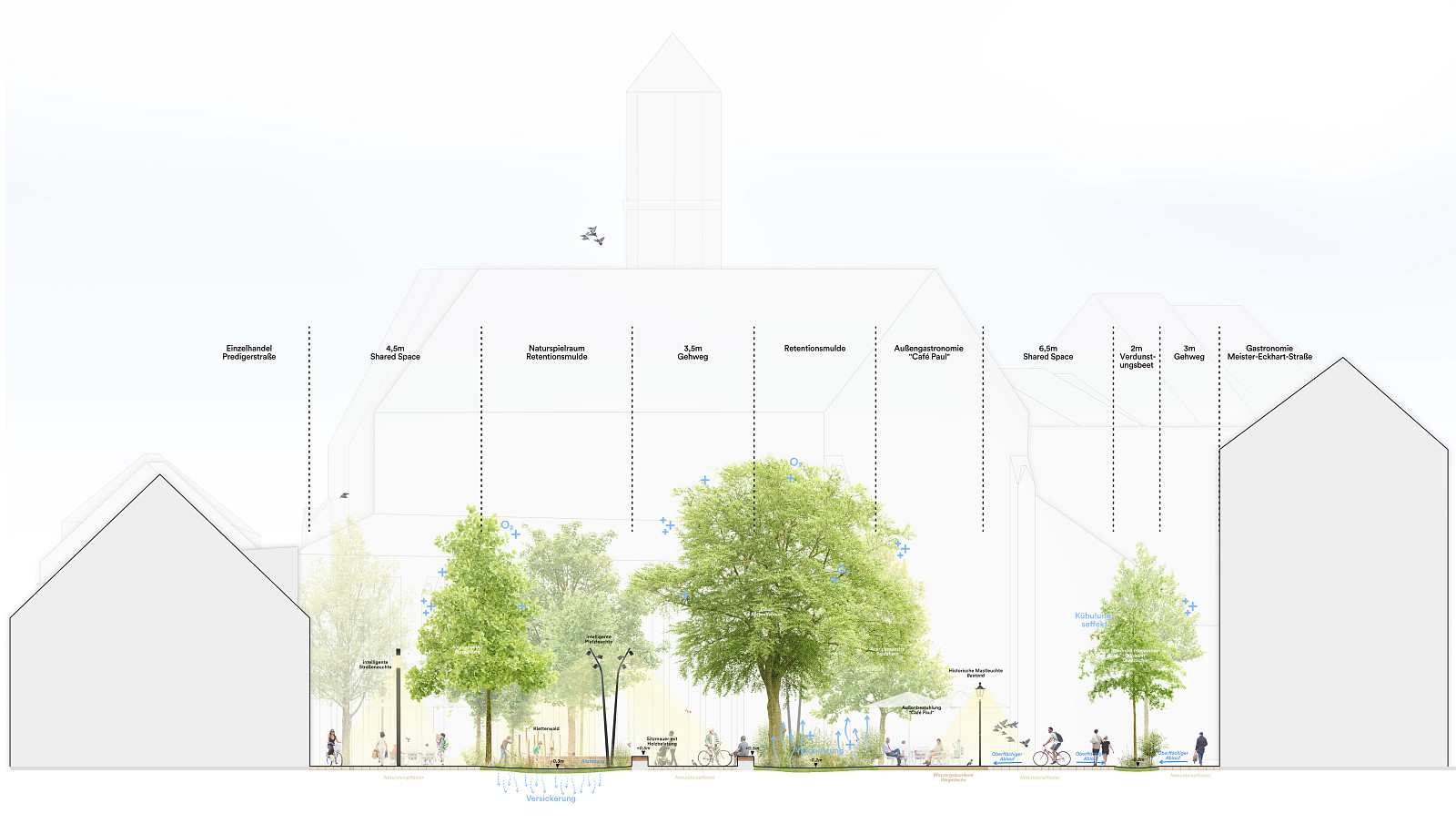
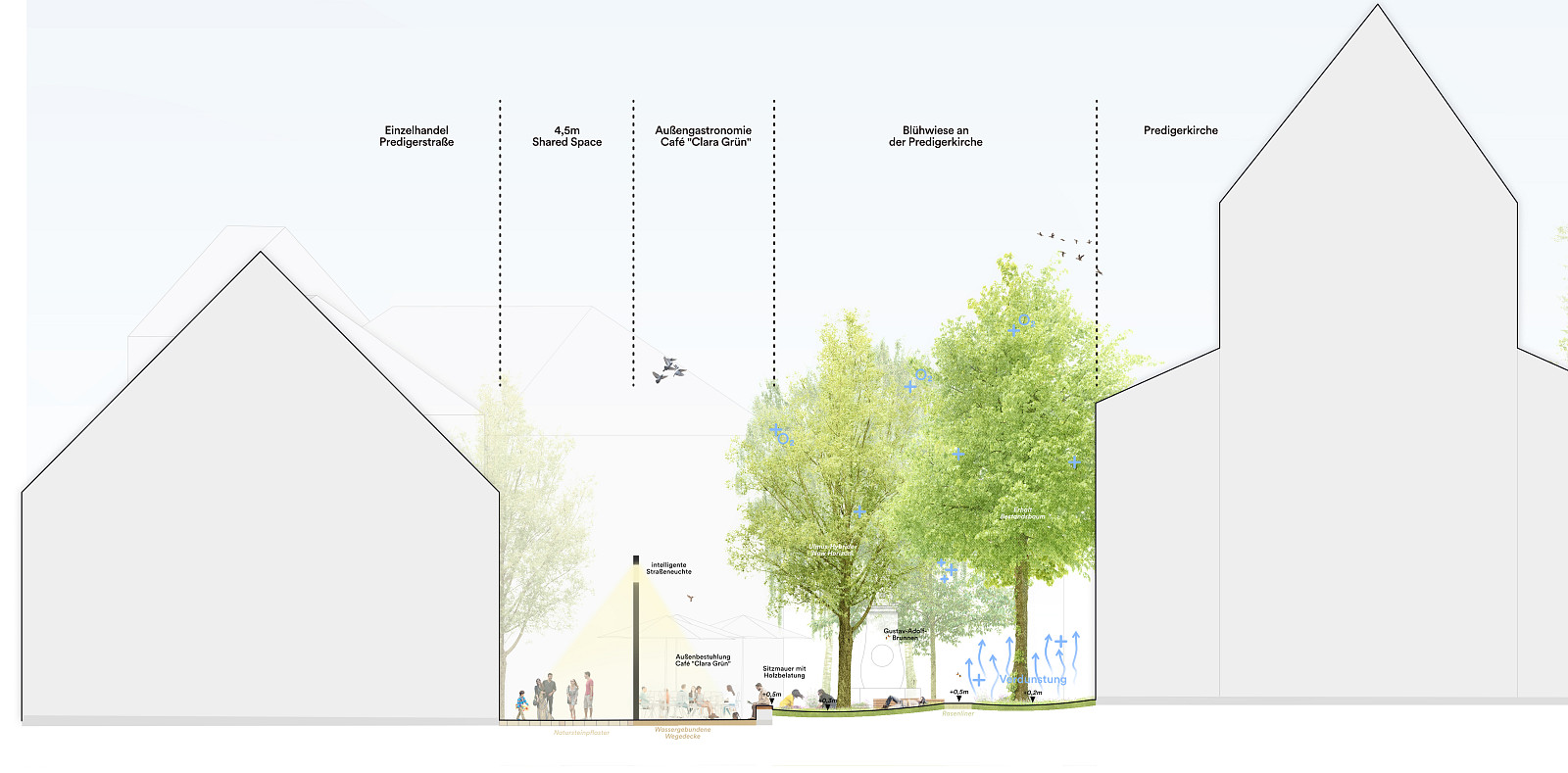
Climate Resilience and Quality of Stay: Through targeted surface unsealing, near-natural retention swales, the planting of new trees, and barrier-free pathways, an inclusive space is created that harmoniously unites diverse usage demands from outdoor gastronomy to play opportunities for children.
Ultimately, the design demonstrates how a balanced distribution of space creates a climate-resilient neighborhood. A place of togetherness is established that fosters communal life and assigns the car a new, integrated, and subordinate role within the urban fabric.
Project description
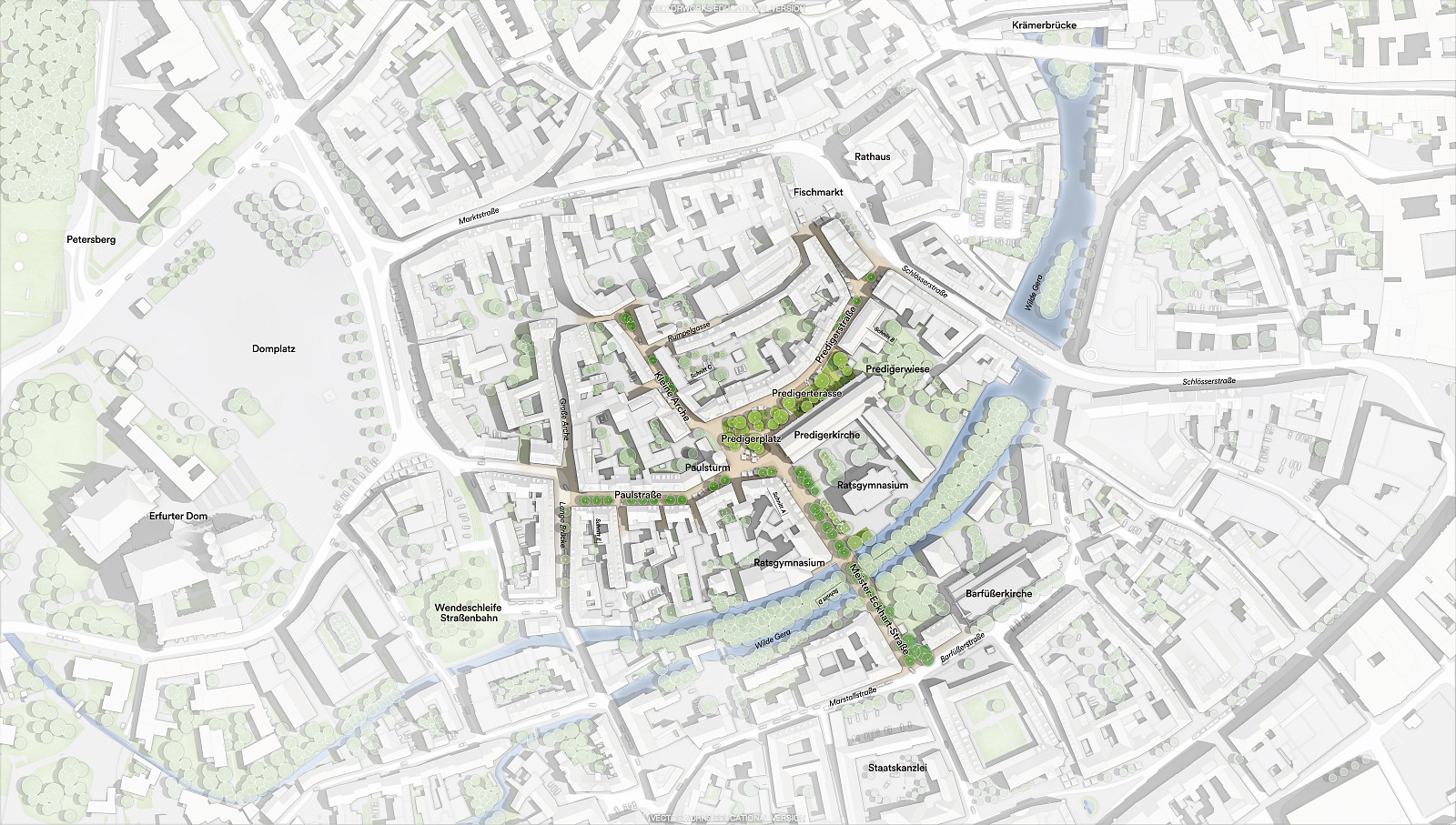
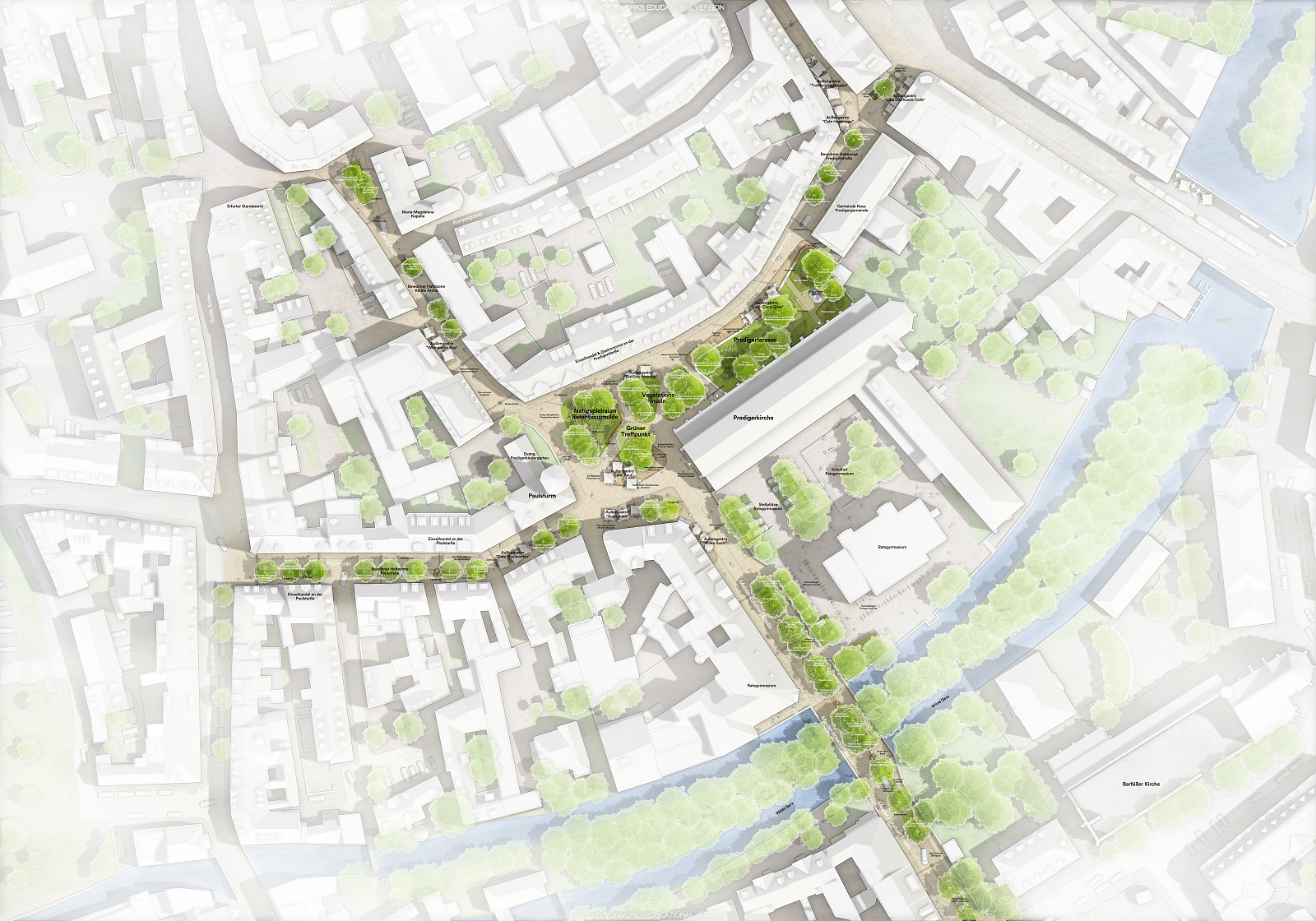
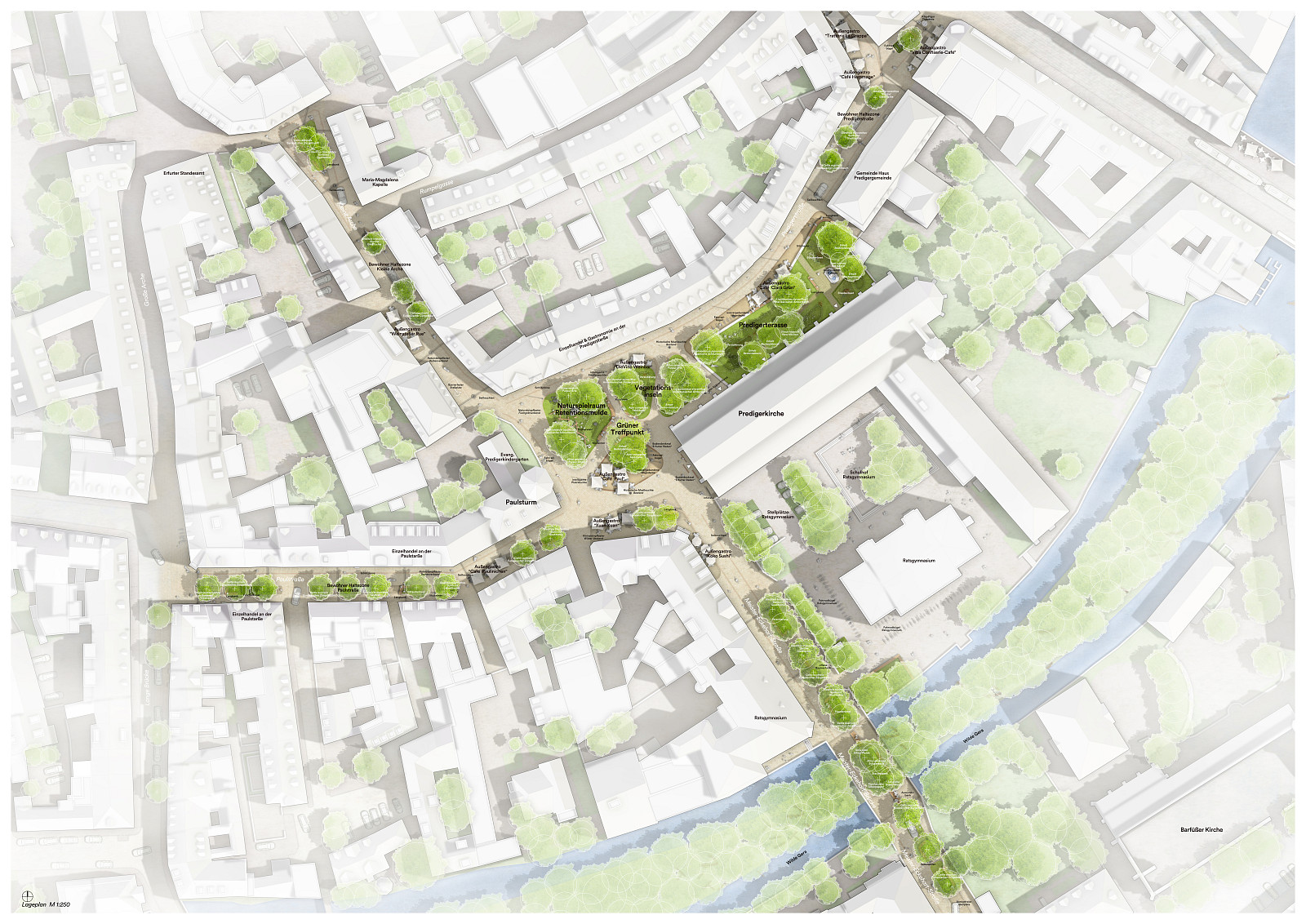
The spatial and conceptual scope of the project solution goes far beyond a mere superficial redesign; it is a research-based evolution of the "Begegnungszone" (meeting zone) already established in Erfurt's inner city. Through the holistic landscape architectural and traffic-planning reorganization of the streets Paulstraße, Predigerstraße, Kleine Arche, and Meister-Eckhart-Straße, a future-proof neighborhood is created that combines historical structures with modern demands for climate protection and sociology.
The solution extends in detail to the following areas of action:
Equal Rights through Research-Based Shared Space:
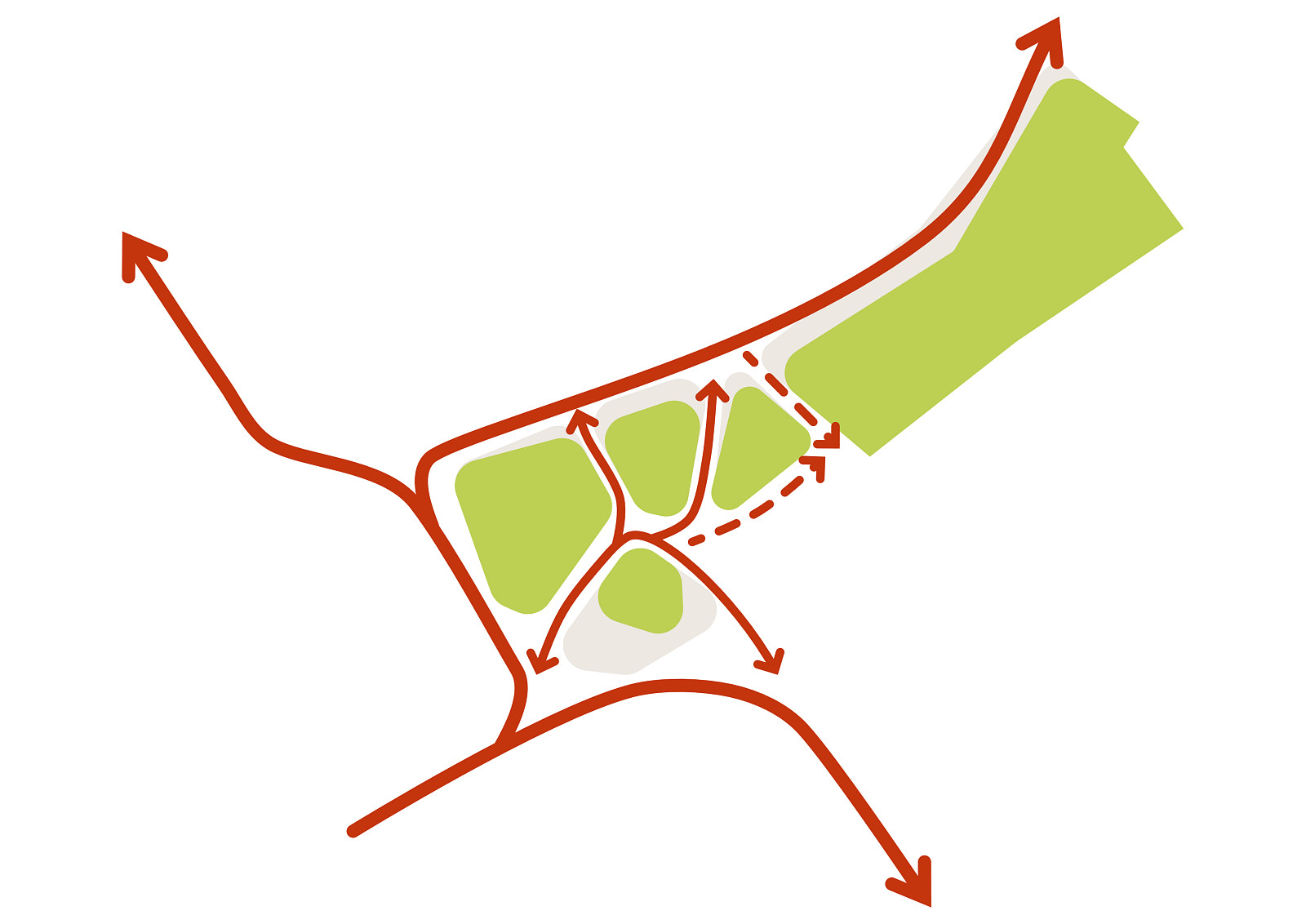
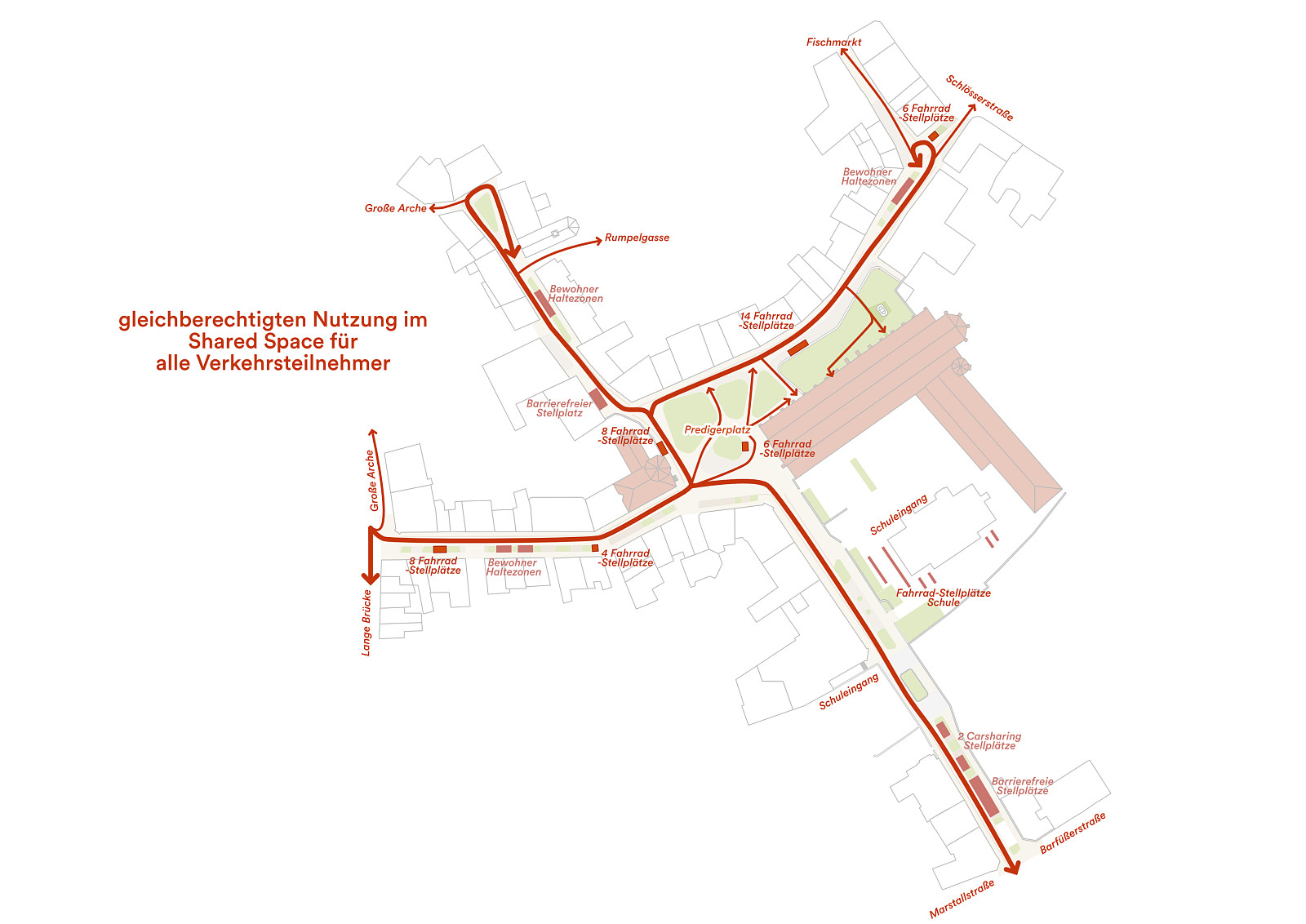
Based on the research of established Shared Space concepts, the classic, car-centric separation of traffic types is completely abolished. The level-surface construction without curbs creates a shared movement area that enforces true equality: complex traffic rules give way to intuitive communication, pedestrians effectively gain priority, and the car becomes a mere "guest" in the neighborhood. To achieve this, approx. 70 public car parking spaces are removed. The remaining traffic is calmed (max. 20 km/h) via a new one-way street system and designated turning areas. Residents are provided with exclusive, time-restricted "neighborhood stops" (Nachbarschafts-Stopps) for loading and unloading, securing their mobility needs without permanently blocking the space.
A New Urban Meeting Point for the Inner City:
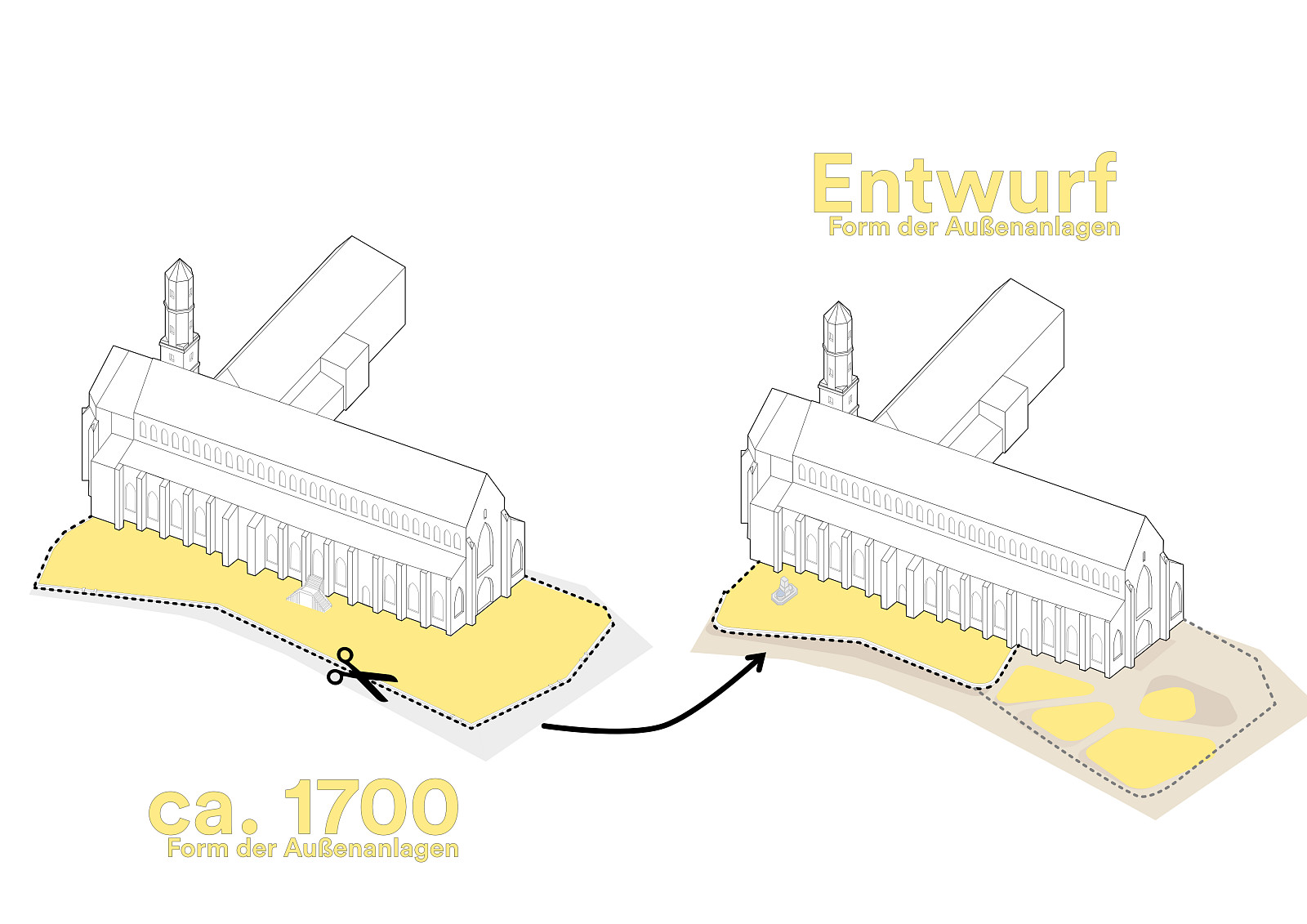
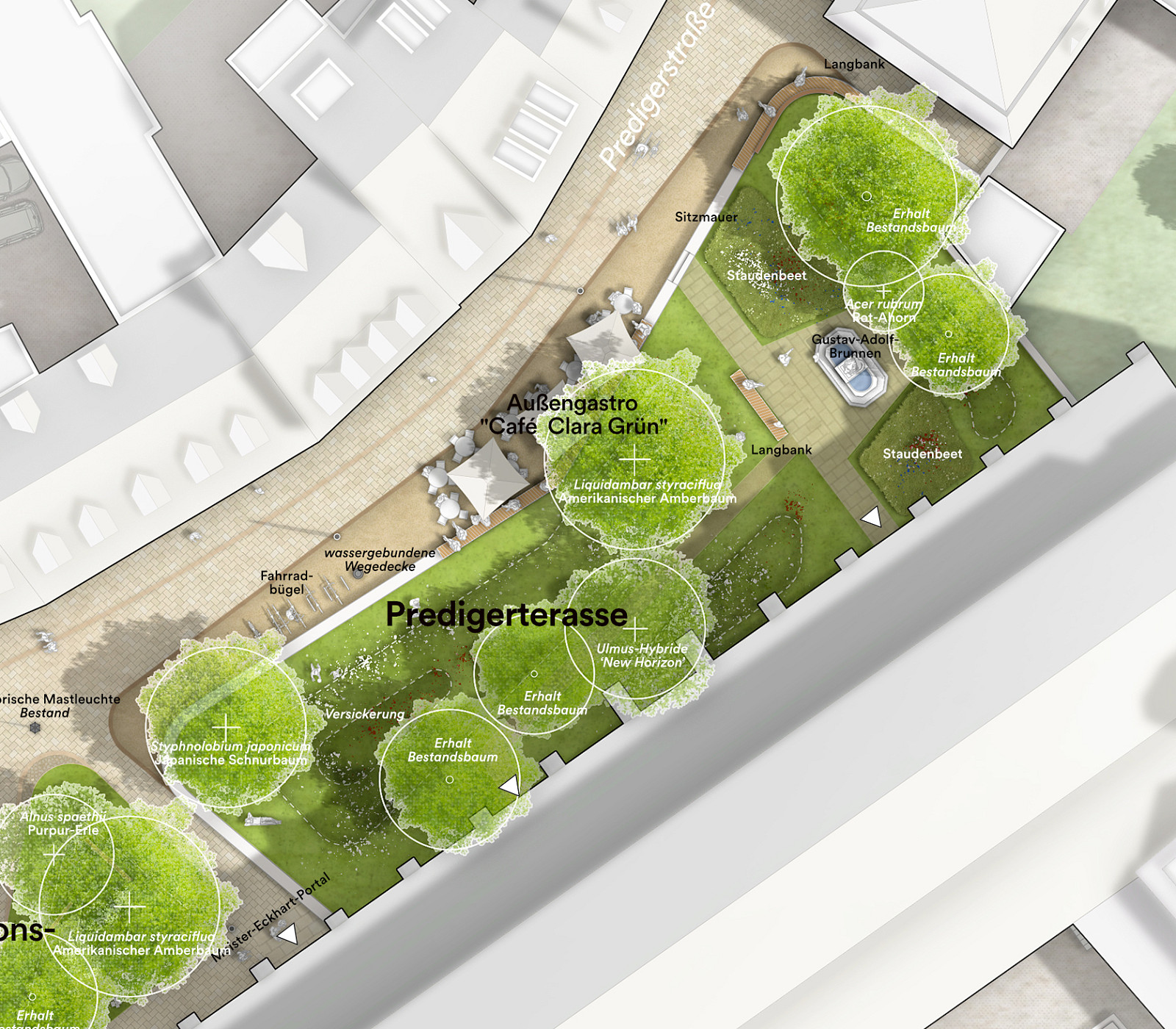
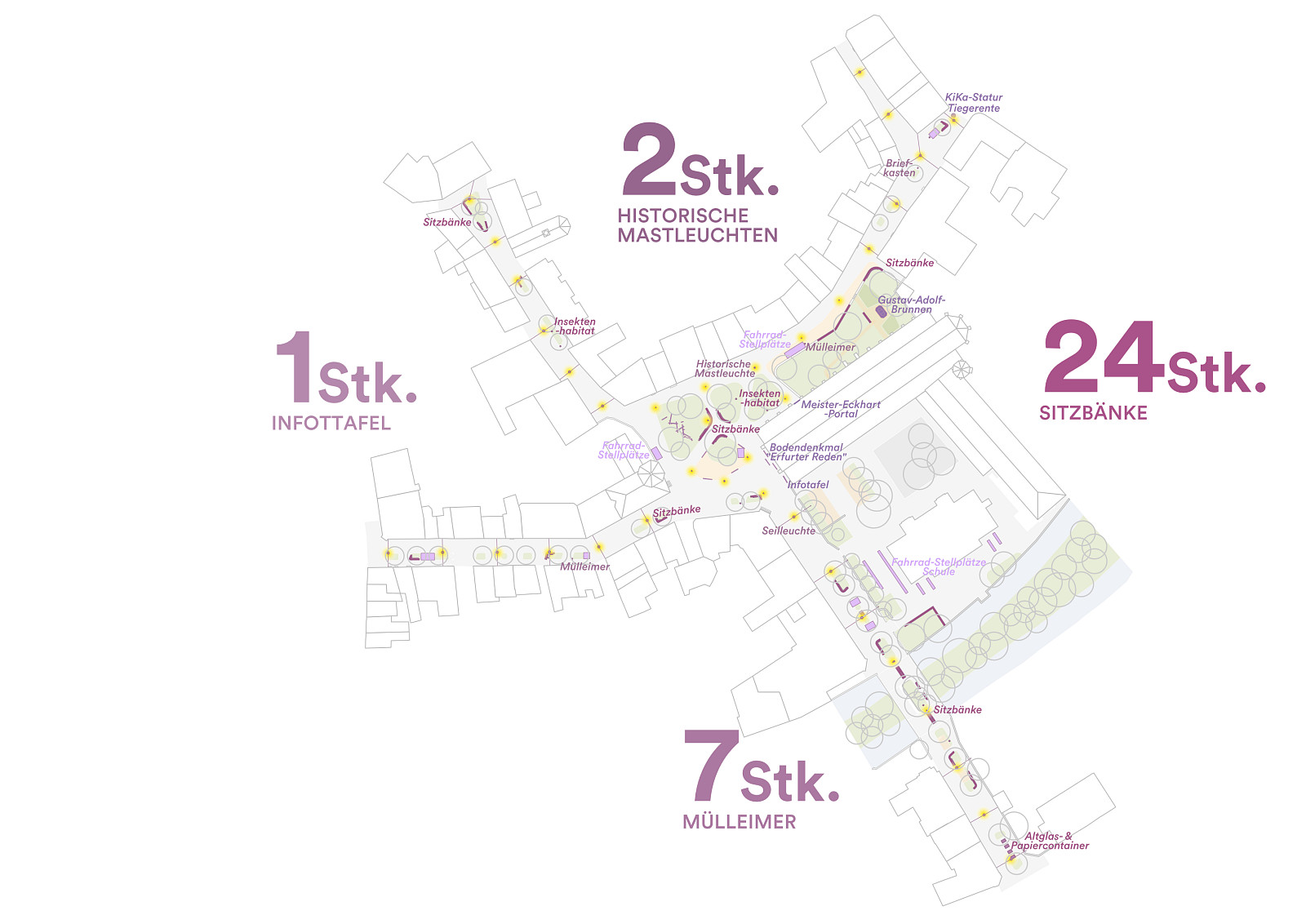
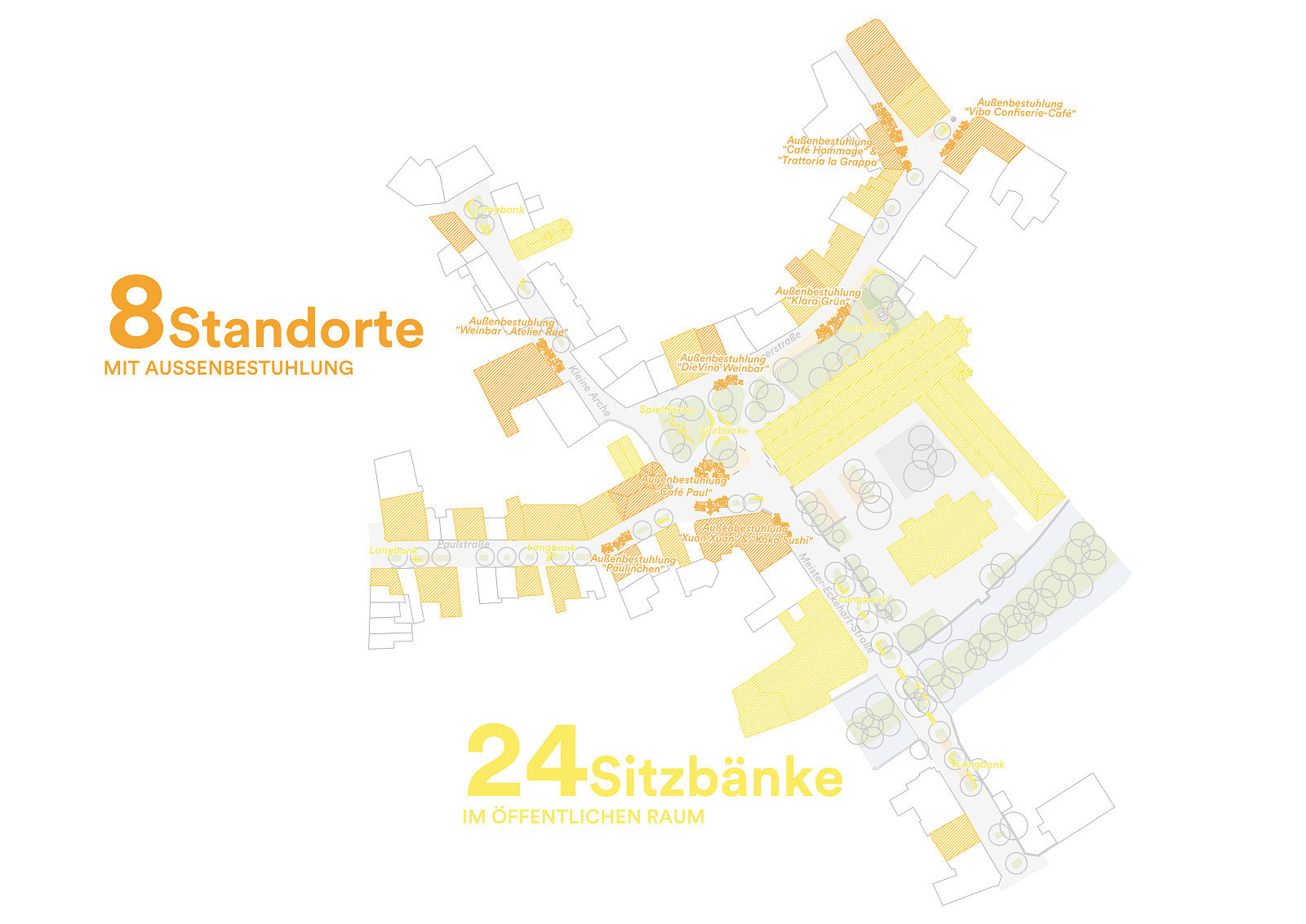
Through the massive reclamation of traffic areas, the new "Predigerplatz" is created in the heart of the neighborhood. It acts as an essential spatial hinge to the pedestrian flows of the Anger and Fischmarkt, forming a new, non-commercial meeting point between the Predigerkirche and the Paulsturm. This is complemented by the creation of the "Predigerterrasse", whose seating walls organically integrate local outdoor gastronomy. With 24 new benches and 46 bicycle parking spots, the neighborhood opens up to the urban society, transforming from a transit space into a place to linger.
Taking Existing Concepts Further (Climate Resilience & Sponge City):
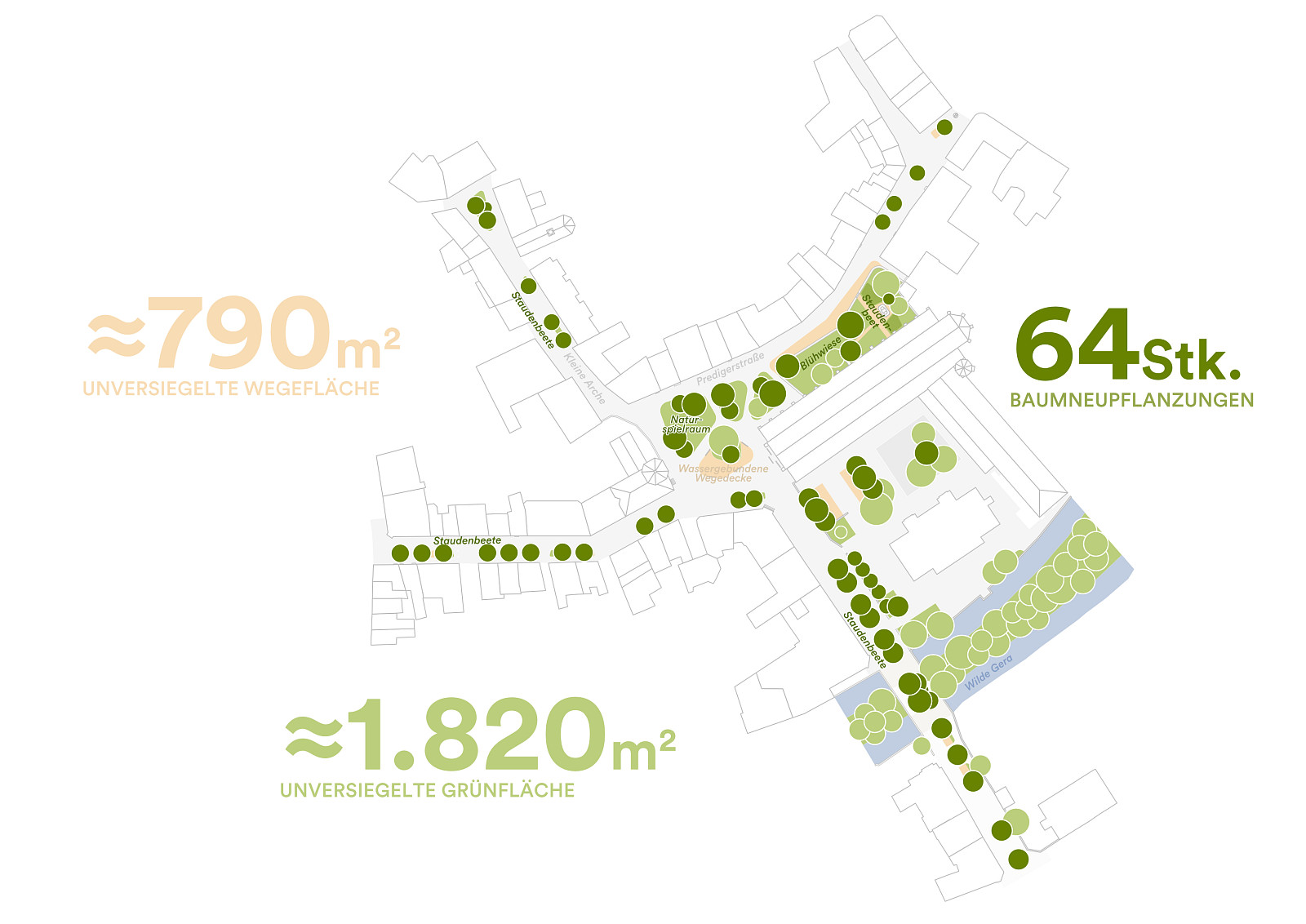
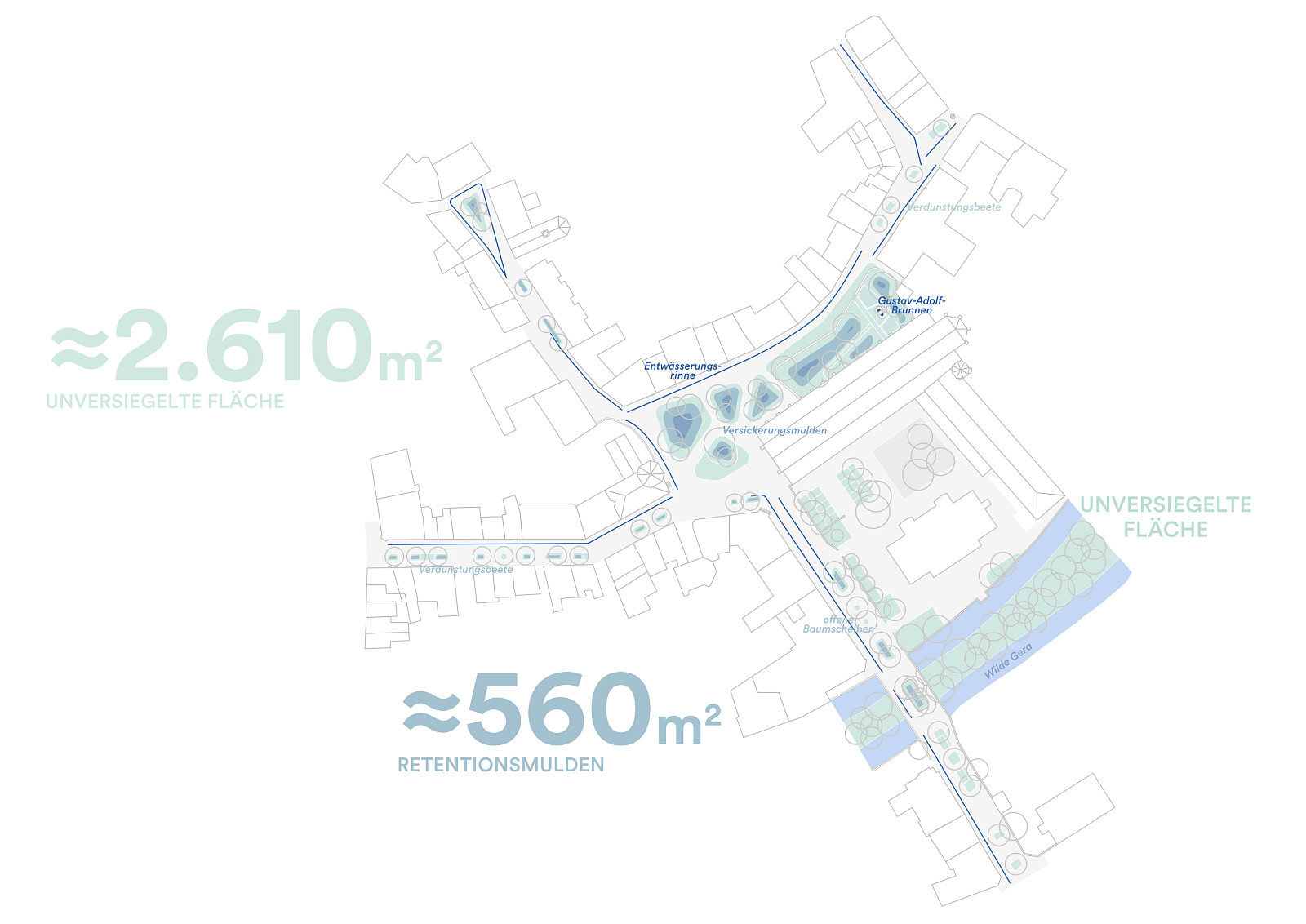
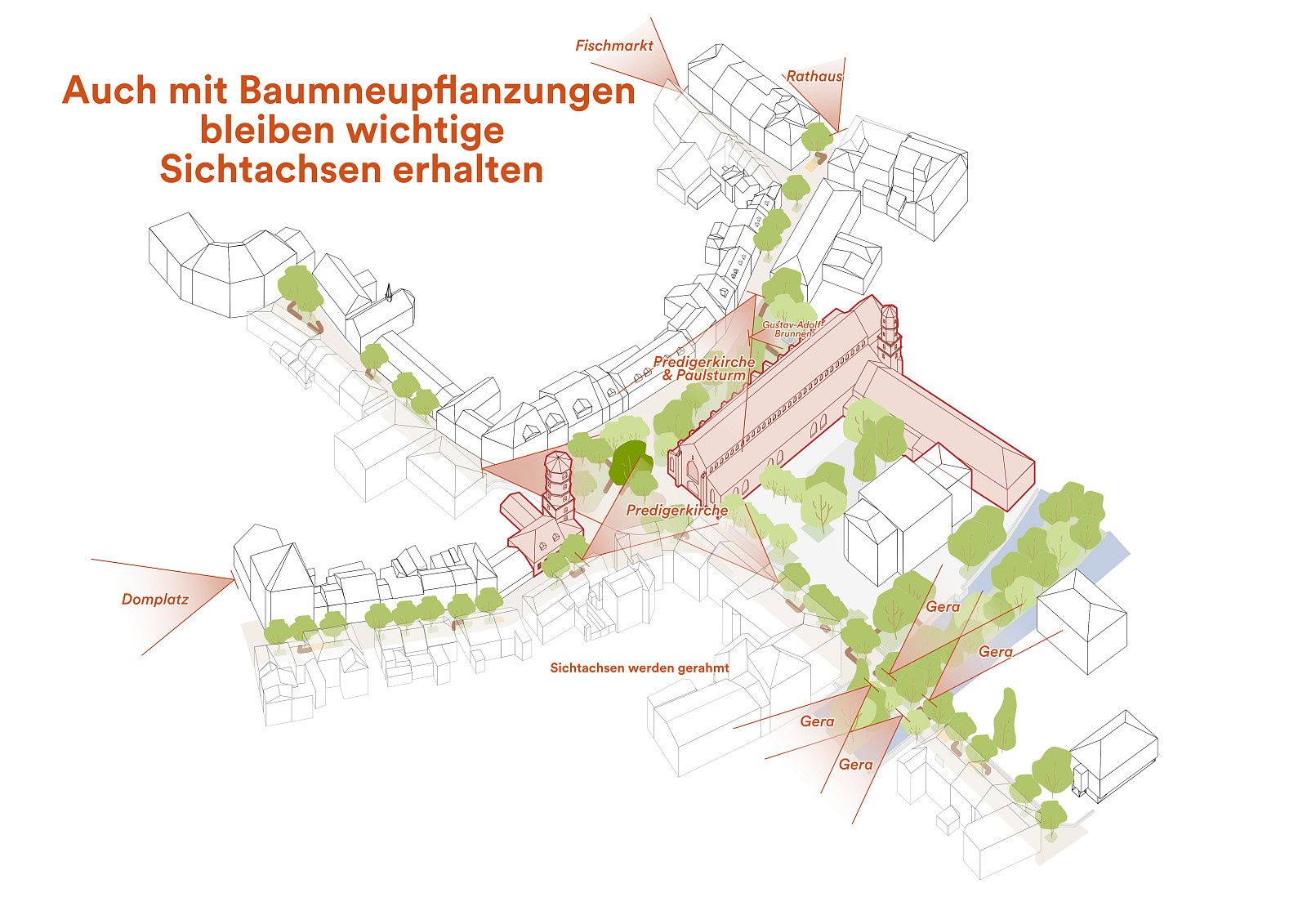
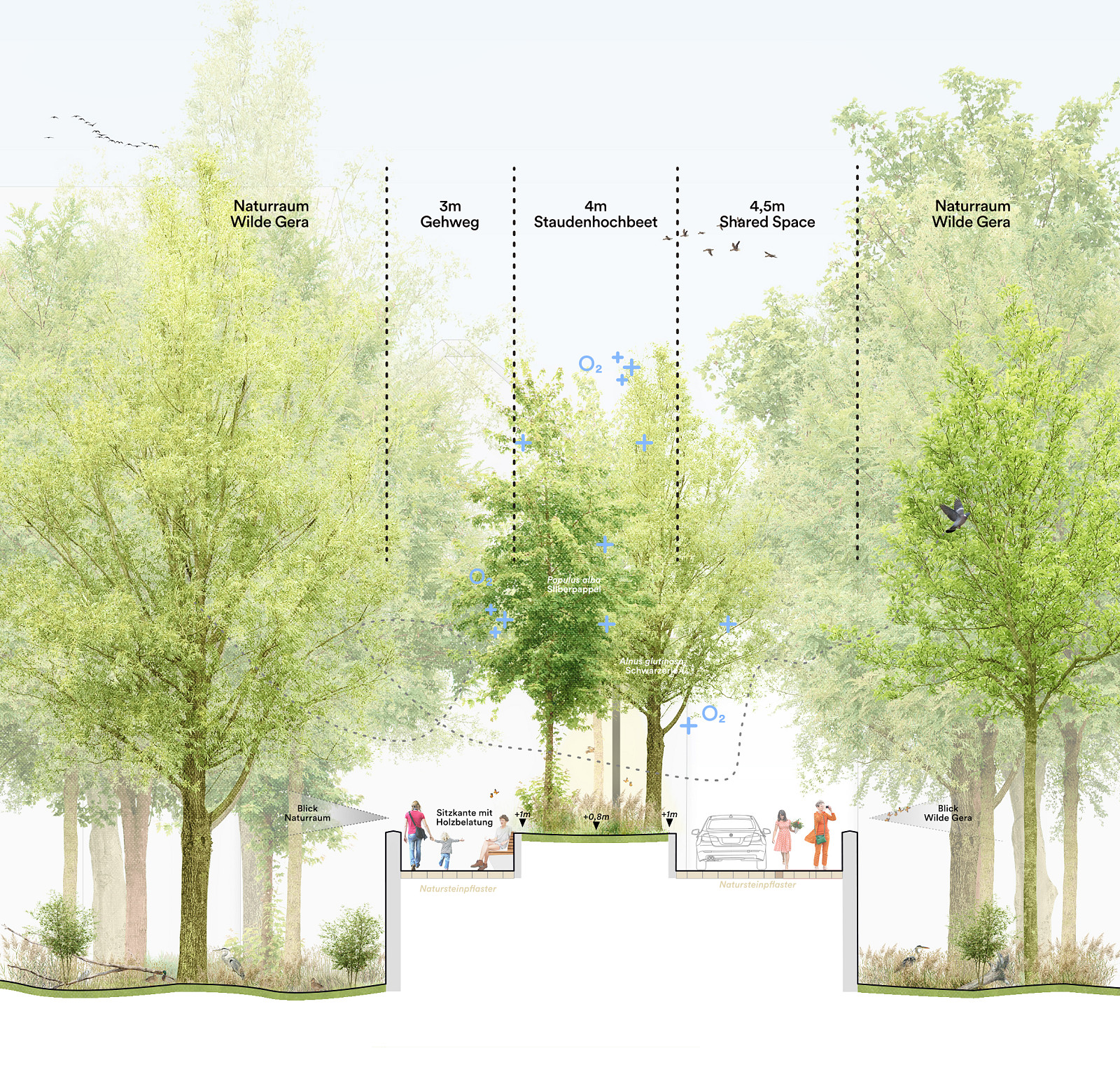
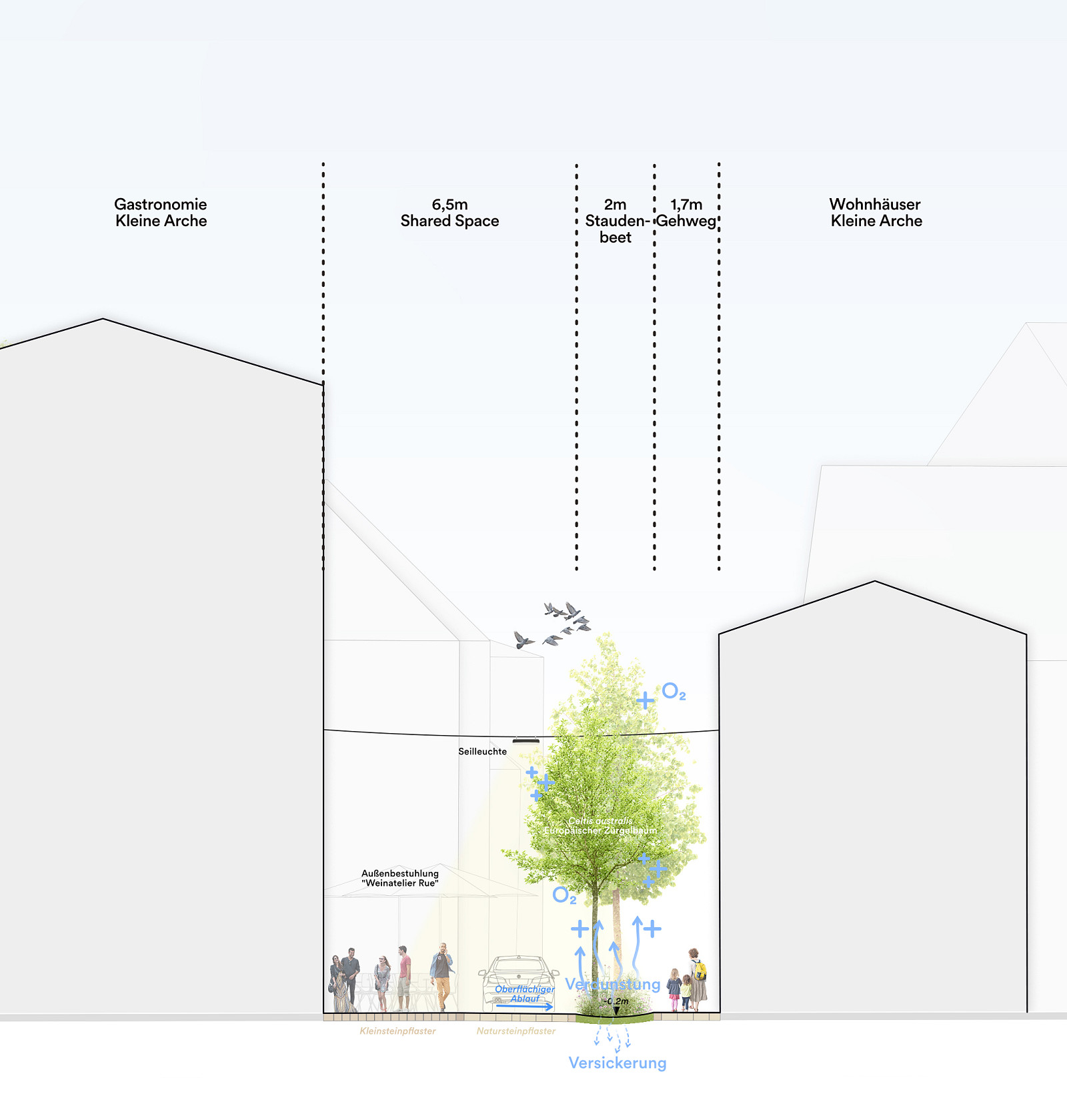
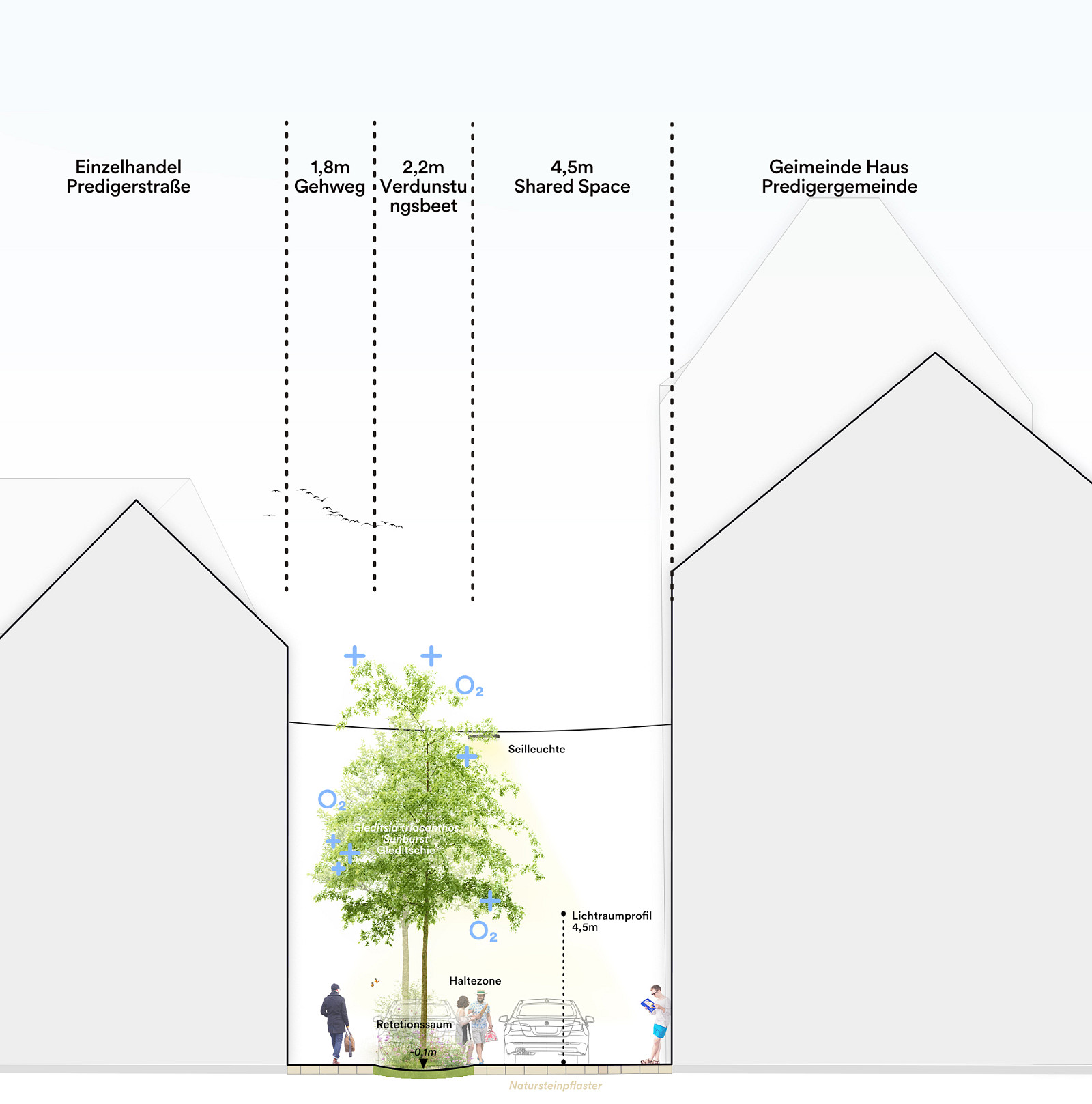
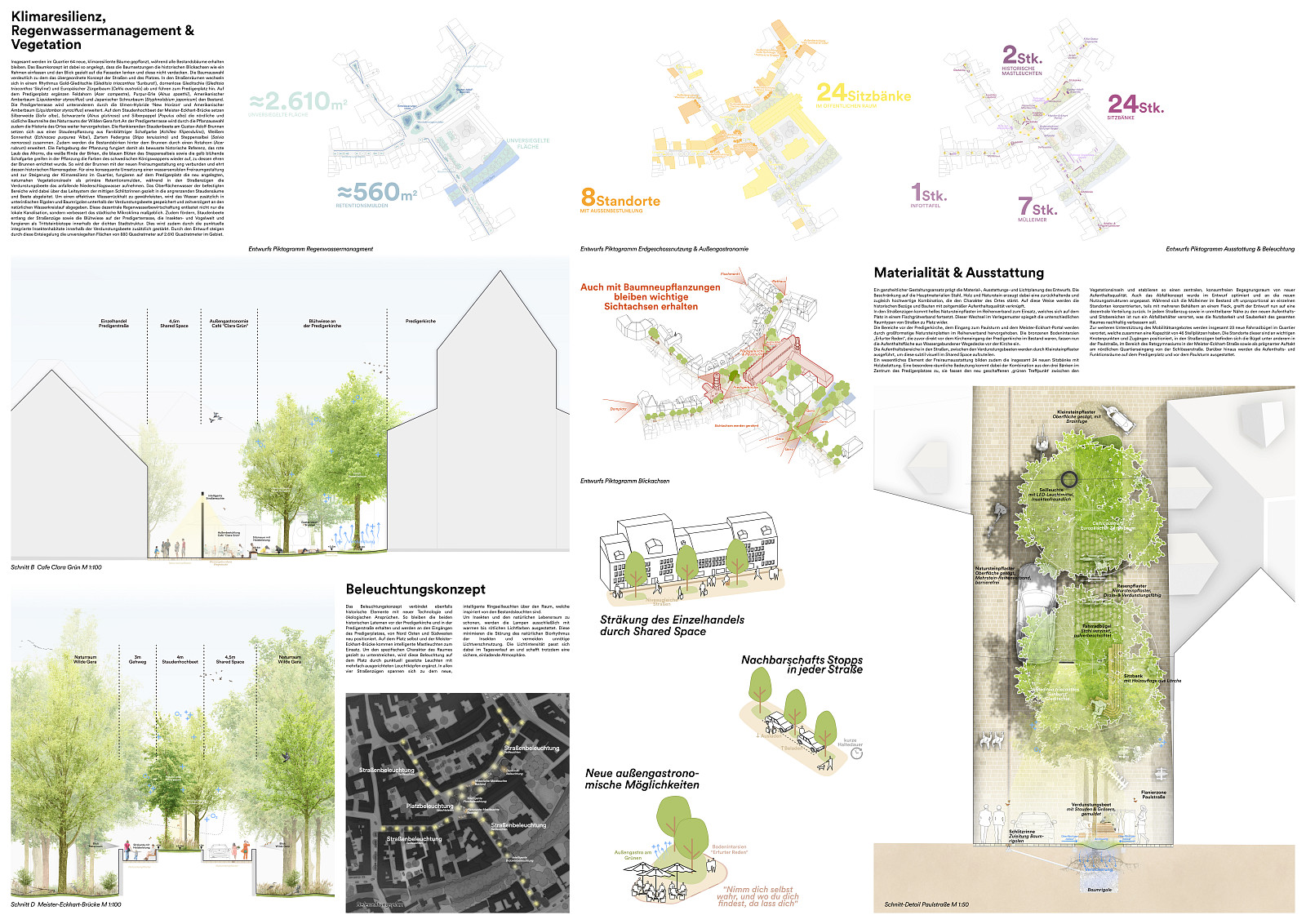
The project solution logically extends the principles of previous traffic calming by inextricably linking the stone-dominated urban space with ecological necessities. The extremely high degree of surface sealing is massively reduced (to approx. 2,610 m² of unsealed area). By implementing the sponge city principle with near-natural retention swales, evaporation beds, and tree trenches, rainwater is managed decentrally on-site. 64 newly planted, climate-resilient trees frame historical lines of sight and, together with new perennial beds, actively counteract urban overheating (urban heat island effect).
Technical information
The design is based on comprehensive material, equipment, and infrastructure planning that combines historical references with contemporary climate resilience and accessibility. The core technical parameters of the project solution include:
Traffic Engineering and Routing:
Cross-sections: A continuous, navigable movement area of at least 3.50 meters in width to ensure access for emergency and supply vehicles.
Level: Completely barrier-free, level-surface construction without classic curbs in accordance with the Shared Space principle.
Traffic Calming: Area-wide speed limit of 20 km/h throughout the neighborhood, supplemented by an explicitly traffic-calmed zone in front of the Ratsgymnasium.
Surfaces and Materiality:
Main Materials: The design is limited to a high-quality, context-appropriate combination of steel, wood, and natural stone.
Paving (Streets): Light natural stone paving in a row pattern along the streets.
Paving (Square): Light natural stone paving in a herringbone pattern on the central Predigerplatz for spatial differentiation.
Special Areas: Large-format natural stone slabs in front of the Predigerkirche and Paulsturm, as well as small stone paving and water-bound macadam in the recreational and gastronomy areas.
Rainwater Management (Sponge City Principle):
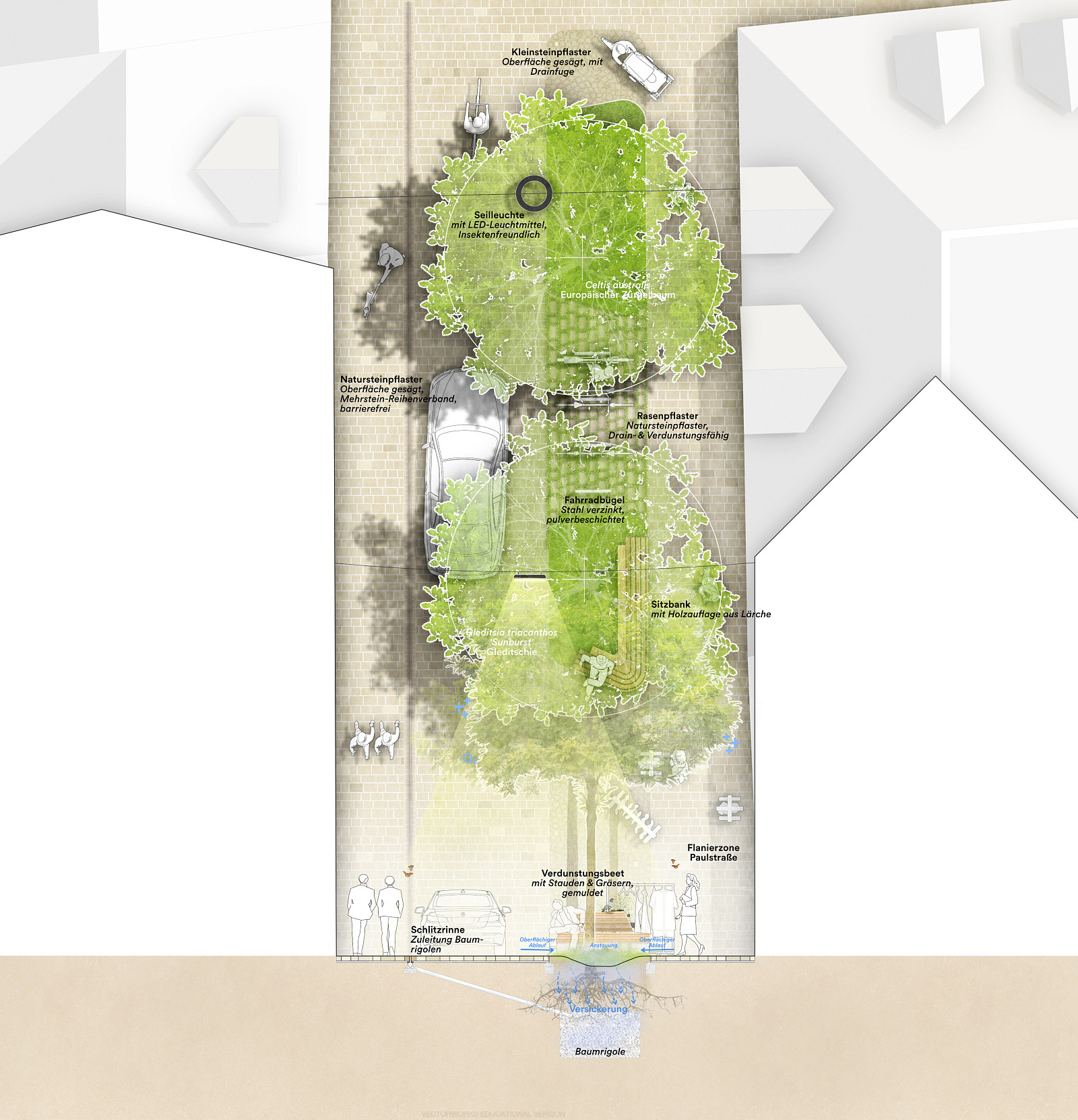
Drainage: Surface water is drained via a central slit gutter embedded in the pavement, which simultaneously serves as a visual guideline for traffic.
Storage and Infiltration: The water is directed decentrally into approx. 560 m² of near-natural retention swales and evaporation beds. Underground infiltration trenches and tree trenches store the water for delayed release.
Unsealing: The unsealed open space is increased to around 2,610 m².
Vegetation Concept:
Tree Stock: Preservation of all 9 existing trees and planting of 64 new climate-resilient trees (including honeylocust, hackberry, field maple, and sweetgum).
Ground Planting: Integration of insect-friendly perennial beds, grasses, and a flowering meadow that act as stepping stone biotopes.
Lighting Concept:
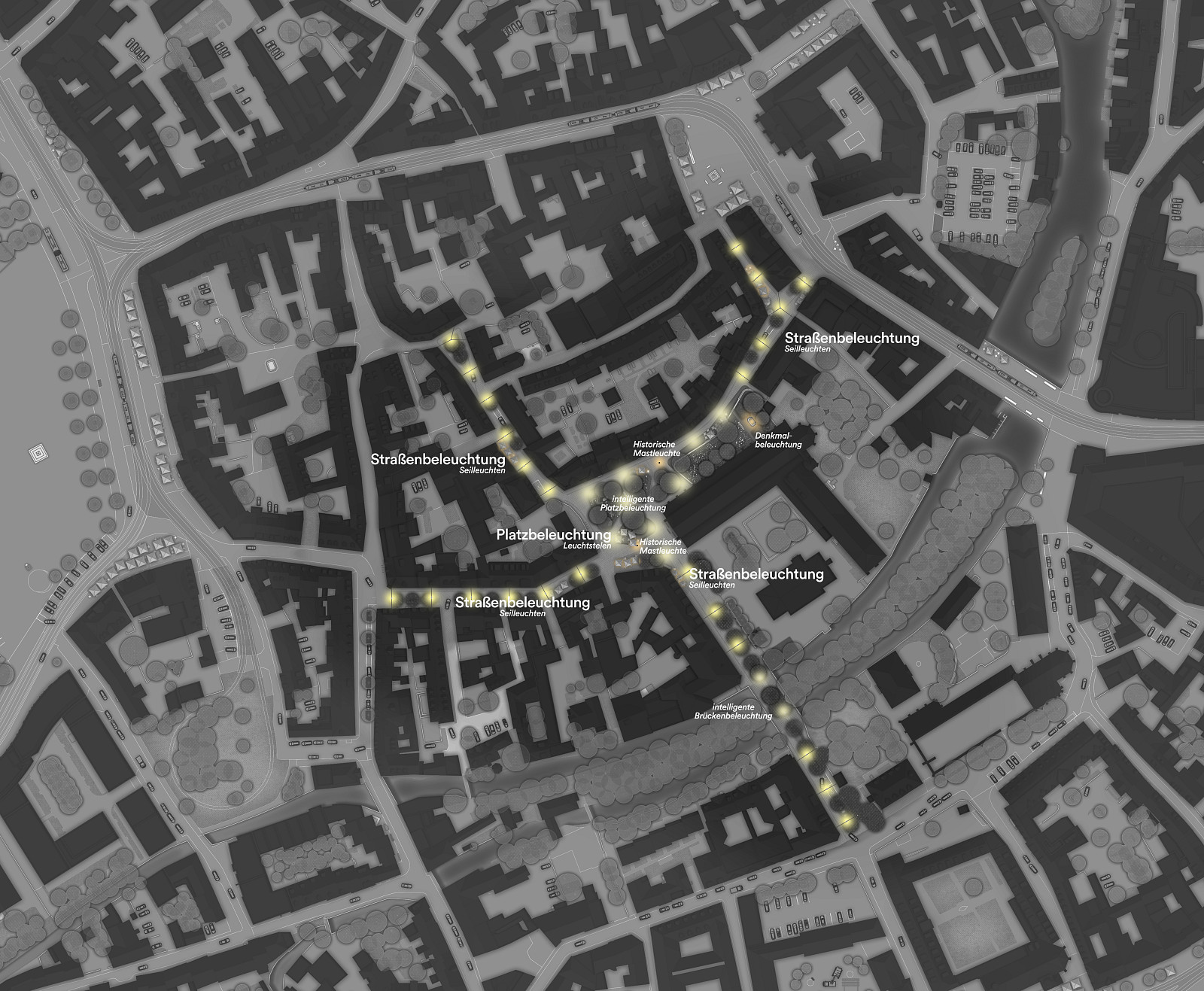
Luminaire Types: Intelligent ring wire luminaires in the narrow streets and mast luminaires with multi-directional light heads on the square areas. Two historical lanterns are preserved and repositioned.
Ecology: Use of insect-friendly, warm to reddish light colors, as well as time-dependent adaptive light intensity to reduce light pollution.
Equipment Volume:
24 new benches with wooden slats.
23 bicycle racks with a total capacity for 46 bicycles.
7 decentrally distributed waste bins as well as new, in-ground waste glass and paper containers in Meister-Eckhart-Straße.

Copyright © 2026 INSPIRELI | All rights reserved. Use of this website signifies your agreement to the Terms of Use, Privacy Policy, and use of cookies.