Historical Rebirth


Project idea
Historical Rebirth is a Final Degree Project that proposes a territorial development model for Tucumán, Argentina. The project arises from a central problem: the strong territorial inequality caused by the excessive concentration of population, services, education, healthcare, and employment in San Miguel de Tucumán.
The idea is to create an integrated regional system capable of decentralizing the province through productive infrastructure, energy independence, and territorial connectivity. The project seeks to transform infrastructure into a tool for social integration, allowing distant cities and communities to access better opportunities without depending entirely on the capital city.
Its main goal is to restore Tucumán’s historical, productive, and strategic role within the Argentine Northwest through a new model of urban and regional development.
Project description
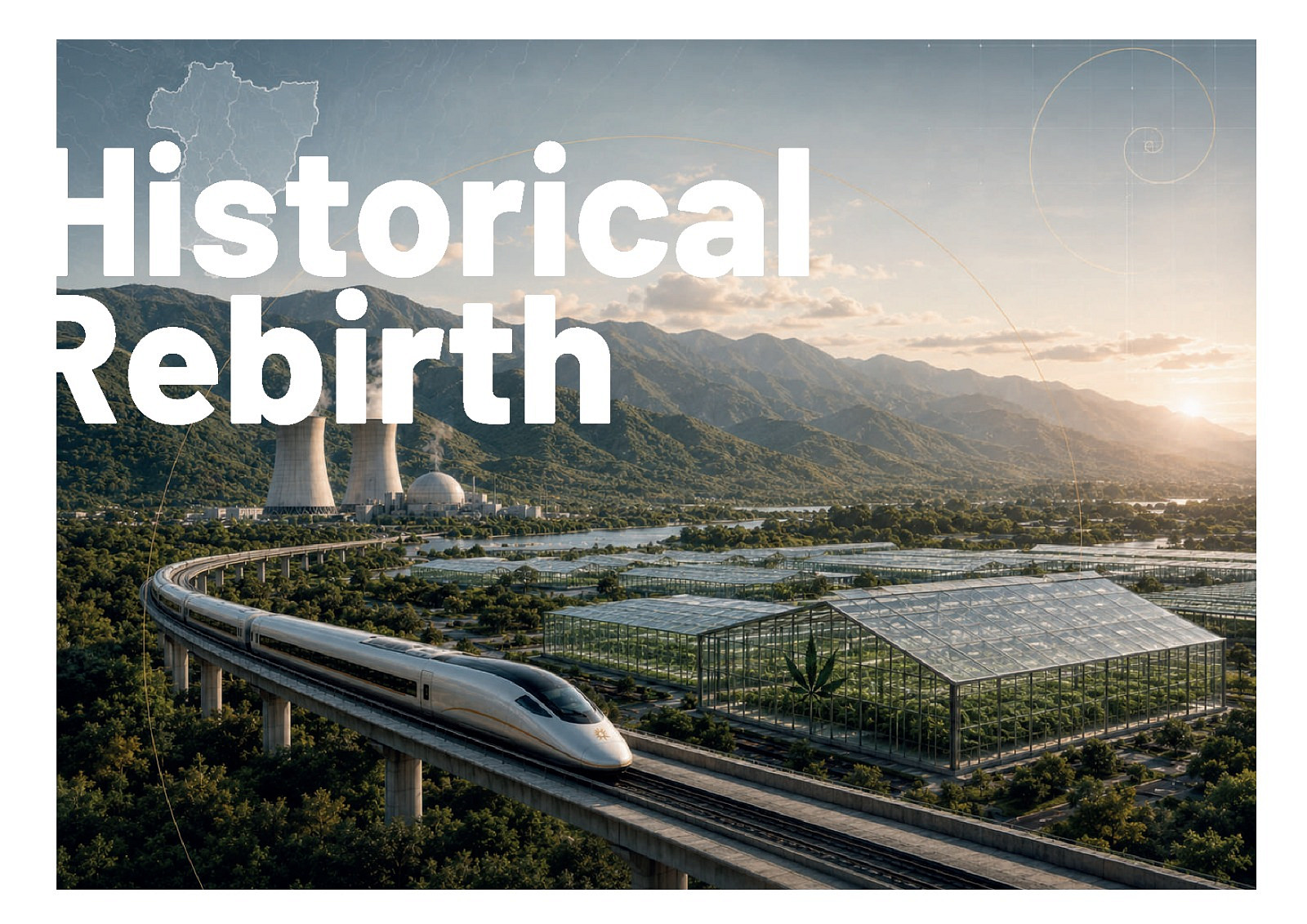
The project is structured as a regional master plan composed of complementary stages. The first stage proposes automated hydroponic cultivation of medicinal cannabis in Graneros, conceived as the initial economic and productive engine of the system. The second stage introduces a precast concrete factory in Cruz Alta, designed to produce columns, beams, segments, decks, and components for viaducts and large-scale infrastructure.
The third component locates a nuclear power plant in Trancas, establishing a strategic energy base capable of supporting the electric railway network, productive facilities, greenhouses, and future population growth. Finally, the project develops a Central Railway Station in San Miguel de Tucumán, conceived as the transfer heart of the system and the starting point for provincial redistribution.
Together, these elements create a territorial strategy that connects production, energy, mobility, and urban development, promoting decentralization and social integration.
Technical information
The architectural proposal focuses on the development of a Central Railway Station as a multimodal transportation hub located near Parque 9 de Julio, the Bus Terminal, and the airport. The station is organized through multiple levels and integrates public spaces, transfer areas, platforms, civic programs, cultural facilities, recreational areas, and urban connections with buses, taxis, pedestrians, bicycles, and potential metropolitan trunk lines.
The structural and constructive strategy is based on large-scale infrastructure systems, including elevated railway viaducts, precast concrete components, columns, beams, deck slabs, and modular construction elements produced locally in Cruz Alta. This allows cost reduction, quality control, faster construction, and the creation of technical local employment.
At the territorial scale, the project also includes automated hydroponic greenhouses with recirculating water systems, climate control, salt monitoring, precision fertigation, and controlled groundwater extraction. The energy system is supported by a nuclear power plant conceived as the regional energy engine of the master plan.
Documentation

Copyright © 2026 INSPIRELI | All rights reserved. Use of this website signifies your agreement to the Terms of Use, Privacy Policy, and use of cookies.
