Adaptive re-use as a contemporary challenge of redefining architectural space. Rocca di Ripafratta climbing complex.


Project idea
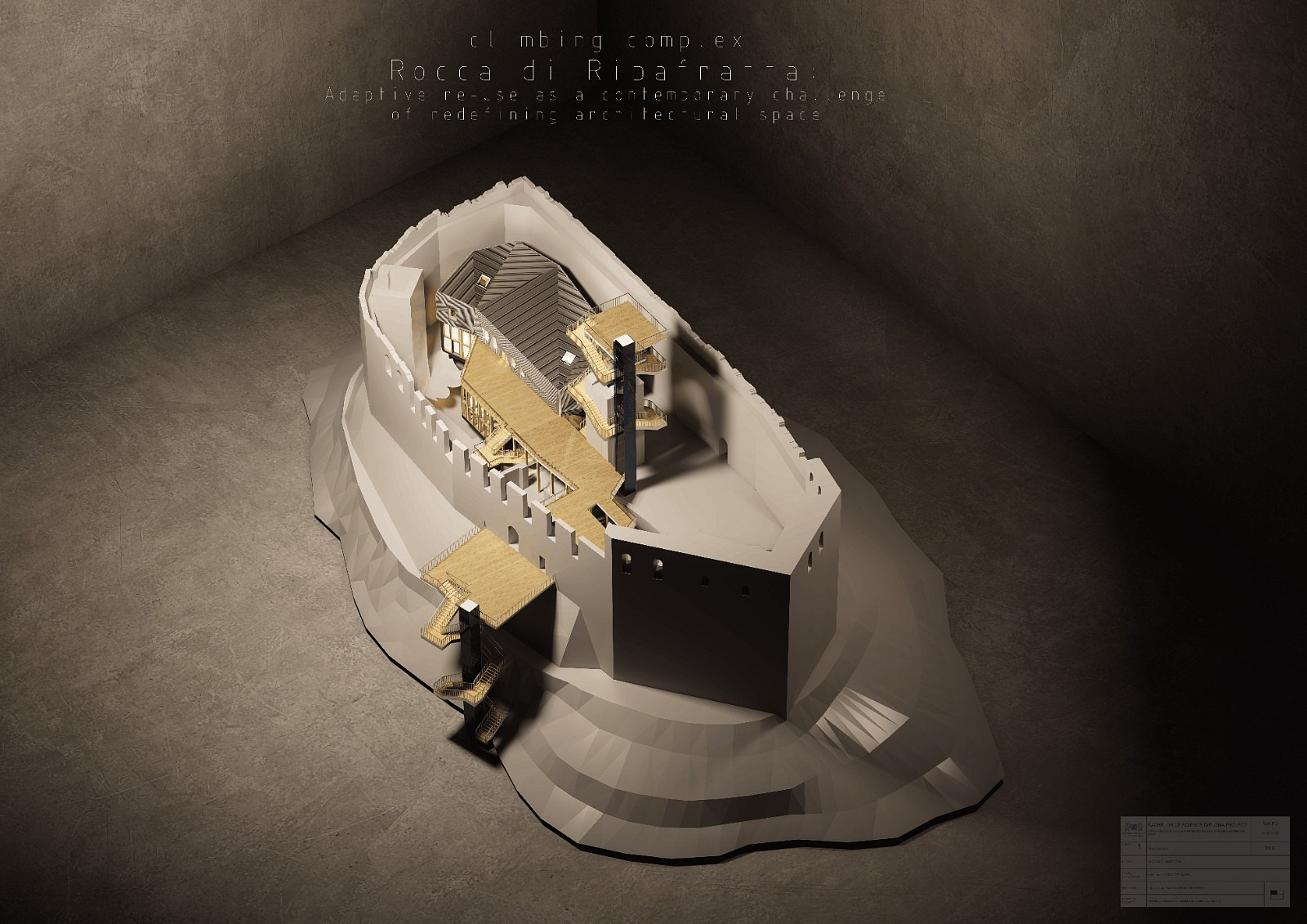
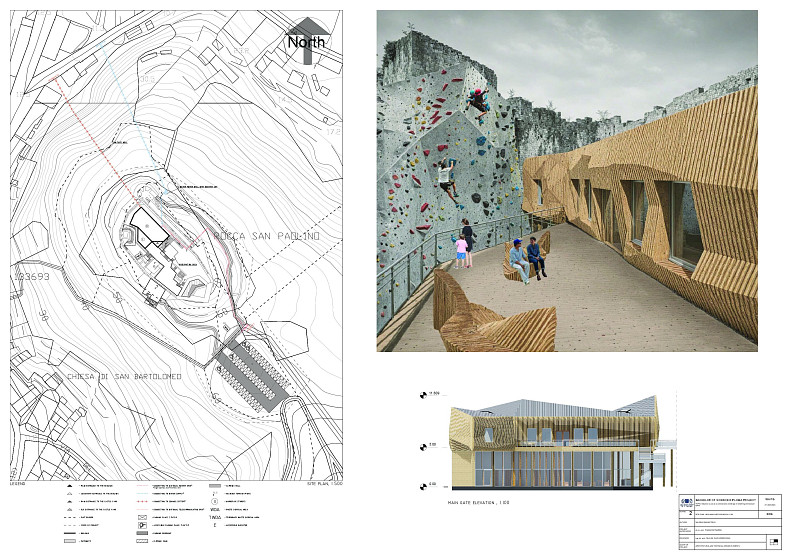
The Fortress of Ripafratta, in the province of Pisa, Tuscany, is a historically significant defensive complex that has fallen into decay after decades of abandonment, with its structural condition now critical and at risk of further collapse. At the same time, it occupies a prominent position in the local landscape and lies close to Falesia San Lorenzo a Vaccoli, a notable rock climbing destination. The idea of the project is to give the fortress renewed purpose through adaptive reuse — not by freezing it as a museum, but by reanimating it with a new, relevant program: a climbing complex with hostel accommodation, a coffee shop, and an observation deck for climbers, tourists, and locals alike. A new, structurally independent volume is placed within the ruins without touching the historic walls, ensuring reversibility, while a CLT timber structure with an irregular, rock-like slat facade is deliberately distinguished from the historic stone and brick fabric, with its massing kept lower than the surviving walls. The objectives are to stabilise the ruins through minimally invasive intervention, restore the historical silhouette of the Mastio tower through a contemporary observation deck, resolve accessibility across the site's three distinct ground levels and newly introduced observation deck, and bring the fortress back into active, sustainable public use.
Project description
The project consists of the following parts:
- a system of three platforms connected by staircases and elevators
- the main building (two-storey: coffee shop and reception area on the ground floor, hostel on the first floor)
- an observation deck
- two climbing walls
- a parking area
- pathways outside the castle walls, connecting the complex with the parking area and existing roads
- pathways and a ramp inside the castle courtyard
Technical information
The primary material is CLT, chosen for its thermal performance, structural flexibility, and visual contrast with the stone and brick walls, complemented by an abstract timber slat facade (5 cm slats with 5 cm gaps) referencing natural rock formations; corten steel was considered and rejected for aesthetic and acoustic reasons. Part of the ground floor facade consists of the UNICEL timber curtain wall system. The building's base is a reinforced concrete foundation slab placed on a layer of levelled gravel, designed to avoid deep excavation. A preliminary assessment of the site's geothermal heating potential was also carried out; geothermal heating was not adopted as the baseline solution pending further surveys, but is recommended for future development. As an alternative and baseline solution, the use of ventilation units with built-in heat pumps is proposed.
The climbing walls are completely free-standing structures, no intervention into existing castle walls is needed. To preserve, at least partly, the view on the historical structure behind them, the use of transparent climbing wall base surface is proposed.
Documentation

Copyright © 2026 INSPIRELI | All rights reserved. Use of this website signifies your agreement to the Terms of Use, Privacy Policy, and use of cookies.