Tiny House


Project idea
This project represents a conceptual response to the urban transformation of the Southern District in Brno, specifically the future development of the flood-protection park along the Svratka River. The project aims to develop a sustainable, low-energy, and fully reversible residential structure that respects the specific constraints of the floodplain territory. The design sensitively responds to the surrounding natural embankment while strengthening the visual and spatial connection to the historical city center.
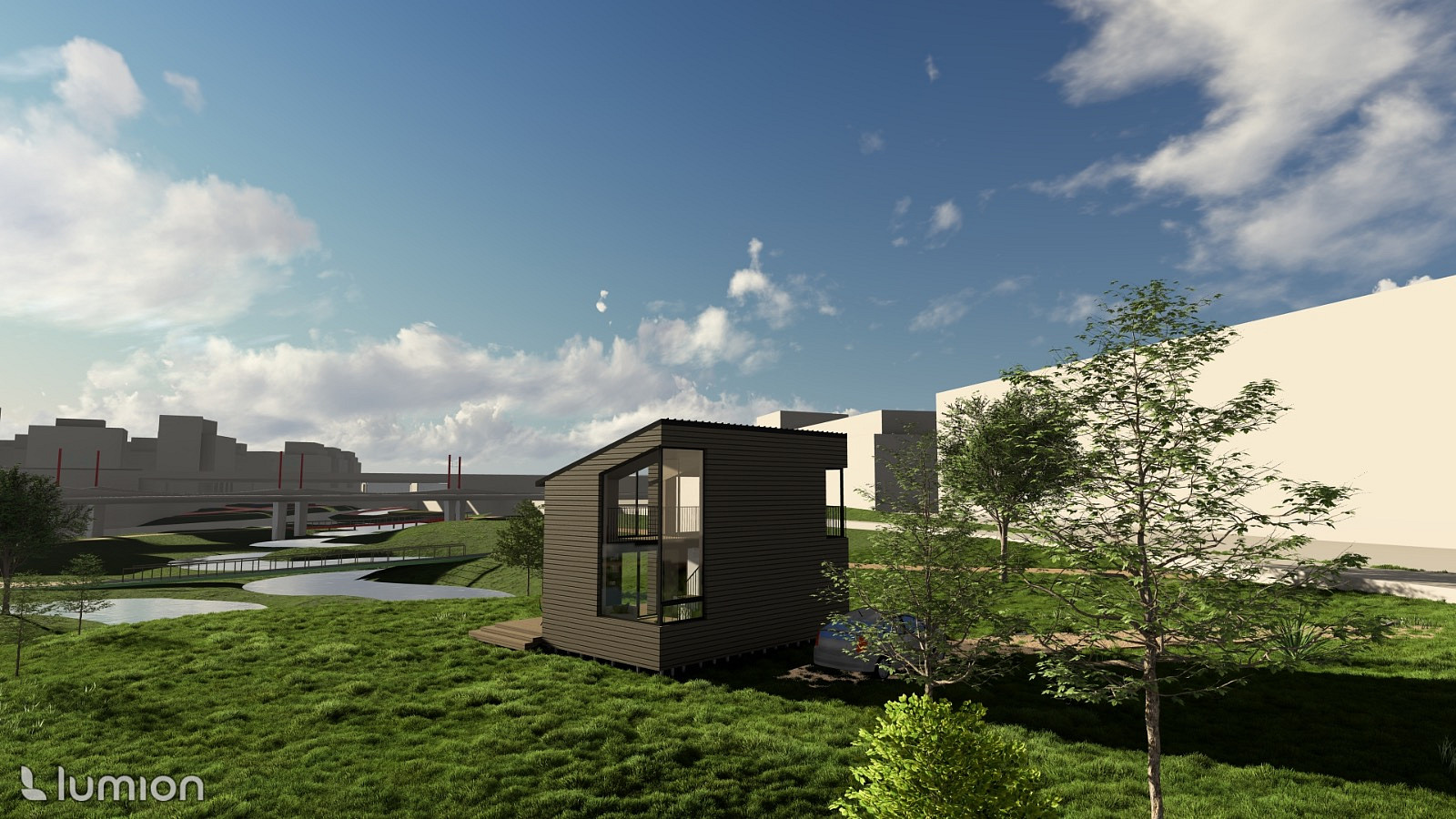
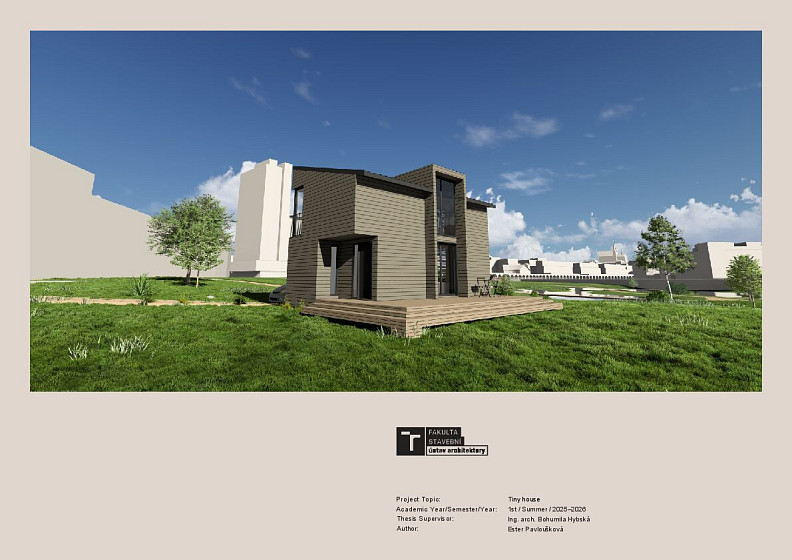
The central philosophy of the design is the material and formal integration of the object into the landscape, maintaining maximum functionality within a minimal footprint. Instead of invasive construction methods, the project utilizes the principles of prefabrication and temporality. The tiered volume with vertical slatted cladding optically reduces the scale of the building, while the panoramic glazing oriented toward the Petrov landmark creates a seamless transition between the interior and exterior. The internal layout efficiently combines social and private spaces through vertical zoning and custom-built multifunctional furniture.
The primary goals of the design include environmental sustainability and reversibility; the application of steel ground screw foundations and a lightweight timber frame entirely eliminates wet construction processes (concrete pouring), allowing for the complete dismantling of the structure without causing permanent damage to the waterfront ecosystem. In terms of energy efficiency, the project aims to reduce the annual space heating demand below 50 kWh/m² through a compact building envelope, optimal glazing orientation for passive solar gains, and the integration of mechanical ventilation with heat recovery. The result is an innovation in temporary residential typology that offers high user comfort, implements blue-green infrastructure elements, and demonstrates the harmonious coexistence of modern architecture with wild urban nature.
Project description
The submitted project documentation defines the physical and spatial boundaries of the architectural design at the schematic study level and is limited to the following components: a site plan addressing the positioning of the object on the plot, establishing setbacks from the road and adjacent property boundaries, and coordination with pedestrian pathways; architectural drawings containing basic floor plans of both levels, cross-sections, and elevations showing the internal layout, clear heights, and staircase parameters; a schematic definition of interior elements, including bathroom fixtures and the operational principles of the built-in furniture (fold-down table, door leaves); and structural diagrams outlining the material scheme of the KVH timber structural frame. The documentation serves as an architectural concept and excludes detailed construction drawings, structural calculations, or detailed MEP engineering execution projects.
Technical information
The building is designed as a lightweight timber structure using a system of
prefabricated wooden posts and beams. This structural system ensures high stability
and stiffness while maintaining a low overall weight. The use of prefabricated elements
enables rapid on-site assembly with minimal impact on the ecosystem of the future
park. Due to its location within the Svratka floodplain, the building is carefully anchored
using steel ground screws evenly distributed beneath the floor structure. This solution
eliminates the need for concrete foundations, ensures stability in soft soil conditions,
and allows for full reversibility of the structure. High thermal performance and year-
round habitability are ensured by an insulated building envelope. The design
emphasizes sustainability and a low carbon footprint, with natural timber as the primary
material for both the structural system and the façade.
Documentation
Created in:


Copyright © 2026 INSPIRELI | All rights reserved. Use of this website signifies your agreement to the Terms of Use, Privacy Policy, and use of cookies.