Rehab & Rehome: A Holistic Well-being Space for Rescued Cats & Dogs


Project idea
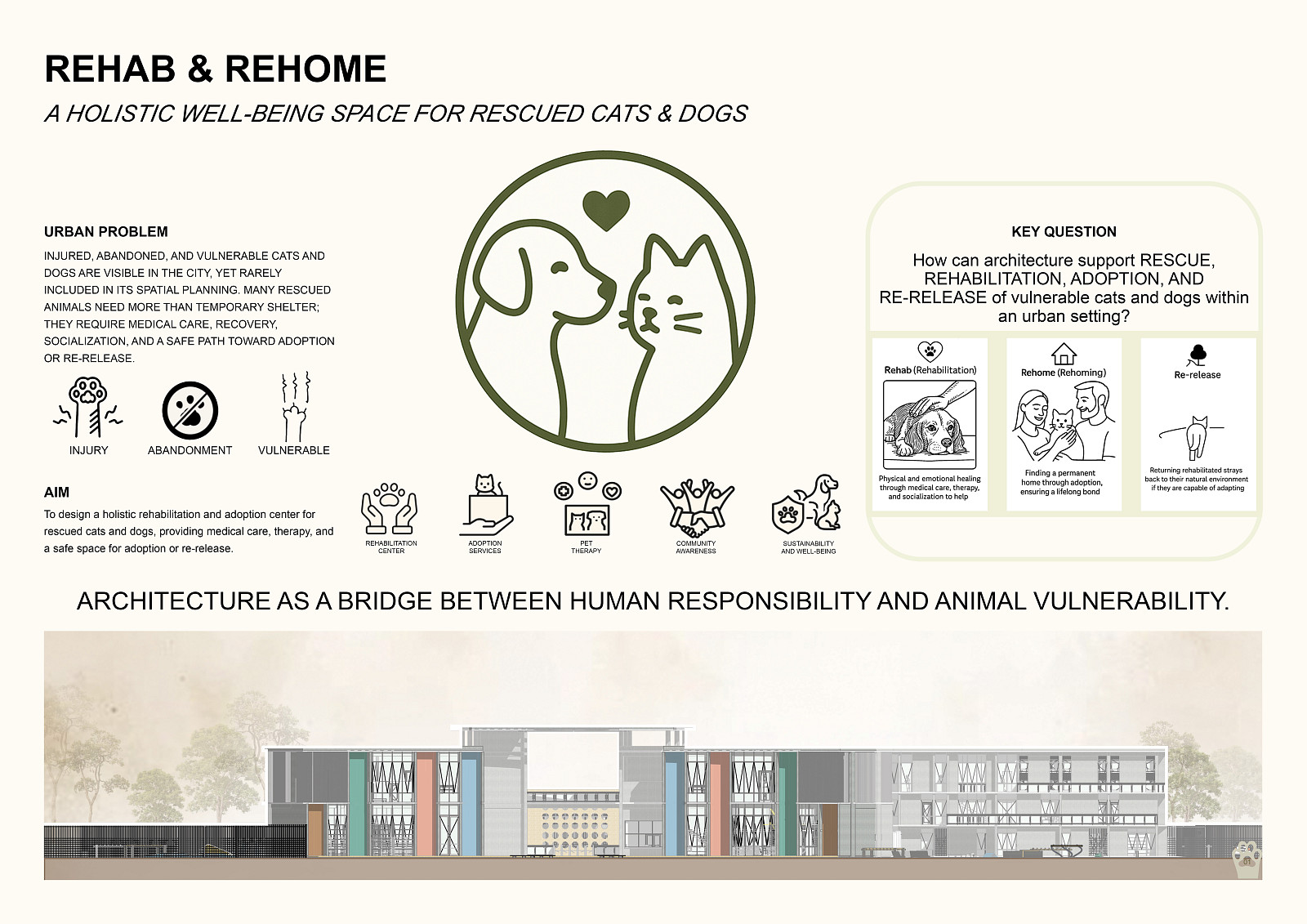
Rehab & Rehome: A Holistic Well-being Space for Rescued Cats & Dogs is an animal-centred rehabilitation and adoption facility that addresses the growing need for organized care systems for injured, abandoned, and vulnerable companion animals in urban environments. While rescued animals often receive temporary shelter, their behavioural recovery, socialization, and long-term well-being are frequently overlooked. The project explores how architecture can support rescue, rehabilitation, adoption, and re-release through a carefully planned environment tailored to the physical and emotional needs of cats and dogs.
The design views care as a sequence rather than a single shelter space, organizing the rehabilitation journey from rescue and treatment to recovery, socialization, and eventual reintegration. By integrating veterinary care, behavioural rehabilitation, community engagement, and long-term support systems, the project aims to create a humane and sustainable model for animal welfare while strengthening the relationship between people and rescued animals
Project description
The project proposes a comprehensive rehabilitation and rehoming center for rescued cats and dogs, designed as a complete care environment rather than a conventional shelter. The planning framework is based on the understanding that recovery is a gradual process involving medical treatment, behavioural rehabilitation, socialization and eventual reintegration into society through adoption or re-release. As a result, the entire facility is organized around the sequential journey of an animal, beginning with rescue and intake, progressing through treatment and recovery, and culminating in rehoming or release.
The site is structured through a hierarchy of public, semi-public, and private zones to balance community engagement with protected rehabilitation spaces. Public functions such as the cat café, pet accessories shop, foster hotels, and awareness facilities create opportunities for interaction between people and animals while encouraging education, empathy and participation in animal welfare initiatives. Semi-public spaces facilitate controlled human-animal engagement, while private zones provide secure environments for treatment, recovery, observation, and long-term sheltering.
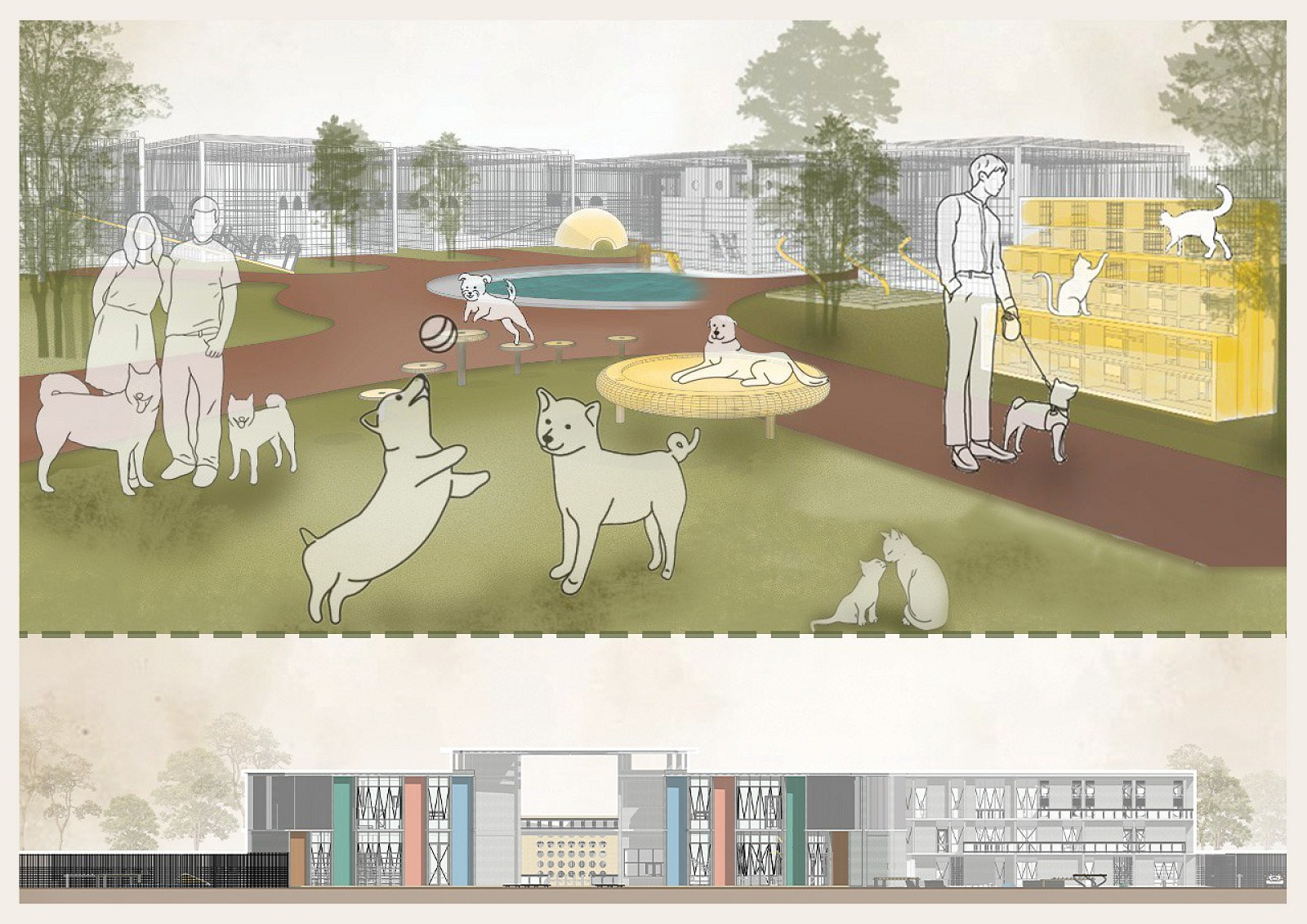
Recognizing the distinct behavioural characteristics of cats and dogs, the project develops separate rehabilitation systems for each species. Dog rehabilitation spaces are organized around movement, exercise, observation, and gradual socialization. Shelter modules are arranged according to temperament, age, and recovery stage, allowing controlled interaction while minimizing stress and behavioural conflict. Cat rehabilitation spaces prioritize privacy, vertical exploration, hiding opportunities, territorial comfort and carefully managed social exposure. The shelter modules incorporate species-specific environmental features that support natural behaviour and emotional well-being throughout the recovery process.
A dedicated veterinary block serves as the clinical core of the facility, accommodating emergency treatment, diagnosis, surgery, post-operative recovery, and medical observation. Post-operative care modules provide protected environments for animals requiring extended supervision before entering the rehabilitation system. Supporting this network are service facilities and caregiver accommodations, enabling continuous twenty-four-hour care and reducing response time during emergencies or recovery periods.
The project further explores how animals perceive and experience space. Landscape elements, circulation systems, shelter modules, and environmental features are informed by behavioural studies and sensory perception. Outdoor yards, shaded resting zones, water features, enrichment elements and species-responsive colour strategies contribute to an environment that supports both physical healing and psychological comfort.
Rather than treating animal welfare as an isolated service, the project integrates rehabilitation, community engagement, education, and adoption within a single architectural framework. Through this approach, the facility functions as both a recovery environment for rescued animals and a public platform that encourages more compassionate relationships between humans and companion animals. Ultimately, the project seeks to demonstrate how architecture can actively contribute to animal welfare by creating spaces that support care, recovery, coexistence, and responsible rehoming.
Technical information
Site Area: Approximately 1.89 acres
Project Type: Animal Rehabilitation, Adoption, and Community Welfare Center
Primary Components:
-Veterinary and emergency care facilities
-Post-operative recovery units
-Cat rehabilitation shelters
-Dog rehabilitation shelters
-Adoption and socialization spaces
-Cat café and public interaction areas
-Pet accessories shop
-Cat and dog foster hotels
-Caregiver dormitories
-Service and support facilities
The planning strategy follows a public–semi-public–private zoning hierarchy, ensuring controlled transitions between community-facing spaces and protected rehabilitation areas. Species-specific shelter modules are designed according to behavioural needs, recovery stages, movement patterns, hygiene requirements, and environmental comfort. Dedicated veterinary facilities provide diagnosis, treatment, surgery, and recovery support, while caregiver accommodation enables continuous monitoring and twenty-four-hour care.
Environmental design strategies include natural ventilation, shaded outdoor areas, controlled socialization zones, drainage systems, behavioural enrichment elements, and species-responsive landscape planning. Modular shelter units allow separation based on age, temperament, medical condition, and recovery stage, ensuring a safe and adaptable rehabilitation environment for both cats and dogs.
Documentation
Created in:


Copyright © 2026 INSPIRELI | All rights reserved. Use of this website signifies your agreement to the Terms of Use, Privacy Policy, and use of cookies.