The Culture Diaries: Stories Places Tell


Project idea
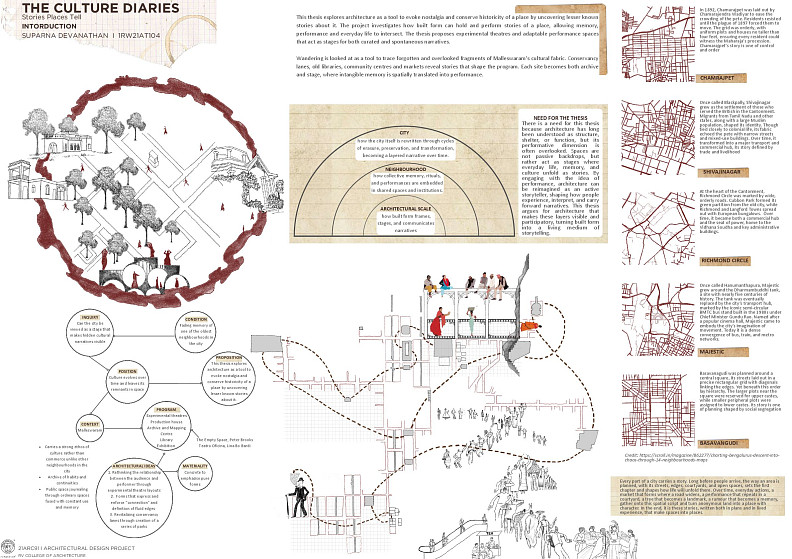
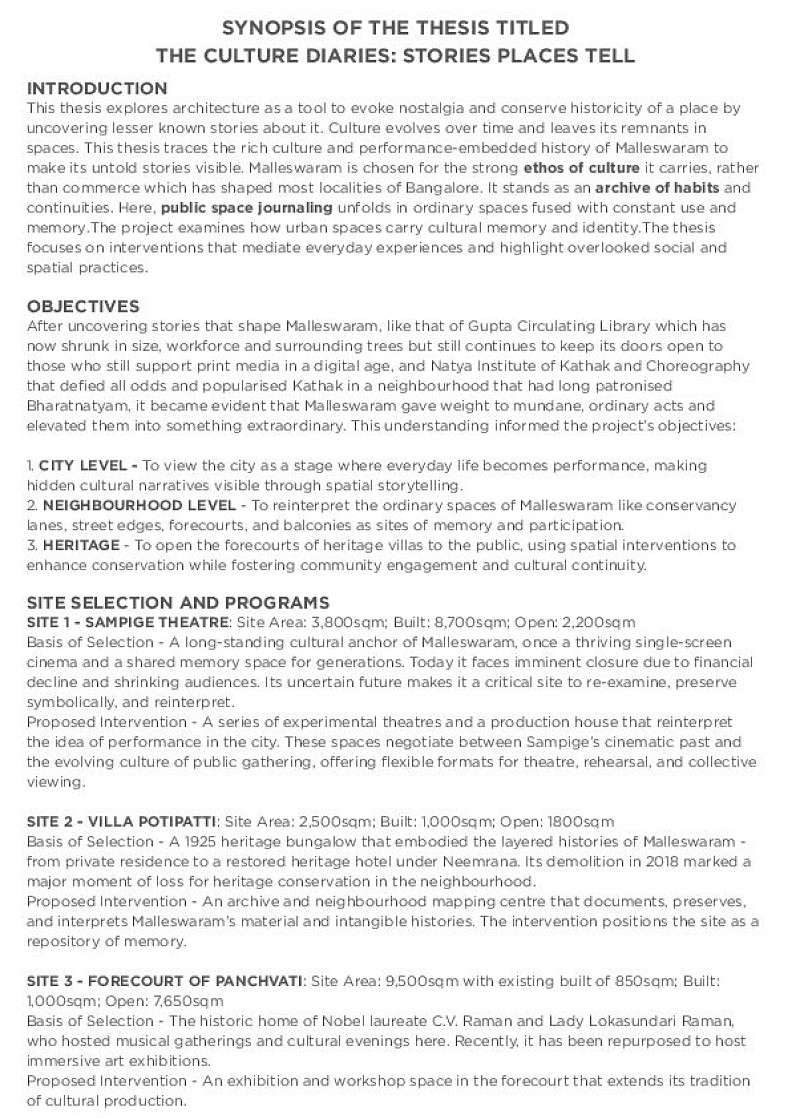
This thesis explores architecture as a tool to evoke nostalgia and conserve historicity of a place by uncovering lesser known stories about it. Culture evolves over time and leaves its remnants in spaces. This thesis traces the rich culture and performance-embedded history of Malleswaram, Bangalore to make its untold stories visible. Malleswaram is chosen for the strong ethos of culture it carries, rather than commerce which has shaped most localities of Bangalore. It stands as an archive of habits and continuities. Here, public space journaling unfolds in ordinary spaces fused with constant use and memory.The project examines how urban spaces carry cultural memory and identity.The thesis focuses on interventions that mediate everyday experiences and highlight overlooked social and spatial practices.
Project description
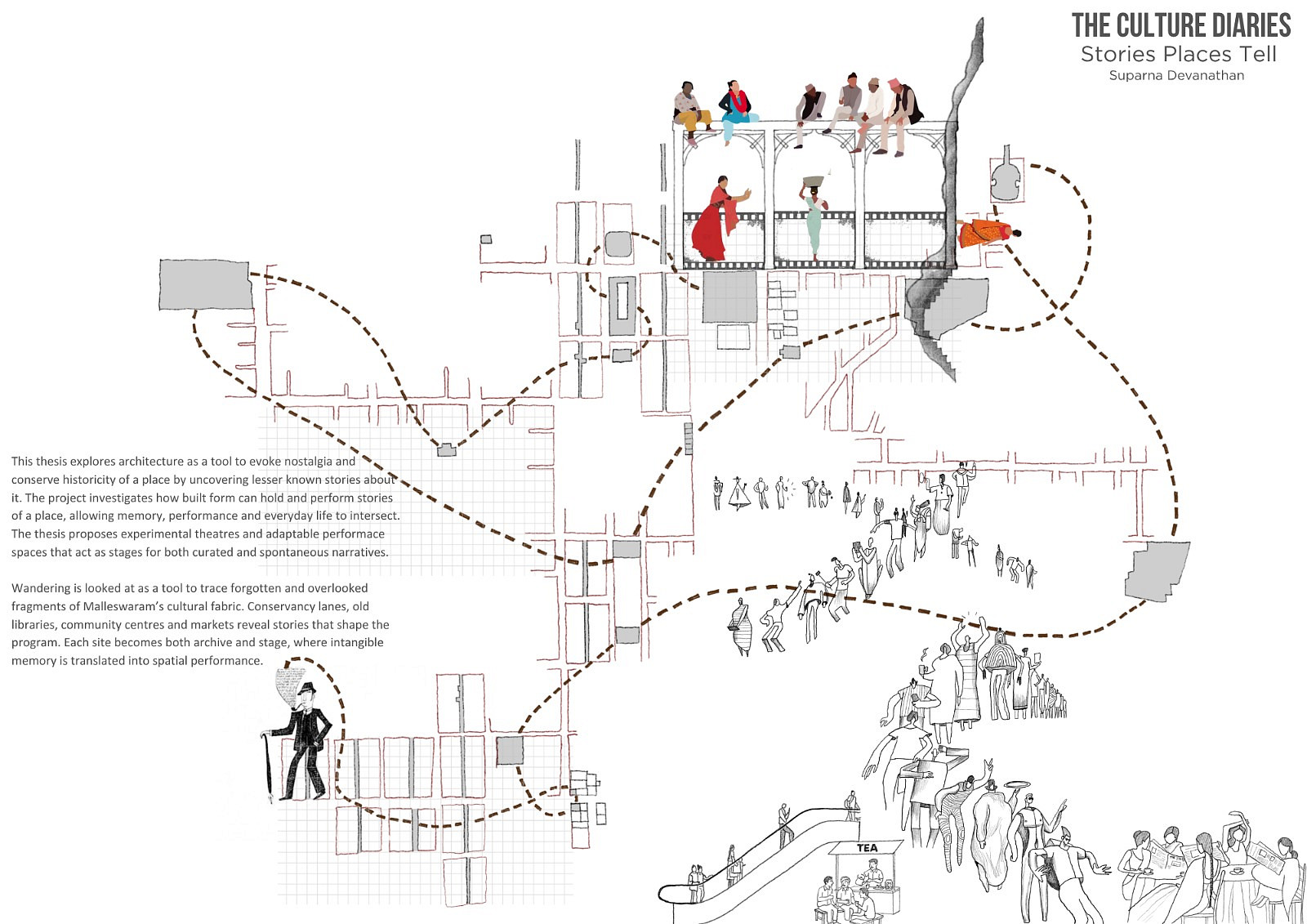
This thesis explores how built form can hold and perform stories of a place. Set in Malleswaram, Bangalore, the project uses wandering as a tool to trace forgotten and overlooked fragments of the neighbourhood's cultural fabric. Conservancy lanes, old libraries, community centres and markets reveal stories that shape the program. Each site becomes both archive and stage, where intangible memory is spatially translated into performance. The thesis argues that spaces are not passive backdrops but rather act as stages where everyday life, memory, and culture unfold as stories. By engaging with the idea of performance, architecture can be reimagined as an active storyteller, shaping how people experience, interpret, and carry forward narratives. The project examines multiple scales: the city level showing how the city is rewritten through cycles of erasure, preservation and transformation; the neighbourhood level exploring how collective memory, rituals and performances are embedded in shared spaces; and the architectural scale investigating how built form frames, stages, and communicates narratives.
Technical information
This thesis investigates how architecture can extend the cultural memory of Malleswaram through a network of interventions across sites facing transformation, loss, or changing relevance. The master plan establishes a framework of connected cultural nodes linked by green corridors, revitalised conservancy lanes, and pocket parks, reinforcing relationships between memory, public life, and everyday movement.
Four key sites are reimagined as contemporary cultural infrastructures: Sampige Theatre as a cluster of experimental performance spaces and a production house; Villa Pottipati as an archive and neighbourhood mapping centre; the forecourt of Panchvati as an exhibition and workshop space; and the forecourt of HVN House as a public open library serving surrounding educational institutions.
At the architectural scale, the design explores themes of connection, fluid edges, and collective participation. The experimental theatres draw from Peter Brook’s 'The Empty Space', translating the Immediate, Rough, Deadly, and Holy theatres into distinct spatial conditions that challenge conventional relationships between performer and audience. Through flexible performance environments and a series of “seeing and being seen” balcony conditions, the project positions the city itself as a stage, where culture emerges through encounter, observation, and shared experience.
Documentation

Copyright © 2026 INSPIRELI | All rights reserved. Use of this website signifies your agreement to the Terms of Use, Privacy Policy, and use of cookies.
