Revitalizing Asad-Ganj: Bridging Trade, Heritage & Future Horizons


Project idea
Asadganj is one of Chattogram’s oldest and most significant trading districts and serves as Bangladesh’s largest wholesale market for shutki (dried fish). Alongside shutki, a wide range of commodities including rice, lentils, spices, and other essential goods are traded and distributed across Chattogram and the rest of the country.
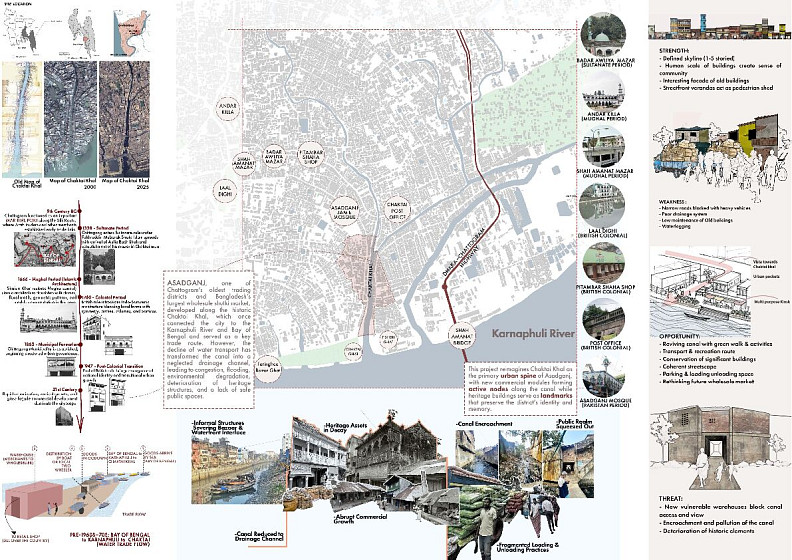
Historically, the district developed along the 5.5 km-long Chaktai Khal, which formed part of Chattogram’s connection to the Maritime Silk Route. Traders entered the city from the Bay of Bengal through the Karnaphuli River and Chaktai Khal, making the canal an important trade corridor linking Bengal with regional and international markets. Asadganj later grew into a thriving commercial district, named after the merchant Asad Ali Swadagar, where historic shophouses, merchant warehouses, and trading culture emerged directly from the canal-based economy.
Today, however, Chaktai Khal has lost its historical role and has gradually become a neglected backside drain hidden behind buildings and informal structures. As water transportation disappeared, wholesale activities became entirely dependent on a limited road network, resulting in severe congestion, flooding, environmental degradation, fire vulnerability, and unsafe canal-edge development. Historic buildings continue to deteriorate, while the absence of public open spaces and safe pedestrian environments causes many parts of the district to become inactive after business hours.
This project reimagines Chaktai Khal as the primary urban spine of Asadganj, where new designed commercial modules act as nodes along this spine, while heritage buildings function as landmarks anchoring identity and memory within the evolving market system
Project description
The proposal revitalizes Asadganj through a connected system of urban and architectural interventions centered around Chaktai Khal, restoring the canal as a functional logistics and public corridor.
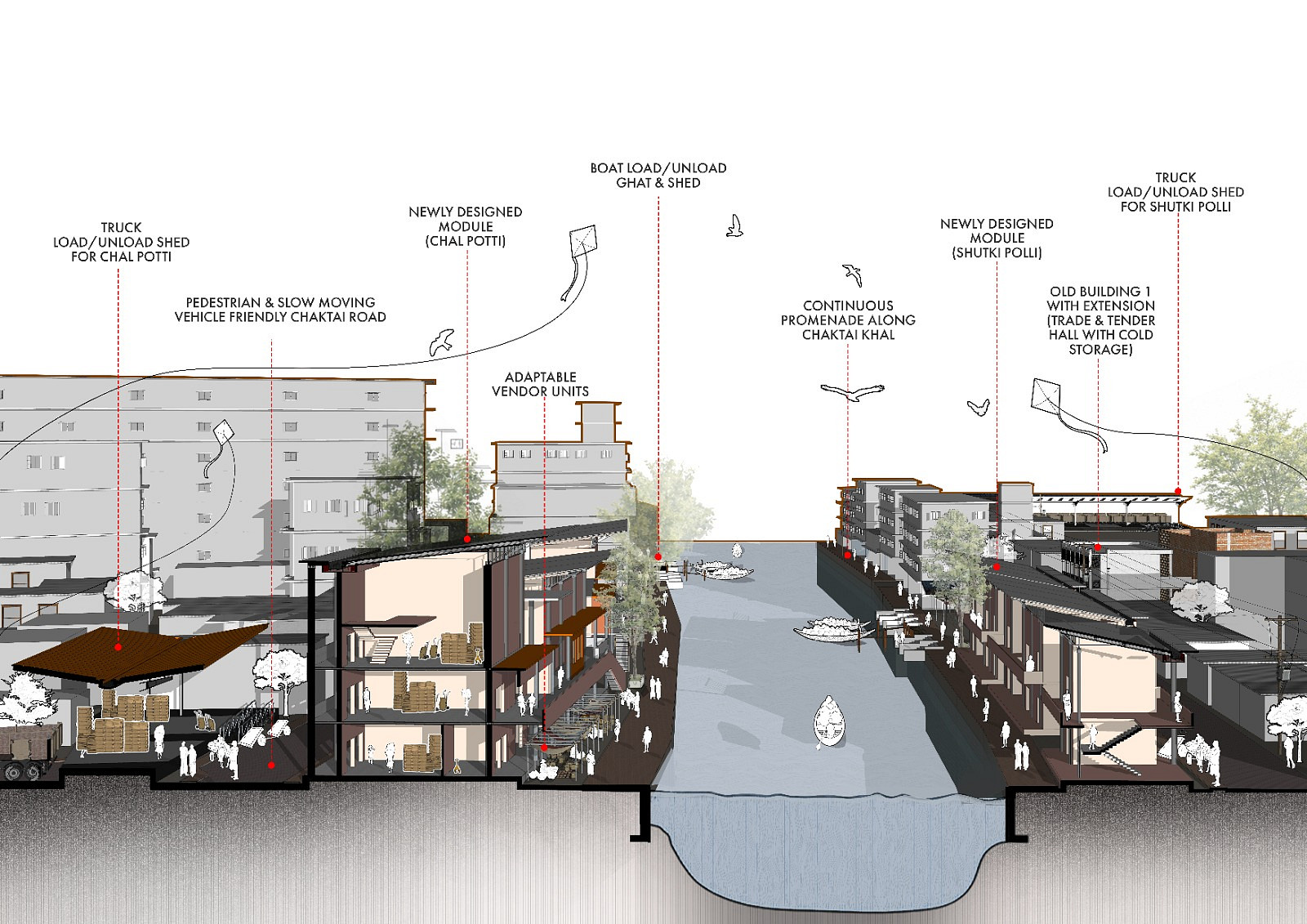
Water-based transport is reintroduced as a complementary trade system alongside road-based movement. Dedicated loading-unloading sheds and structured truck routes reorganize wholesale logistics, while selected internal streets are redesigned as pedestrian- and cart-oriented commercial corridors to reduce congestion and improve safety.
Encroached canal-edge areas are replaced with flexible commerce modules supporting wholesale, storage, and retail activities. These operate dynamically: wholesale in the early morning, retail during the day, and informal community use in the evening, ensuring continuous activation of the waterfront.
Five surviving colonial and post-colonial era shophouses are preserved as heritage anchors. Three continue commercial use, one becomes a shutki (dry fish) tender hall and trade office with cold-storage extension, and another is transformed into a local food hotel, and trader lodging facility.
The project focuses on approximately 1.2 km of canal edge, which is reclaimed as continuous public waterfront with walkways, green spaces, vendor zones, pocket plazas, and community spaces, reconnecting trade activity with public life.
Technical information
Integrated Trade Infrastructure and Spine-Based System
• The proposal establishes an integrated trade infrastructure that reconnects water-based and road-based logistics systems along the 5.5 km-long Chaktai Khal, where the canal functions as the primary spine of the entire system, structuring movement, trade flow, and urban organization.
• Goods arriving through the Bay of Bengal and Karnaphuli River are transferred at Firinghee Bazar Ghat and redistributed through Chaktai Ghat into Asadganj using both boats and road transport based on existing and operational trade routes. Reintroduced water transport will be able to accommodate 20–30 cargo boats daily, reducing truck movement within the market area by an estimated 15–20% while improving overall logistics efficiency.
• Dedicated boat and truck loading-unloading points facilitate efficient transfer of goods while minimizing disruption to existing public circulation and ongoing market activities.
Circulation and Logistics Strategy
• A hierarchical circulation network is established between vehicular and non-vehicular transport to organize existing movement patterns.
• Trucks access designated loading-unloading sheds through peripheral logistics routes serving major wholesale zones, while internal market streets, including Chaktai Road and Asadganj Road, are reserved for handcarts and pedestrians.
• This strategy reduces conflicts between logistics operations and public movement while maintaining efficient distribution throughout the market district.
Loading-Unloading Infrastructure
• Four loading-unloading sheds are strategically positioned adjacent to major wholesale clusters based on existing trade intensity and movement patterns.
• Two sheds serve the shutki wholesale district, while two serve the rice wholesale district.
• These facilities function as transfer hubs where goods arriving by truck are redistributed through handcarts and boats, reducing heavy vehicle penetration into internal market streets.
Commerce Modules and Canal Edge Development
• New commerce modules are introduced along the canal edge as a series of urban nodes along the spine, replacing vulnerable structures and accommodating wholesale, storage, and retail activities through a phased implementation strategy.
• During early morning wholesale operations, the open ground floor functions as a loading and sorting area. Throughout the day, folding shutters transform the same space into retail units, while upper floors remain dedicated to storage. In the evening, the frontage accommodates informal tea stalls and community gathering spaces.
• The modules utilize a hybrid steel-and-brick construction system. Lightweight steel framing enables rapid construction, future expansion, and flexible internal layouts, while brick-clad ground floors provide durability against flooding and intensive commercial use.
• Shaded frontages, sloped roofs, and integrated drainage systems reinterpret the architectural character of Asadganj’s historic shophouses while responding to local climatic conditions and practical construction requirements.
Heritage Integration Strategy
• Five surviving colonial and post colonial-era shophouses are restored and treated as permanent landmarks within the canal spine system.
• Three continue their existing commercial functions, ensuring continuity of ongoing trade activity.
• One historic building is adapted into a shutki tender hall supported by a contemporary cold-storage extension.
• Another restored shophouse accommodates a café and trade office, while a new extension provides temporary lodging for visiting traders.
Urban Impact and Feasibility
• Canal-edge recovery improves accessibility, environmental quality, and drainage performance through phased and realistic implementation strategies.
• Continuous commercial and social activity throughout the day and evening increases natural surveillance and supports the long-term resilience of the district.
• The proposal is designed to operate within the existing economic framework of Asadganj, allowing incremental implementation without disrupting ongoing wholesale activities.
Documentation
Created in:


Copyright © 2026 INSPIRELI | All rights reserved. Use of this website signifies your agreement to the Terms of Use, Privacy Policy, and use of cookies.