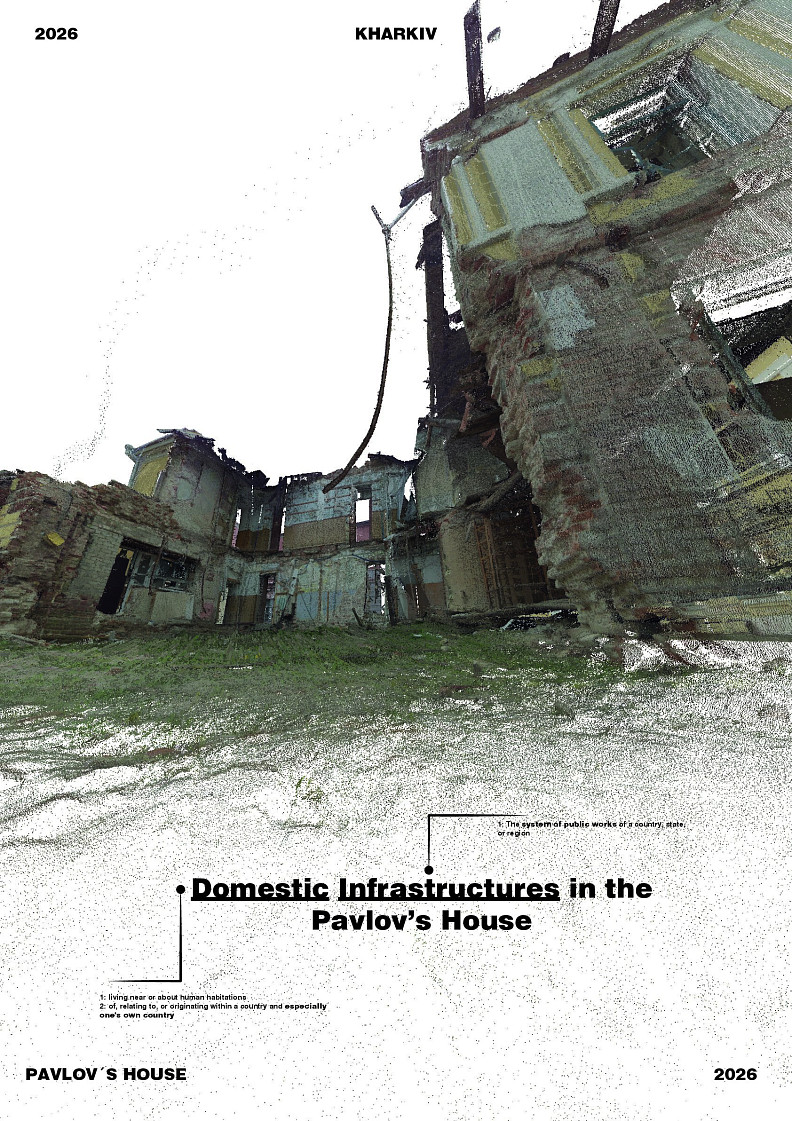
Domestic Infrastructures in the Pavlov’s House


Project idea
The proposal is conceived as an urban landmark that is open, accessible, and deeply connected to public life. Rather than functioning as an isolated object, the building extends the public realm, creating a civic space that fosters interaction between the city, the nation’s culture, and its people.
At the heart of the project lies the atrium, the main spatial and symbolic element of the design. Acting as both a threshold and a gathering space, it establishes a direct relationship between the urban context and the interior, welcoming visitors and encouraging exchange, encounter, and participation. This central void becomes a place where different paths, activities, and perspectives converge, embodying the diversity and richness of the country’s cultural identity.
Through a formally expressive architectural language, the project engages in a dialogue with memory and history, understanding them as living and evolving narratives rather than fixed references. The architecture seeks to reinterpret these collective memories in a contemporary way, transforming them into a platform for civic engagement. Ultimately, the proposal aims to bring people together around discussion, reflection, and shared experiences, reinforcing the role of architecture as a catalyst for dialogue and collective understanding.
Project description
The first floor serves as an introduction to the building. From
both sides you can aproach and enter the variety of spaces
designed. In comparison to the old Pavlov’s House this distri
bution offers bigger spaces, interconected functions as well
as a grand variety of Domesticities that can fit through the
walls.
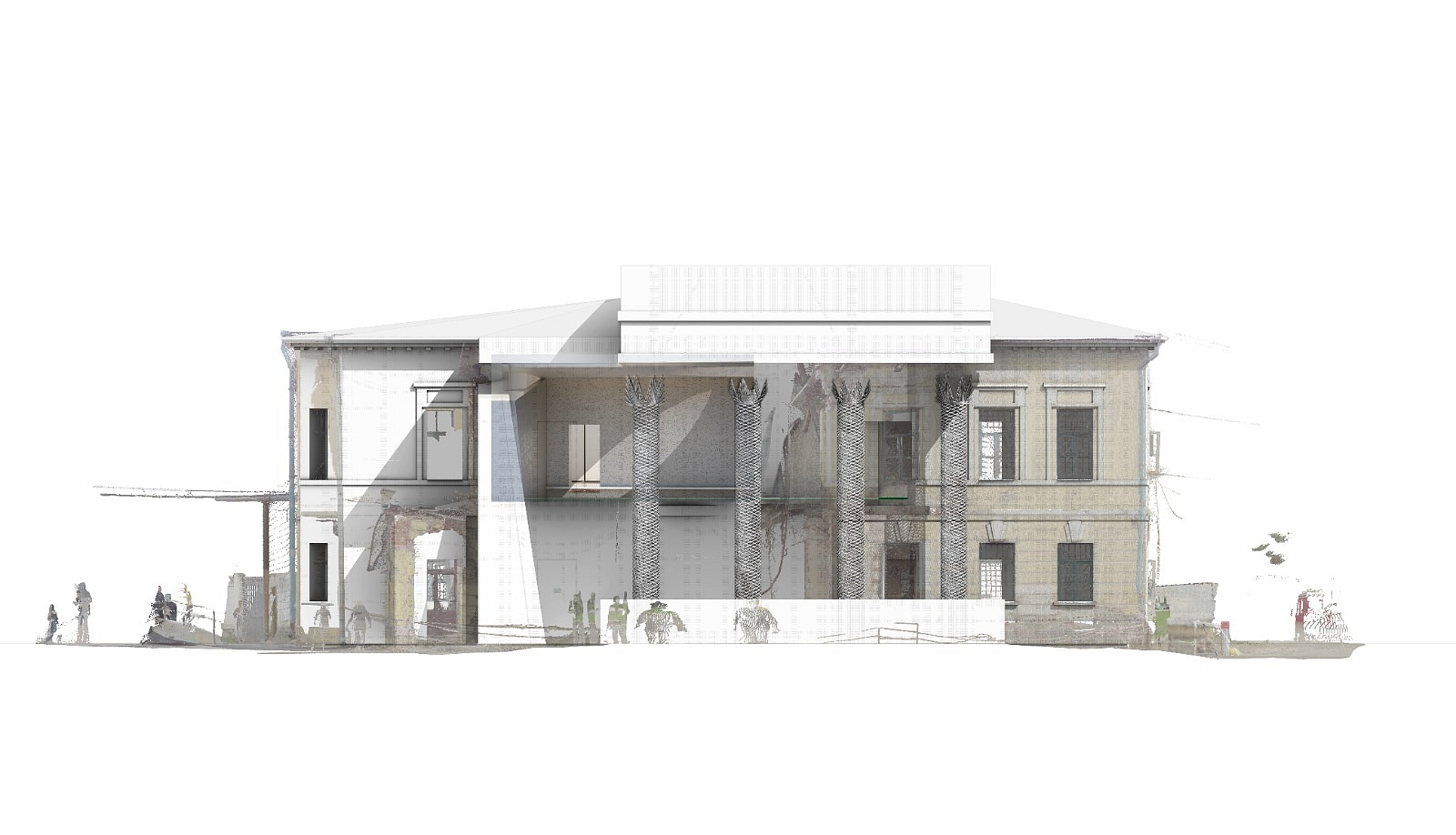
In The second floor layout the essence of the project shines.
Four double heiths appear making out of the space a monu
mental and grandiose presence. You can admire the floors
below you as well as travel through the space with ease.
Technical information
In order to protect the building for
it’s new use as well as to make it a
great landmark in the complex city of
Kharkiv a new composition has to be
made, but not from scratch, we must
adore what came before so we can see
the future.
The piece of the roof is planned
carefully. First a sky-light in reme
brance of what happened. Then a
tensile structure directed to sup
port all of the weight of the memo
ries.
Then it must come to the ground
through the Atrium.
The floor plan design is free, open and mobile. A wood deck is
instaled coinciding with the steel frame box guides in orde to
give the interior a worm feel.
For structural integrity the interior of the rooms is
protected with a steel-frame box. This action prevents
any room from colapsing as well as preserves the
original structure for its apreciation.
The tramex promenade
guides you across the
rooms of Pavlov’s House.
You can observe rooms
from above thanks to the
double heiths created.
The most affected structural areas are
resolved with a concrete poured block that
embraces the pre-existing materials. It gives
structural stability via a monolitic piece.
For structural integrity windows shall be reinforced
with a steel frame coinciding with the window.
Documentation

Copyright © 2026 INSPIRELI | All rights reserved. Use of this website signifies your agreement to the Terms of Use, Privacy Policy, and use of cookies.