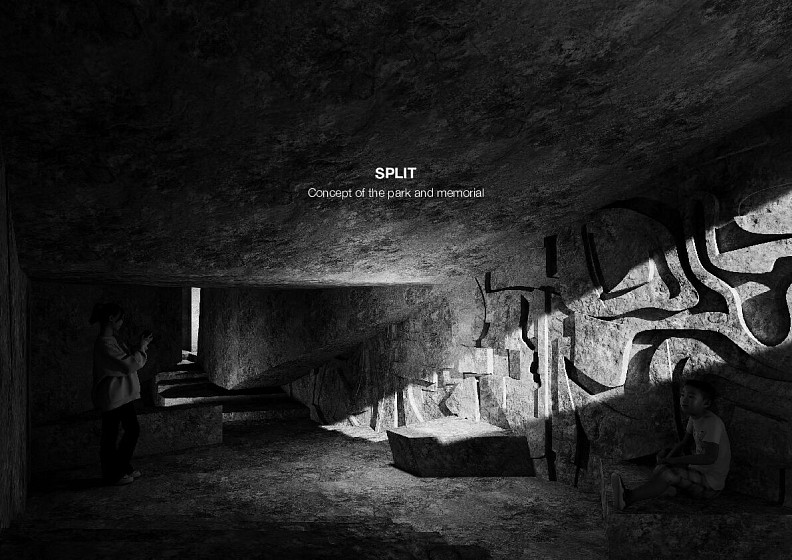
SPLIT

Project idea
The military dictatorship in Argentina (1976–1983) split society in two. In this situation, one ordinary person became an executioner, while another became a victim. The regime itself divided them, creating a mechanism in which yesterday's neighbor began to torture, and yesterday's friend disappeared forever.
Who were they? How did they live before the dictatorship entered their homes? Who were the people who found themselves on opposite sides: those who were kidnapped and those who did the kidnapping? How did they end up here: by chance, through denunciation, by order, out of conviction? What happened to them within these walls in the clandestine detention center, in the cells, during interrogations, in the "death flights"? How did they leave this place, or did they never leave at all? And what became of them afterwards: were the victims ever able to return to life, and did the executioners ever come to understand what they had done?
Our memory is the only protection against this happening again. This memorial on the site of the "Arsenal," the former base of the Argentine Army's "Miguel de Azcuénaga" Arsenal Company, where a clandestine detention, torture, and extermination center operated from 1976 to 1978, does more than document crimes. It gives back a voice to those who were meant to be erased. It asks questions of those who would rather forget. Because only by understanding what they felt can we recognize in time the signs of a repeating history.
Project description
The memorial exhibition is built around two narrative lines, between which this rupture occurred: the side of the victims and the side of the perpetrators. Walking through it, visitors will be able to feel with their entire bodies what people on opposite sides of the regime experienced.
Initially, these were ordinary people. They had families, jobs, dreams, and habits. They lived as neighbors and walked the same streets. But at a certain moment, their fates diverged forever, while at the same time tragically converging within this horrific regime.
The Path of the Victim immerses the visitor in the experience of kidnapping, imprisonment, torture, and the anticipation of death. Through sound, light, tactile surfaces, narrow spaces, and sudden expansions, the exhibition conveys feelings of fear, isolation, loss of time, and loss of hope.
The Path of the Perpetrator reveals the other side: how the repressive machinery turned an ordinary person into an enforcer. There is no justification here, but there is an attempt to understand how a system is built in which a neighbor begins to torture a neighbor. This path forces visitors to ask themselves: "What would I have done?"
The two lines sometimes diverge and sometimes intersect at key points in the exhibition. At these points, visitors simultaneously see and feel both sides of a single event.
Walking this route, a person does not simply learn facts. They live through them with their entire body and all their senses. And they leave the exhibition with one central question: how can we ensure that this never happens again?
Technical information
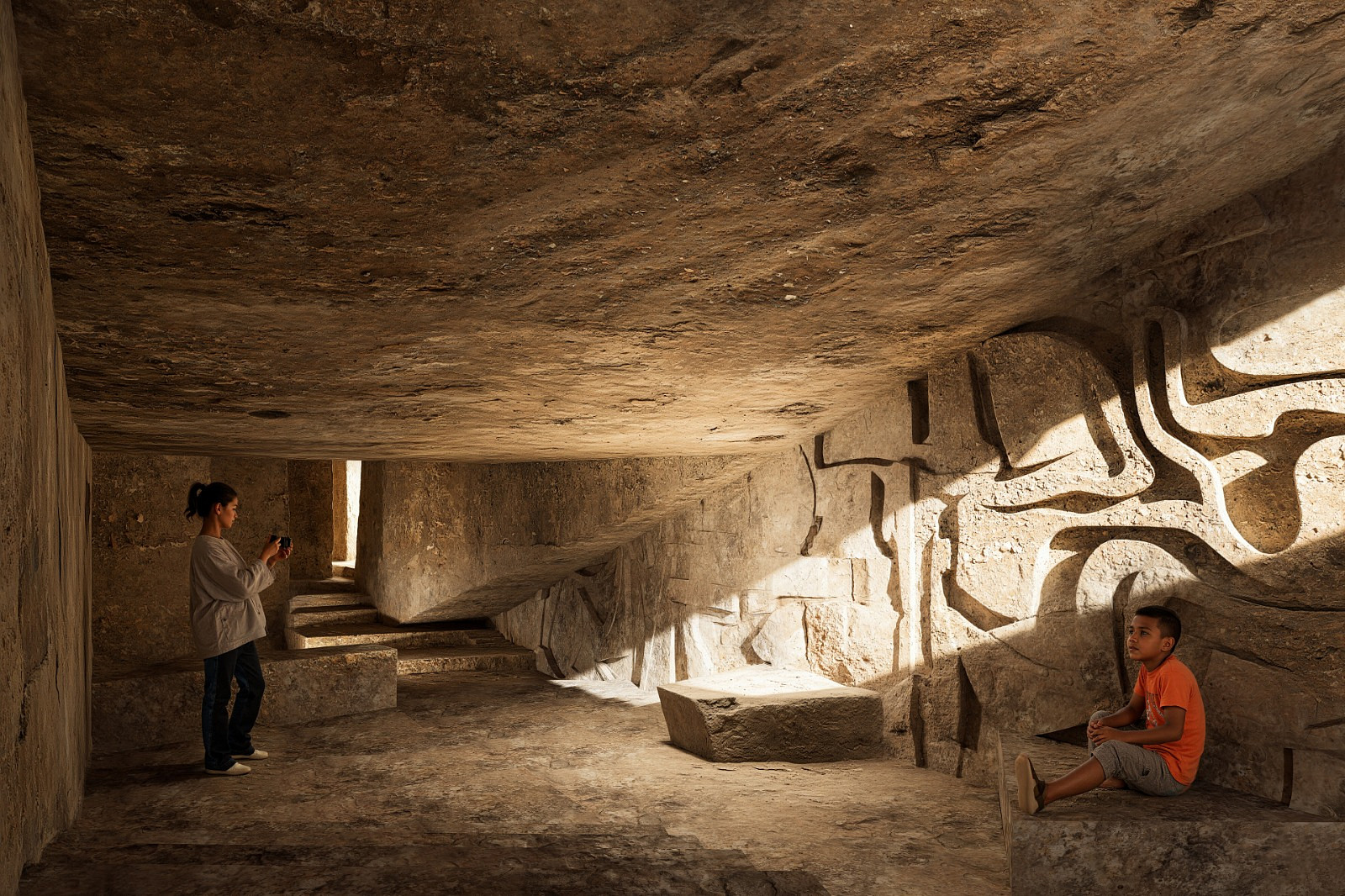
The interior exhibition space of the memorial is a complex, fragmented environment that holds the historical meanings and the stories of the people who survived the horrific events. We intentionally broke, bent, and deformed the space of the memorial to achieve the best possible immersion in and study of the history. Natural sunlight complements this space, illuminating all the elements and details necessary for understanding. To immerse visitors in the history through space, we incorporated numerical parameters and proportions that describe the historical spaces of the illegal detention center on this territory. For example, part of the exhibition is shaped by a passage 1.1 meters wide, corresponding to the width of the small, stuffy rooms where prisoners were held. The average ceiling height is 2.5 meters, matching the height of the enclosure walls of the detention area. We sought to compose the memorial exhibition using only architectural methods and means, avoiding as much as possible any graphic information, which is already abundant everywhere in our time. Instead, we wanted visitors to the memorial to partially experience and live through this resonant historical event on a sensory and emotional level of perception as they walk through the exhibition.
Documentation

Copyright © 2026 INSPIRELI | All rights reserved. Use of this website signifies your agreement to the Terms of Use, Privacy Policy, and use of cookies.