Pavlov's Art and Music School


Project idea
Bombed and rebuilt, Pavlov's mansion is restored as an art and music school, bringing culture to the heart of Kharkiv.
Project description
Relationship to the Urban Context
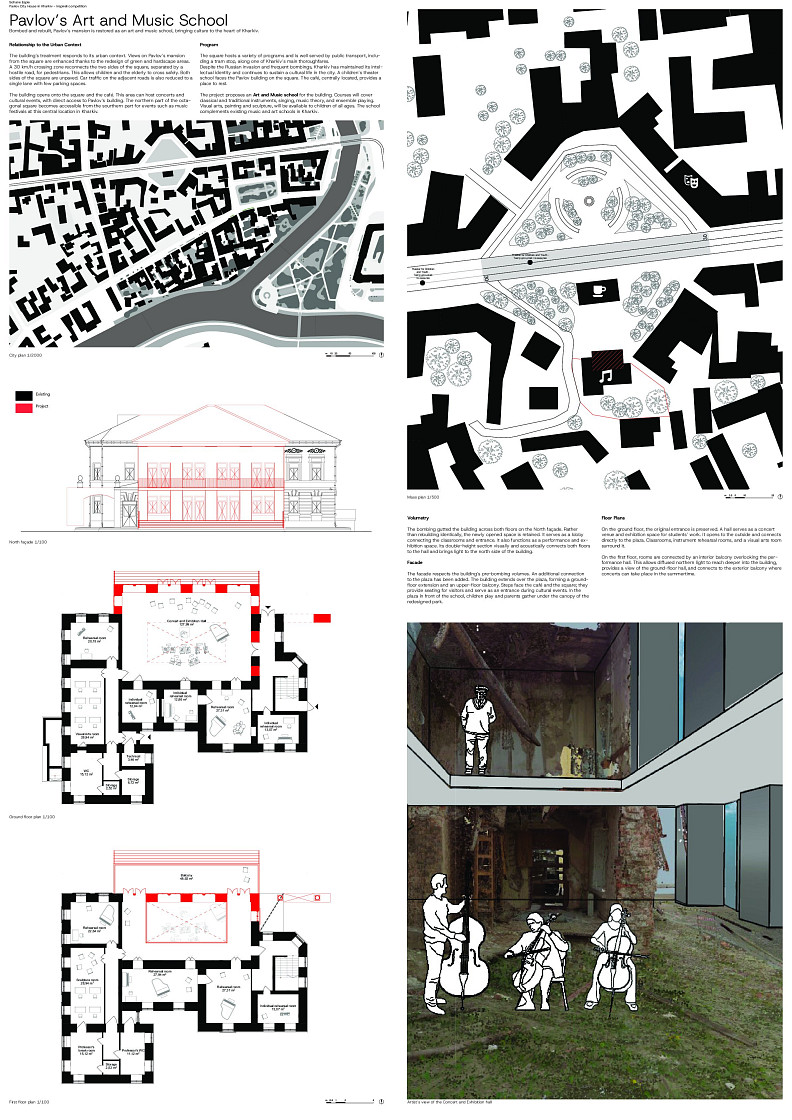
The building’s treatment responds to its urban context. Views on Pavlov’s mansion from the square are enhanced thanks to the redesign of green and hardscape areas. A 30 km/h crossing zone reconnects the two sides of the square, separated by a hostile road, for pedestrians. This allows children and the elderly to cross safely. Both sides of the square are unpaved. Car traffic on the adjacent roads is also reduced to a single lane with few parking spaces.
The building opens onto the square and the café. This area can host concerts and cultural events, with direct access to Pavlov’s building. The northern part of the octagonal square becomes accessible from the sourthern part for events such as music festivals at this central location in Kharkiv.
Program
The square hosts a variety of programs and is well served by public transport, including a tram stop, along one of Kharkiv’s main thoroughfares.
Despite the Russian invasion and frequent bombings, Kharkiv has maintained its intellectual identity and continues to sustain a cultural life in the city. A children’s theater school faces the Pavlov building on the square. The café, centrally located, provides a place to rest.
The project proposes an Art and Music school for the building. Courses will cover classical and traditional instruments, singing, music theory, and ensemble playing. Visual arts, painting and sculpture, will be available to children of all ages. The school complements existing music and art schools in Kharkiv.
Technical information
Volumetry
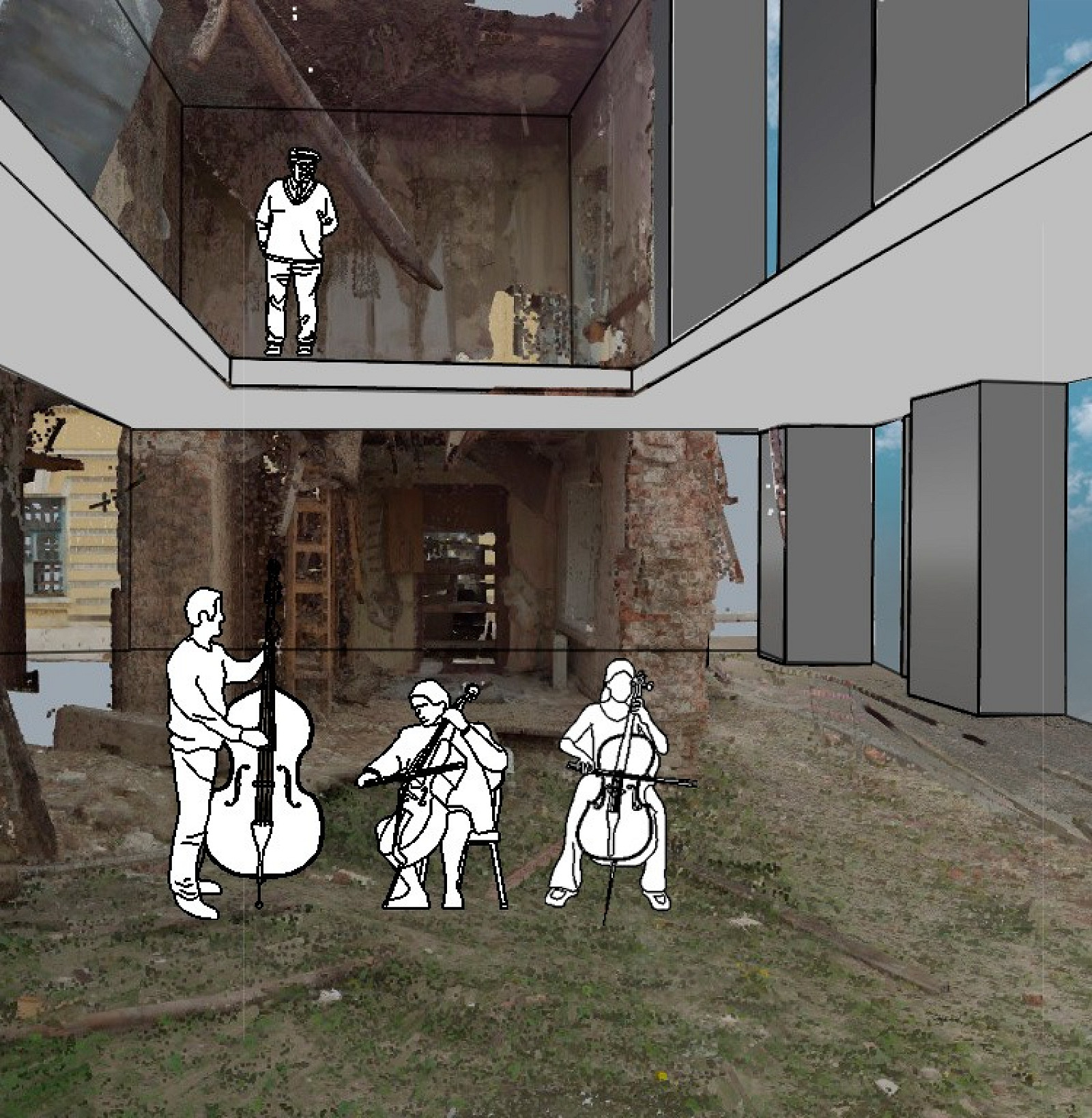
The bombing gutted the building across both floors on the North façade. Rather than rebuilding identically, the newly opened space is retained. It serves as a lobby connecting the classrooms and entrance. It also functions as a performance and exhibition space. Its double-height section visually and acoustically connects both floors to the hall and brings light to the north side of the building.
Facade
The facade respects the building’s pre-bombing volumes. An additional connection to the plaza has been added. The building extends over the plaza, forming a ground-floor extension and an upper-floor balcony. Steps face the café and the square; they provide seating for visitors and serve as an entrance during cultural events. In the plaza in front of the school, children play and parents gather under the canopy of the redesigned park.
Floor Plans
On the ground floor, the original entrance is preserved. A hall serves as a concert venue and exhibition space for students’ work. It opens to the outside and connects directly to the plaza. Classrooms, instrument rehearsal rooms, and a visual arts room surround it.
On the first floor, rooms are connected by an interior balcony overlooking the performance hall. This allows diffused northern light to reach deeper into the building, provides a view of the ground-floor hall, and connects to the exterior balcony where concerts can take place in the summertime.
Documentation
Created in:


Copyright © 2026 INSPIRELI | All rights reserved. Use of this website signifies your agreement to the Terms of Use, Privacy Policy, and use of cookies.