GROUNDED SOUND - Rethinking the Contemporary Concert Hall through Ecological Integration at Sjobacka Tippen in Gothenburg


Project idea
ABSTRACT:
This master’s thesis addresses whether public architecture can transcend its traditional role as a static monument to become an active participant in a new reality defined by nature, user experience, and sustainability. Historically, the design of public buildings has been driven by a desire to create visually striking icons, frequently emphasizing the importance of their expression while giving limited consideration to their broader ecological context.
This project challenges environmental isolation by re-evaluating the traditional concert hall, a typology typically characterized by its monumental detachment, by proposing instead a “Grounded Sound” that operates as an adaptive design situated in a natural environment. Based on the artificial landscape of Sjöbacka Tippen, a site defined by demolition waste, water, and low biodiversity, the research explores both land regeneration strategies and architecture that intends to shift from being a static, isolated element toward becoming an ecologically integrated design embedded within its terrain.
The methodology follows a three-stage approach. The first stage restores the site’s topography through regenerative strategies, transforming the artificial industrial ground into an ecological foundation that supports natural habitats and enhances biodiversity. The second stage introduces a responsive architectural system in which the building envelope serves as an adaptive interface, adjusting to the surrounding landscape and blurring the boundary between architecture and nature. The final stage develops the detailed design of the concert hall, which integrates aesthetic quality with the recovering ecosystem and technical and acoustic excellence.
As a result, this concept demonstrates a shift in focus towards a more modest approach, illustrating how concert hall design can serve as a tool for ecological stabilization rather than disruption. By incorporating nature-oriented design and technical rigor, the resulting proposal proves that the primary function of a music hall can be enhanced through its relationship with the environment. Ultimately, the work suggests that the future of public architecture lies in its ability to foster a deeper, more balanced connection between humans and ecosystems, proving that sustainability and cultural excellence are not mutually exclusive but, in fact, deeply interdependent.
KEY WORDS: HARMONY; NATURE; REGENERATION; ADAPTABILITY; SUSTAINABILITY
Project description
AIM
This thesis aims to rethink the concert hall typology and integrate it into the natural landscape. The project challenges the monumentality and environmental isolation of the contemporary concert hall.
Design, located on the artificial landscape of Sjöbacka Tippen, explores the typology of a concert hall as more than just a compact building for music events. It integrates with nature, enhances human-nature interaction, provides spaces for the local community, and demonstrates its flexibility in transformation over time. Instead of an iconic, isolated, and static monument, it will operate as an adaptive design embedded in a landscape.
Through ecological stabilization strategies and a design that promotes modularity, local materiality, and adaptability, the project proposes a concert hall typology grounded in humility and ecological integration. It will respect local context through an architecture that prioritizes local culture over tourism and iconicity.
RESEARCH QUESTION
How can the contemporary concert hall evolve from environmental isolation and monumentality toward greater ecological integration?
Sub-question:
How can adaptable design challenge the building’s static performance through modular solutions and building-lifespan strategies?
Sub-questions 2’:
Can the design:
- Incorporate community spaces?
- Have low CO2 footprint?
- Consider the use of locally sourced materials?
- Integrate nature into the spaces?
BACKGROUND & DISCOURSE
While architecture is rooted in honored traditions, it often struggles to account for the environmental aspects of its heritage. Although the industry is shifting toward sustainability, this transition is currently applied only to residential design, failing to address the impact on cultural buildings.
The Bilbao Effect
Public architecture continues to be criticized as one of the most unsustainable sectors of design, largely because these buildings are expected to be ”screaming monuments” rather than humble, integrated structures. It is closely related to an urge of creating so-called ’’Bilbao Effect’’. The “Bilbao Effect” (also known as the “Guggenheim Effect”) is a phenomenon in which a city undergoes a massive economic and cultural transformation through the construction of a single iconic piece of architecture. Witold Rabczynski, a Canadian architect, in his article ‘’The Bilbao effect. ‘’ expresses a deep skepticism toward this trend, arguing that the high-pressure context of public competitions often encourages vividness over careful, functional thought.
Unsustainable aspects
While new modern, public buildings can incorporate sustainable designs, a significant part of the sector relies on aging, inefficient, and carbon-intensive infrastructure and on old practices. Public industry still lags in adopting the circular economy rather than the linear economy. Its biggest challenge is low energy efficiency, which led to almost 28% of generated energy-related CO2 emissions in 2018. (Foster, G., & Kreinin, J., 2020). The design should be checked through LCA calculations, aiming for the lowest possible CO2 emissions and potential assessment of energy usage during its lifespan.
Relevance for the profession
There is an urgent need for a new cultural design language that exemplifies an Anthropocentric approach in which architecture serves people, context, and nature rather than mere ‘iconicity.’ In a broader sense, it could serve as a model global example for navigating complex design challenges, asking the right questions, and adapting to our shifting reality. I have chosen to tackle this challenge by proving that thoughtful, integrated design offers far more ecological and contextual value than a traditionally ‘iconic.’
SUSTAINABLE DEVELOPMENT
The project of the new concert hall strives to fulfill both technical requirements and to examine and apply sustainable principles through a landscape-responsive, adaptive architecture, the implements local materiality, maintaining technical rigour simultaniously. It uses landscape regeneration strategies to establish the base for the building design. Following ‘‘The Global Goals for Sustainable Development’’ in the era of Anthropocene, the design will aim to align with potentially 3 of them, as listed below:
Sustainable cities and communities
This thesis addresses the topic, as the design assumes close proximity to the city centre, promoting nature integration within the spaces. It is located only 20 minutes from the city centre of Göteborg, demonstrating a sustainable public design solution that can be implemented in the future. (United Nations Development Programme. (n.d.)
Responsive consumption and production
The design will assume responsible construction through the use of local materials and modular systems that incorporate repetitive elements, which can be produced with less energy and later replaced or modified as needed. It enables the implementation of concepts such as design for disassembly and creates an opportunity to adapt the building to a different function in the future. (United Nations Development Programme. (n.d.)
Life on land
This principle calls for more regenerative designs, rewilding, and soil remediation. The design strives to suggest solutions that could be implemented on site, through biodiversity enhancements and many other practices. It is not only building design, but its integration with nature and humans, as they are highly interdependent. (United Nations Development Programme. (n.d.)
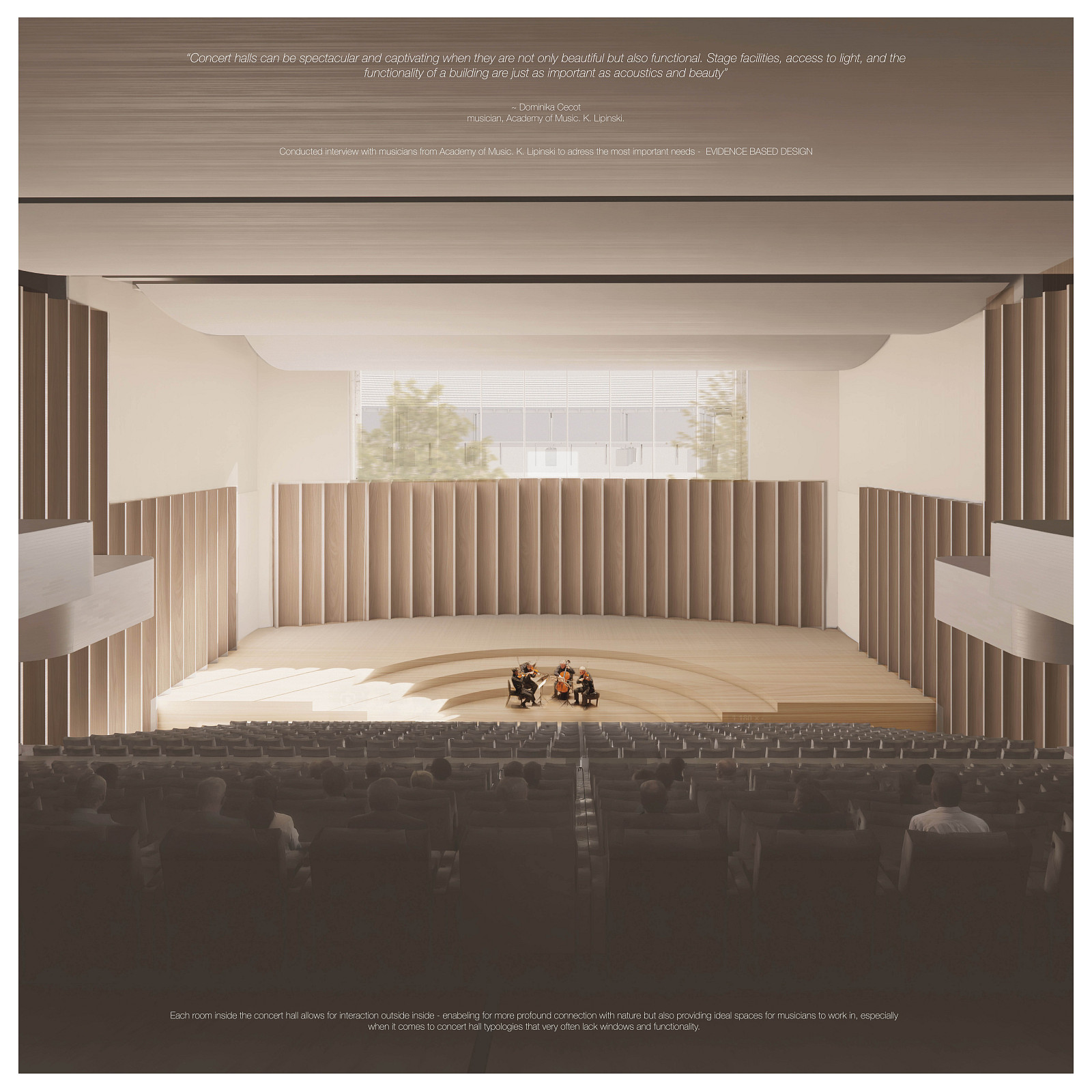
THE INTERVIEW - EVIDENCE BASED DESIGN.
In order to better understand user needs I conducted an interview with musicians from Academy of Music. K. Lipinski. Questions had many layers, especially tackling subjects like aesthetics and functionality of music space. This served as a source of reference while creating the design.
LOCATION & CONTEXT
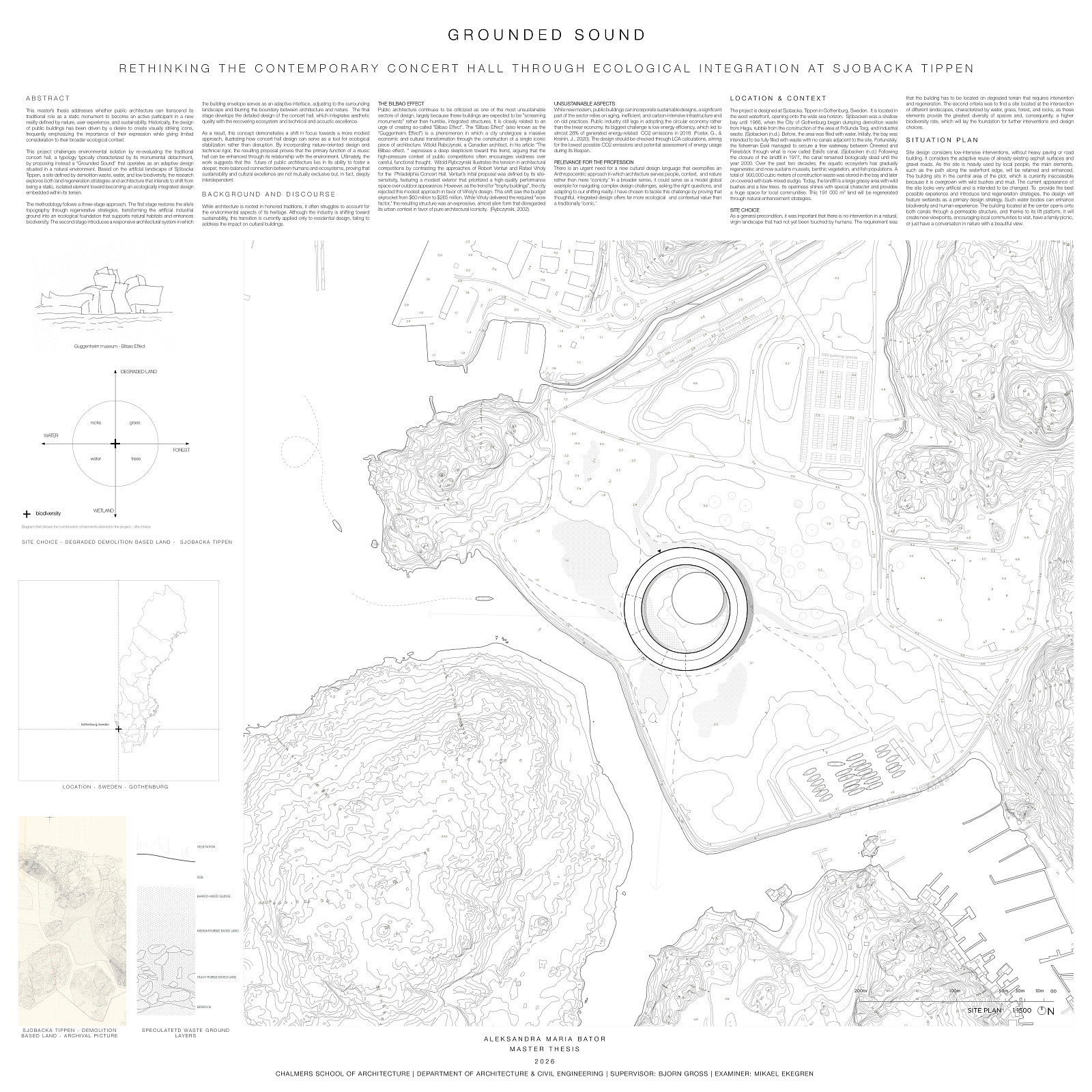
The project is designed at Sjobacka, Tippen in Gothenburg, Sweden. It is located in the west waterfront, opening onto the wide sea horizon.
Sjöbacken was a shallow bay until 1966, when the City of Gothenburg began dumping demolition waste from Haga, rubble from the construction of the area at Frölunda Torg, and industrial waste. (Sjobacken (n.d.). Before, the area was filled with water. Following the closure of the landfill in 1977, the canal remained biologically dead until the year 2000. A total of 900,000 cubic meters of construction waste was stored in the bay and later on covered with bark-mixed sludge. Today, the landfill is a large grassy area with wild bushes and a few trees. Its openness shines with special character and provides a huge space for local communities. This 191 000 m² land will be regenerated through natural enhancement strategies.
SITE TYPOLOGY
Sjobacka Tippen is a human-made artificial island created to store an excessive amount of demolition waste. Typical artificial island serves for infrastructure, residential housing, etc. Sjobacka Island, however, is not used or planned to be exploited for any development. It is intensively used by local communities, though struggles with accessibility due to its bad ground quality. Due to its location and potential, it calls for a place where people could thrive, and new design should enhance exiting place, not replace or remove them.
SITE CHOICE
As a general precondition, it was important that there is no intervention in a natural, virgin landscape that had not yet been touched by humans. The requirement was that the building has to be located on degraded terrain that requires intervention and regeneration. The second criteria was to find a site located at the intersection of different landscapes, characterized by water, grass, forest, and rocks, as these elements provide the greatest diversity of spaces and, consequently, a higher biodiversity rate, which will lay the foundation for further interventions and design choices.
SITE ANALYSIS - DEMOLITION WASTE BASED LAND
Site’s ground is based on demolition waste, which is described in a local articles as rubble, paint, and covered with bark - mixed sludge. Based on the architecture in Haga in Goteborg, where the waste is coming from, it suggests the island is built of wood, concrete and stone piled in this water bay. (Sjobacken (n.d.)
LAND REGENERATION STRATEGIES
Transforming demolition-based land often requires implementing different strategies, including soil rehabilitation, phytoremediation (removal of heavy metals from soil), and native planting. The process could consider 4 stages: Assessment, Soil Regeneration and Remediation, Enhanced Biodiversity, and Long-term Management:
ASSESSMENT
This stage requires evaluating the existing wasteland before proceeding to the next stage. It includes evaluating soil contamination, soil type, and existing vegetation. (Landmarc. (n.d.).
SOIL REGENERATION AND REMEEDIATION
This stage considers soil work which will enhance its qualities. It introduces:
- Phytoremediation
- Decompaction
- Organic matter
- Soil nutrition with fungi
ENHANCED BIODIVERSITY
These stage suggest practices that will enhance biodiversity through
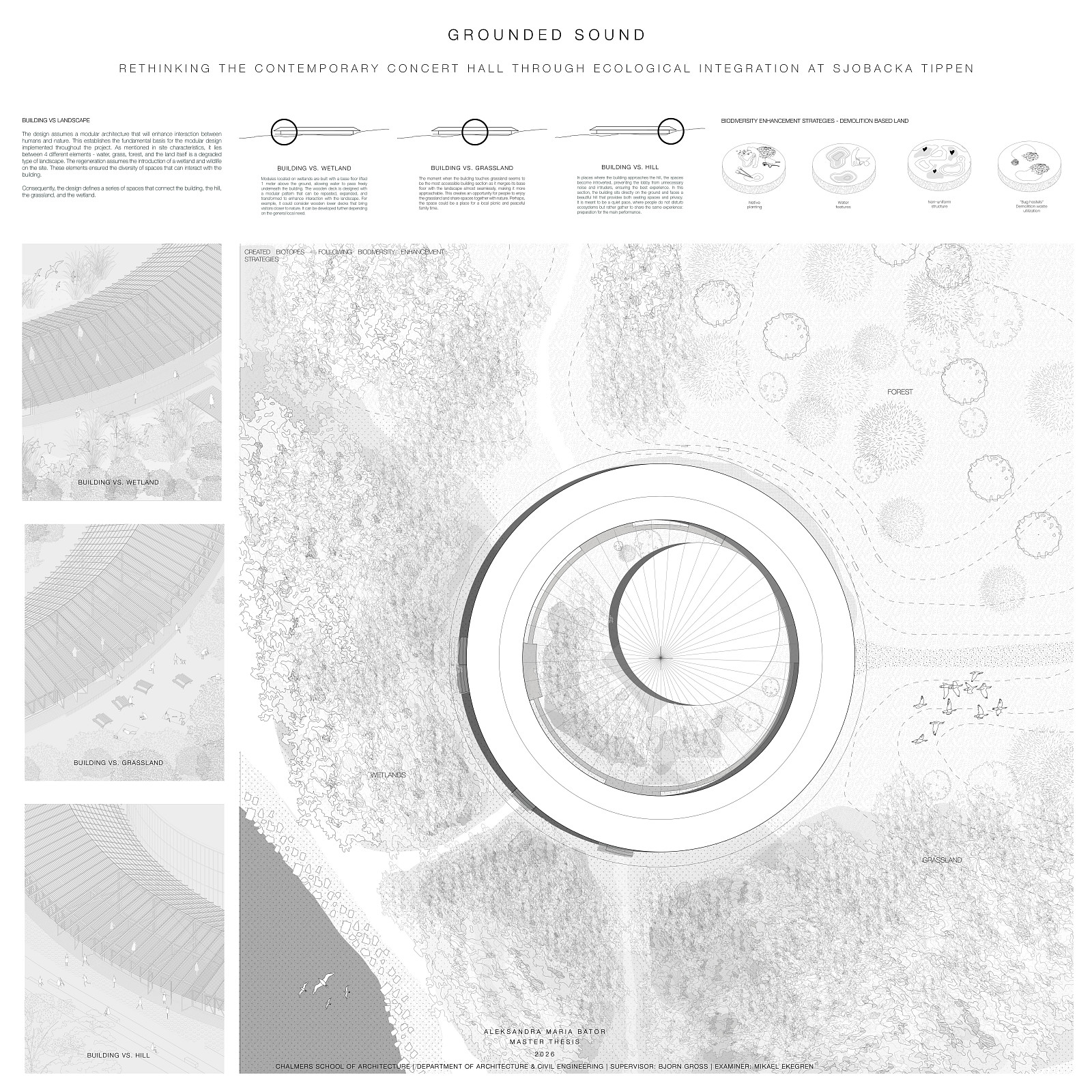
- Native planting: which suggests using local wildflowers, mixed with shrub and local tree types,s as it will provide both animal shelter and a place for them to thrive. (United Nations Environment Program. (2024, May 23).
- Water features: introducing ponds, water bodies or rainwater retention, which will attract insects and birds (United Nations Environment Program). (2024, May 23).
- Non-uniform Structure and land sharing: Creating Varying topography through hills and depressions, rather than keeping the site flat, will -create different microspaces for different ecological niches.(Jager, H. (2018).
- Demolition waste utilization: Instead of removing rubble, it is possible to create ‘‘bug hostels’’ which, thanks to its permability, can create homes for local animals and insects.
- Invasive species removal: It is important to monitor species that can dominate the landscape, creating a hostile environment for other plants.
LONG-TERM MANAGEMENT
- Low invasive management
- Rewilding
THE DESIGN:
CREATIVE APPROACH: CONCEPT
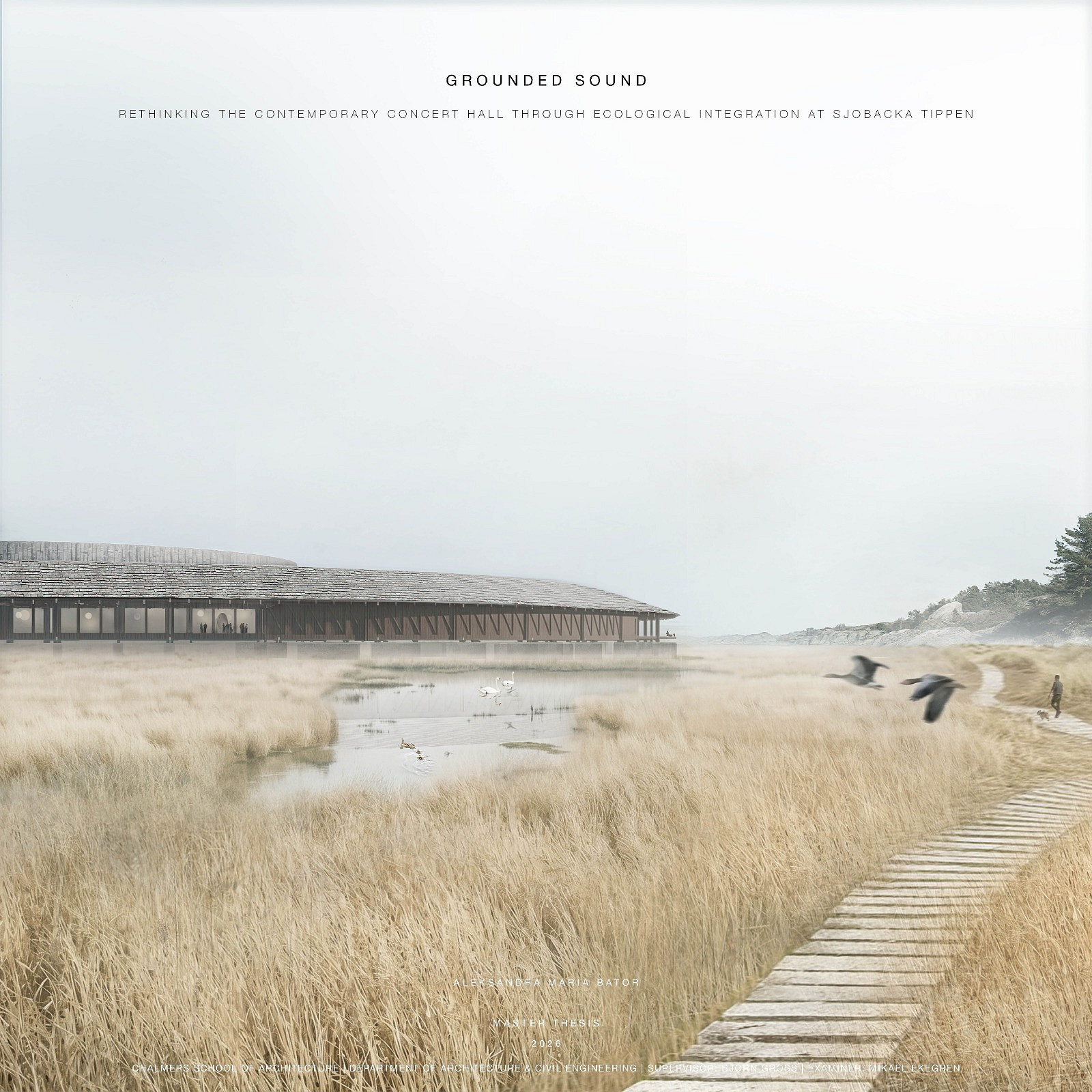
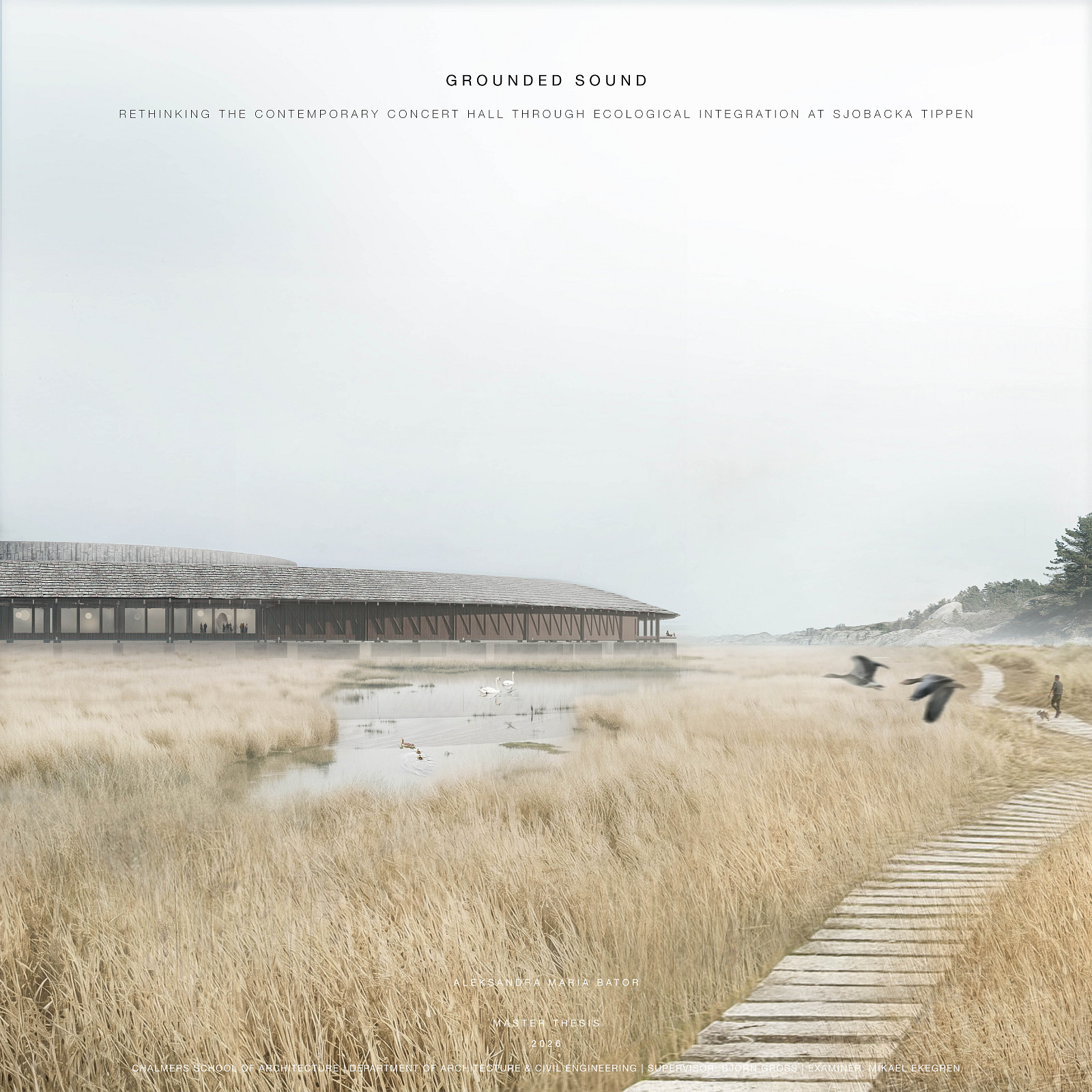
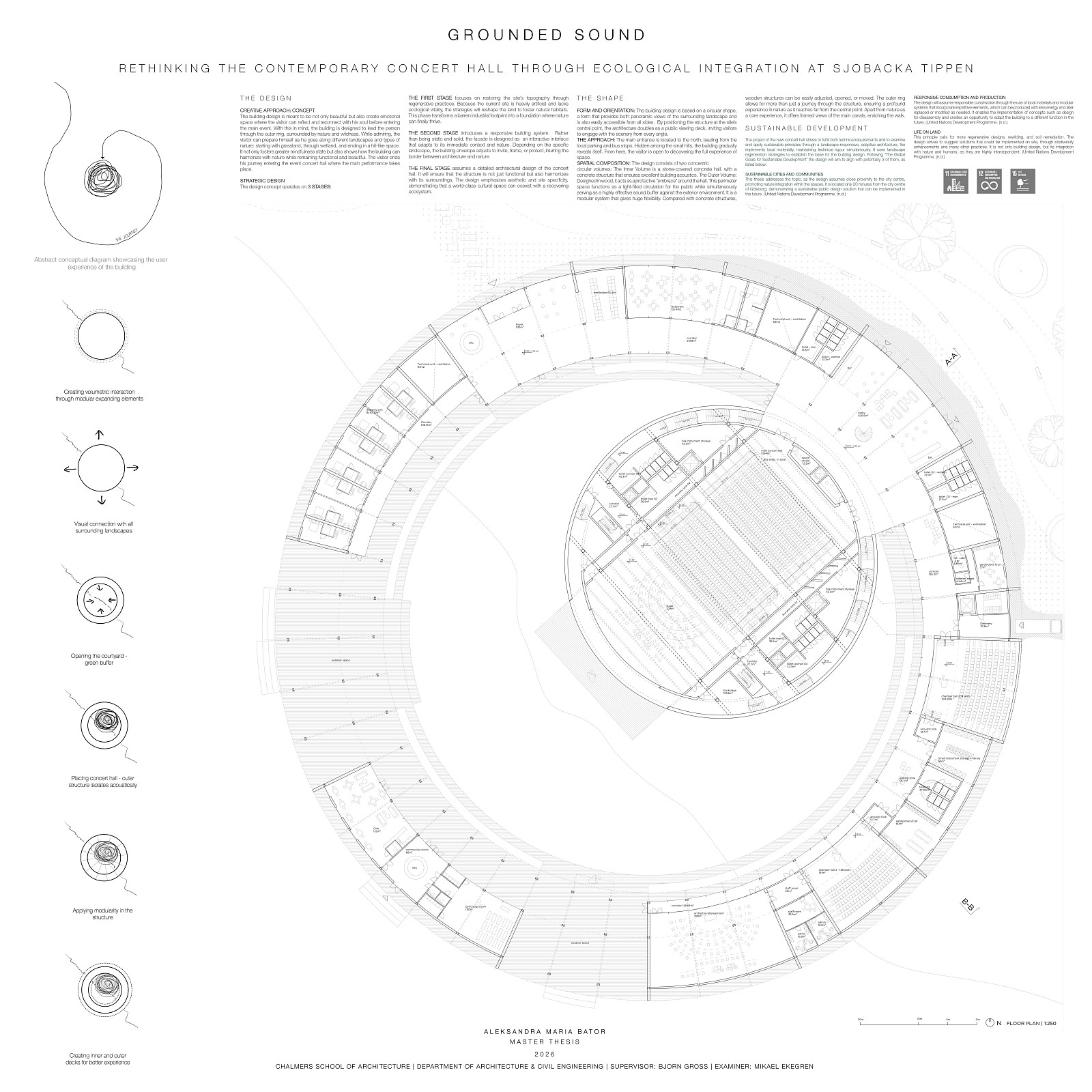
The building design is meant to be not only beautiful but also create emotional space where the visitor can reflect and reconnect with his soul before entering the main event. With this in mind, the building is designed to lead the person through the outer ring, surrounded by nature and wildness. While admiring, the visitor can prepare himself as he goes along different landscapes and types of nature: starting with grassland, through wetland, and ending in a hill-like space. It not only fosters greater mindfulness state but also shows how the building can harmonize with nature while remaining functional and beautiful. The visitor ends his journey entering the event concert hall where the main performance takes place.
STRATEGIC DESIGN
The design concept operates on 3 stages:
The first stage focuses on restoring the site’s topography through regenerative practices. Because the current site is heavily artificial and lacks ecological vitality, the strategies will reshape the land to foster natural habitats. This phase transforms a barren industrial footprint into a foundation where nature can finally thrive.
The second stage introduces a responsive building system. Rather than being static and solid, the facade is designed as an interactive interface that adapts to its immediate context and nature. Depending on the specific landscape, the building envelope adjusts to invite, frame, or protect, blurring the border between architecture and nature.
The final stage assumes a detailed architectural design of the concert hall. It will ensure that the structure is not just functional but also harmonizes with its surroundings. The design emphasizes aesthetic and site specificity, demonstrating that a world-class cultural space can coexist with a recovering ecosystem.
The shape
THE SHAPE:
Form and Orientation: The building design is based on a circular shape, a form that provides both panoramic views of the surrounding landscape and is also easily accessible from all sides. By positioning the structure at the site’s central point, the architecture doubles as a public viewing deck, inviting visitors to engage with the scenery from every angle.
The Approach: The main entrance is located to the north, leading from the local parking and bus stops. Hidden among the small hills, the building gradually reveals itself. From here, the visitor is open to discovering the full experience of space.
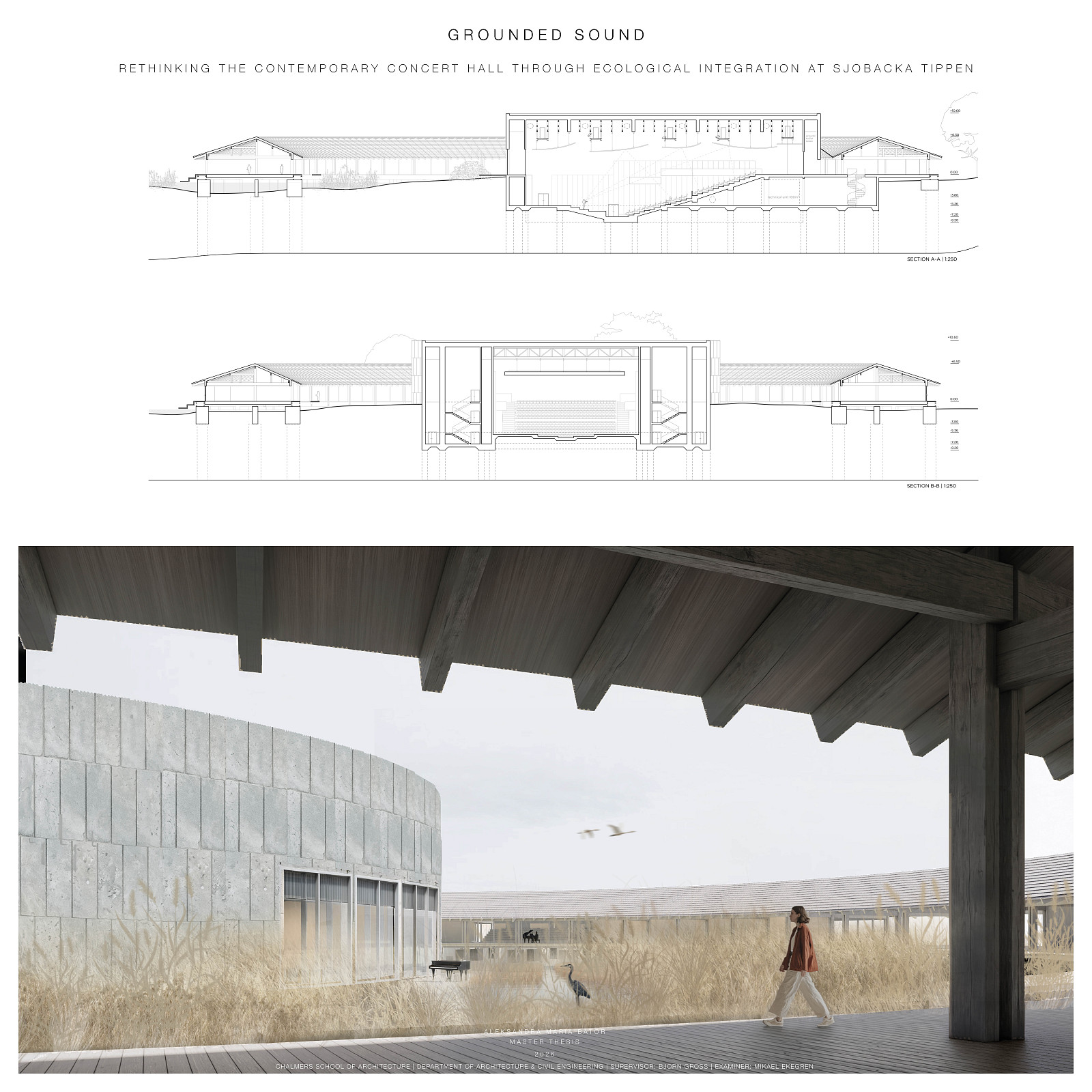
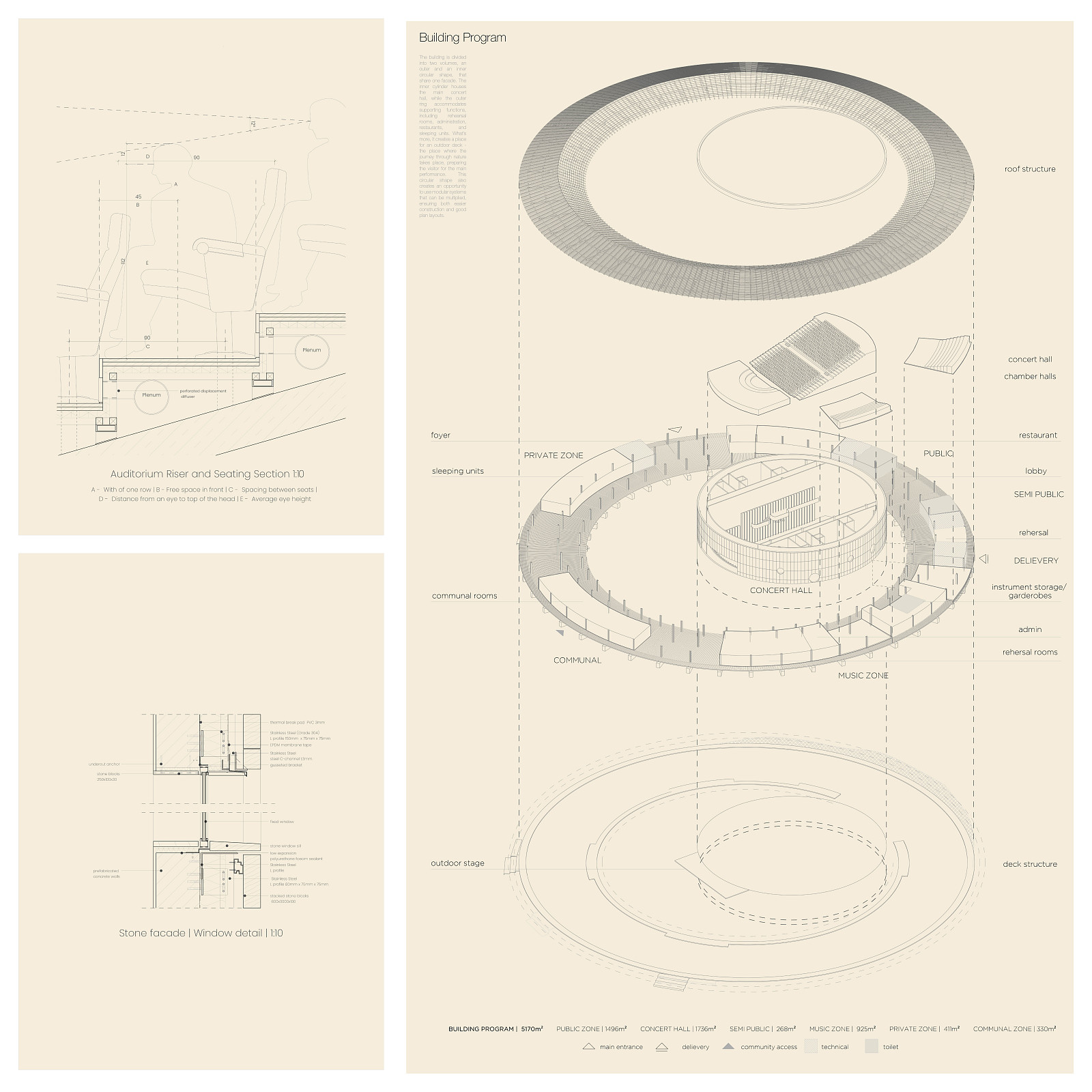
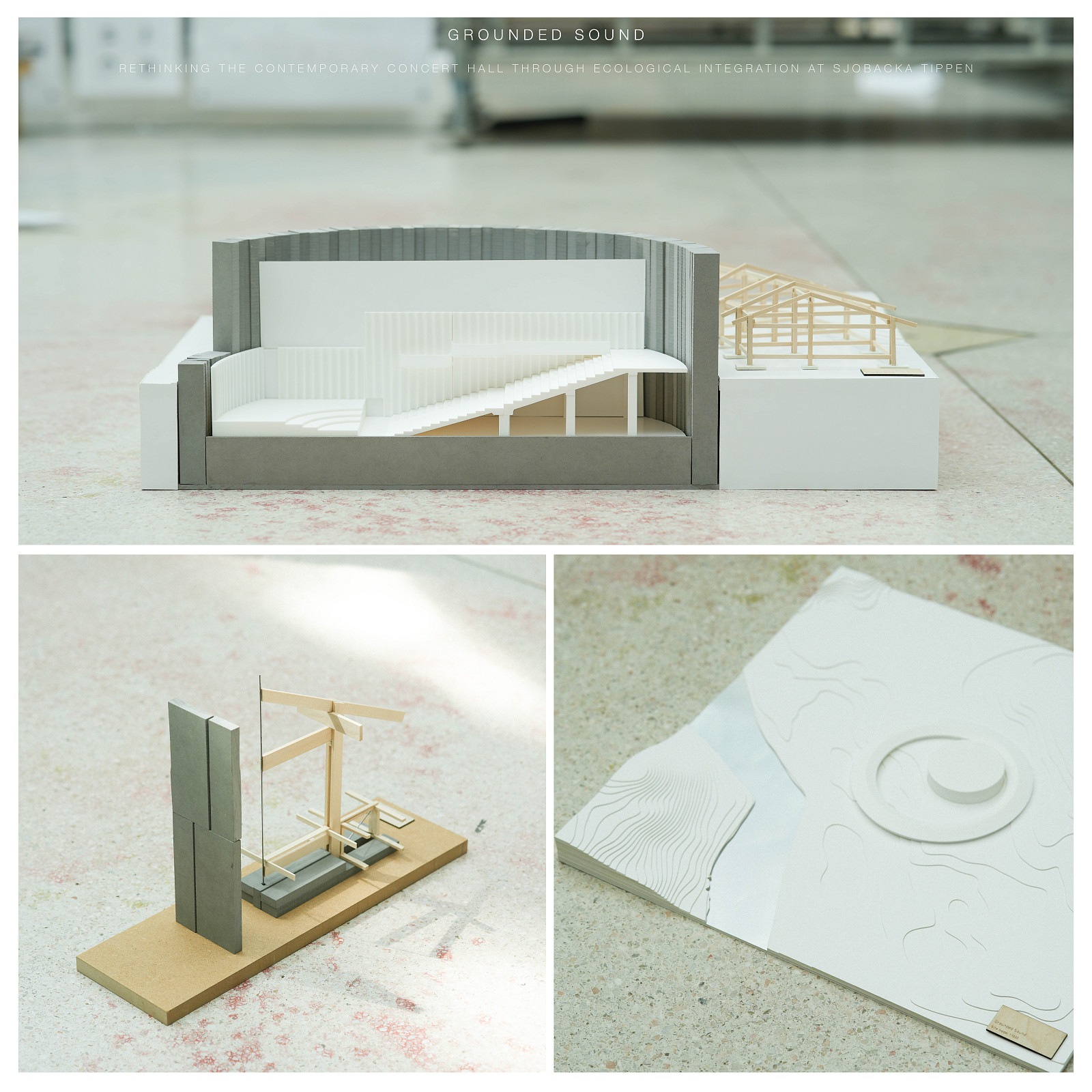
Spatial Composition: The design consists of two concentric circular volumes: The Inner Volume is a stone-covered concrete hall, with a concrete structure that ensures excellent building acoustics. The Outer Volume: Designed in wood, it acts as a protective “embrace” around the hall. This perimeter space functions as a light-filled circulation for the public while simultaneously serving as a highly effective sound buffer against the exterior environment. It is a modular system that gives huge flexibility. Compared with concrete structures, wooden structures can be easily adjusted, opened, or moved. The outer ring allows for more than just a journey through the structure, ensuring a profound experience in nature as it reaches far from the central point. Apart from nature as a core experience, it offers framed views of the main canals, enriching the walk.
SITUATION PLAN 1:1500
Site design considers low-intensive interventions, without heavy paving or road building. It considers the adaptive reuse of already existing asphalt surfaces and gravel roads. As the site is heavily used by local people, the main elements, such as the path along the waterfront edge, will be retained and enhanced. The building sits in the central area of the plot, which is currently inaccessible because it is overgrown with wild bushes and mud. The current appearance of the site looks very artificial and is intended to be changed. To provide the best possible experience and introduce land regeneration strategies, the design will feature wetlands as a primary design strategy. Such water bodies can enhance biodiversity and human experience. The building located at the center opens onto both canals through a permeable structure, and thanks to its lift platform, it will create new viewpoints, encouraging local communities to visit, have a family picnic, or just have a conversation in nature with a beautiful view.
PROGRAM 1:250
The building is divided into two volumes, an outer and an inner circular shape, that share one facade. The inner cylinder houses the main concert hall, while the outer ring accommodates supporting functions, including rehearsal rooms, administration, restaurants, and sleeping units. What’s more, it creates a place for an outdoor deck - the place where the journey through nature takes place, preparing the visitor for the main performance. This circular shape also creates an opportunity to use modular systems that can be multiplied, ensuring both easier construction and good plan layouts.
ACCESSIBILITY
To enhance accessibility, outer volume is connected with the concert hall through the lower level, accessible via elevator or circular staircases in the lobby. This lower floor is located at the same point as the main stage, enabling disabled to both attend the event but also play on the stage. This choice of making such floor, ensured about the design that adresses user’s needs.
PROGRAM METRICS
The building has a total Floor Net floor area (NFA) of 5,170m2. Total covered space is approximately 10,000 m2, including outdoor seating and decks. The main hall size will be based on the target number of accomodated visitors of approximately 1000 per performance. That creates certain ranges in size - the main hall being 25x50m and min 12.5m tall. The design plans for rehearsal rooms and chamber halls of 190m2 and 225m2, accommodating up to 200 people, are a place for smaller performances.
BUILDING VS. LANDSCAPE
The design assumes a modular architecture that will enhance interaction between humans and nature. This establishes the fundamental basis for the modular design implemented throughout the project. As mentioned in site characteristics, it lies between 4 different elements - water, grass, forest, and the land itself is a degraded type of landscape. The regeneration assumes the introduction of a wetland and wildlife on the site. These elements ensured the diversity of spaces that can interact with the building. Consequently, the design defines a series of spaces that connect the building, the hill, the grassland, and the wetland.
BUILDING VS. WETLAND
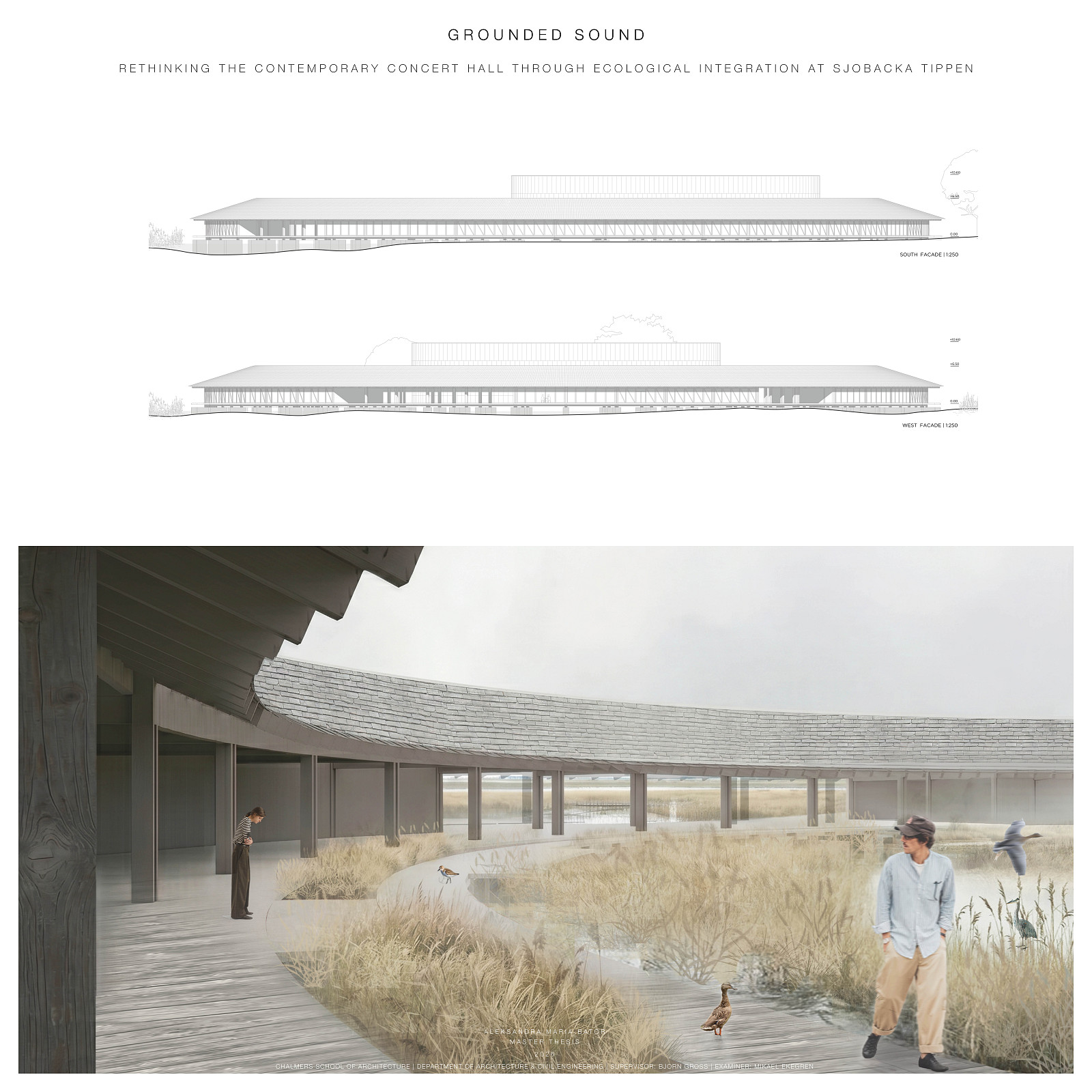
Modules located on wetlands are built with a base floor lifted 1 meter above the ground, allowing water to pass freely underneath the building. The wooden deck is designed with a modular pattern that can be repeated, expanded, and transformed to enhance interaction with the landscape. For example, it could consider wooden lower decks that bring visitors closer to nature. It can be developed further depending on the general local need.
BUILDING VS. GRASSLAND
The moment when the building touches grassland seems to be the most accessible building section as it merges its base floor with the landscape almost seamlessly, making it more approachable. This creates an opportunity for people to enjoy the grassland and share spaces together with nature. Perhaps, the space could be a place for a local picnic and peaceful family time.
BUILDING VS. HILL
In places where the building approaches the hill, the spaces become introverted, preventing the lobby from unnecessary noise and intruders, ensuring the best experience. In this section, the building sits directly on the ground and faces a beautiful hill that provides both seating spaces and privacy. It is meant to be a quiet pace, where people do not disturb ecosystems but rather gather to share the same experience: preparation for the main performance.
DISCUSSION:
The thesis’s main research focuses on public building architecture, highlighting its poor performance in terms of sustainability, functionality, and contextual relevance. The task was to challenge the iconicity, ecological isolation, and monumentality of such elements in space, which nowadays shine as icons and are being placed in the city, full of noise, far from a natural environment. The bilbao effect shows the critical approach to public architecture, which aims to drive massive economic transformation through a single iconic building. This rises skepticism about its functionality and contextual value. Secondly, engineers refer to them as white elephants because their costs exceed their economic value, raising further questions about how to design public architecture and what it should aim for. As we face significant changes in both mental approach and legislation that will increase building requirements for sustainable development, the thesis responds to the rising need for sustainable design in the public building industry, which requires as much new experimentation and attention as housing design.
In order to fully answer the question ‘’ How can the contemporary concert hall evolve from environmental isolation and monumentality toward greater ecological integration?’’ it was necessary to work with the site located in nature. One of the first and most important criteria when choosing the site was that it was degraded terrain in need of regeneration. This created an opportunity to work with landscape regeneration strategies, which formed the fundamental basis for the building design.
The building addresses the question through the implementation of the mentioned strategies, the integration of nature, an adaptable design, and the maintenance of the concert hall’s functionality. Thanks to the modular system based on the circular shape, it ensures easy control over cost, life-cycle assessment, and building longevity, planning for its future functions. As the main concert hall is embedded in the terrain, it keeps a modest appearance. To contextualize the design, only natural and local materials were used, bringing the architecture closer to its surroundings and respecting cultural values. What’s more, it not only creates spaces for visitors but also provides communal zones for the local community to use or rent.
In order to define the full rightness of the building, there are steps that would need to be explored in the next stage, which include conducting comprehensive Life Cycle Assessment (LCA) calculations, performing detailed acoustic modeling and validation, and developing technical documentation and geotechnical analysis of the site’s soil composition to support the land regeneration strategy. That would enable answering questions such as: What is the real-world viability of realizing this type of architectural proposal? Is it possible to change the way we think about concert halls, transforming it into a shared habitat for both human culture and natural ecosystems? Would sustainable practices be effectively applied to this specific typology? (LCA, DFD, building lifespan). Would it cause another bilbao effect?
Ultimately, I envision this project as a model for public design that integrates spaces for both humans and nature, making it beautiful, functional, contextualized, and sustainable.
Technical information
STRUCTURE:
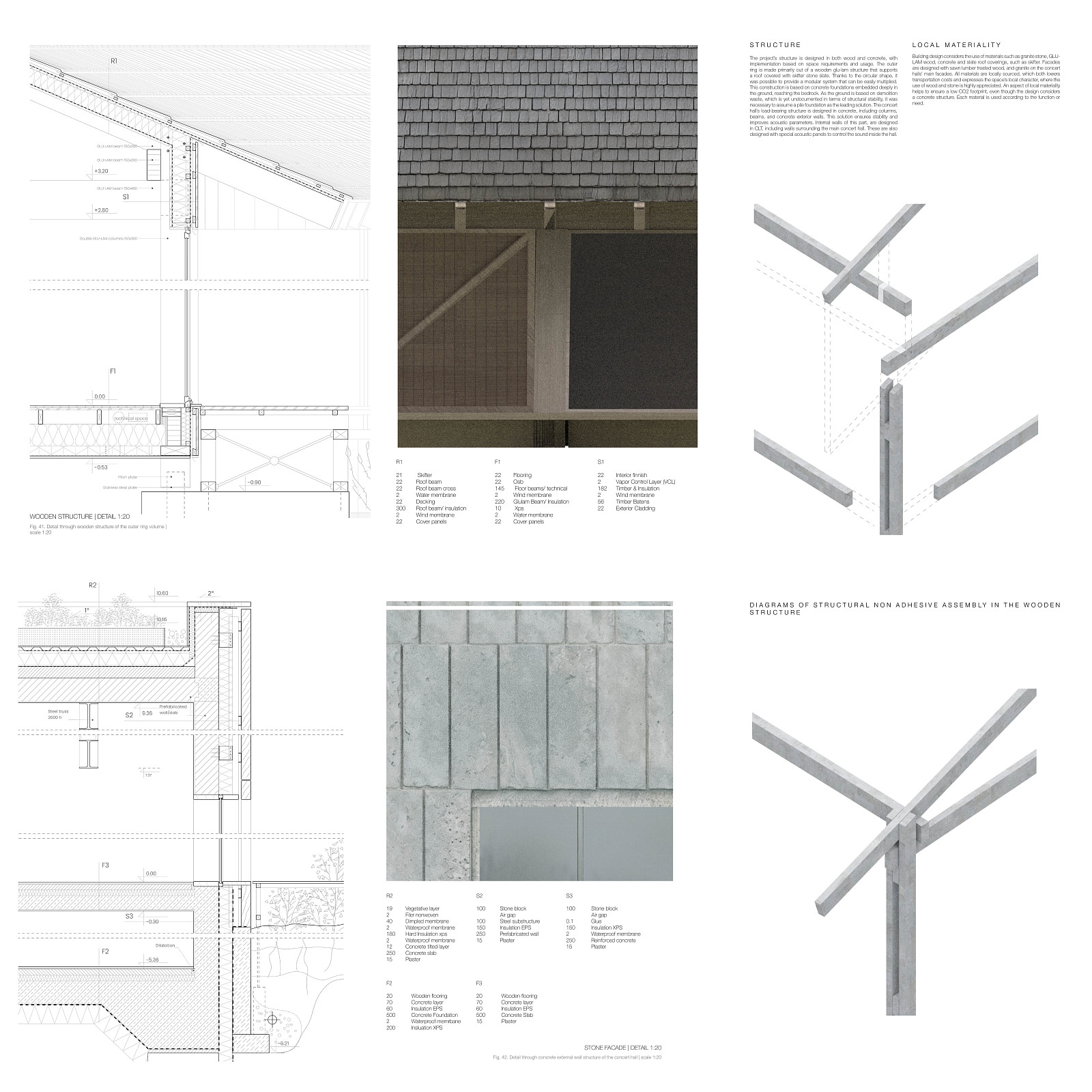
The project’s structure is designed in both wood and concrete, with implementation based on space requirements and usage. The outer ring is made primarily out of a wooden glu-lam structure that supports a roof covered with skifter stone slate. Thanks to the circular shape, it was possible to provide a modular system that can be easily multiplied. This construction is based on concrete foundations embedded deeply in the ground, reaching the bedrock. As the ground is based on demolition waste, which is yet undocumented in terms of structural stability, it was necessary to assume a pile foundation as the leading solution. The concert hall’s load-bearing structure is designed in concrete, including columns, beams, and concrete exterior walls. This solution ensures stability and improves acoustic parameters. Internal walls of this part, are designed in CLT, including walls surrounding the main concert hall. These are also designed with special acoustic panels to control the sound inside the hall.
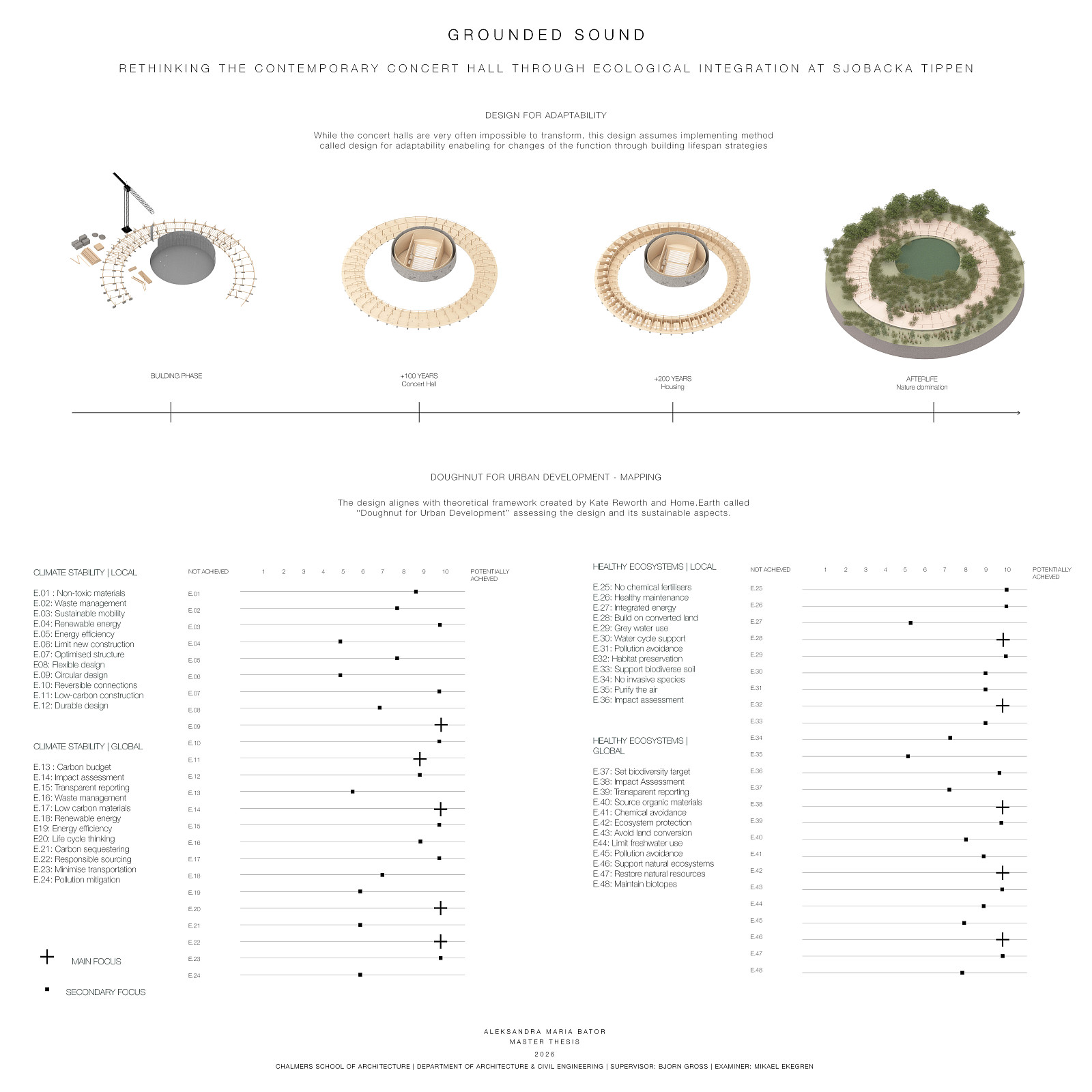
DESIGN FOR ADAPTABILITY
The design allows for adaptability due to its modular structure. The building can be converted and transformed while keeping the same module. In particular, the outer wooden volume allows for changing functions over time, from a concert hall’s supporting functions into housing, student housing, and shelter. The main concrete concert hall transformation process can include spaces such as a communal zone, storage, or a bunker. The building afterlife perdicts either full disassembly or allows the structure to stay and be used as a viewing deck, whereas the concrete concert hall remainings can be transformed to a water pond, futher enhancing biodiveristypredicts either full disassembly or allows the structure to stay and be used as a viewing deck, whereas the concrete concert hall remains can be transformed.
LOCAL MATERIALITY
Building design considers the use of materials such as granite stone, GLU-LAM wood, concrete and slate roof coverings, such as skifter. Facades are designed with sawn lumber treated wood, and granite on the concert halls’ main facades. All materials are locally sourced, which both lowers transportation costs and expresses the space’s local character, where the use of wood and stone is highly appreciated. An aspect of local materiality helps to ensure a low CO2 footprint, even though the design considers a concrete structure. Each material is used according to the function or need.
DOUGHNUT FOR URBAN DEVELOPMENT - MAPPING SUSTAINABLE ASPECTS
The design alignes with theoretical framework created by Kate Reworth and Home.Earth called ‘‘Doughnut for Urban Development’’ assessing the design and its rightness. The book tackles upon sustainable design within Planetary boundries, refering to ecological ceiling and social foundation. Group of scientists collected such data to navigate building and urban design. Shown diagram is based on assumptions on what the building could answer or deal with. Additional testing is required. Ecological ceiling refers more to urban planning, whereas social foundation can define building design. Due to that, the considerations tackle climate stability and healthy ecosystems as main topics. Diagrams show scale from 1 to10, which allows for more in tact definitions.
Documentation



Copyright © 2026 INSPIRELI | All rights reserved. Use of this website signifies your agreement to the Terms of Use, Privacy Policy, and use of cookies.